Every iteration of an agent loop has to answer the same question:
What should the model see this time?
The answer is rarely everything the system currently holds.
A coding agent repairing a payment module may have access to conversation history, a repository map, hundreds of files, API documentation, previous incidents, test logs, user preferences, the last tool result, and several passages returned by RAG.
Any of those may matter. They do not all belong in the same model call.
Too little context hides constraints. Too much context dilutes them with repeated, stale, or low-value material. A larger context window increases capacity; it does not identify authority, remove obsolete claims, or prevent material from another tenant entering the prompt.
Anthropic describes context engineering as the recurring discipline of curating the context most likely to produce the desired behaviour at inference time. It covers far more than prompts, including tool definitions, message history, external data, and runtime observations. Anthropic also treats context as a finite resource with diminishing marginal returns. The objective is not brevity for its own sake, but the smallest high-signal set that is sufficient for the task.1
For a harness, context engineering is a governance process:
Discover
→ Qualify
→ Select
→ Assemble
→ Observe
→ Persist or discard
→ Invalidate when sources change
It decides what the model sees now while ensuring that omitted material remains in the appropriate authoritative system and can be retrieved later.
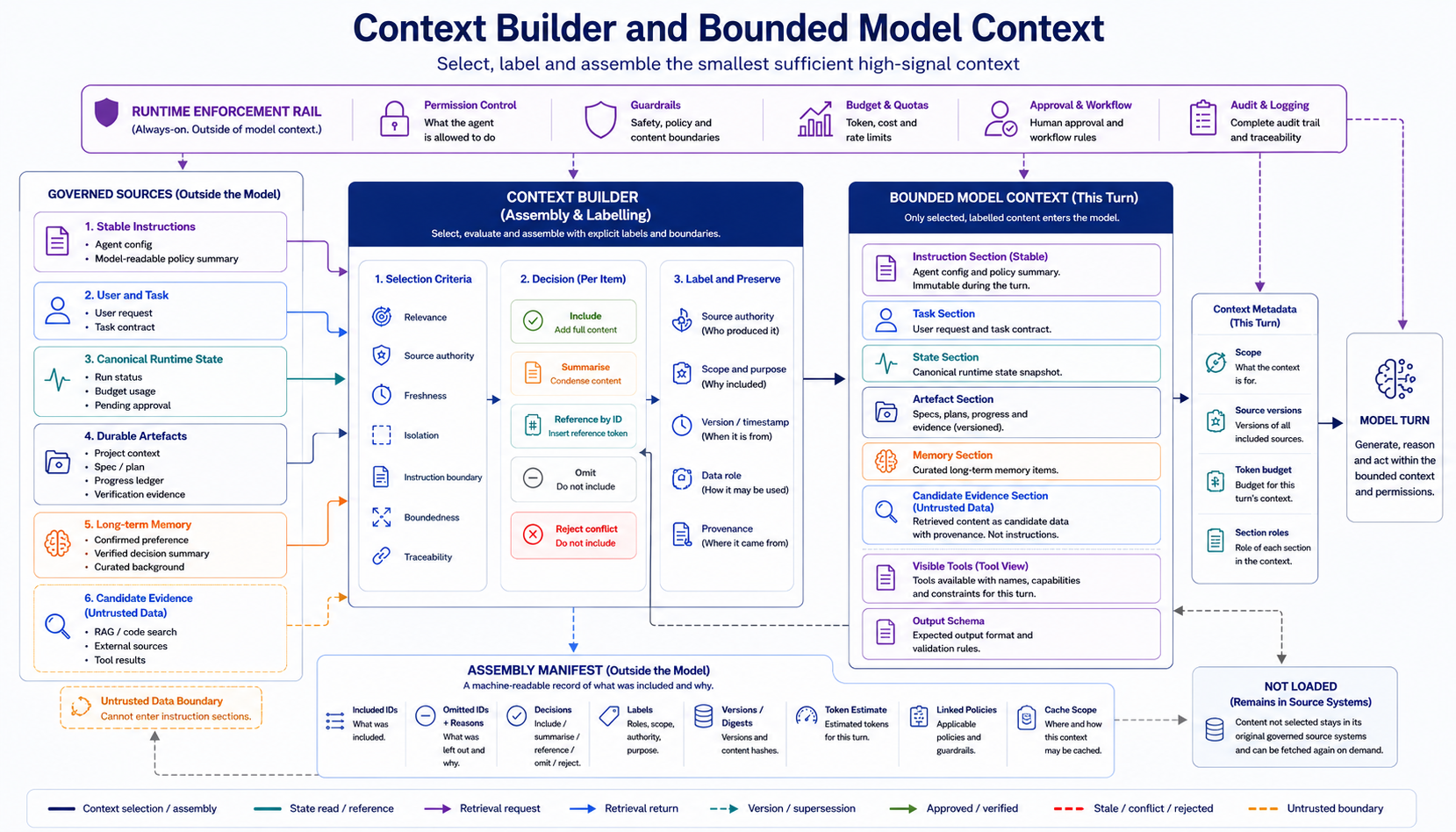
Figure 4-1 | The context builder selects material for the current turn, retaining its source, version, scope, and inclusion reason before assembling a bounded model context.
Context is neither the chat history nor everything the system knows
The word context is often used for everything available to an agent. An engineering design needs at least five separate categories.
| Category | Primary purpose | Canonical authority? | Loaded by default? |
|---|---|---|---|
| Model context | Input to the current inference | No | Only what the turn needs |
| Runtime state | Run lifecycle and state transitions | Yes for the run lifecycle | Usually a selected view |
| Durable artefacts | Versioned specifications, plans, and evidence | Depends on the artefact type | Task-scoped |
| Long-term memory | Reusable information across sessions | Usually not the final authority for business or run state | Selected by scope and task |
| Retrieved evidence | Candidate evidence for the current question | Authority comes from the original source | On demand |
Model context
Model context is the set of tokens sent for the current inference, such as:
- stable instructions
- the user request
- a task-contract summary
- selected conversation history
- tool definitions
- retrieved evidence
- the latest observation
- an output schema
A model-readable policy summary may be included, but permissions, budgets, sandbox boundaries, and approval requirements still need runtime enforcement. Writing “do not access the production database” in the prompt does not remove credentials or close a network route.
Model context is temporary inference input. It is not the system of record.
Runtime state
Runtime state records execution facts, including:
- run, turn, and task status
- current state version
- pending approvals
- tool request/result receipts
- consumed budget
- active background work
- workspace and tenant identity
- cancellation state
- side-effect operation identifiers
The context builder may turn part of this into a model-readable summary. Canonical state must not exist only as prose in the conversation.
Durable artefacts
Durable artefacts are versioned and reviewable work products that survive sessions, such as:
- project context
- specifications
- plans
- architecture decision records
- progress ledgers
- test evidence
- diffs, build logs, and review findings
They may live in a repository, document store, object storage, or another authoritative system. They do not need to remain in every prompt, and material should not be copied into memory merely because it is not currently loaded.
Long-term memory
Memory retains information worth reusing across sessions, such as confirmed preferences, approved decisions, or stable working background.
It should not replace canonical task progress, business records, or repository facts. The current position of a task belongs in run state or a progress ledger. Memory may retain a governed summary and pointer, but it should not become the final status authority.
Memory needs:
- scope
- schema
- provenance
- verification status
- retention
- consent
- supersession
- revocation and deletion
“The model said this earlier” is not a sufficient write policy.
Retrieved evidence
Retrieved evidence is acquired for the current question through a vector index, SQL, document search, the web, code search, or another tool.
A retriever returns candidate content. A high similarity score does not convert it into truth. Authority comes from the originating system and its governance, not from vector distance.
The harness still has to determine:
- whether the material belongs to the correct tenant and scope
- whether the actor may use the source
- whether its version and freshness suit the task
- whether it contains untrusted text that must not become instructions
- whether it supports the eventual claim
- whether another source is required
Combining these five categories in one undifferentiated prompt makes three questions difficult to answer: where did this statement come from, is it still valid, and why did the model see it in this turn?
The context builder: who decides what the model sees?
The context builder is a runtime assembler. It obtains candidate sections from several sources, applies a selection policy, and emits the bounded structure accepted by the model API.
Typical inputs include:
- agent configuration and stable instructions
- user request and task contract
- canonical run state
- tenant, identity, and permission decisions
- project and work-track artefacts
- retrieved evidence
- tool catalogue
- tool results
- verifier feedback
- remaining token, time, and cost budgets
- output schema
It does more than concatenate strings. It must address at least seven conditions:
| Condition | Question |
|---|---|
| Relevance | Does this section help the current step? |
| Source authority | Is it policy, user input, an artefact, an external system, or unverified model output? |
| Freshness | Is the derived material valid after source changes? |
| Isolation | Does it belong to the correct tenant, workspace, task, and actor? |
| Instruction boundary | Is it an instruction or untrusted material that may only be read as data? |
| Boundedness | Are tokens, tool outputs, and duplication controlled? |
| Traceability | Can its source, version, digest, and inclusion reason be reconstructed? |
The context builder should not promote low-trust material into authority. It preserves source labels, applies defined precedence, and refuses assembly or requests clarification when a conflict cannot be resolved safely.
The following architecture-level manifest is illustrative rather than a provider API:
{
 "run_id": "run_204",
 "scope": {
 "tenant_id": "tenant_acme",
 "workspace_ref": "checkout-fix@a81c4f2"
 },
 "sections": [
 {
 "id": "task-contract",
 "role": "instruction",
 "authority": "approved_spec",
 "source_ref": "spec-221",
 "source_version": "spec-v7",
 "tokens": 842
 },
 {
 "id": "retrieved-evidence",
 "role": "untrusted_data",
 "authority": "project_docs",
 "source_ref": "docs-query-481",
 "source_version": "docs-index-93",
 "tokens": 2140
 },
 {
 "id": "latest-test-result",
 "role": "runtime_evidence",
 "authority": "test_runner",
 "source_ref": "artifact-test-881",
 "source_version": "sha256:...",
 "tokens": 1260
 }
 ],
 "budget": {
 "context_tokens": 18000,
 "reserved_output_tokens": 4000
 }
}
The token figures are illustrative, not universal budgets.
What this example establishes
- A section can carry scope, role, authority, source reference, version, and token accounting.
- Different sections may have different owners and authoritative origins.
- Retrieved material can be labelled
untrusted_datarather than being treated as a system instruction. - Output space should be reserved instead of filling the whole window before generation.
- A trace can record included and omitted sections with their source versions.
What it does not establish
- It does not prescribe a prompt format or provider API.
- It does not show that the illustrative budget suits a real workload.
- It does not fully solve prompt injection, secrets, masking, or tenant authorisation.
- It does not show that retrieved evidence is correct or sufficient.
- It does not demonstrate that the selection policy has been evaluated.
A manifest makes context observable. It does not make the selection policy intelligent by itself.
Runtime prompt assembly: keep stable and dynamic sections separate
A system prompt should not become one ever-growing string. A more maintainable design gives each section an owner, version, priority, token budget, and loading condition.
Stable sections
Material that may belong in a stable prefix includes:
- identity and operating principles
- model-readable summaries of invariant policy
- output conventions
- stable tool guidance
Dynamic sections
Material that may change by run or turn includes:
- workspace, branch, tenant, and actor
- current tool catalogue
- task, plan, and run state
- memory-index generation
- connected external capabilities
- current budgets
- retrieved evidence
Dynamic state should not contaminate a reusable stable-prefix cache. Changes to tools, permissions, memory, workspace, or policy should invalidate the relevant assembly.
Every model call should record at least:
- loaded section identifiers
- omitted section identifiers and reasons
- section digests and versions
- total token count
- cache-hit scope
- stable/dynamic boundary
Sections should be selected from real state and policy rather than guessed solely from query keywords.
Progressive disclosure: map first, detail for the task, evidence on demand
A coding agent rarely needs the whole repository on its first turn. A layered loading strategy is more reliable.
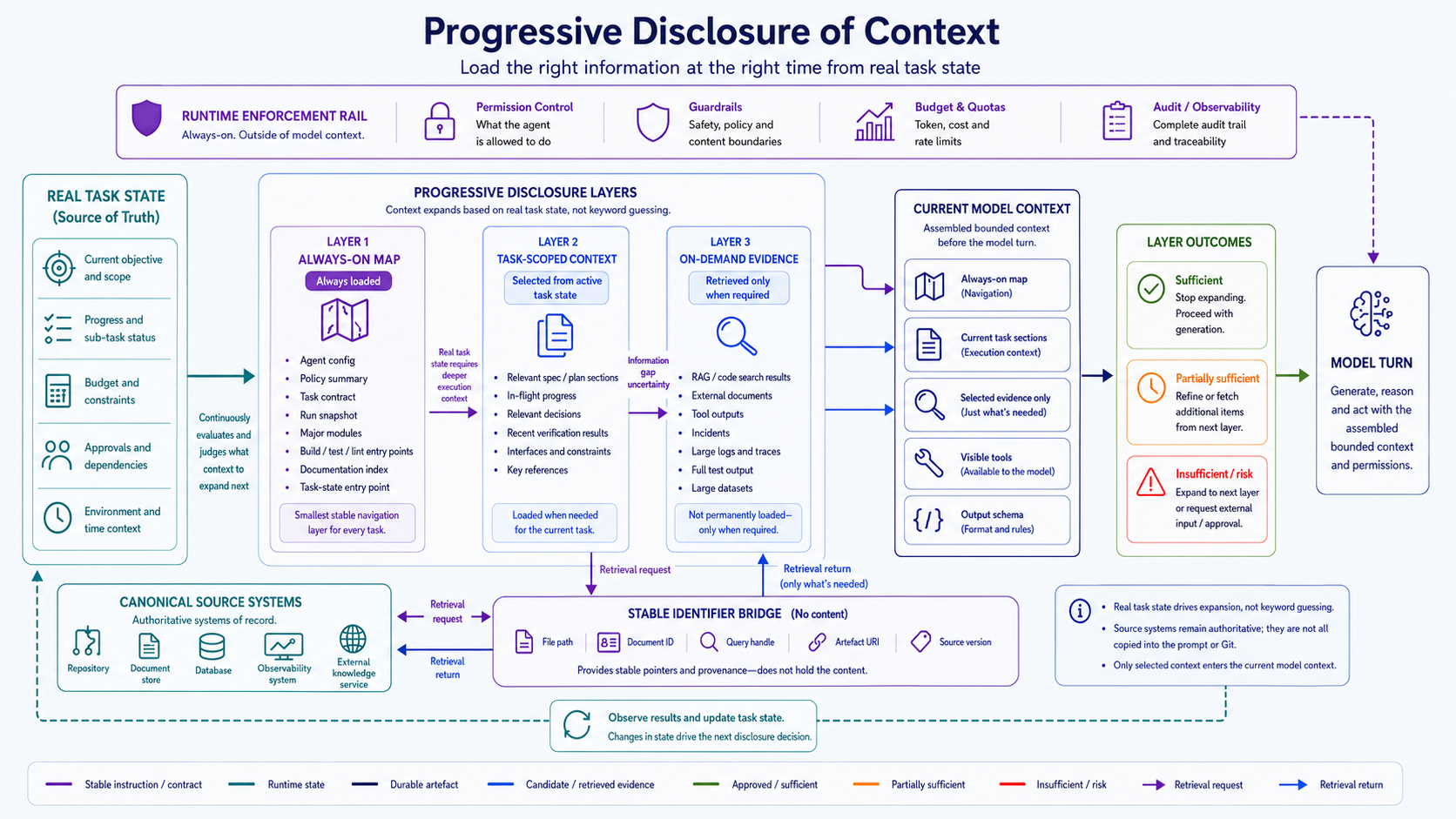
Figure 4-2 | An always-on map provides navigation, task-scoped context supports current work, and on-demand evidence is acquired through governed tools.
Always-on map
The always-on map should be short, stable, and navigable. It commonly includes:
- project purpose and major modules
- build, test, lint, and run entry points
- important safety and data constraints
- an index of deeper documentation
- an entry point to current task state
Its job is to tell the agent where to look, not to replace the knowledge base.
Task-scoped context
Load only what the current task needs:
- relevant modules and real file paths
- API, schema, and dependency boundaries
- established implementation patterns
- feature or defect specifications, plans, and acceptance criteria
- allowed scope and required verification
When the task or run state changes, this layer should be selected again. Similar-looking tasks should not inherit one another’s context by default.
On-demand evidence
Large, infrequently used, or rapidly changing material should remain behind tools:
- historical decisions
- previous incidents
- large logs and traces
- external documentation
- complete test output
- large tables
Just-in-time retrieval depends on reliable identifiers, such as a file path, document ID, query handle, or artefact URI. Anthropic similarly distinguishes agentic search from loading all possible material in advance.1
Repository-native context does not require all knowledge to be copied into Git. Code, build commands, and architectural rules often belong with the repository. Commercial, sensitive, cross-project, or live data may remain in other canonical systems and be exposed through controlled tools.
A fixed percentage of the context window is not a general design rule. The balance between map, task context, and evidence should be evaluated against task success, constraint recall, retrieval precision, tool errors, latency, and cost.
The context artefact lifecycle: govern intent, plans, progress, and evidence
Chat history records interaction. It is a weak sole specification for a complex project.
Work that spans turns, sessions, or operators needs durable artefacts.
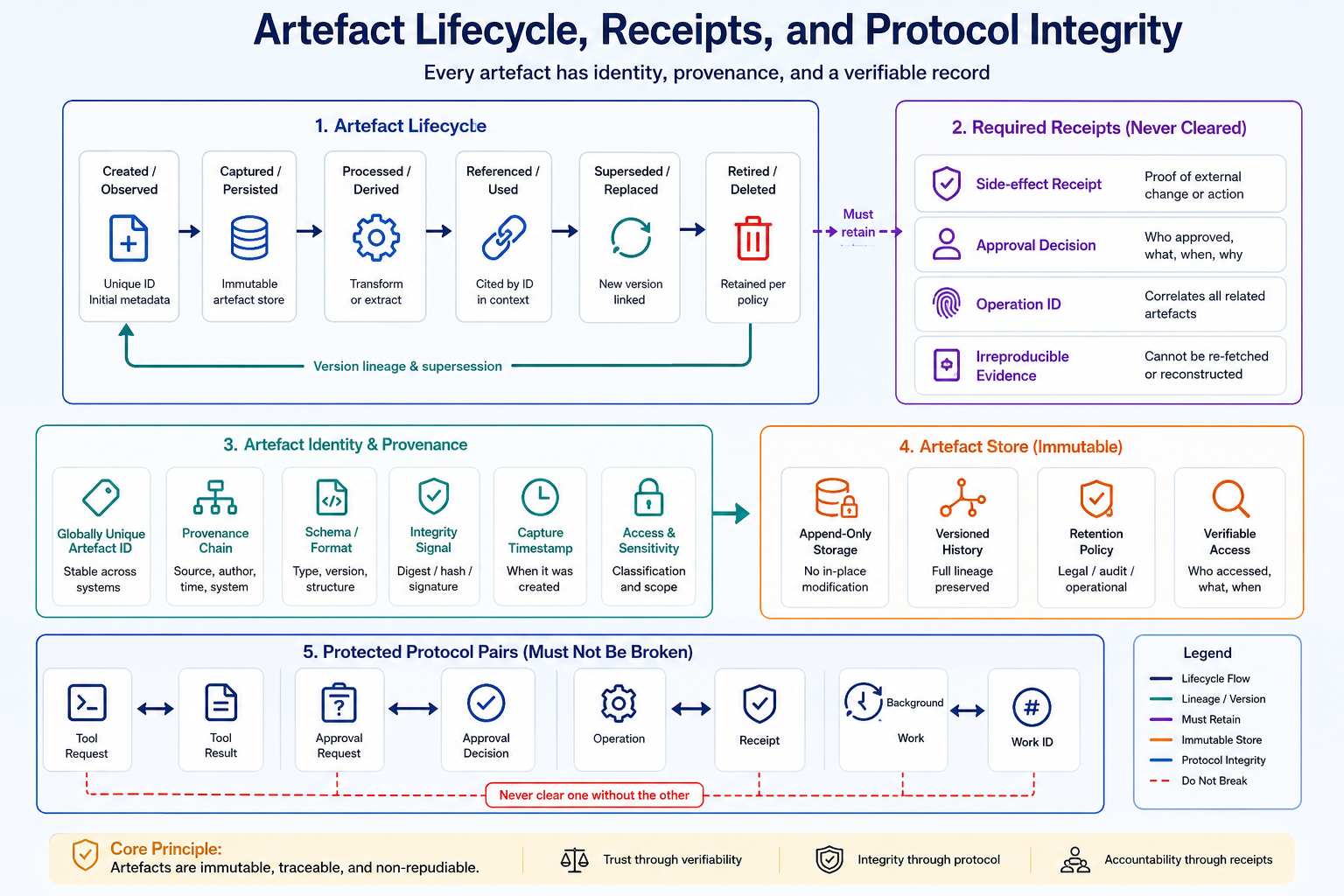
Figure 4-3 | Project context, specifications, plans, progress, and verification evidence have separate versions and review states. A change creates a new version rather than silently rewriting approved intent.
A useful artefact state graph is:
Bootstrap Project Context
→ Create Work Track
→ Draft Spec
→ Review / Approve Spec
→ Draft Executable Plan
→ Review / Approve Plan
→ Implement + Update Progress Ledger
→ Verify Completion
→ Promote Durable Knowledge / Retain Evidence / Archive Disposable Material
When an assumption, scope boundary, or architecture changes mid-flight, the system should not simply overwrite an approved document:
Detect change
→ create a new artefact version
→ record reason and impact
→ re-review the affected specification or plan
→ update verification requirements
→ resume from an explicit state
Google Conductor stores project context, specifications, and plans as persistent Markdown beside the code. The significant property is not Markdown itself. Intent, plans, and progress no longer exist only in an ephemeral chat session. Google’s workflow also requires plan approval before implementation.2
Project context
Relatively stable material across work tracks:
- product users and goals
- architecture and domain boundaries
- technology stack
- team workflow and testing rules
- security and operational constraints
Work-track context
Material for one defect, feature, or migration:
- problem and rationale
- scope and out-of-scope work
- specification
- plan and phases
- risks
- acceptance criteria
- progress, blockers, and decisions
Runtime evidence
Verifiable facts produced during execution:
- test results
- build logs
- diffs
- operation receipts
- traces or screenshots
- review findings
- verification reports
Completion should not send all of this material into one knowledge folder:
- reusable, verified decisions may become ADRs or maintained guidance
- completion evidence follows its retention policy rather than being discarded as temporary material
- superseded specifications and plans retain their version relationships
- low-value exploratory drafts may be archived or deleted
Brownfield bootstrap needs more than one automatic summary
Context for an established system should combine:
- code and dependency analysis
- existing documentation
- tests
- Git history
- runtime evidence
- human interview and confirmation
- architecture decision records
An automatically produced project description is a draft. Conflicting sources should produce an explicit conflict and unresolved assumption rather than whichever story reads most smoothly.
Context drift
Artefacts and the system will diverge without maintenance. Important artefacts need:
- owner
- version
- status
- last verified date
- canonical sources
- related code, schema, or policy
- stale triggers
- supersedes/superseded-by relationships
- archive or retention policy
Changing a plan during execution is not the problem. Failing to record the reason, impact, re-approval, and new verification requirements is.
Compaction, clearing, and memory solve different problems
When context grows, teams often reach immediately for a summary or memory store. Either can be the wrong primitive.
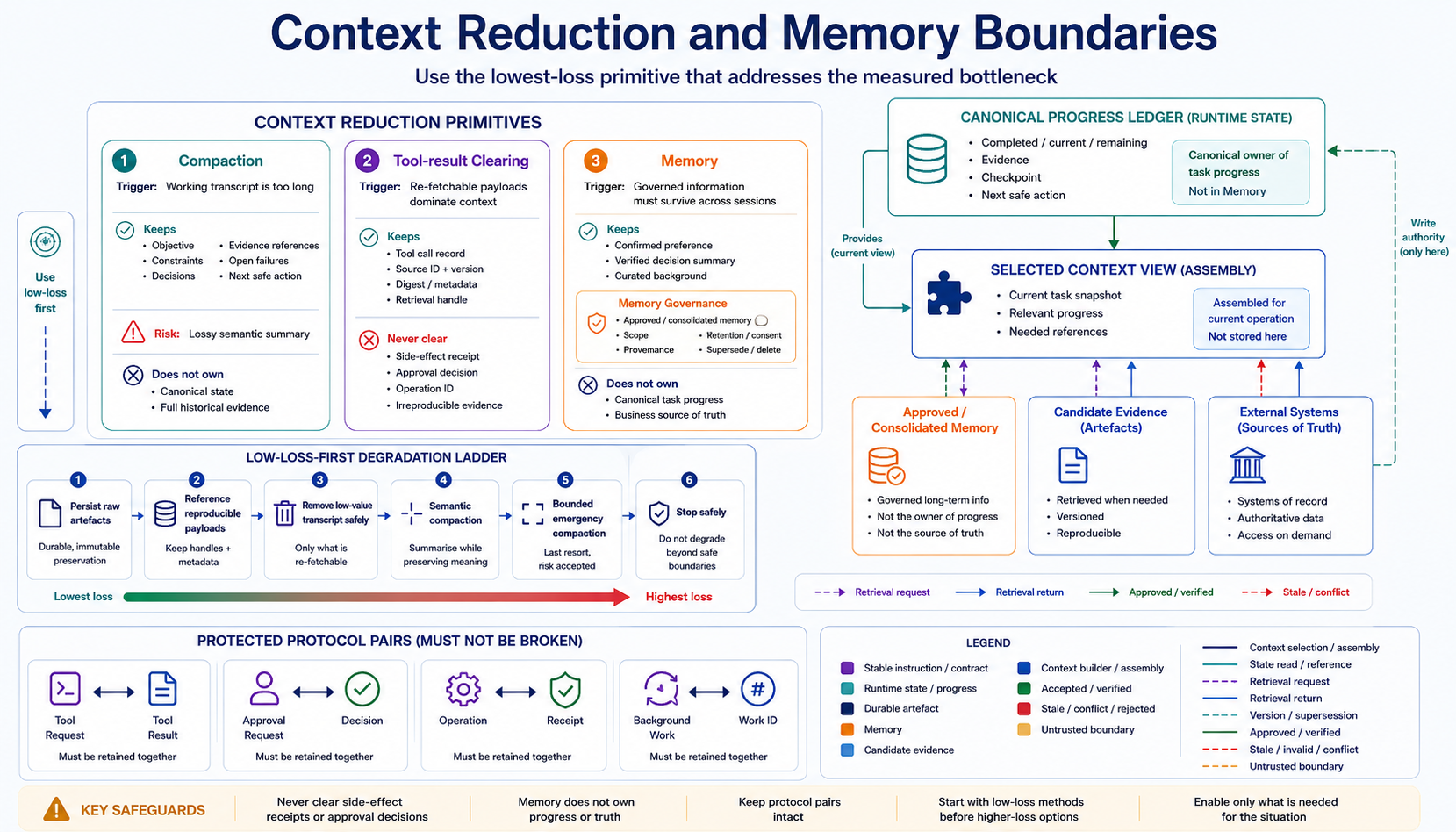
Figure 4-4 | Compaction compresses the working narrative, clearing removes safely reproducible payloads, and memory retains reusable cross-session material. Canonical progress remains in runtime state or a progress ledger.
| Primitive | Main problem | Suitable retained material | Responsibility it should not own |
|---|---|---|---|
| Compaction | The transcript as a whole is too long | Goal, decisions, open issues, evidence references, next step | Lossless history or durable-state authority |
| Tool-result clearing | Re-fetchable tool payloads dominate context | Call record, source ID, digest, retrieval handle | Side-effect receipts, approvals, or irreproducible evidence |
| Memory | Information needs reuse across sessions | Confirmed preferences, verified decisions, curated background | Canonical task progress or business records |
Compaction
Compaction summarises a long transcript so that work can continue in a new or reduced context.
A summary contract should retain:
- current objective
- user constraints
- accepted decisions and reasons
- modified resources
- tests and evidence references
- open failures
- active operation identifiers
- remaining work
- next safe action
Compaction is lossy. Its prompt, required fields, evaluation probes, and recovery path need testing. A detail judged unimportant now may become the root cause later.
Tool-result clearing
File reads, search pages, API responses, and large logs often consume the most tokens. A safely reproducible payload can be removed while retaining:
- tool-call identity
- source identifier and version
- digest and metadata
- retrieval handle
- required citation positions
Do not clear:
- side-effect receipts
- approval decisions
- operation identifiers
- irreproducible outcomes
- evidence required by later verification
Memory
Memory is an external persistence layer. It should not save every model output or load every stored record into every turn.
A usable memory lifecycle separates:
Selection → load relevant memory
Extraction → propose candidate memory
Consolidation → approve, merge, supersede, expire, or delete
A candidate memory is not a fact. Before writing it, ask:
- Does it need to survive the session?
- Does a more authoritative source already hold it?
- Is it verified fact, confirmed preference, or model inference?
- Does it belong to user, project, tenant, or session scope?
- Is it sensitive, and would the user expect it to be retained?
- Who can inspect, correct, revoke, export, or delete it?
- When should it be superseded or expire?
An illustrative record might be:
memory_id: mem-123
scope: project
subject_id: checkout-service
type: verified_decision_summary
content: "PostgreSQL remains the source of truth for payment state."
source_ref: adr-017
source_version: 4
verification_status: approved
approved_by: architecture-owner
created_at: 2026-07-08
expires_at: null
policy_version: memory-policy-4
The YAML does not make the record trustworthy. Its canonical source, version, approval status, and lifecycle do.
Task progress belongs in a progress ledger:
Canonical progress ledger
→ context builder selects a relevant view
→ model sees current progress
The reverse arrangement, in which a memory summary becomes task truth, creates split-brain state.
Anthropic’s cookbook also treats memory, compaction, and tool-result clearing as different techniques for different context bottlenecks. It notes that subagent isolation and programmatic tool calling can keep large data out of the main context entirely.3
Prefer low-loss reduction before semantic compaction
A safer degradation ladder is:
1. Persist oversized raw artefacts
2. Replace old, reproducible tool payloads with references
3. Remove low-value middle transcript without breaking protocol pairs
4. Create a semantic summary under a summary contract
5. Perform bounded emergency compaction
6. Stop safely when further compression cannot preserve required state
Order matters. Clearing a large result before persisting the only evidence it contains makes recovery impossible.
No cutting operation should separate:
- a tool request and its correlated result
- an approval request and decision
- background acceptance and its work identifier
- a side-effect operation and receipt
- a task claim and ownership record
A full transcript may be retained in durable storage, but retained does not mean model-accessible. A later session still needs an artefact tool, retrieval path, or explicit reference to recover the detail.
Semantic compaction should have a bounded retry policy. Continuing to summarise after required state can no longer be preserved only spends more money while increasing loss.
Where RAG belongs in the harness
RAG is a knowledge-acquisition subsystem governed by the harness. It is not the whole harness, and it need not share a process with the harness runtime.
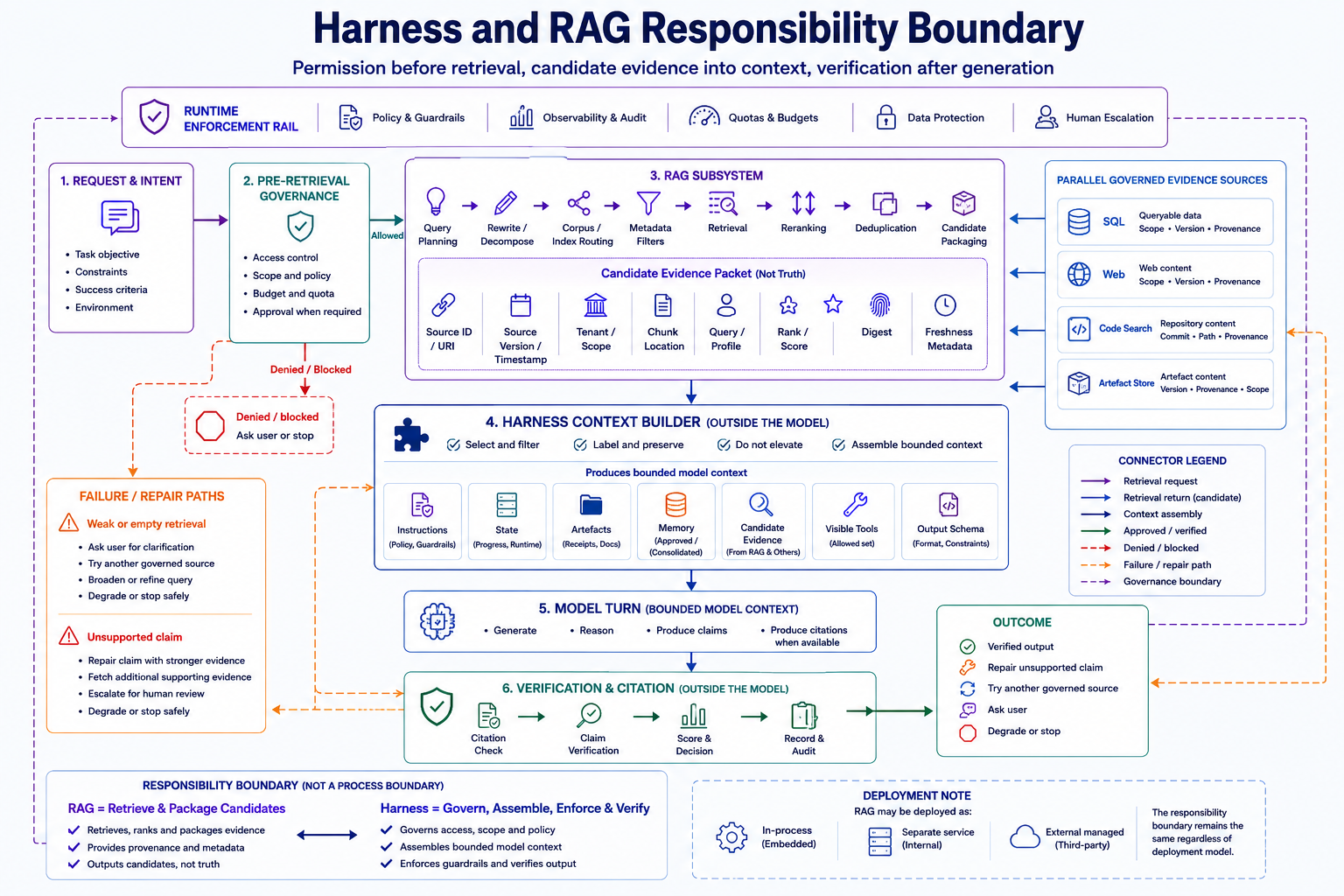
Figure 4-5 | RAG plans and executes retrieval, returning candidate evidence with provenance. The harness still owns scope, policy, context assembly, fallback, completion, and tracing.
RAG commonly handles:
- query planning
- rewriting and decomposition
- corpus or index routing
- metadata-filter construction
- retrieval
- reranking
- deduplication
- candidate-evidence packaging
The harness still decides:
- whether this turn needs retrieval
- which corpora, tenants, and fields the actor may query
- the retrieval profile, model, and budget
- which scope and filters the planner may use
- how to handle empty or weak retrieval
- whether SQL, web, code search, or user clarification is permitted
- how candidate evidence is qualified and inserted into context
- whether a claim and citation are supported
- when to retry, degrade, ask, or stop
- how trace, cost, and evaluation evidence are retained
Therefore:
Good Retrieval ≠ Grounded Answer ≠ Good Production HarnessA retriever may find highly similar material while the system still produces an untrustworthy result through incorrect permission, stale content, broken citation mapping, or a weak stopping policy.
What should candidate evidence carry?
RAG should not return only plain text. A useful result retains:
- source identifier and URI
- source version or timestamp
- tenant and scope
- chunk location
- retrieval query and profile
- rank or score as a retrieval signal
- content digest
- data classification
- freshness or validity metadata
A score is a ranking signal, not a truth score. The context builder may select evidence under policy and budget. Claim verification remains a separate step after an answer or action has been produced.
Query planning answers how to search
Query planning may:
- rewrite an ambiguous query
- split it into subqueries
- route to different indexes
- add metadata filters
- run multi-step retrieval
- merge and deduplicate results
- decide that the retrieval plan has gathered enough evidence
That last decision stops retrieval, not the whole task.
Orchestration still decides whether to use SQL, ask the user, enter verification, or stop the run.
Do not confuse the context builder with synthetics
| Area | Context builder | Synthetics |
|---|---|---|
| Timing | Every runtime turn | Before or around retrieval, training, or evaluation |
| Purpose | Assemble the context needed now | Generate auxiliary queries, documents, QA, or training data |
| Typical output | Messages, input items, section manifest | HyDE document, synthetic query, QA pair, hard negative |
| Main risk | Pollution, excess length, staleness, cross-scope data | Bias, hallucination, evaluation leakage |
HyDE and synthetic queries may improve a retrieval problem. They are not memory and do not replace the context builder.
Derived-context caches also become stale
Context builders frequently produce expensive derived material:
- repository maps
- schema summaries
- recent-commit digests
- documentation indexes
- tool-catalogue summaries
- memory indexes
A cache hit reduces latency and cost. If the source changes without invalidation, the agent continues reasoning about an obsolete world.
A cached block should record:
- tenant and workspace scope
- source reference
- dependency versions or generations
- policy version
- tool-catalogue version
- memory-index generation
- generation time
- content digest
For example:
repository-map-v21
├── tenant: tenant_acme
├── workspace_ref: a81c4f2
├── file_tree_generation: 94
├── policy_version: policy-8
├── tool_catalog_version: tools-31
└── generated_at: 2026-07-08T10:30:00Z
Common mutation points include:
- file writes, renames, and deletion
- Git checkout, merge, and rebase
- schema migrations
- tool registration and plugin enablement
- permission and policy changes
- memory updates
- dependency or environment changes
A mutation should emit an invalidation event. If dependencies cannot be tracked reliably, use a short TTL or do not cache.
Testing only that the second request hits the cache proves little. A correctness test is:
Build cache
→ mutate a declared dependency
→ verify invalidation event
→ rebuild context
→ confirm the old source version is absent
Provider stable-prefix caching, application section-assembly caching, and derived-data caching are separate layers. They should not share a vague cached=true state or one invalidation rule.
The fresh-session test: can a new session reconstruct the work?
A direct way to test context artefacts is to start a fresh session, provide no private verbal briefing, and ask the agent to reconstruct the work through the standard entry points.
The test should resemble real execution:
- use production-like instruction precedence
- use the standard tools and permission profile
- begin from a clean checkout or known checkpoint
- provide no tester-only hints
- require citations to the artefacts used
The new session should be able to answer:
- What is this system?
- Where are the main modules and authority boundaries?
- How is it installed, started, stopped, and checked?
- What work is active, complete, blocked, or cancelled?
- What is the next safe action?
- Which operations are prohibited or require approval?
- Which artefacts support those conclusions?
Record:
- discovery time
- invalid tool calls
- false assumptions
- human interventions
- stale documents encountered
- missing canonical artefacts
Failures can be classified as:
- missing: required information does not exist
- hidden: it exists but is not discoverable through the standard path
- stale: artefact and system have diverged
- ambiguous: several sources make conflicting authority claims
- inexecutable: a documented instruction cannot be run
- unauthorised: recovery requires permissions that should not be exposed
OpenAI’s Harness Engineering article describes repository knowledge as a system of record and agent legibility as an engineering goal. This does not require all information to live in the repository. It requires authoritative information to be discoverable, interpretable, verifiable, and traceable from the agent’s environment.4
Repeated failure should not be answered by adding more material to AGENTS.md. The repair may be a better index, an executable command, a corrected progress ledger, explicit ownership, or deletion of contradictory documentation.
Context needs gardening and an admission gate
Once agents generate specifications, summaries, memory, and documentation at scale, the problem changes from missing information to low-signal growth.
Before material enters core knowledge, ask:
- What decision value does it add?
- Does it duplicate or conflict with existing material?
- What are its source authority and temporal scope?
- Who maintains it, and which mutations make it stale?
- Does it belong in core, reference, watchlist, or rejected/expired material?
Agents can collect, summarise, deduplicate, find broken links, and propose placement. Admission to canonical knowledge remains a governance decision.
A maintainable gardening loop is:
Scan
→ classify stale / orphan / conflict
→ open a bounded repair
→ verify against code or authority
→ update indexes
→ supersede, archive, or delete safely
A knowledge base that adds a document after every failure but never repairs or retires an old one will eventually offer several plausible answers to the same question.
Walking through a payment-state inconsistency
Continue the payment example. A provider has captured the payment, but the internal order remains pending.
A governed context flow might be:
- The always-on map points to the checkout, payment, and order modules and their test entry points.
- The task contract limits the work to state synchronisation, keeps the provider, and prohibits direct production-data changes.
- The context builder reads workspace identity, run state, API contracts, and the latest test evidence.
- RAG and code search find the webhook handler, state transition, and a previous incident while retaining source versions.
- Policy applies tenant, corpus, and field scope before retrieval.
- The context builder labels retrieved text as data so that it cannot override system instructions.
- The agent reads only the required files and logs rather than loading the whole repository.
- A large raw log is persisted as an artefact; only relevant lines, time range, digest, and artefact identifier enter context.
- The agent proposes a patch and tests produce new runtime evidence.
- The next context gives priority to the diff, failing tests, original acceptance criteria, and remaining work.
- A webhook-schema change invalidates the old schema summary and dependent context caches.
- Temporary search payloads are cleared; evidence follows retention policy; a confirmed design decision becomes an ADR rather than an unsourced memory.
An apparently complete context can still be wrong. Without step eleven, the next inference uses obsolete fields and reasons coherently about the wrong version of the system.
Ten questions for reviewing a context system
- Who owns the context builder, and which state and policy drive its choices?
- Are model context, runtime state, durable artefacts, memory, and retrieved evidence separate?
- Does every section carry role, authority, scope, source version, digest, and inclusion reason?
- Is retrieved or tool content treated as data rather than silently promoted into instruction?
- Is the always-on map navigational, and is task-scoped context reselected for each task?
- Is large raw data persisted or processed outside the prompt before a compact view is loaded?
- Do compaction, clearing, and memory address measured bottlenecks in a low-loss-first order?
- Does canonical progress remain in run state or a progress ledger rather than a memory summary?
- Does the harness govern RAG permission, freshness, fallback, provenance, and citation verification?
- Can cache-invalidation tests and a fresh-session test expose stale, hidden, ambiguous, or inexecutable context?
Good context engineering does not require the model to know everything. It gives the model enough trustworthy and actionable information at the right time, together with stable identifiers for reaching the next layer of evidence.
From theory to implementation: Part 04 checklist
- Model context, runtime state, artefacts, memory, and retrieved evidence have explicit boundaries.
- Context sections carry role, owner, scope, authority, source version, digest, and provenance.
- Policy summaries may enter context, while permissions, budgets, and approvals remain runtime-enforced.
- The always-on map stays small, and task-scoped and on-demand material is loaded from real state.
- Specifications and plans are reviewed separately; mid-flight changes create versions and revalidation.
- Progress ledgers and verification evidence do not exist only in chat history or memory.
- Necessary raw artefacts are persisted before clearing, and protocol pairs are never split.
- Compaction has a summary contract, evaluation probes, bounded retries, and a recovery path.
- Memory has selection, extraction, approval or consolidation, supersession, and deletion.
- RAG returns candidate evidence with provenance rather than treating retrieval score as truth.
- Derived caches bind to dependencies and scope and emit invalidation events after mutation.
- The fresh-session test uses production-like instructions, tools, and permissions.
Part 05 examines the capability surface that the context builder exposes to the model: tools, skills, hooks, plugins, and MCP, and why adding more tools does not necessarily make an agent more capable.
References
Footnotes
-
Anthropic, Effective context engineering for AI agents, 29 September 2025. ↩ ↩2
-
Google Developers Blog, Conductor: Introducing context-driven development for Gemini CLI, 17 December 2025. ↩
-
Anthropic, Context engineering: memory, compaction, and tool clearing, 20 March 2026. ↩
-
OpenAI, Harness engineering: leveraging Codex in an agent-first world, 11 February 2026. ↩