Connecting an agent to a function is easy.
The harder problem arrives when the same system can use a shell, browser, database, GitHub, email, Slack, internal APIs, MCP servers, skills and plugins. Which capabilities should the model see? Which one should it choose? Who is allowed to execute it? What should come back into the next reasoning step?
Consider an agent asked to find overdue invoices for the week, prepare reminder drafts and send them after approval:
- The invoice query might be a tool, an SQL CLI or an MCP tool.
- Reminder rules and writing guidance might belong in a skill.
- A pre-send review could be a hook or a policy gate.
- Gmail integration might be installed by a plugin or exposed by an MCP server.
- A2A only becomes relevant if the work is delegated to an independent finance agent.
Those terms are not synonyms, and they do not occupy the same architectural layer.
Capability engineering covers how capabilities are described, discovered, selected, authorised, executed, observed and governed over time. Putting function names into a prompt completes only a small part of that work.
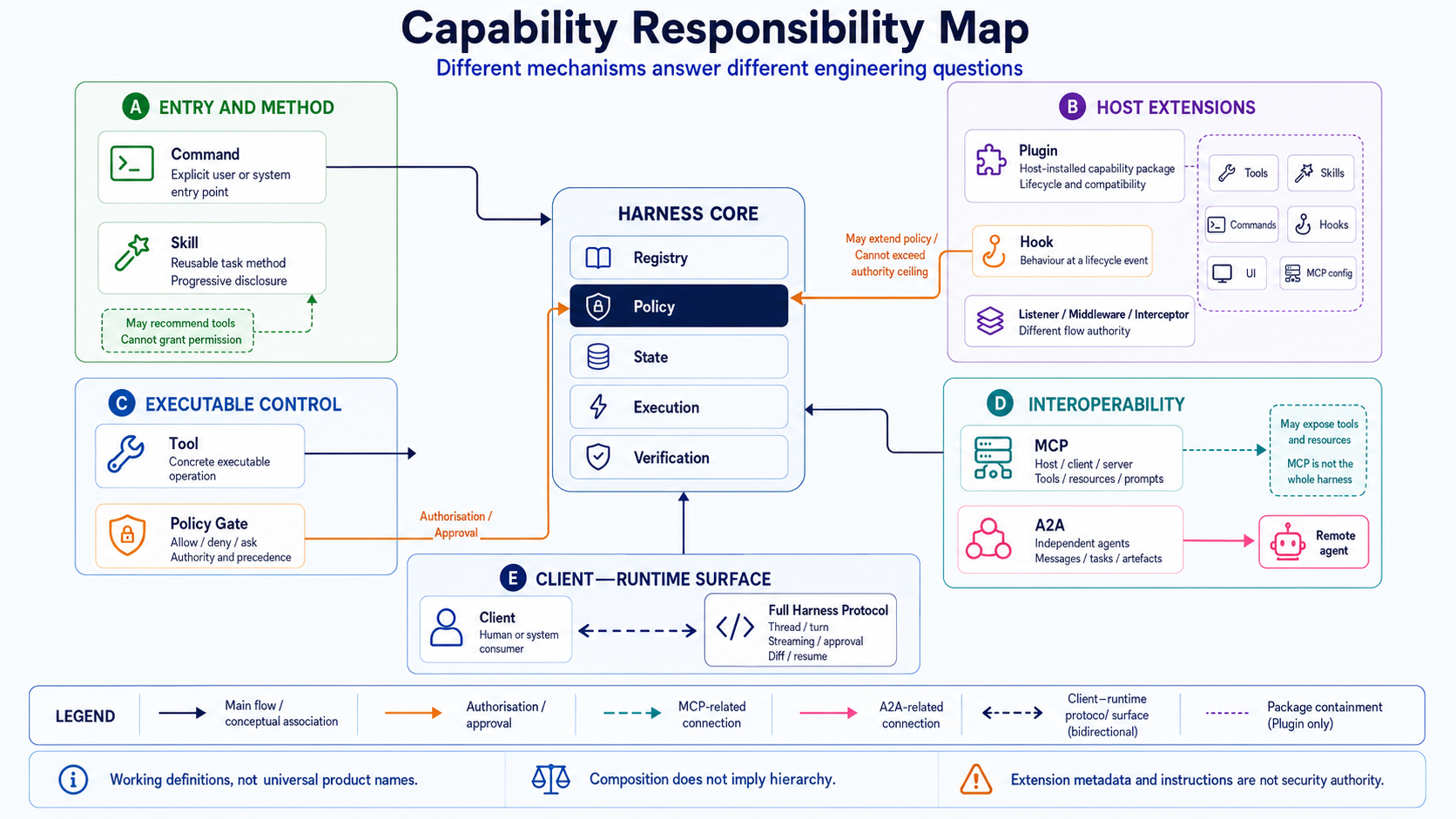
Figure 5-1 | A tool is an executable unit; a skill packages a method; a plugin extends a host; a hook attaches behaviour to a lifecycle point; MCP and A2A address different interoperability boundaries.
Separate the terms before selecting the technology
Capability systems often fail because the same label means different things across products. Rather than memorising one framework’s vocabulary, identify the question each mechanism answers.
| Term | The question it answers | Typical content |
|---|---|---|
| Tool | What specific capability can the agent execute? | search_documents, run_tests, send_email |
| Command | Which explicit entry point did a user or system invoke? | /eval, a CLI command, an API route |
| Skill | What method should the agent follow for this class of task? | SOP, tool order, decision rules, acceptance criteria |
| Plugin | Which package of capabilities can this host install? | Tools, skills, commands, hooks, UI, configuration |
| Listener | Who receives a notification after an event? | Telemetry, audit, analytics |
| Hook | What behaviour runs at a lifecycle point? | PreToolUse, PostCompact, SessionEnd |
| Middleware | What wraps a request or response pipeline? | Authentication, tracing, normalisation, rate limiting |
| Interceptor | What may inspect or alter a particular operation? | Tool validation, approval, policy extension |
| MCP | How does an AI host connect to external tools, resources and prompts? | Host, client and server capability protocol |
| A2A | How do independent agents discover one another and manage delegated work? | Agent Card, Task, Message, Artifact |
| Full harness protocol | How does a client drive the complete agent runtime? | Thread, turn, streaming, approval, diff, resume |
A host may support several of these at once:
Harness
├── Command Router
├── Skill Library
├── Plugin Manager
│ └── MCP Client Adapter
├── Hook / Middleware System
├── Tool Registry
└── Policy / State / Verification
This tree is not a maturity ranking. It marks responsibility boundaries.
A tool is an executable unit. A skill tells the agent how to carry out a class of work. A plugin installs a package into a host. A hook inserts behaviour into an existing lifecycle. MCP exposes capabilities across processes or products. A2A treats another agent as a remote collaborator with its own runtime.
Calling all of them “tools” removes the precision needed for architecture review.
Visible, discoverable, authorised and executed are different states
Capability governance is often compressed into one claim: “The model has this tool, so it can use it.”
That claim merges several states:
- Registered: the tool contract exists in the registry.
- Discoverable: the current actor may see its catalogue metadata.
- Model-visible: the complete schema is loaded into this turn.
- Authorised for this call: the actor may perform this operation on the canonical resource.
- Executed with a known outcome: the runtime has run it and committed a correlated terminal result.
Appearing in model context establishes at most part of the first three. It does not establish per-call permission or prove that an external side effect completed.
The same boundary applies to built-in tools, plugin tools, MCP tools and server-executed tools. Execution location may vary, but the product still needs owners for identity, tenant scope, business policy, approval, side-effect evidence and completion.
A production tool call does not jump directly from model output to a handler
A structured tool request is a proposed operation.
A more complete execution lifecycle is:
Resolve catalogue snapshot
→ Parse and schema-validate
→ Canonicalise arguments and resources
→ Classify effect, risk and concurrency
→ Final authorisation / approval
→ Bind execution context
→ Execute in boundary
→ Normalise result
→ Commit audit and observation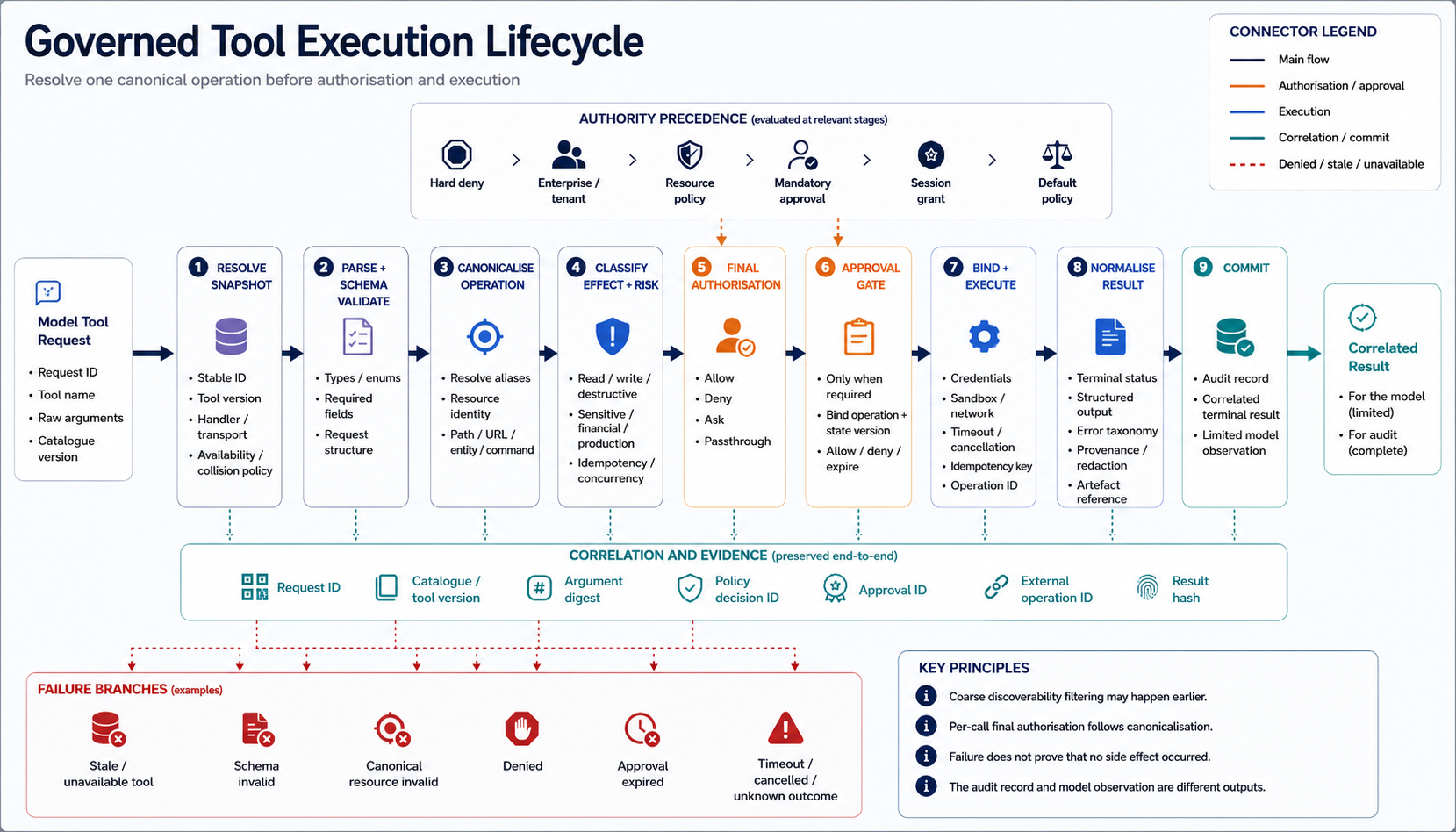
Figure 5-2 | The harness resolves one canonical operation before applying resource-specific authorisation, execution controls and correlated result commitment.
Resolve the catalogue snapshot
The runtime fixes:
- stable tool identifier
- tool version
- catalogue version
- handler or transport
- host, tenant, region and runtime availability
- name-collision policy
- deprecation or disabled state
A model-produced name is not an executable pointer.
If the model saw billing.send_reminder@v2 and only a semantically different v3 remains at execution time, the runtime should return a structured stale or unavailable result. It should not silently substitute another tool.
Parse and schema-validate
The runtime checks request structure, required fields, types, enums, formats and additional-property rules.
Schema validity establishes shape. It does not establish that the resource is correct or authorised.
Canonicalise arguments and resources
Policy has to evaluate the operation that will actually run.
For example:
./exports/../payments/config.jsonIf policy evaluates the raw string and the file API resolves it later, authorisation and execution may refer to different resources.
A safer order is:
Parse
→ resolve aliases
→ canonicalise path / URL / entity / command
→ resolve resource identity
→ evaluate policy against that operation
A coarse entitlement filter may run before catalogue search to prevent metadata leakage. Per-call final authorisation must still happen after canonicalisation.
Classify effect, risk and concurrency
The same tool can have different risk for different arguments:
read_fileagainst a README or credential directoryrun_sqlforSELECTorDELETEsend_emailto a test account or a customerdeployto preview or production
Each call should be classified for:
- read, write, destructive or external-send effect
- sensitive data
- financial or production impact
- idempotency
- shared-resource conflict
- parallel-execution safety
- human approval
Tool annotations may inform policy; they are not security guarantees. The MCP 2025-11-25 tools specification requires clients to treat annotations as untrusted unless they come from trusted servers.1
Apply final authorisation and approval
The decision should bind to actor, tenant, workspace, canonical resource, action, argument digest, tool and catalogue versions, policy version and current state version.
A useful decision set is:
allow | deny | ask | passthroughA lower-authority hook or plugin must not override a higher-authority denial. A typical precedence might be:
Immutable / hard deny
> enterprise or tenant deny
> resource-specific deny
> mandatory ask
> session grant
> project or user allow
> default policy
The exact sources may differ. Precedence must be testable, traceable and fail closed on unresolved conflict.
Bind and execute
Before execution, the runtime binds:
- least-privilege credentials
- sandbox, filesystem and network boundaries
- timeout and cancellation
- rate and concurrency limits
- idempotency key
- external operation identifier
- trace, run and tool-call identifiers
Credentials should not come from model arguments or become available merely because a skill or plugin requested them.
Execution outcomes should distinguish:
successvalidation_failedpermission_deniedapproval_requiredtimeoutcancelledpartialbackground_acceptedunknown_outcomeunavailable_tool
Failure does not establish the absence of a side effect. Retry, idempotency, unknown outcomes and compensation are covered in Part 08.
Normalise the result
Raw API, CLI or MCP results should not be copied directly into model context.
A normalised result should include terminal status, structured output, error taxonomy, retryability, provenance, external operation identifier, latency, partial state, redaction, and an artefact reference or pagination.
The complete payload may be retained as an artefact. The model receives only the bounded observation needed for the next step.
Commit audit and observation
The audit record and model-visible observation are different products.
Audit may retain a canonical-argument digest, policy-decision identifier, approval identifier, catalogue and tool versions, start and finish times, external operation identifier, result hash and unknown state.
The observation answers a narrower question: what does the model need for its next decision?
Every tool request must receive one correlated terminal result. Background work may emit progress and a later completion event, but that completion must not masquerade as a second result for the original request.
A tool contract needs execution semantics, not only parameter shapes
A governable registry entry needs more than a name and input schema.
The following is illustrative rather than a standard product schema:
{
 "id": "billing.invoice.send_approved_reminders",
 "version": "2.1.0",
 "owner": "billing-platform",
 "description": "Send reminders for an approved reminder batch.",
 "input_schema": {
 "type": "object",
 "properties": {
 "batch_id": {"type": "string"},
 "approval_token": {"type": "string"}
 },
 "required": ["batch_id", "approval_token"],
 "additionalProperties": false
 },
 "output_schema": {
 "type": "object",
 "properties": {
 "operation_id": {"type": "string"},
 "sent_count": {"type": "integer"},
 "failed_count": {"type": "integer"}
 },
 "required": ["operation_id", "sent_count", "failed_count"]
 },
 "effects": ["external_send", "customer_communication"],
 "risk_class": "high",
 "approval_class": "mandatory",
 "idempotency": {"required": true, "scope": "batch_id"},
 "concurrency": "exclusive_per_batch",
 "timeout_ms": 15000,
 "error_taxonomy": [
 "approval_invalid",
 "batch_stale",
 "rate_limited",
 "unknown_outcome"
 ],
 "redaction": ["approval_token"],
 "deprecated": false
}
This illustrates that a registry may need:
- stable identifier, version and owner
- input and output contracts
- side effects and risk
- approval and idempotency
- concurrency
- timeout
- error taxonomy
- sensitive-field redaction
- deprecation
It does not show that fifteen seconds is a suitable timeout, that the handler is idempotent, that business authorisation is correct, or that a model can select the tool reliably.
A contract is the entry point for governance, not a quality certificate.
New tools should fail closed. Before review, they should not be assumed to be read-only, safe for concurrent execution, automatically approved or idempotent.
The Agent-Computer Interface is a user interface
Anthropic places the Agent-Computer Interface, or ACI, alongside the Human-Computer Interface and recommends investing comparable care in tool documentation and testing.2
Function calling does not make an ambiguous interface clear merely because it uses JSON.
A strong ACI tends to provide:
- names with distinct, stable meanings
- parameters that can be understood without hidden formatting rules
- enums and controlled resource identifiers instead of vague free text
- a visible separation between reads and destructive actions
- stable result structures
- errors that explain how the call can be corrected
- pagination, field selection or artefact references for large results
- neighbouring tools whose purposes can be distinguished by the model
Do not hide an entire business domain behind manage()
This interface looks flexible:
{
 "name": "manage_invoice",
 "arguments": {
 "action": "string",
 "payload": "object"
 }
}
The model must now infer the permitted action values, payload shapes, reversibility and success semantics.
A safer interface might expose:
search_overdue_invoices
preview_reminder_drafts
approve_reminder_batch
send_approved_reminders
The purpose is not to maximise the tool count. It is to create enforceable boundaries around meaning, permission and side effects.
Poka-yoke: make common errors difficult
Instead of repeating “be careful” in the prompt, the interface can remove some invalid paths:
- accept a controlled
invoice_idrather than arbitrary SQL - separate Preview from Commit
- allow the send tool to accept only an approved
draft_batch_id - require an
approval_tokenfor a high-risk action - avoid a field that accepts dates, timestamps and natural-language time expressions at once
ACI quality must eventually be measured with real model behaviour: wrong-tool selection, invalid arguments, correction attempts, completion time and confusion between adjacent capabilities. A tidy schema proves that the schema is tidy.
More capability is not always better: the surface has a budget
Every active tool, skill, plugin instruction and MCP server consumes context and selection attention.
Anthropic’s context-engineering guidance highlights bloated or overlapping tool sets as a common source of ambiguous decisions. Tools should be self-contained, clearly differentiated and economical in what they return.3
A Capability Surface Budget includes:
- tool names and descriptions
- input and output schemas
- examples
- skill metadata and instructions
- server-level guidance
- hook behaviour
- policy guidance
- error documentation
- tool-result payloads
A more useful activation model is:
Always-on core capabilities
+ task-retrieved tools
+ explicitly activated skills
+ temporary subagent capabilities
It is rarely helpful to expose every capability in the organisation on every turn.
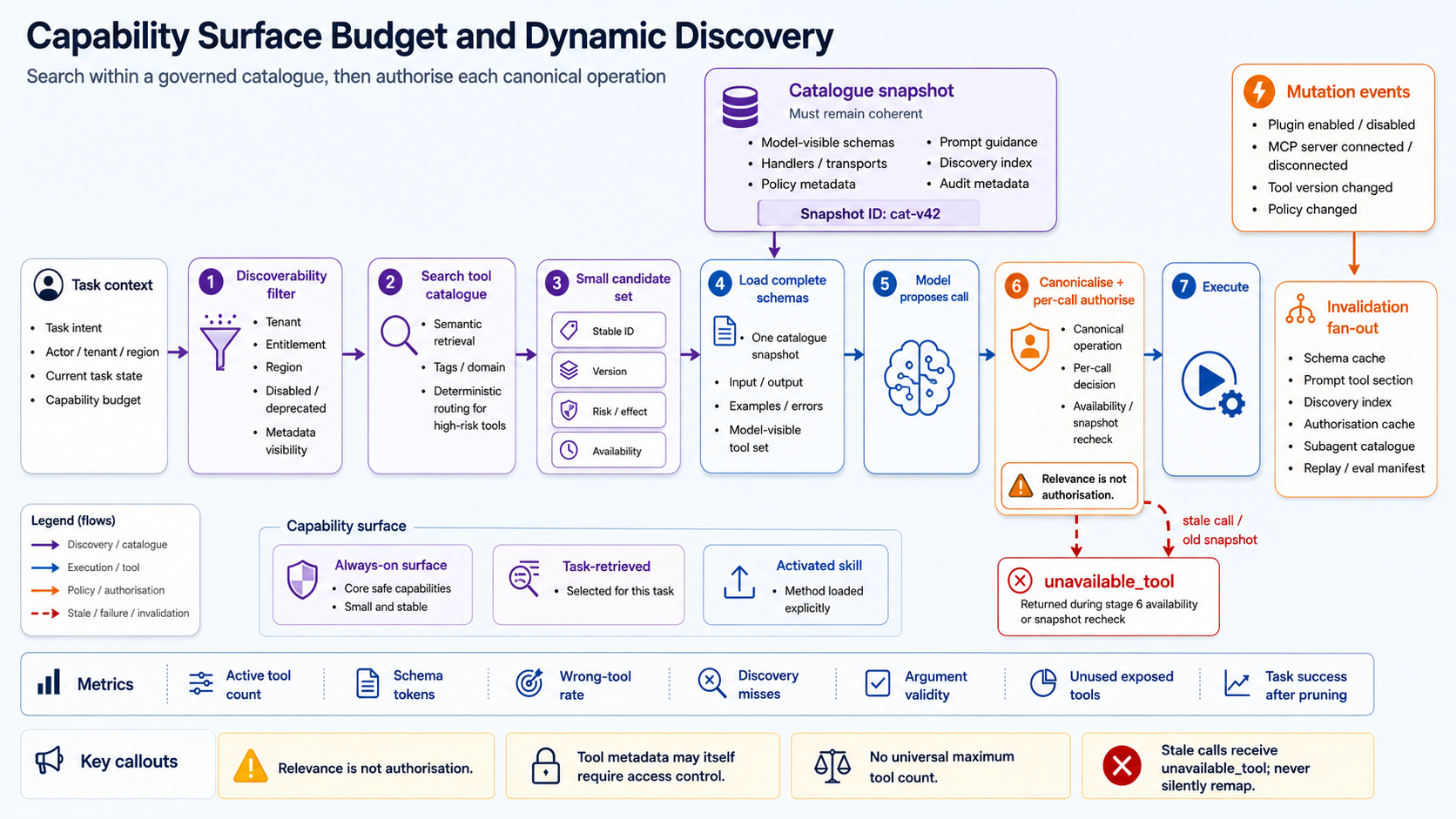
Figure 5-3 | Keep a small always-on surface, retrieve a limited candidate set from the catalogue for the current task, then authorise each call at runtime. Discovery is not permission.
Dynamic tool discovery: restrict discoverability before search
As the catalogue grows, loading every complete schema increases cost, confusion and cache churn.
A stronger discovery path is:
Task intent + actor scope
→ filter discoverable catalogue metadata
→ search candidate tools
→ return a small candidate set
→ load complete schemas from one catalogue snapshot
→ model proposes a call
→ canonicalise operation
→ per-call final authorisation
→ execute
Catalogue metadata should include:
- stable identifier, name, version and owner
- description and example tasks
- input and output schemas
- domain, tags and namespace
- side-effect, risk and approval class
- latency and cost class
- tenant, region and entitlement availability
- deprecation state
- compatibility constraints
Discovery relevance is not authorisation
Semantic search establishes task relevance.
If catalogue metadata is itself sensitive, actor, tenant, region and entitlement filters should run before search. Execution authority is still re-evaluated after the canonical operation exists.
The embedding model is not the permission engine.
Use one coherent catalogue snapshot
One model turn should see coherent versions of:
- model-visible schemas
- execution handlers
- policy metadata
- prompt guidance
- discovery index
- audit metadata
- catalogue version
Plugin enablement, MCP disconnection, tool upgrades and policy changes should invalidate schema caches, prompt tool sections, discovery indexes, authorisation caches, subagent catalogues and replay or evaluation manifests.
When a server disappears or a tool is revoked, the runtime should increment the catalogue version and return unavailable_tool for stale requests. It must not use a removed handler or silently map the request to a namesake.
Skills, plugins and hooks carry different responsibilities
A skill packages a reusable method
A skill behaves like an on-demand SOP. It may contain:
- activation conditions
- a task-specific decision procedure
- recommended tool order
- failure handling
- templates
- scripts
- references
- acceptance criteria
- evaluation cases
The public Agent Skills specification requires a directory containing at least a SKILL.md file and permits scripts/, references/, assets/ and other files. SKILL.md includes frontmatter with required name and description fields; allowed-tools is currently marked experimental.4
invoice-reminder/
├── SKILL.md
├── scripts/ # optional
├── references/ # optional
├── assets/ # optional
└── ...
This article additionally recommends evals/ or extra metadata for maintainability. Those are not required Agent Skills directories.
A skill may recommend tools and load its method through progressive disclosure. It does not raise runtime permission merely by declaring allowed-tools.
A skill should not contain:
- secrets, tokens or private URLs
- repository-specific facts presented as a universal method
- undisclosed destructive behaviour
- a large manual forced into every turn
- instructions that cannot be evaluated or traced
A plugin is a package installed under a host contract
There is no single plugin format across all agent hosts. In this series, a plugin means a capability package installed under a particular host’s discovery, installation, registration, permission and lifecycle contract.
It may contain:
- tools
- skills
- commands
- hooks
- UI
- configuration
- MCP client or server settings
A plausible lifecycle is:
Discover
→ validate provenance and compatibility
→ install
→ initialise
→ register
→ enable
→ execute
→ upgrade / disable
→ unload / revoke
A manifest should describe:
- unique identifier, name and version
- host and API compatibility
- entry point
- requested permissions and resources
- bundled capabilities
- configuration schema
- migration and rollback
- publisher, provenance, digest or signature
- disable and revoke path
A plugin must not bypass the host’s tool registry, tenant boundary, sandbox or immutable denials. An extension’s authority ceiling cannot exceed the security core it extends.
A hook attaches behaviour to a stable lifecycle point
Hooks attach validation, logging, context injection, cleanup and policy extensions to explicit events rather than turning the core loop into intertwined conditionals.
Common event points include:
SessionStart
UserPromptSubmit
PreModelCall / PostModelCall
PreToolUse / PostToolUse / ToolFailure
PreCompact / PostCompact
TaskCreated / TaskCompleted
Stop / SessionEnd
ConfigChanged
WorkspaceChanged
The event name is not the contract. A production hook definition needs:
- trigger timing
- input and output schemas
- whether input or output may change
- whether the hook may block, ask, cancel or retry
- authority ceiling
- multiple-hook ordering
- conflict resolution
- timeout
- failure policy
- side-effect policy
- trace fields
- re-entrancy guard
Several hooks should not always be composed through “first non-empty result wins”. Denial and cancellation generally have high precedence; additional context may accumulate within a budget; updated input needs explicit conflict resolution; retry requests remain subject to budgets and idempotency.
Critical security hooks should fail closed. A non-critical telemetry listener may fail open when its risk allows it.
Listener, hook, middleware, interceptor and policy gate
| Mechanism | Typical semantics | May change the main flow? |
|---|---|---|
| Listener | Receives notification after an event | Usually no |
| Hook | Runs an extension at a lifecycle point | Depends on the contract |
| Middleware | Wraps a pipeline | Yes |
| Interceptor | Intercepts a specific operation | Yes |
| Policy gate | Applies authority to allow, deny or ask | Must be able to |
Do not infer authority from the name.
A PreToolUse hook that can deny an operation behaves as an interceptor or policy extension. It still cannot override enterprise denial, tenant isolation, sandbox boundaries or mandatory approval.
A listener that can be removed by a plugin should not be the only enforcement mechanism for a critical rule.
Select the integration surface by the interaction semantics you must preserve
The same capability may be exposed through a CLI, SDK, MCP or a complete app-server protocol. The choice is not merely stylistic. Each surface preserves a different amount of lifecycle information.
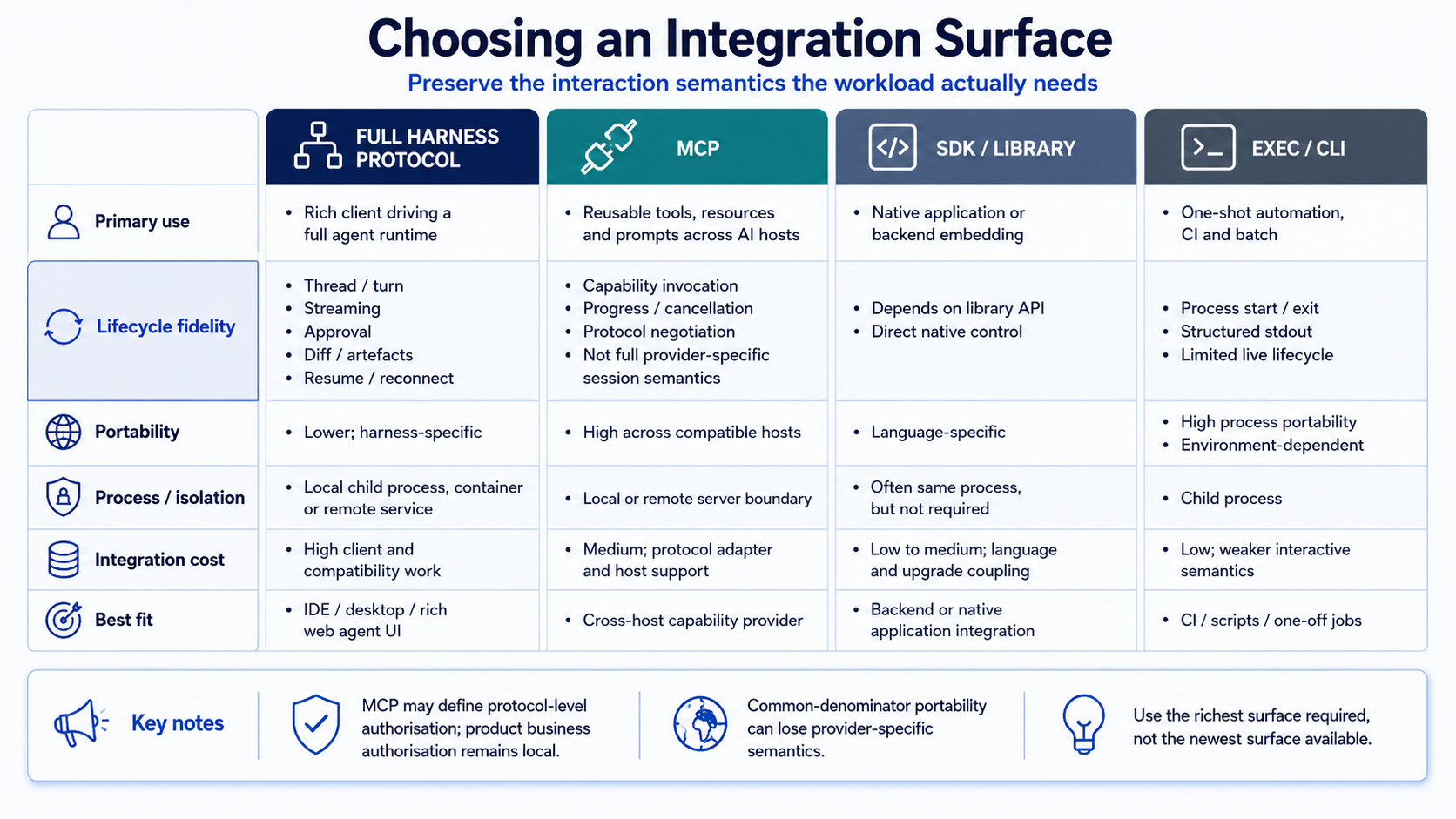
Figure 5-4 | Choose an integration surface according to session lifecycle, streaming, approvals, artefacts, diffs, portability and deployment boundaries.
Full harness protocol or App Server
Use a richer protocol when the client needs:
- a durable thread lifecycle
- bidirectional streaming
- approval requests and responses
- incremental progress
- diffs and artefacts
- pause, resume, fork and archive
- a rich client UI
When OpenAI designed the Codex App Server, the team first experimented with exposing Codex as an MCP server. The VS Code integration needed richer session semantics, diff updates and server-initiated approval flows, so they adopted a bidirectional JSON-RPC surface that mirrors more of the complete agent loop. OpenAI now distinguishes invoking Codex through MCP as a callable tool from using the App Server when the full harness surface is required.5
MCP
MCP is a good fit when:
- the host already has an MCP client
- the capability should be reusable across AI applications
- tools, resources and prompts are sufficient
- full provider-specific session semantics are not required
MCP uses a host, client and server architecture with JSON-RPC messages. It supports capability negotiation, tools, resources, prompts, progress, cancellation and logging.6
That makes it a broad capability protocol, not a universal replacement for every harness lifecycle.
SDK or library
An SDK suits:
- embedding inside an application using the same language
- direct control over local runtime APIs
- avoiding a separate client protocol
The trade-off is tighter coupling across process, language, upgrades and isolation.
Exec or CLI
Exec and CLI modes suit:
- one-shot automation
- CI and batch work
- clear exit codes
- structured standard output
- established authentication and operator workflows
MCP does not make a mature CLI obsolete. When the model already understands the commands, output can be reduced with tools such as jq or grep, and the command set is small, a CLI may remain the lower-cost and more testable surface.
It is less suitable for long-lived bidirectional interaction, detailed approval UI and durable session control.
MCP and A2A: capability integration and agent collaboration
MCP and A2A operate at different interoperability layers.
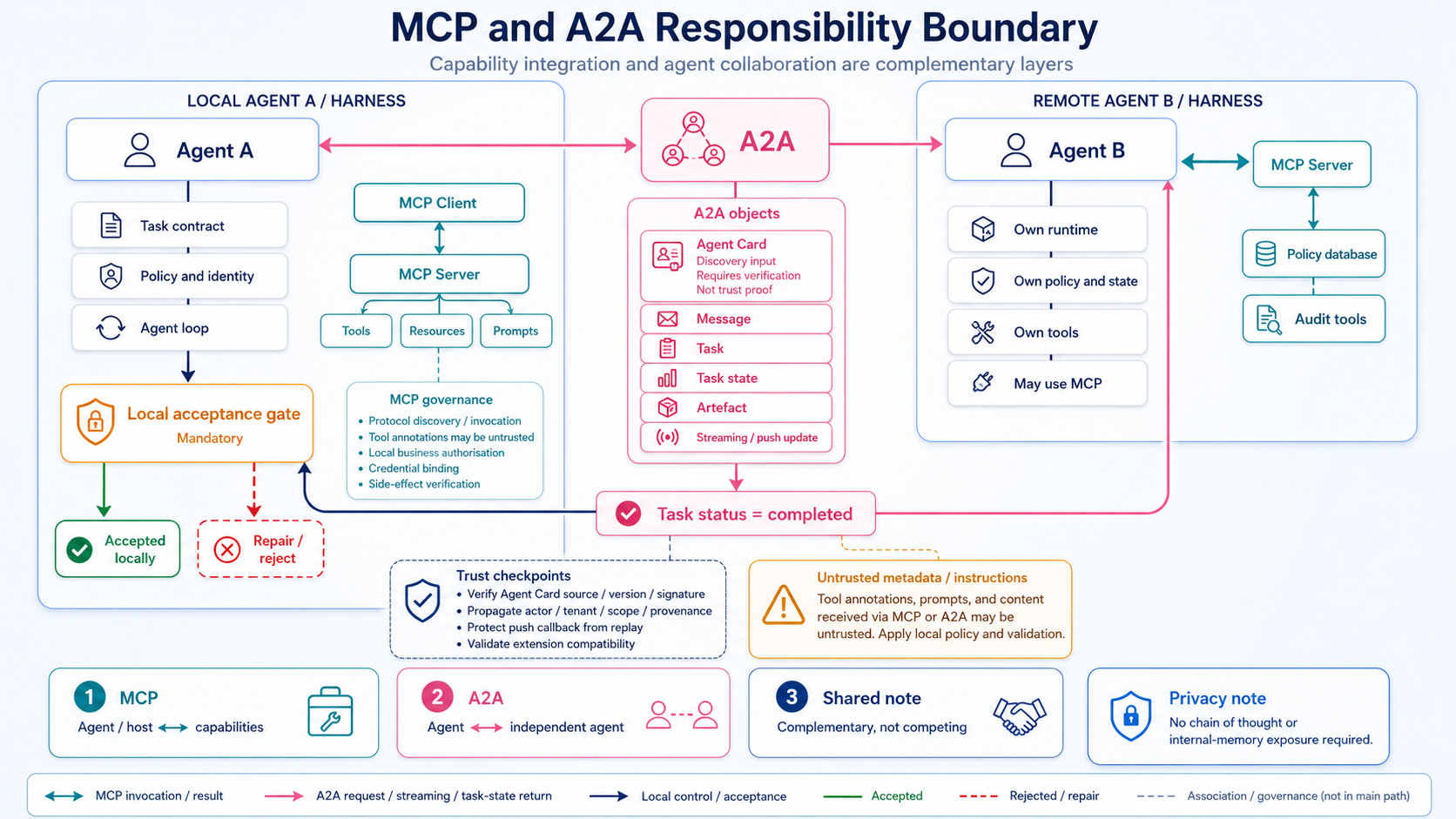
Figure 5-5 | An agent may use MCP for tools, resources and prompts, and A2A for tasks, messages and artefacts with another independent agent. Remote completion still passes through local acceptance.
MCP connects a host to capability providers
The main relationship is:
AI Host
└── MCP Client
 └── MCP Server
 ├── Tools
 ├── Resources
 └── Prompts
The server may wrap a database, SaaS API, filesystem, search service or another capability.
MCP tool descriptions, annotations and resource content are not automatically trustworthy. The host validates source, version and permission boundaries.
A2A connects independent agent systems
A2A 1.0.0 targets independent, potentially opaque agent systems and defines discovery, messages, tasks, artefacts, streaming and long-running interaction. One goal is collaboration without exposing internal state, memory or tool implementations.7
A2A is appropriate when the remote party has:
- its own runtime
- its own task state
- potentially long-running work
- streaming or push updates
- artefact production
- a cross-team, framework or vendor boundary
If the compliance service is only a structured rules check, a tool or service API may be simpler. Wrapping a function as an agent adds task lifecycle, authentication, retry, versioning and remote-trust costs.
They can be composed
Agent A
├── MCP → Billing Tools / Customer Data
└── A2A → Compliance Agent B
 └── MCP → Policy Database / Audit Tools
The official A2A material describes the protocols as complementary: MCP handles tool and resource integration, while A2A handles agent-to-agent coordination.8
However:
- agent discovery is not trust
- an Agent Card needs source, version, signature or endpoint validation
- delegation carries actor, tenant, scope and provenance
- a remote
completedstate does not establish local task acceptance - push callbacks need replay protection and allow-lists
- extensions need compatibility policy
The local harness still applies its own contract, policy and evidence through a local acceptance gate.
Plugins and MCP may be composed
A compact distinction is:
Plugin = a capability package installed into a host
MCP = a standard protocol between a host and external capabilities
A plugin may:
- install an MCP client adapter
- manage an MCP server’s configuration and lifecycle
- provide UI, commands, skills and hooks alongside it
An MCP server may itself be installed by a plugin.
A plugin is often natural when the capability serves one host and needs deep UI or lifecycle integration. MCP becomes attractive when the same service should be reused across IDEs, agents and runtimes.
Do not rewrite the business implementation simply to claim MCP support. Keep the protocol adapter thin and retain the core rules in an independently testable service or library.
Programmatic tool calling moves mechanical data work out of the main context
A conventional tool loop may run a model inference after every call and append each raw response to the transcript.
For large queries, filtering, aggregation and transformation, that pattern increases both latency and context pollution.
Programmatic tool calling lets the model generate controlled code that invokes allowlisted tools inside a sandbox. Only the necessary summary, evidence and errors return to the main context.
Suitable workloads include:
- aggregating many API requests
- analysing CSV, JSON or logs
- filtering large document sets
- deterministic dependencies between tools
- large raw data with a small final set of statistics or citations
Required boundaries include:
- sandboxed generated code
- a tool allowlist
- CPU, memory, network, wall-clock and call budgets
- credentials kept out of generated code
- raw results retained in the isolated environment by default
- tighter controls around side-effecting tools
- traces for generated code, tool calls and outputs
The point is not to grant arbitrary execution power. It is to move programmable mechanical work outside the limited reasoning window.
MCP is not the required starting point
A script does not become reliable because a protocol is placed in front of it.
A healthier maturity path is:
Library
→ Stable CLI / API
→ Machine-readable Output
→ Agent-ready SOP and Safety Rules
→ Structured Service Adapter
→ MCP Server or Host-specific Plugin
→ Optional Third-party Extension Surface
Stabilise the underlying capability first:
- a predictable interface
- explicit error codes
- timeout and cancellation
- separate read and write actions
- defined idempotency
- a run identifier and trace
- observable authentication and human-action state
Then decide whether MCP, a plugin or an SDK is warranted.
Otherwise the result is simply an unreliable script that more agents can call remotely. Portability improves, and the blast radius goes sightseeing.
Evaluate tool quality in layers
A tool being callable proves that transport and parsing work.
Part 10 develops full evaluation. Part 05 needs five layers:
| Layer | Main question |
|---|---|
| Definition | Are name, description, schema, examples and errors understandable? |
| Selection | Does the model choose the right tool and avoid unnecessary calls? |
| Arguments | Are resource, scope, format and permission inputs correct? |
| Execution | Are latency, timeout, rate limiting, idempotency and side effects reliable? |
| Outcome | Did the task complete with sufficient evidence at reasonable cost? |
Model-generated feedback can be a diagnostic candidate. It does not replace ground truth, metrics and adversarial cases.
Walk through the invoice-reminder task
Return to the opening task: find overdue invoices, prepare reminders and send them after approval.
Existing CLI or library
If the billing system already has a stable read-only CLI, keep it:
billing invoices overdue --account <id> --format jsonIt handles the query. It does not send email, and it does not let the model invent the tenant scope.
Skill
An invoice-reminder-skill can describe:
- when the process applies
- overdue-invoice rules
- the recommended query sequence
- accounts that must not be handled automatically
- fields required in each draft
- the step that must wait for approval
- completion evidence
Tools
The harness exposes narrowly bounded tools:
search_overdue_invoices
preview_reminder_drafts
request_batch_approval
send_approved_reminders
send_approved_reminders accepts only an approved batch identifier.
Hook or policy gate
PreToolUse(send_approved_reminders) checks:
- whether the approval token is valid
- whether the batch still has the approved version
- whether recipients remain in scope
- whether the daily send limit has been exceeded
An audit listener records the outcome but does not own allow or deny authority.
Plugin or MCP
If the Gmail integration serves only this host and needs host-specific UI, OAuth configuration and approval screens, a plugin is a natural package.
If several agent runtimes need the same mail capability, keep a shared Mail Service and expose it through a thin MCP server.
A2A
A2A is justified only if compliance review is delegated to another agent with independent state, a task lifecycle and collaborative interaction. If compliance is a bounded structured check, an ordinary tool or service API may be more appropriate.
There is no universal answer, but each responsibility should have an explicit owner.
A practical capability-selection sequence
For a new integration requirement, ask:
- Is this a concrete operation, reusable method, host extension or remote agent?
- Is there already a stable library, service, API or CLI?
- Does the tool have a stable identifier, version, owner, input/output contract and error taxonomy?
- Are model visibility, discovery, per-call authorisation and execution separate?
- Are arguments canonicalised before final policy evaluation?
- Are risk, concurrency, idempotency and approval evaluated per call?
- Is the active capability surface small enough to evaluate for the task?
- Are the catalogue snapshot, handlers, policy metadata, index and caches coherent?
- Are provenance, permissions, authority ceiling and revocation clear for skills, plugins and hooks?
- Does the integration require rich session semantics, or is a callable capability sufficient?
- Is the remote party a capability provider or an agent with its own task lifecycle?
- How are definition, selection, arguments, execution and outcome tested?
If questions two to six remain unanswered, an MCP server is premature. A protocol cannot supply a stable core contract.
Theory to practice: Part 05 checklist
- Tool, skill, plugin, hook, policy gate, MCP, A2A and full harness protocol responsibilities are distinct.
- The registry retains stable identifier, version, owner, input/output, effects, risk, idempotency, concurrency, errors and redaction.
- Discoverability, model visibility, per-call authorisation and execution are separate states.
- Tool requests are parsed, canonicalised and resolved before final authorisation.
- Risk, concurrency and approval are re-evaluated against canonical arguments and resources.
- Results include terminal status, provenance, operation identifier, error taxonomy, bounded payload and artefact reference.
- The capability surface is task-selected and measured for wrong-tool rate, discovery misses, argument validity and payload cost.
- Dynamic catalogues filter discoverability before search, re-authorise calls and use coherent snapshots.
- The official skill format is separated from team package conventions, and skills do not raise runtime permission.
- Plugins declare provenance, compatibility, requested permissions, migration, rollback, disable and revocation.
- Hooks define trigger, authority, ordering, conflicts, timeout, failure policy and re-entrancy.
- Extensions cannot override enterprise denial, tenant boundaries, sandboxes or mandatory approval.
- The chosen full protocol, MCP, SDK or exec surface preserves the lifecycle semantics the workload needs.
- MCP protocol-level authorisation is not confused with product business authorisation.
- A2A remote completion still passes through local contract, policy and acceptance.
- Adapters remain thin; core business logic, authorisation and idempotency are independently testable.
References
Footnotes
-
Model Context Protocol, Tools specification 2025-11-25, accessed 8 July 2026. ↩
-
Anthropic, Building effective agents, 19 December 2024. ↩
-
Anthropic, Effective context engineering for AI agents, 29 September 2025. ↩
-
Agent Skills, Specification, accessed 8 July 2026. ↩
-
OpenAI, Unlocking the Codex harness: how we built the App Server, 4 February 2026. ↩
-
Model Context Protocol, Specification 2025-11-25, accessed 8 July 2026. ↩
-
A2A Protocol, Agent2Agent Protocol Specification 1.0.0, accessed 8 July 2026. ↩
-
A2A Protocol, A2A and MCP: Detailed Comparison, accessed 8 July 2026. ↩