I used to imagine Web3 adoption as something visible.
A user knows they have a wallet. They know which chain they are on. They know what gas is. They understand signatures. They know why points, NFTs, tokens, DAOs, governance and ownership all matter in slightly different ways.
The longer I look at real product adoption, the less convinced I am by that picture.
Mature infrastructure rarely insists on being seen. HTTPS does not ask for applause. CDNs do not turn every image load into an educational moment. Card authorisation, fraud checks, clearing networks, cloud routing and tax logic do their work quietly. Users mostly notice them when they fail.
That is not an argument that Web3 is unimportant. It is almost the opposite.
The more fundamental an infrastructure layer becomes, the less it should demand the user’s attention.
This series uses x402 as the entry point, but this is not an x402 tutorial and it is not a Web3 beginner’s guide. x402 is simply a useful current example: as AI agents, APIs, data services and inference providers begin to need programmable payments, blockchains and stablecoins may become settlement rails behind the task, not the product story users have to stare at.
The question I want to ask is simple:
What if the most successful version of Web3 is the one users do not realise they used?
What this piece does and does not do
This piece is about product judgement. It asks whether Web3 adoption must depend on users consciously understanding Web3.
It will not explain every x402 header or walk through facilitator implementation. It will not go deep on EIP-3009, PAYMENT-SIGNATURE, AP2 or MPP. Those belong in the next two pieces.
The core claim here is:
The next phase of Web3 should not only be about getting users on-chain. It should be about helping users complete tasks while on-chain infrastructure works quietly in the background.
That may sound modest, but it changes how we design Web3 products.
Why x402 is the entry point, not the answer
I am using x402 as the entry point for this series, not because I want to present it as the inevitable winning protocol. That kind of writing too easily turns into the standard Web3 red-carpet narrative: a new standard appears, several large companies support it, a few tokens move, and suddenly the whole future is folded into one protocol.
What interests me more is the problem x402 exposes: when AI agents, APIs, data services, inference providers and MCP tools begin to transact at the level of individual requests, should Web3 stand in front of the user, or should it retreat behind the workflow?
x402 may not be the final answer. It may end up coexisting with AP2, MPP, ACP, ERC-8004, wallet policies, facilitators, marketplaces and enterprise accounting systems inside a much messier agent commerce stack. But it is already a useful mirror for rethinking Web3 adoption.
If Web3 only works when users see it, understand it and change their behaviour for it, its ceiling is low. The version that can grow much larger should sometimes behave more like electricity: not celebrated every minute, but quietly depended on.
Web3 has often asked users to believe the worldview first
A lot of Web3 products are not difficult because the technology is uninteresting. They are difficult because the entrance ritual is heavy.
You want to play a game, first learn wallets. You want to buy a membership, first understand NFTs. You want to use a tool, first learn chains, gas, signatures and tokens. You want to join a community, first accept a story about governance, airdrops and token economics.
Inside the industry this feels natural. We see these primitives as part of the value proposition. To many users it feels like a restaurant asking them to understand kitchen ventilation, cold-chain logistics and accounting before ordering noodles.
Some experiences absolutely need visible Web3. If a user is self-custodying assets, voting in governance, trading, reviewing on-chain records or taking financial risk, hiding the rails can become irresponsible.
But many use cases are not like that.
In travel, content, APIs, data, AI tooling, cross-border settlement, loyalty and partner reconciliation, users usually do not arrive because they want to “use Web3”. They want to complete something: get data, buy a service, redeem a benefit, finish a booking, save time through an agent.
If Web3 becomes too visible in the middle of that task, it starts to feel like a small museum placed between the user and the door.
Why x402 is interesting: it does not begin by educating humans
A simple way to understand x402 is this:
When a client or AI agent requests a paid API, content item or service, the server can respond with HTTP 402 and payment terms. The client can then retry the request with payment proof and receive the resource.
The interesting part is not only that stablecoins are involved. It is not only that the long-reserved HTTP 402 status code gets revived. The more important point is that payment returns to the language of the web request.
Traditional online payment often lives in another room: create an account, add a card, buy credits, open a dashboard, set up an API key, wait for invoices or monthly settlement.
Humans can tolerate that, even if they dislike it. AI agents cannot really operate that way. An agent can call APIs, compare sources, generate code and orchestrate workflows. Yet once it hits a paid data source, it becomes a child at a counter with no wallet.
x402 tries to remove that break.
If an agent has been authorised, has a budget, has wallet access and is constrained by policy, it can pay for an API call, a dataset, an inference, a crawl or a tool during the task. The user does not need to know how Base, USDC, gas or a facilitator cooperate. The user notices only that the agent did not stop halfway and ask them to register somewhere and enter a card number.
That is the flavour of invisible Web3.
Not Web3 shouting louder, but the task continuing without the usual interruption.
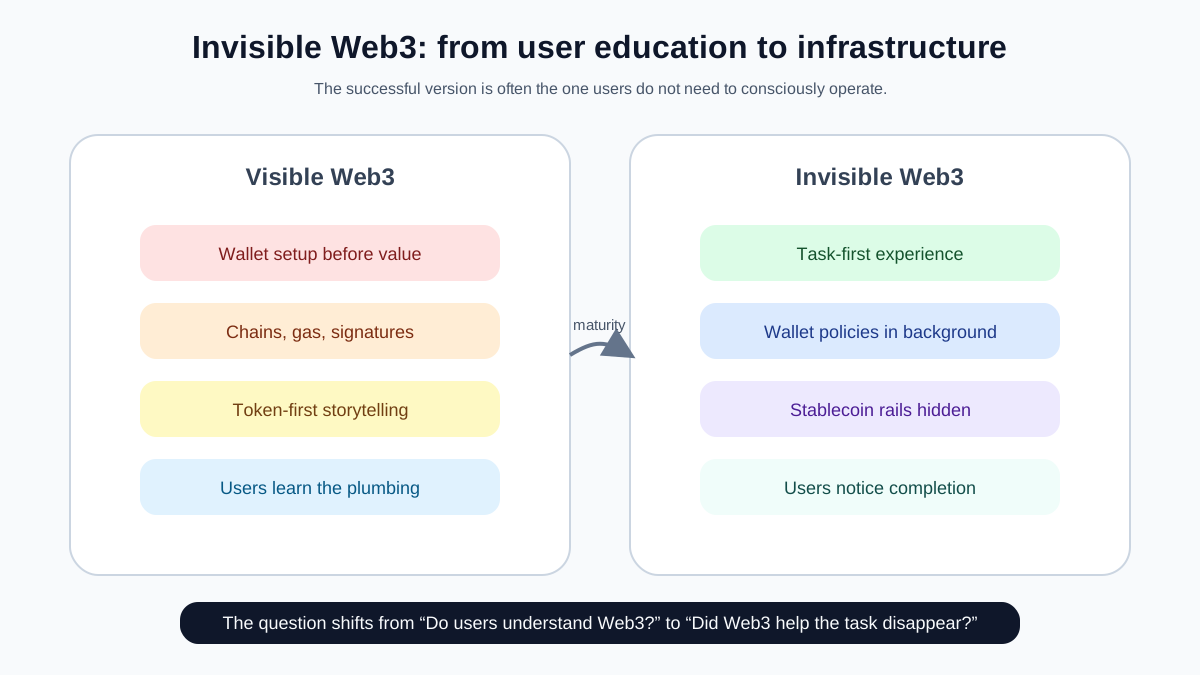
The best infrastructure often becomes boring
We do not celebrate a website for using TLS. We do not screenshot an image because it came through a CDN. We do not describe every card transaction as a complex dance between authorisation, risk, clearing, issuing and acquiring systems.
Those systems matter. They just become normal when they work.
Web3 has long carried a contradiction. It wants to become foundational infrastructure, yet many products push the underlying concepts to the front of the interface. The result can feel like a car with a transparent bonnet: impressive engineering, but the passenger only wanted to get to the airport.
I am not saying Web3 should always be hidden. I am also not saying wallets and chain data should disappear from every interface.
I am saying that for task-oriented products and AI agent workflows, the success metric should not be how many Web3 terms users learn. Better questions are:
- Did the task complete faster?
- Did cross-service payment lose friction?
- Can APIs, data and compute be purchased at a more granular level?
- Is the user clearly authorised and protected?
- Does the service provider receive revenue that can be reconciled?
- Are risks designed, rather than merely hidden?
Those questions are closer to product reality than “did the user know which chain they touched?”
Web3 is not disappearing. It is moving from brand to capability
I increasingly think of Web3 in two modes.
The first is Web3 as identity. It is a brand, a culture and a worldview. Users know they are in Web3. They know they hold tokens, participate in governance and leave records on-chain.
The second is Web3 as capability. It may not be visible, but it gives the product capabilities: programmable payments, open settlement, portable assets, cross-platform benefits, transparent records, verifiable authorisation and non-platform-specific reconciliation.
In recent years Web3 as identity has been loud and good at creating attention. The version that enters mainstream products may more often be Web3 as capability.
x402 belongs to the second category.
It does not need ordinary users to say “I am using x402”. It gives APIs, data services, AI agents and content platforms a standard way to express:
This resource costs this amount.
These payment methods are acceptable.
This is how you prove payment.
This is how the resource is delivered after payment.
That is not as glamorous as a token launch. It is closer to what infrastructure is supposed to feel like.
Inclusive Web3 does not mean everyone must become a Web3 person
I dislike the exclusionary tone that sometimes appears in Web3 narratives.
As if not understanding wallets means you are not free enough. As if not using a chain means you are not future-facing enough. As if using cards and Web2 accounts means you have not been enlightened yet.
That tone turns technology into a badge.
The Web3 I find more interesting is inclusive. It does not force every user to adopt a new language before entering. It gives different levels of visibility to different users:
- Expert users can inspect on-chain proof, control wallets and set policies.
- Ordinary users can see task results, spending history and permission prompts.
- Enterprises can get reconciliation, auditability, compliance and risk controls.
- AI agents can pay and obtain services within authorised boundaries.
- Developers can turn endpoints, datasets, models and tools into resources that can be bought programmatically.
That does not dilute Web3. It stops Web3 from serving only people who already understand it.
A truly inclusive technology does not require an ideology test at the door.
Invisible does not mean irresponsible
This is where the brakes matter.
Invisible Web3 should not mean hiding everything and hoping users never ask. That would be dangerous.
An AI agent can spend money without the user knowing which chain settled the payment, but the user must still know what they authorised. A user does not need to understand facilitators, but the product still needs records, error handling and dispute paths. A user does not need to understand stablecoin settlement, but the business still needs finance, tax, treasury, risk and reconciliation.
The worst version hides complexity and hides responsibility with it. The best version hides unnecessary complexity while making control, permission, records and risk boundaries clear.
One is stage magic. The other is infrastructure design.
When should Web3 not be invisible?
Not every context should hide the rails.
If the core value of the product is asset sovereignty, on-chain governance, verifiable ownership, financial risk, DAO participation or high-value transaction control, users should know what they are doing. In those cases, over-hiding Web3 is not friendly. It is careless.
My rule is not “always make Web3 invisible”. It is this:
When users need to make risk decisions, Web3 should be visible.
When users only need to complete a low-risk task, Web3 can move into the background.
That rule is more useful than arguing whether visibility is always good or always bad.
For AI agent products, Web3 looks like economic muscle
AI agents do not only need to answer questions or call tools. Once they become workflow systems, they run into economic coordination.
They need to buy data, inference, crawling, browser sessions, API calls and specialised services. They need to compare suppliers by price, quality, latency and trust.
These are not chat problems. They are economic coordination problems.
If an agent must ask a human to fill in a card, buy credits or create an account every time it hits a paid service, the automation keeps collapsing into a checkout queue. In that context, stablecoins, wallet policies, HTTP-native payments, x402, AP2 and MPP matter not because they are Web3, but because they may let agents develop controlled economic behaviour.
I think of Web3 here not as the skin of AI, but as its economic muscle.
Muscle does not need to be displayed all day. Without it, the agent can do a lot of gesturing but very little real moving.
My working conclusion
Web3 has often tried to become the front door. The bigger opportunity may be to become the corridor.
What makes x402 worth watching is not simply that people may use stablecoins, or that HTTP 402 is being revived. Those are surface details.
The deeper shift is this: as AI agents, APIs, data services and content platforms begin to transact at the level of individual requests, Web3 may move from an asset narrative into a workflow capability.
If it works, the user will not say:
I just used an on-chain stablecoin payment protocol.
They will say:
The agent did not get stuck this time. It found the data, paid a tiny amount, got the result and finished the task.
That may be what mature Web3 looks like.
Not gone. Just in the right place.
Next in the series
The next piece moves closer to x402 itself. My claim is:
x402 is not Stripe for AI agents. It is closer to a paid request grammar.
That phrasing is less flashy, but more accurate. Stripe is a full commercial system. x402 standardises a payment handshake between client and server. Understanding that boundary prevents us from mistaking “payment works” for “commerce is solved”.
References are in resource/references.md.
Image specifications are in resource/image-asset-plan.md.