The first two essays argued that mature Web3 may not need to remain visible all the time.
Now comes the other half.
If Web3 moves into the background, its risks may move into the background too. If an AI agent is quietly using stablecoins to buy data, call APIs, purchase inference or rent browser sessions, the user may not see chains, gas, facilitators, metadata, request binding, payment retries or settlement failures.
That is both the promise and the danger.
The promise is smoother experience. The danger is quieter risk.
I think the design question for Invisible Web3 is not “how do we make users know nothing?” It is:
How do we make sure users do not have to understand the underlying technology, while still being clearly authorised, protected and accounted for?
This is not an argument against x402. It is the opposite. x402 is worth writing about because it pushes a new product problem into view: once an HTTP request carries money, an API is no longer just an API. It becomes a small commercial contract.
Commercial contracts do not only need payment. They need control.
First, split the risk: four invisible responsibility layers
The second essay placed x402, AP2, MPP, ACP and ERC-8004 on the same agent commerce map. This piece turns that map into a governance problem.
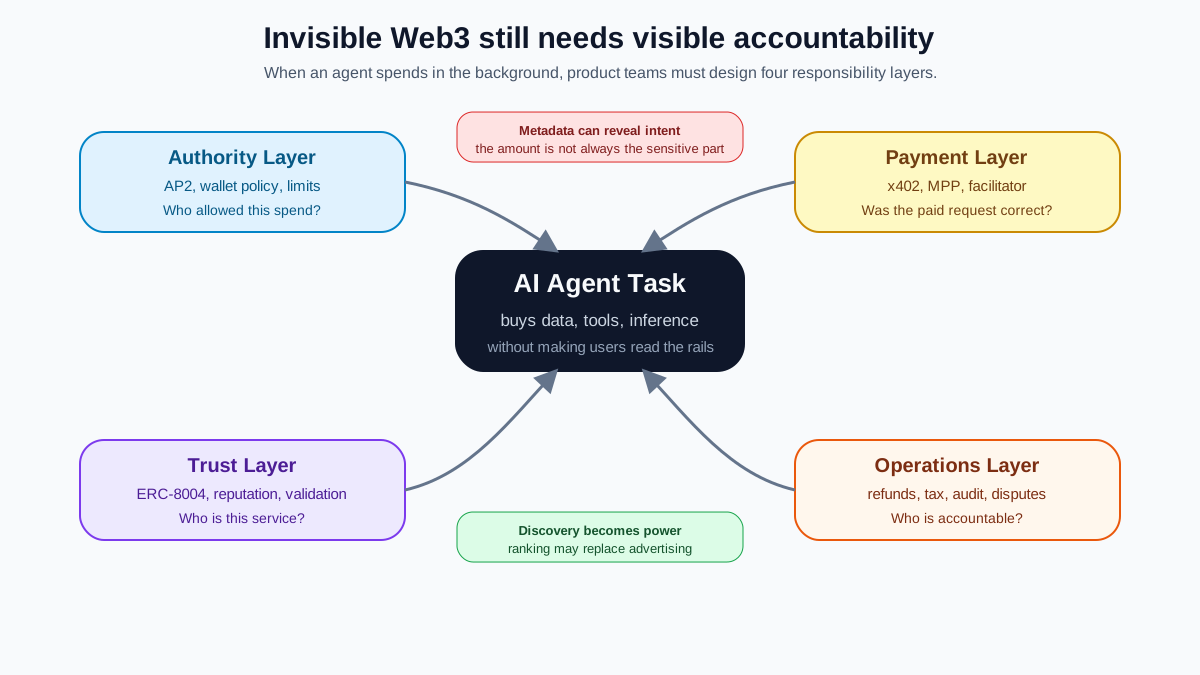
I would split the risks of Invisible Web3 into four layers:
| Risk layer | Core question | Possible mechanisms |
|---|---|---|
| Authority | Is the agent allowed to spend this money, and within what scope? | AP2, wallet policy, spending limits, approval boundaries |
| Payment | Are payment requirements, proofs, settlement and retries correct? | x402, MPP, facilitators, idempotency, request binding |
| Trust | Who is the service provider, how has it performed, and can the result be validated? | ERC-8004, reputation, validation, service registries |
| Operations | How do refunds, tax, reconciliation, disputes and compliance work? | product ops, accounting, compliance, audit trails |
This table matters because it separates the word “invisible” into actual responsibilities. x402 can make payment less visible, but authority, trust, fulfilment and operations cannot disappear into the fog with it.
In other words, Invisible Web3 cannot be only about invisible payment. It also needs visible accountability.
Users do not need to see every chain. The product still has to make responsibility visible.
What this piece does and does not do
The first essay covered the product philosophy of Invisible Web3. The second positioned x402 as paid request grammar, not Stripe for AI agents.
This final piece addresses the governance layer. If Web3 and payment move behind agent workflows, how should product teams design risk controls?
This is not a security checklist. It is a product governance framework. It asks:
- What should an AI agent be allowed to spend?
- Could facilitators become new intermediaries?
- Can payment metadata leak user intent?
- Could discovery become the next advertising layer?
- Does successful payment mean the service was fulfilled?
- If everything is seamless, what control does the user retain?
Invisible does not mean ungoverned
The version of Invisible Web3 I fear most is the one where everything is hidden and called good UX.
That is not good UX. That is risk swept under a carpet.
Good invisible infrastructure should look more like this:
Users do not need to understand every chain, but they need to know what they authorised. Users do not need to see gas, but they need budgets and limits. Users do not need to manage facilitators, but they need payment records and error handling. Users do not need to read HTTP headers, but the product must handle replay, double charging and request binding. Users do not need to see metadata, but the system must avoid sending sensitive task context everywhere.
Invisible does not mean ungoverned. It means governance must enter product design earlier, not later.
Control point one: the wallet firewall
AI agents spending money sounds exciting. The more important question is whether they can be prevented from spending the wrong money.
I call this layer the Wallet Firewall.
It is not merely a wallet interface. It is an agent spending policy. It may include:
- per-transaction limits
- daily limits
- per-task limits
- per-provider limits
- API allowlists and blocklists
- human approval for high-risk spend
- price anomaly detection
- duplicate payment detection
- prompt injection protection
- spending logs and audit trails
- session keys and scoped delegation
- automatic revocation after task completion
Without this layer, x402’s smoothness becomes dangerous.
Traditional checkout friction has one accidental benefit: every payment forces a human pause. Agent payment removes that pause, so product teams must replace human hesitation with policy boundaries.
My test for an agent wallet is simple:
Do not ask only whether it can pay. Ask whether it can refuse to pay.
Refusal is where governance begins.
Control point two: the facilitator paradox
x402 narratives often talk about removing traditional payment gateways. That direction is valid, but it creates a paradox:
When you remove the traditional payment processor, you may grow a new facilitator processor.
Facilitators are useful. They can verify payment payloads, handle on-chain interactions, confirm settlement and abstract network or token differences. They allow ordinary SaaS teams to add paid endpoints without becoming blockchain infrastructure teams.
But once facilitators handle significant transaction flow, they are no longer background extras.
They may influence which payments are verified, which payments are rejected, which chains are supported, which tokens are supported, how gas or settlement costs are passed on, what payment metadata is visible, what compliance checks are applied, which merchants are onboarded, how routing works and what happens when payments fail.
That is power.
x402 may not eliminate intermediaries. It may move intermediation from card networks and payment gateways into facilitators, wallet providers and agent marketplaces.
That is not automatically bad. Large-scale payment systems always need operational layers. The problem is pretending they are not there.
If a facilitator is a key trust component, we should ask:
- Are there multiple substitutable facilitators?
- Is metadata minimised?
- Is self-hosting possible?
- Are failure modes explicit?
- Are audit logs available?
- Are fees transparent?
- Are compliance responsibilities clear?
Disintermediation should not mean no intermediaries. It should mean intermediaries can be replaced, audited and constrained.
Control point three: metadata may be more sensitive than money
When people think about x402 risk, they often think about money first. Will the agent overspend? Will funds be stolen? Will the transaction fail?
Those are real concerns.
But the quieter risk is metadata.
When an agent pays during a task, the payment request or surrounding control plane may include resource URLs, descriptions, reason strings, task context, user intent, internal project names, customer data, research topics, medical, legal, financial or travel preferences, company intelligence or private plans.
A wallet address and amount may reveal “how much was spent”. Metadata may reveal “why it was spent”.
That difference is enormous.
If an agent buys medical information, legal summaries, competitor prices, investment research or private travel services, payment metadata can be more sensitive than the on-chain transaction itself. Worse, this information may not only be written to a chain. It may pass through servers, facilitators, log pipelines, monitoring tools, analytics systems or third-party services.
So privacy design for Invisible Web3 cannot stop at “is the chain anonymous?” It must ask:
What did the payment control plane see before and after settlement?
That becomes a crucial security layer for agent payments.
Control point four: discovery may be the next advertising layer
If x402 lets agents pay, the next question is not whether they can pay. It is who they pay.
That leads to discovery.
In the human web, advertising buys attention. Search rankings, recommendations, sponsored listings and app store rankings are all commercial battlefields.
In the agent web, advertising does not disappear. It changes shape.
An AI agent may not be persuaded by banner ads. But it may be influenced by tool marketplace ranking, API registry ordering, provider reputation scores, default facilitators, sponsored endpoints, preferred partners, recommended data sources, default services inside agent SDKs, benchmarks and ratings.
That is why I do not buy the easy claim that AI agents will kill advertising.
A more likely outcome is that advertising moves from the human attention market into the agent decision market.
The powerful actor may not be the one who lets the agent pay. It may be the one who helps the agent see, trust and prioritise a provider.
Discovery becomes platform power.
Without this layer, x402 may open payment while discovery closes the market again.
Control point five: trust cannot come only from payment
If x402 solves paid requests, ERC-8004 asks a different question: why should agents and services trust each other at all?
Payment alone cannot answer that.
A service can receive payment correctly and still be low-quality. An agent can pay successfully and still be malicious, abusive or not properly authorised by a user. An API can return data while its source, freshness, accuracy and fulfilment history remain opaque.
That is why ERC-8004 belongs in this discussion. It points towards agent discovery, reputation and validation: who can be found, how they have performed, and whether the result can be verified.
It is not a replacement for x402. It is more like a neighbour.
x402 lets a request pay. ERC-8004 helps an agent or service become discoverable, assessable and verifiable.
If agents are going to buy data, models, tools and services autonomously, payment grammar only solves half the problem. The other half is trust grammar.
Without a trust layer, agent payments may become a fast payment mechanism connected to services whose quality is unknown, ranking is opaque and fulfilment is hard to verify.
That is not a machine economy. That is automated stepping on rakes.
Control point six: payment success is not fulfilment success
This is where x402 can be over-read.
Payment success does not mean the service was completed. Service completion does not mean the result had value. A valuable result does not mean the user understood why the payment happened.
For simple APIs, this is manageable. Pay 0.01 USDC for weather data, receive weather data, done.
Agent commerce quickly reaches fuzzier transactions: a research report, generated code, cleaned data, a travel recommendation, an investment risk summary, supplier comparison or multi-agent collaboration.
These are not necessarily fulfilled just because a JSON response arrives.
x402 solves the payment handshake. It does not guarantee fulfilment.
Moving forward, this may require receipts, result hashes, quality scores, reputation registries, third-party validation, dispute resolution, escrow or delayed settlement, atomic service channels, SLA-aware pricing and human review for high-value work.
I suspect this becomes the real battleground for agent payments.
Not who can make agents pay. Who can prove the paid work was actually done.
Control point seven: accounting, tax and refunds are product, not admin dust
Technical articles often leave accounting, tax and refunds to the end, as if they are dust swept up after the interesting work.
In real products, they are adoption gates.
Especially in companies.
If a business allows agents to buy APIs, data, inference, crawling and browser sessions, it will need transaction records, cost attribution by task or project, downloadable receipts, monthly reconciliation, tax classification, supplier lists, abnormal spend alerts, refunds, credit notes, internal approval trails and finance system integrations.
These are not glamorous, but they determine whether a product can enter a company.
Web3 products often underestimate this because on-chain transparency creates the illusion that “we have a transaction hash, so we have accounting”. A transaction hash is not an accounting answer. It is a raw event.
The real questions are:
What is this spend in the company’s books? Who approved it? What was purchased? For which task? Is it tax-deductible? Is it auditable? Who is the supplier? Who fixes it if something breaks?
If Invisible Web3 wants to enter mainstream workflows, these cannot be “later” problems.
They are the product.
The Agent Payment Control Plane
To connect all of this, I would describe the required product layer as the:
Agent Payment Control Plane
It is not necessarily one product. It is a set of product responsibilities:
| Control surface | Question it must answer |
|---|---|
| Authority | Who authorised the agent to spend, and within what scope? |
| Budget | What are the per-transaction, daily, task and provider limits? |
| Discovery | Which services does the agent see, and can ranking be trusted? |
| Trust | Who is the provider, and how are reputation, fulfilment and validation checked? |
| Payment | How does the request quote, pay, verify and deliver? |
| Metadata | Does payment context leak sensitive information? |
| Fulfilment | Was the service actually completed and how is quality verified? |
| Recovery | How do retries, refunds and compensation work? |
| Accounting | How are transactions reconciled, classified, audited and reported? |
| Compliance | Which transactions need identity, sanctions, tax or regulatory checks? |
x402 fits naturally in the Payment row. If the other rows are missing, agent payment is still immature.
That is why I keep resisting the idea of x402 as the whole answer. It is an important block, not the entire building.
Closing: invisible things need more design, not less
I still believe the claim from the first essay:
The most successful Web3 may be the one users never notice.
But after this third piece, I would complete it like this:
The most successful Web3 may be the one users do not need to notice, while still clearly knowing what they authorised, how much was spent, what was bought and who is responsible if it fails.
That is maturity.
x402 gives HTTP requests a way to carry money. That matters. It may help AI agents, APIs, data, inference, tools and content enter a new programmable commercial relationship.
But once a request carries money, it is no longer just a request. It is a quote, an authorisation, a payment, a fulfilment claim, a record and a responsibility.
The endpoint of Invisible Web3 is not hiding all of that.
It is moving the technical rails into the background while bringing product responsibility to the front.
Then users do not need to become Web3 experts, and they do not become passengers in a vehicle whose risks they cannot see.
That is the version I currently believe in most:
Web3 can be invisible. Control cannot.
References are in resource/references.md.
Image specifications are in resource/image-asset-plan.md.