I do not particularly like the phrase “x402 is Stripe for AI agents”.
It is useful. It travels well. It also loses precision in exactly the place where precision matters.
Stripe is not merely payment. Stripe is merchant onboarding, payment methods, fraud controls, refunds, disputes, dashboards, reconciliation, acquiring, compliance, tax logic, global payouts and payment operations.
x402 is not that.
A better way to understand x402 is as a paid request grammar. It gives an HTTP request a way to say more than “I want this resource”. It lets the exchange carry a few extra statements:
This resource costs this amount.
These payment methods are acceptable.
This is how you prove willingness to pay.
This is how the payment gets verified.
This is how the resource is delivered after payment.
That difference matters. If we call x402 “Stripe for AI agents”, people may assume that once the payment protocol works, agent commerce works. Anyone who has built products knows payment is only one node in a larger commercial workflow. Around it sit authority, discovery, risk, fulfilment, refunds, accounting, audit, compliance and support.
This essay is about drawing that boundary carefully.
What this piece does and does not do
The previous essay argued for Invisible Web3: mature Web3 may not require users to see chains, wallets and gas every day.
This one goes one layer deeper: what responsibility does x402 actually carry?
This is not an installation guide. I will not show how to add middleware to Next.js, Express or Cloudflare Workers. The point here is architectural language:
x402 standardises the grammar of a paid request. It does not standardise a payment company, a full commerce stack or a complete trust system.
That distinction is what lets us evaluate where x402 belongs and where the story becomes inflated.
First, what is x402?
x402 is an open payment protocol that embeds payment into the HTTP request / response lifecycle.
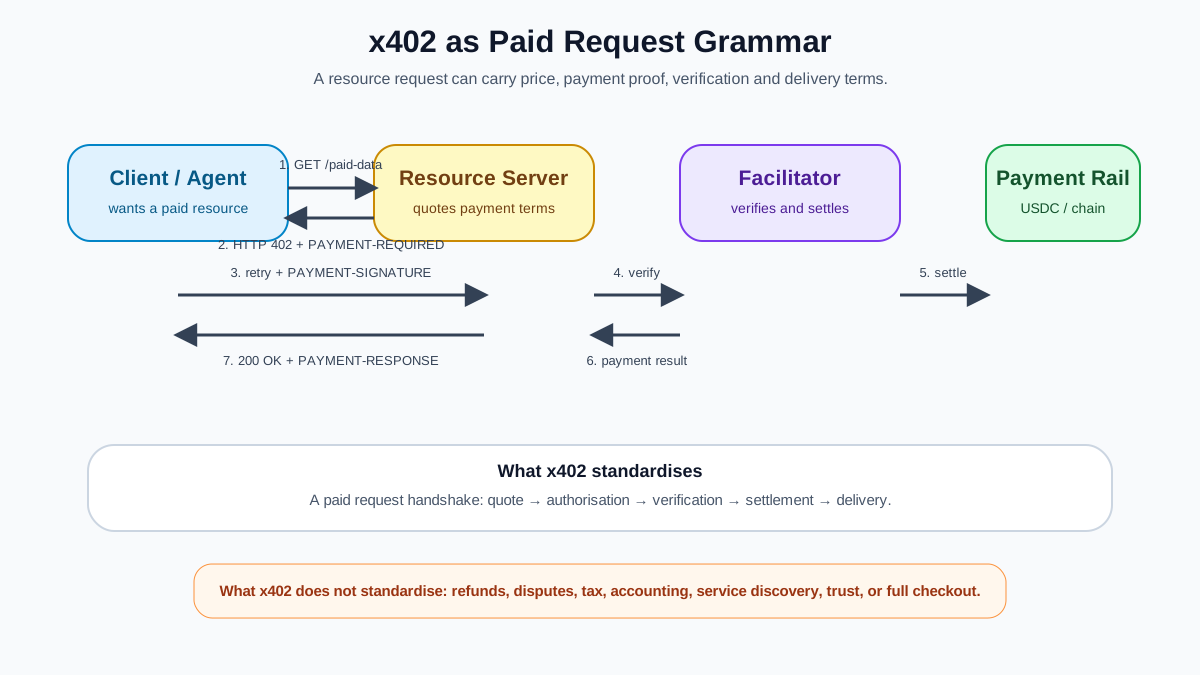
The minimal flow looks like this:
- A client or AI agent requests a paid resource from a server.
- The server replies with
HTTP 402 Payment Required, including machine-readable payment terms such as price, asset, network, recipient address and sometimes a facilitator endpoint. - The client parses those terms and signs a payment authorisation or payment payload with a wallet.
- The client retries the request with payment proof attached.
- The server or facilitator verifies that the payment matches the terms.
- The server returns
200 OK, delivers the original resource and includes a payment response or receipt.
So x402 is not a new coin, a new chain, or a complete checkout product. It is a common syntax for saying: this request costs money, and here is how you prove you paid.
I think of it as a paid request sentence in the language of HTTP.
Before x402, a request usually said:
Give me this data.
With x402, it can say:
Give me this data; if payment is required, tell me the terms; I will pay in a verifiable way; once you have verified it, return the resource.
This is not a beginner’s guide to Web3. It is a shared base layer for readers who already understand APIs, agent workflows and crypto rails: the point of x402 is not simply “paying with stablecoins”. The point is that the request itself starts carrying commercial meaning.
The minimal mental model: a request becomes a commercial action
A normal HTTP request often looks like this:
client says: “I want /premium-data.”
server replies: “200 OK, here is the data.”
Or: “401 / 403, you are not authorised.”
Or: “404, not found.”
x402 revives another answer:
server replies: “402 Payment Required. This resource requires payment, and here are the terms.”
The client can then parse those machine-readable payment terms, sign a payment payload and retry the request. The server or a facilitator verifies the payment and returns the resource.
The important thing is not merely the status code. It is the change in the nature of the request.
It is no longer just a technical request. It becomes a small commercial action.
That action contains at least five parts:
- Quote: the server prices a resource.
- Intent: the client indicates willingness to pay.
- Proof: the client includes payment proof or authorisation.
- Verification: the server or facilitator checks the payment terms.
- Fulfilment: the server delivers the resource.
That is why I call it paid request grammar.
Not because the phrase is stylish, but because it is more accurate than “payment tool”.
What does x402 actually standardise?
Many summaries say x402 lets AI agents pay with stablecoins. That is true, but thin.
More precisely, x402 standardises:
- how a server declares that an endpoint requires payment
- how a client understands the payment terms
- how a client attaches payment proof or authorisation
- how a server verifies payment
- how a server delivers the resource after success
- how these signals move through HTTP headers and response flows
In other words, it brings payment back into the request lifecycle.
That matters for APIs, data providers and AI inference services because they are already consumed through requests. If payment can speak the same language, the user or agent does not have to fall out of the flow into accounts, subscriptions, invoices and prepaid credit packages.
But the crucial limitation is this:
x402 standardises the payment handshake, not the whole commercial relationship.
It does not automatically solve identity, KYC / KYB, refunds, disputes, tax documents, accounting treatment, invoices, service-level agreements, delivery quality, rankings, agent authority or enterprise procurement.
So if someone says x402 is important, I agree. If they say x402 alone is the complete answer to AI commerce, I do not.
Why this matters for AI agents
AI agents do not work like humans.
Humans can tolerate a surprising amount of commercial nonsense: create an account, verify an email, add a card, buy credits, upgrade a plan manually, download an invoice, check usage in a dashboard.
AI agents are a poor fit for that workflow.
If an agent is completing research, trading monitoring, travel planning, data analysis, code generation or supplier comparison, it may need to call many external services during one task. If every service first demands account setup, contract negotiation or prepaid credits, the workflow becomes a row of counters where the agent keeps getting stuck.
The x402 idea is to turn services into resources that can be bought at the moment of use. The agent does not need a long-standing relationship with every API provider. It needs to read the price, confirm the supported asset and network, check the budget, sign the payment and receive the result.
That could turn some services from subscription products into machine-purchasable capabilities.
This is the part I find genuinely interesting. x402 is not giving a credit card to AI. It is turning APIs, data, model inference, scraping, research tools and MCP tools into capabilities that can be procured by software at runtime.
Comparison: traditional payments, x402, Google AP2 and Stripe MPP
x402 should not be understood in isolation. Agent payment protocols are multiplying, and the easiest mistake is to throw all of them into one basket labelled “AI can pay”.
I prefer to ask: which layer of the problem does each one actually address?
| Dimension | Traditional payment flow | x402 | Google AP2 | Stripe MPP |
|---|---|---|---|---|
| Core problem | How humans complete payments | How an HTTP request carries payment terms and proof | Whether an agent is authorised to pay on behalf of a user | How agents and services coordinate payments programmatically |
| Typical scene | Checkout, subscriptions, card payments, invoices, enterprise procurement | Paid APIs, data, content, MCP tools, one-off resource requests | Agent shopping, cross-platform commerce, transactions requiring clear user authority | High-frequency machine payments, microtransactions, recurring payments, session-based service access |
| Payment grammar | Forms, checkout pages, payment gateways, contracts and invoices | HTTP 402 + payment requirements + retry with payment authorisation | Mandates / user intent / delegated authority | HTTP 402-like flow + programmable payment coordination |
| Best suited for | Human users, merchants, SaaS teams, finance departments | APIs, data providers, agents, backend services, tool providers | Agent commerce that needs verifiable user intent | Workflows that need richer payment coordination, continuous payment or recurring interactions |
| Strength | Mature compliance, refunds, consumer protection and accounting workflows | Lightweight, HTTP-native, strong fit for paid resource requests | Clarifies who authorised the agent to spend | Closer to a production payment rail for broader machine-payment coordination |
| What it does not solve | Machine-speed, high-frequency, low-value requests | Authority, trust, refunds, accounting, fulfilment | The underlying payment rail for every resource request | Discovery, reputation or validation of services |
| My shorthand | The old backbone of human commerce | Paid Request Grammar | Agent Authorization Layer | Machine Payment Coordination Layer |
This table is not about declaring a winner. The more useful interpretation is that these protocols may occupy different layers.
x402 is strong at describing how one HTTP request gets paid. AP2 is closer to the question of whether an agent has verifiable user intent and delegated authority. MPP is closer to machine payment coordination, especially for higher-frequency, continuous, recurring or session-based payment scenarios.
In one sentence:
x402 answers how the request pays. AP2 answers why the agent is allowed to pay. MPP answers how longer or higher-frequency machine interactions coordinate payment.
Traditional payment flows do not disappear. They remain sensible for human checkout, larger transactions, heavy refund needs, regulated sectors and complex enterprise workflows. The real question is not “who replaces whom”. It is: which commercial actions no longer need to be squeezed into a human checkout mould?
Where does ACP fit?
There is also the Agentic Commerce Protocol, or ACP, from OpenAI and Stripe.
I would not put it in the main table because ACP sits closer to the interaction model between buyers, AI agents and businesses completing purchases, especially in e-commerce settings involving catalogues, checkout and merchant relationships.
That is not the same layer as x402’s paid request grammar. x402 may be a better fit for API calls, data access and tool usage. ACP is closer to AI-mediated shopping, product discovery and merchant transactions.
If you are building “an AI helps a user buy a product”, ACP and AP2 become very relevant. If you are building “an agent pays per API call, per dataset, per inference, or per MCP tool”, x402 or MPP will usually appear earlier in the architecture.
This is why I avoid the “Stripe for AI agents” line. The agent commerce map is splitting into layers, and neat metaphors tend to flatten the very thing we need to see.
x402 is not the agent commerce stack
Real agent commerce needs more than payment.
Suppose an AI agent is preparing an investment research brief. It wants to buy three external services: on-chain analytics, market data and a deep research model. It may also need a browser session or scraping tool.
x402 can handle how this specific API request gets paid. But the full workflow asks more questions:
- How does the agent discover which services are available?
- How does it compare price and quality?
- Who authorised it to buy these services?
- What happens if the spend exceeds budget?
- What if the paid data is wrong?
- What if the service fails to deliver?
- Which transactions need human confirmation?
- How are invoices and accounting handled?
- Does payment metadata leak user intent?
- Are service rankings polluted by sponsorship?
Those are not problems x402 solves by itself.
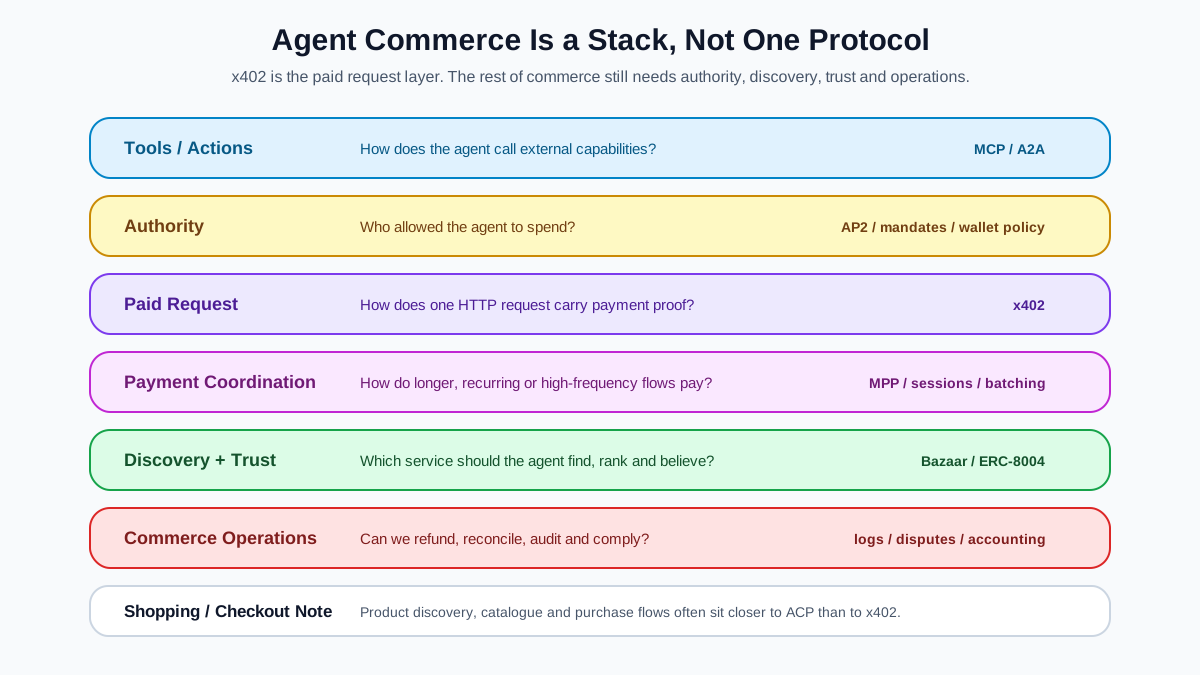
A fuller map looks more like this:
- MCP / tools: how an agent calls external tools
- A2A / agent communication: how agents talk to each other
- AP2 / mandates: who authorised an agent to pay
- x402: how an HTTP request executes programmable payment
- MPP / session payment: how high-frequency or session-based payments are coordinated
- ACP / checkout interaction: how agents, buyers and businesses complete product purchases
- ERC-8004: how agents and services are discovered, evaluated and validated
- wallet policy: what an agent may buy, how much it may spend, and when human approval is required
- discovery / marketplace: which services the agent can see, and how they are ranked
- accounting / compliance: reconciliation, tax, audit and dispute handling
This is not a map a single protocol can swallow. It is a stack.
ERC-8004: beyond payment, agents need a trust grammar
x402 can tell an agent: this endpoint costs this much, here is how to pay, and here is how payment will be verified.
It does not answer a different question:
Who is this agent or service? How has it behaved before? Can anyone verify that it completed the task?
That is why ERC-8004 belongs in the same conversation.
ERC-8004, titled Trustless Agents, is concerned with discovery, reputation and validation in agent economies. The idea is to let agents discover each other, build reputational signals and verify outcomes across organisational boundaries, rather than beginning every interaction with a blank trust slate.
I would split the layers this way:
| Layer | Question | Possible protocols / mechanisms |
|---|---|---|
| Payment | How does this request get paid? | x402 / MPP |
| Authority | Who allowed the agent to spend? | AP2 / mandates / wallet policy |
| Discovery | Where does the agent find services? | Bazaar / marketplace / registry |
| Trust | How has this service behaved before? | ERC-8004 reputation |
| Validation | Was the task actually completed? | ERC-8004 validation / receipts / external verifiers |
So x402 and ERC-8004 are not substitutes. They are two different grammars:
x402 is a payment grammar.
ERC-8004 is a trust grammar.
Real agent commerce needs both, not one pretending to be the other.
This is why ERC-8004 belongs in this piece. If we only discuss x402, we end up drawing the cash register without drawing the shop, shelves, cameras, customer service, reviews or warehouse.
Paid MCP tools may be one of the earliest real use cases
The more I look at x402, the less convinced I am that its first meaningful PMF will be ordinary consumers buying articles with stablecoins.
It may arrive earlier at the moment an agent calls a tool.
The reason is simple: an MCP tool call is already a machine-readable action. If a tool call can be wrapped with pricing, payment requirements and a receipt, the tool becomes more than a tool. It becomes a service that an agent can procure at runtime.
Cloudflare’s agentic payments documentation already places x402 in the context of the Agents SDK and MCP servers, including paid tools. That is a good sign. Agents do not need payment most when they are casually browsing. They need payment when a task requires an external capability.
Examples:
- scraping a paid data source
- calling a high-quality search or enrichment tool
- buying a blockchain risk report
- accessing a specialised model
- paying another agent for a subtask
- renting a browser rendering session
These feel closer to early real usage than “a human pays 0.05 USDC to read an article”.
I am not saying content micropayments will not happen. I am saying they should not be the only story. x402 is more interesting when it turns external capabilities inside an agent workflow into things software can procure.
Gas has not disappeared. It has been hidden.
Invisible Web3 has a recurring trap: we too easily mistake “the user does not see it” for “it does not exist”.
x402 is often described as gasless or frictionless. That can be true at the experience layer, but the system still needs careful reading.
Gas has not disappeared. It is usually being hidden behind facilitators, token standards, permit / authorisation models, gas sponsorship and network choice.
For example, in the EVM ecosystem, USDC / EURC-style tokens that support EIP-3009 can let the buyer sign an off-chain authorisation while a facilitator submits the transfer. Other ERC-20 tokens may rely on Permit2 or related authorisation flows. These designs mean the buyer does not need to hold native tokens for gas or perform an on-chain approval every time.
That is good UX.
But it is not zero cost. The cost has been redistributed:
- facilitators may absorb or pass through gas costs
- network congestion can return as latency or pricing pressure
- token standard support changes the user experience
- permit and authorisation design becomes security-critical
- retries, nonces, expiry windows and request binding all matter
So my shorthand is:
x402 does not make the chain disappear. It tries to remove the chain from the user’s attention.
That is the right product direction. It is not an excuse for builders to forget where the complexity went.
x402 is no longer only a Coinbase story
This point is worth adding.
If x402 were merely a Coinbase Developer Platform product, the ceiling would be lower. What makes it more interesting is its move into the Linux Foundation’s x402 Foundation, which pushes it towards neutral open-standard governance.
That shifts the question from “Can Coinbase ship a payment product?” to:
Can this paid request grammar become a shared language across infrastructure providers, wallets, agent frameworks, payment companies, cloud platforms and API providers?
Standards politics are usually slower and messier than technical demos. They also matter. A payment grammar that wants to sit near the web’s substrate cannot remain a proprietary rail owned by one company.
This is one reason my interest in x402 has gone up. Not because it has become a louder narrative, but because it is moving from product narrative towards standard governance.
When x402 is a good fit
I would put x402’s strengths in a few categories.
1. Long-tail API monetisation
Small APIs, data services, analytics tools and model services may not have the resources to build a full subscription and billing backend. x402 can turn a specific endpoint into a paid resource without first building a full SaaS billing system.
2. Agent-friendly pay-per-use
Agents do not want to log into dashboards or estimate usage in advance. They are better suited to buying capabilities during a task. x402’s request-based flow fits that shape.
3. Accountless trials
Some services are not worth forcing registration for. One dataset, one article, one report, one tool call. If the user or agent can pay and access it directly, trial friction falls.
4. Machine-readable pricing
For humans, a pricing page can be UI. For agents, price must be parseable. x402 makes conditions like price, asset, network and recipient available as machine-readable terms.
5. Paid MCP tools
If an MCP server has both free and paid tools, x402 is a natural fit. It can turn a tool call into a paid action without sending the user to another dashboard to buy credits.
When not to rush into x402
There are also many cases where forcing x402 into the system would be premature.
If your product depends on heavy human trust, complex refunds, long contracts, enterprise procurement, invoices, seat-based pricing or intense regulation, x402 will not remove the hard parts.
If your users are mostly ordinary consumers, the transaction value is meaningful, and buyers expect familiar payment experiences, card protections and refunds, traditional checkout may still be more appropriate.
If you need continuous high-frequency micropayments, such as streaming telemetry, long-running agent collaboration or large volumes of inference calls, request-based x402 may be too granular. Session, batch or deferred payment designs may be better.
If your service is difficult to validate, such as “is this research good?”, “is this AI answer acceptable?”, or “did this agent’s subtask actually create value?”, payment success is not business success. You still need reputation, validation, refund or escrow-like mechanisms.
x402 is not magic. It puts payment grammar back into the HTTP request. That matters, but it does not flatten every payment problem into a status code.
The real product question: what happens after payment succeeds?
Many x402 narratives stop at “the agent can pay”. I think the real product question comes immediately after that:
Once payment succeeds, who confirms that the transaction was actually valuable?
For an API call, that may be simple. The returned data is the delivery. For a research report, it is less simple. For a subtask performed by another agent, it is more complex. For travel planning, supplier quotes, risk analysis or legal summaries, the distance between payment and fulfilment is larger again.
x402 can help a request carry money. It does not automatically make the service good. It can make payment programmable. It does not make trust programmable. It can make micropayments feasible. It does not create willingness to pay. It can reduce checkout friction. It does not eliminate commercial risk.
If a service has no real value, x402 will only help it fail to get a second purchase faster.
A product rubric for Web3 builders
If you are evaluating x402, I would not start with “Can we integrate it?”
I would ask:
- Is my service naturally purchasable per request?
- Is the value of each request clear?
- Does payment success roughly equal fulfilment success?
- Can failure be retried, refunded or compensated cleanly?
- Is the user a human, an agent or a backend service?
- Do I need a discovery layer so agents can find me?
- Do I have logs, reconciliation, audit and error handling?
- Am I comfortable with facilitator or payment-rail dependency?
- Do I need AP2 / ACP-style authority or checkout layers?
- Do I need ERC-8004-style identity, reputation and validation?
- Does this model improve task completion, or merely create transaction volume?
That last question matters most.
x402’s product-market fit should not be measured only by transaction count. Transaction volume can come from testing, noise, speculation or machines paying machines for low-value loops. The better question is:
How many tasks does an agent complete because x402 removed a payment bottleneck?
That is the real value of paid request grammar.
Closing: do not mistake payment grammar for commercial infrastructure
The core claim of this essay is simple:
x402 is not Stripe for AI agents. It is closer to the paid request grammar inside the agent commerce stack: a way for HTTP requests to quote, authorise, pay, verify and deliver.
But real machine commerce also needs AP2’s authority grammar, ERC-8004’s trust grammar, MPP’s high-frequency payment grammar, ACP’s purchase-flow grammar, and product-level refunds, reconciliation, risk controls and validation.
Seen this way, x402 becomes more important, not less.
Not because it solves everything, but because it puts something long missing back into the language of the web:
A request can move forward with price, payment proof and delivery terms attached.
That is small. It is also large.
Small because it is only a handshake. Large because, if adopted, APIs, data, models, tools, content and agent services may be sliced into capabilities that software can procure at runtime.
I still want to keep a little suspicion in the room.
Invisible Web3 does not mean costless Web3. The easiest mistake in invisible infrastructure is hiding complexity and then pretending it vanished.
The best version of x402 is not a world where humans finally learn on-chain payment. The best version is an agent quietly procuring what it needs in the background, while the user simply feels the task was completed.
Before that happens, we need to separate grammar, authority, trust, risk, fulfilment and accounting.
Otherwise, it is not invisible Web3.
It is invisible chaos.
Next piece
The next essay turns to the side of this series that is easiest to ignore:
When Web3 becomes invisible, risk may become invisible too.
Invisible Web3 is attractive. But if users do not know they are using Web3, product teams have even less excuse to hand-wave authority, budgets, metadata, facilitators, discovery, refunds, reconciliation and compliance.
Mature invisible infrastructure does not merely feel smooth. It preserves control in the places users cannot see.
References are in resource/references.md.
Image notes are in resource/image-asset-plan.md.