Northstar Co. does not look like a company in immediate trouble. It reports 12.0 of consolidated cash, carries 18.0 of total debt, has made its payments, and still has a committed 5.0 revolving facility.
The uncomfortable part appears only when those headline numbers are turned into decisions.
For this teaching case, Northstar can use only 9.0 of the 12.0 over the relevant decision horizon. 6.0 of principal falls due within nine months. Some operating inflows arrive in a different currency from debt service, some borrowing is floating-rate, and the revolver that is fully available in the base case leaves only 3.0 immediately drawable under the hypothetical stress conditions.
Its example maintenance covenant also moves from 3.1x to 3.4x against an illustrative 3.5x limit.
Nothing in that description says Northstar has run out of cash. Nothing says it has defaulted. What has changed is the number of credible moves still available to management.
The previous article dealt with the cash-survival boundary. The question here comes sooner: what can remove a financing option before the cash balance itself becomes critical?
Cash is positive, yet the choice set is already smaller
Financial flexibility is useful here as a management idea, not as an accounting metric. It means the set of funding and operating actions that remain executable after obligations, market movements and contractual restrictions are taken into account.
That definition is deliberately broader than cash.
A currency move or a higher floating reference rate is a market-risk event because it changes the economics or cash burden of an exposure. A company that cannot obtain cash or funding in the required amount, currency, entity or time has a liquidity or funding problem. A failure by a borrower or counterparty to perform is a credit or default problem.
One can lead into another without becoming the same thing. A weaker operating currency may increase the cash needed for foreign-currency debt service; that can become a funding problem; an unresolved funding problem can eventually become a default problem.
Northstar therefore needs a constraint map rather than one reassuring number.
Usable cash is an availability question
A consolidated balance sheet aggregates cash. Treasury has to disaggregate it again.
The relevant diagnostic is not merely “where is the money?” but “can this money serve this payment?”. Legal entity, bank account, currency, timing and restrictions can all matter.
In Northstar’s synthetic case the answer is:
12.0 consolidated cash → 9.0 usable cash over the decision horizon
The missing 3.0 is not a claim about a particular tax system, exchange-control regime or cash-pooling structure. It is simply assumed to be unavailable in the required place or time for this decision. Another company could have almost no such gap.
A practical treasury walk-through would ask five questions in sequence. Who owns the cash? Where is it held? In what currency? Can it be transferred and converted before the payment date? Does a contract, regulation or other restriction limit its use?
That approach is consistent with the SEC’s MD&A liquidity guidance, which asks companies to address known cash requirements, sources of liquidity and material restrictions on access to cash or assets within the consolidated group. AFP’s liquidity-management framing likewise treats availability and timing as central concerns.
The important boundary is symmetrical: consolidated cash is not automatically usable, but cross-entity cash is not automatically trapped either.
For Northstar, 9.0 is now the operative pool.
Currency and rates can move the obligation before operations move
Suppose Northstar earns part of its operating cash flow in currency A but services debt in currency B. If A weakens against B, the same B-denominated interest or principal payment consumes more A-denominated cash.
No new borrowing is required for that pressure to appear.
The accounting and treasury questions should be kept apart. IAS 21 governs foreign-currency transactions, foreign operations and translation in financial reporting. It does not, by itself, describe the economics of every hedge, the timing of settlement cash flows or the remaining basis risk.
Likewise, hedging changes the shape of an exposure rather than deleting it. Forwards, FX swaps and currency swaps can reduce one currency mismatch while introducing their own cross-currency payment obligations. BIS analysis of those instruments is useful precisely because it makes those payment legs visible.
Floating-rate debt creates a second channel. A higher reference rate at the next reset can raise cash interest. Yet a reference rate is only one component of borrowing economics. SOFR, for instance, is the New York Fed’s broad measure of the cost of overnight cash borrowing collateralised by U.S. Treasury securities; Northstar’s all-in cost can also contain a spread, fees, hedge costs, reset conventions and other contractual items.
So two shortcuts fail at once: “we are hedged, therefore FX risk is gone” and “SOFR is our borrowing cost”.
The reverse cases matter too. Currency movements can help when exposures offset, and fixed-rate debt can remove part of the rate channel. Neither observation removes the date on which principal must be repaid.
Total debt describes size; the debt calendar describes urgency
Northstar’s 18.0 of debt is less informative than one smaller figure: 6.0 of principal matures within nine months.
The debt calendar should put interest, recurring fees, amortisation, maturities, expected refinancing and covenant test dates on the same timeline. Only then can management distinguish a liability that exists from an event that requires action.
If Northstar plans to refinance the 6.0, month nine is not the real decision date. Lenders or markets have to be approached, information prepared, terms agreed, documents executed and closing conditions satisfied before the maturity itself.
The action date therefore moves forward whenever market access, facility availability or covenant room becomes less certain.
This is why a fixed coupon does not solve refinancing risk. It may stabilise one component of interest expense while leaving the maturity clock untouched.
SEC liquidity and capital-resources guidance is helpful here because it brings cash requirements, liquidity sources and material trends into one analysis. 18.0 total debt tells management how much debt exists. 6.0 due within nine months starts to tell management when waiting becomes expensive.
Northstar might ultimately use cash, operating inflows, a facility, refinancing, an asset sale or some other capital action. Choosing among those instruments belongs to the later capital-structure discussion. For this article, the key point is simpler: a maturity can become binding while the cash balance is still positive.
A committed facility has three different numbers hidden inside it
There is a difference between committed, available and executable funding.
Northstar’s facility is committed at 5.0. In the base case, the full 5.0 is drawable. Under the hypothetical stress terms, only 3.0 is immediately drawable.
The headline facility size has not changed. The funding that can actually be used at the required moment has.
This is why the shortcut 9.0 cash + 5.0 revolver = 14.0 liquidity is unsafe unless the draw conditions have already been checked.
A real facility agreement controls the answer. Different deals can impose different availability requirements, so this article does not invent a standard set of conditions. The 5.0 → 3.0 movement is a teaching assumption whose only purpose is to make executability visible.
Management would want to know whether the line can be drawn today, what remains drawable under the relevant stress, which conditions must still be satisfied, and whether the timing of that availability actually matches the 6.0 maturity. It should also ask whether drawing more debt changes an agreement-defined leverage measure.
Covenant headroom can narrow before covenant failure
Maintenance covenants are recurring tests defined by an agreement. The name of the ratio is not enough to reproduce the test because definitions can vary materially by instrument.
LSTA educational material on financial definitions makes this deal-specificity explicit. EBITDA add-backs, cash netting, baskets, exclusions, testing dates and cure mechanics can differ even when two agreements both use a label such as Net Debt / EBITDA.
Northstar’s example is intentionally simple. Assume its agreement sets:
Net Debt / EBITDA <= 3.5x
At 3.1x, illustrative headroom is 0.4x. Under the article’s stress assumptions, the measure reaches 3.4x, leaving:
3.5x - 3.4x = 0.1x
3.5x is not a market benchmark and 0.1x is not a universal danger zone. They are teaching numbers for one hypothetical agreement.
What the smaller margin changes is the amount of room for error and for new actions. Another borrowing, an acquisition, a distribution or a different corporate action may or may not be constrained, depending on the actual agreement. Thin headroom means management has less ability to assume those actions remain available without checking.
The SEC’s MD&A guidance explicitly brings debt covenants into the discussion of restrictions that may affect financing ability. That matters because a covenant can influence funding choices before a formal breach occurs.
If a breach does occur, three consequences still need to be distinguished. The contractual consequence depends on the agreement and applicable law and might involve a waiver, an event-of-default provision, acceleration rights, facility restrictions or something else. The accounting consequence concerns classification and disclosure rules; the IAS 1 covenant amendments, including the EU-adopted text, help mark that boundary. Accounting classification is not itself a lender remedy. The financing consequence is broader: narrowing headroom can make refinancing or incremental funding harder even before either of the first two layers becomes decisive.
Wide headroom is not a complete safety test either. A near maturity, inaccessible cash or an unavailable facility can bind first.
Manage the first option you are likely to lose
The full constraint sequence is:
Consolidated Cash → Usable Cash → FX / Rate Exposure → Debt Service & Maturity → Drawable Facilities → Covenant Headroom → Remaining Financial Flexibility
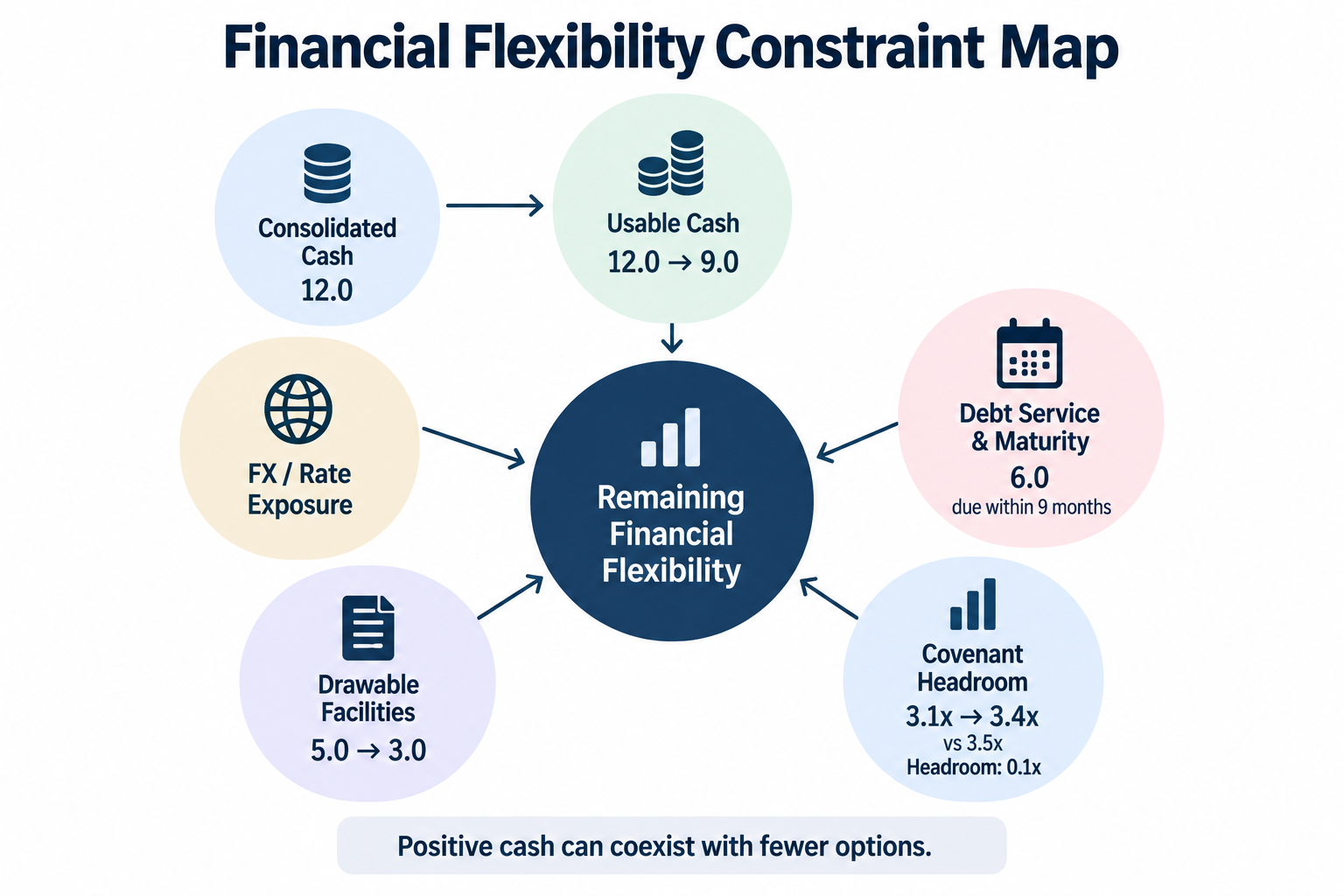
It is not a waterfall. FX exposure is not an amount to subtract from 9.0; neither is covenant headroom. Each layer changes a different dimension of the decision: the cash that can be used, the cash that may be required, the date at which it is required, the funding that can actually be executed, or the actions that remain contractually feasible.
A useful management review can therefore stay focused on six questions:
- Cash accessibility: how much reported cash can the right entity use, in the right currency, by the required date?
- FX and rate exposure: which financing obligation changes cash burden first if currencies or rates move against us?
- Debt timing: what is the next principal, interest, fee or maturity event, and how much earlier is the true action date?
- Funding executability: how much of our committed funding is genuinely drawable today and under the relevant stress?
- Covenant headroom: which agreement-defined variable is most likely to consume the remaining room before the next test date?
- First lost option: if those pressures arrive together, which financing or operating action stops being realistically available first?
For Northstar, that sixth question is more informative than a countdown to zero cash. A company can still have money in the bank while losing the ability to refinance on acceptable terms, draw an expected facility, add borrowing or take another agreement-constrained action.
If the first lost option arrives before the cash-zero date, that earlier date is the financial boundary management needs to act against.
References
- Association for Financial Professionals - Liquidity Management
- IFRS Foundation - IAS 21 The Effects of Changes in Foreign Exchange Rates
- U.S. SEC - Commission Guidance Regarding Management’s Discussion and Analysis of Financial Condition and Results of Operations
- SEC Investor.gov - What Are Corporate Bonds?
- Federal Reserve Bank of New York - Secured Overnight Financing Rate Data
- Bank for International Settlements - Dollar debt in FX swaps and forwards: huge, missing and growing
- Loan Syndications and Trading Association - Financial Definitions 101: Borrower and Lender Perspectives
- EUR-Lex - Commission Regulation (EU) 2023/2822