Northstar has 30 of cash on its balance sheet. Of that, 8 is restricted or operationally unavailable, management wants to preserve 10 as its own minimum cash boundary, and a further 20 sits in an undrawn revolving facility whose availability depends on contractual conditions and covenant compliance. A material debt maturity falls inside the next twelve months, while EBITDA and collections are weakening.
None of those facts says that Northstar is insolvent. They do say that the bank balance is a poor proxy for how much room management still has. By Week 0, three questions are already more useful than “How much cash is left?” How much of the 30 is genuinely usable? Which action has the earliest decision deadline? Which option becomes unavailable if the company waits another four weeks?
A company can run out of options before it runs out of cash. Here, option decay is shorthand for that management problem. It is not a statutory sequence or an insolvency test. It describes the way liquidity access, debt headroom, financing execution, stakeholder rights and transaction timing can progressively narrow what the company can still do.
Distress can begin with positive cash
Financial distress can appear while payroll is still being met and cash remains positive. Legal insolvency is a different question, with tests and consequences that depend on the relevant jurisdiction. Suppliers tightening terms, a lender consent becoming necessary or covenant headroom compressing can all matter before any missed payment.
For Northstar, the useful separation is:
Cash balance ≠ usable liquidity ≠ financial headroom ≠ strategic optionality.
The cash balance is the recorded position. Usable liquidity asks whether funds can actually be accessed, lawfully used and deployed in time. Financial headroom adds maturities, covenants, minimum-liquidity requirements, borrowing bases and drawing conditions. Strategic optionality asks whether management still has enough time and authority to cut costs, negotiate a waiver, refinance, sell assets, raise equity or pursue a larger transaction. That is why a business with less cash but genuinely drawable committed liquidity may have more room to manoeuvre than one with a larger, restricted balance sitting in front of a maturity wall.
A 13-week view changes the deadline
A rolling 13-week cash flow forecast is useful here because it works from receipts and disbursements rather than using P&L timing as a substitute for cash timing. Deloitte’s material on 13-week cash forecasting treats it as a practical short-term liquidity tool. It is not a universal legal requirement.
Now apply that view to Northstar. The 30 becomes 22 once the unavailable 8 is separated. Management then chooses to protect 10 as its own minimum cash boundary for critical obligations, forecast error and operating shocks. The 10 is a company-specific management assumption, not a benchmark.
The 20 revolver belongs in a different column from bank cash. A committed facility can provide real protection only if Northstar can satisfy the relevant representations, covenants, borrowing conditions and other contractual requirements. The Association for Financial Professionals makes the same practical distinction in its liquidity-management material: a funding source matters when it is accessible, usable and available when required.
| Point in time | What Northstar can see | Management implication |
|---|---|---|
| Week 0 | Headline cash is 30, but 8 is unavailable and the management minimum is 10 | The company cannot treat all 30 as buffer |
| Week 4 | Collections slow, EBITDA weakens and the projected cash low point falls | Lead time for cost actions and funding work starts to matter |
| Week 7 | Covenant headroom is tighter; a waiver or amendment can no longer be left to the last minute | Contractual options acquire their own deadlines |
| Week 10 | If new funding or an asset sale is still not executable, cash may remain positive while contingency plans become too slow | The cash-zero date is no longer the most important date |
If refinancing takes six to eight weeks, a lender amendment needs information and consent, and a cost programme also needs implementation time, the relevant deadline is the latest date on which those actions can still finish before they are needed.
Cash zero may arrive later. The same is true of the minimum-cash figure: 10 is meaningful only in the context of Northstar’s fixed costs, seasonality, supply-chain dependence, access to funding and shutdown costs. Another business may need a different buffer.
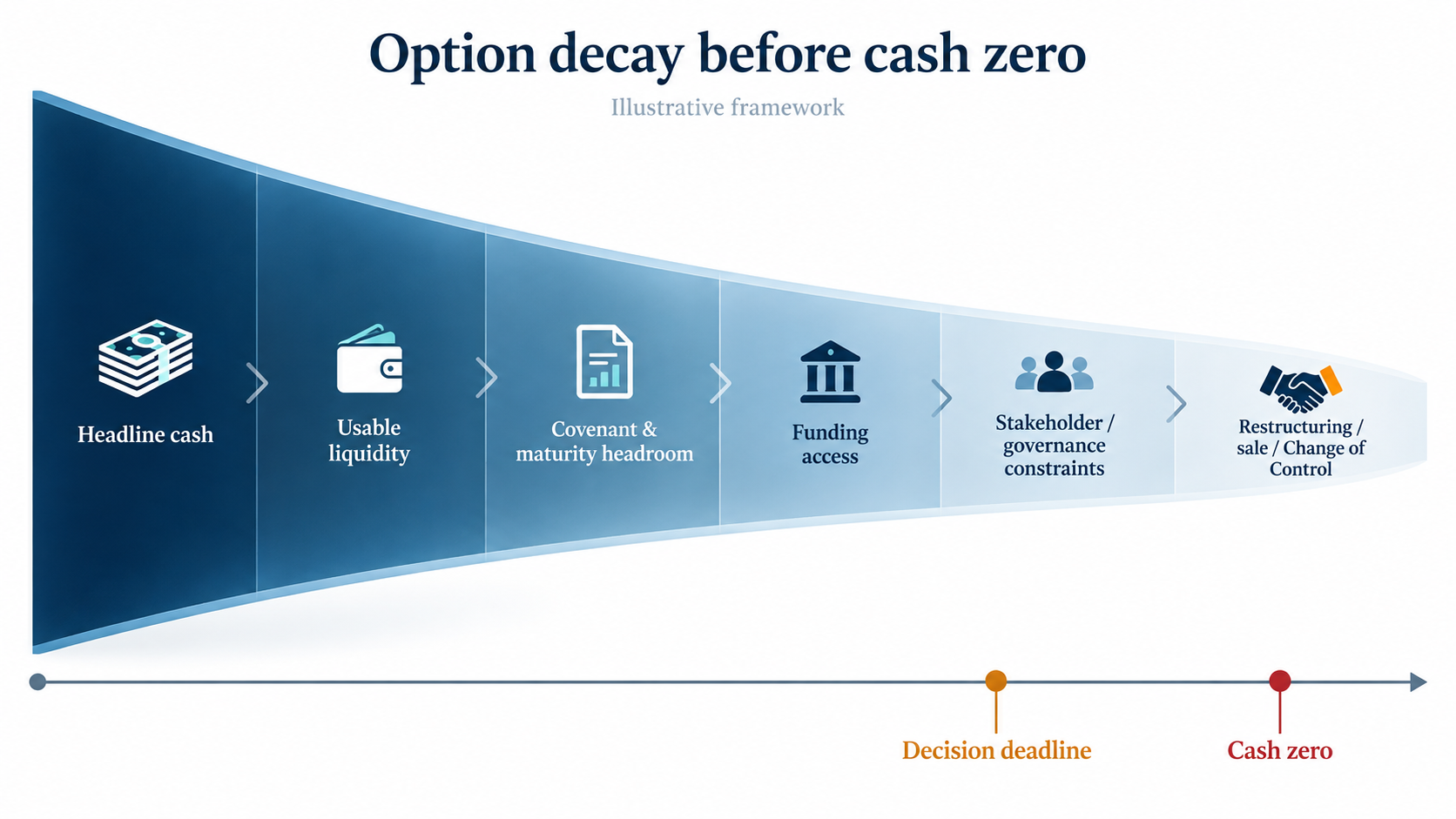
Illustrative framework: the ordering organises constraint types rather than prescribing a universal path. A company may encounter these constraints in a different order, or not reach every category.
Headroom can shrink without a covenant breach
At Week 4, suppose EBITDA weakens again. Northstar can remain compliant with a leverage or coverage covenant while its room for another earnings miss, additional debt or a delayed refinancing steadily contracts.
There is no universal “safe” leverage ratio that solves this. The Loan Syndications and Trading Association’s work on financial definitions shows why EBITDA, Debt and Net Leverage can be built differently across agreements, with different add-backs, cash netting, baskets, test periods and exceptions. Two borrowers reporting 4.0x may therefore have very different headroom.
Three states should stay separate: narrowing headroom means the company remains compliant but can tolerate less adverse movement; actual breach depends on the documents, including cure rights and whether a waiver is required; insolvency is a separate legal question and should not be inferred mechanically from a covenant breach.
Maturities create their own clock. A debt maturity inside twelve months does not, on its own, make a company distressed. The exposure grows when repayment depends on refinancing and lenders or capital markets must remain available before the due date. The OECD’s Global Debt Report 2025 places large refinancing needs and a higher-cost environment at the centre of the broader corporate-debt risk picture.
By Week 7, Northstar has a process problem even without a default. Waivers, amendments and refinancing need information, negotiation, consent, pricing and lead time. Waiting for a formal breach can surrender negotiating room that still existed a few weeks earlier.
Test funding where it is supposed to save you
“We can refinance later” is not yet a liquidity source. In a distress funding triage, management first needs to protect genuinely usable liquidity and avoid avoidable covenant or payment triggers while new-money options are tested. Every contingency should then be tested in the same downside case that creates the need for it:
Availability → Conditions → Lead time → Consent → Close date → What happens if it slips?
The 20 revolver is a useful contrast. If it is committed and Northstar continues to satisfy its drawing conditions, there is an existing contract whose availability can be checked. A new loan has a different execution path involving market appetite, pricing, due diligence, lender committees, documentation and perhaps a covenant reset.
An asset sale has another set of failure points. A saleable asset does not equal available cash: there still needs to be a buyer, an acceptable price, any required lender consent and enough time to close before the liquidity deadline. An equity raise carries the same timing problem. Once the market knows that a company must complete a transaction by a particular date, delay becomes less useful as a negotiating option.
Northstar is not being rated, but S&P’s corporate-liquidity methodology is instructive because it looks at sources and uses, reliance on external capital, covenant headroom and refinancing conditions together. A rescue plan that works only if the market remains open during the downside case should carry a meaningful execution discount.
By Week 10, Northstar may still have positive cash and no missed payment. If revolver availability remains uncertain, refinancing has not reached a term sheet and an asset sale still has no buyer, those alternatives are materially less executable than they were at Week 0.
Creditors gaining leverage is not the same as taking control
Financial pressure can move bargaining power quickly. The phrase “creditors take control” hides several different mechanisms, so Northstar needs to identify which one is actually changing.
- Economic leverage: who gains bargaining power because the company urgently needs money, time or consent.
- Contractual rights: who holds consent rights, security, priority, default remedies or other negotiated rights.
- Insolvency priority: how claims rank in a formal process, subject to the relevant jurisdiction and procedure.
- Governance / fiduciary duties: the framework within which directors and managers handle risks, conflicts and major transactions.
- Legal control / ownership: who holds equity, voting rights, board appointment rights or other formal control mechanisms.
A lender can have considerable leverage because a waiver needs its consent without becoming the legal owner of the company. Delaware’s Gheewalla decision also puts a boundary around the shortcut that directors’ duties simply “shift to creditors” as stress increases. The Delaware Supreme Court held that creditors of a solvent corporation in the so-called zone of insolvency could not bring direct fiduciary-duty claims merely because the company was under that form of stress; creditor standing in actual insolvency raises a different derivative-claim question. The point is jurisdictional, not universal.
The board’s own process becomes more exposed as alternatives narrow. The G20/OECD Principles of Corporate Governance place oversight of strategy, risk management, major transactions, conflicts and reporting/control integrity among core board responsibilities. If approvals, recusals, minutes or key assumptions disappear from the record because the company is moving quickly, later review becomes harder: which alternatives existed, who knew what, who approved the decision, and on what basis?
Change of Control can turn a sale into a financing problem
Once Northstar is considering a restructuring, a whole-company sale or a new investor that changes control, debt documents and transaction design have to be read together. Change of Control is a negotiated definition. The credit agreement, indenture, shareholder agreement and other governing documents determine the threshold, exceptions and consequences.
One practical way to review the clause is to follow the sequence Definition → Trigger → Consent → Remedy → Financing consequence → Governance / process requirement.
Some credit agreements filed with the U.S. SEC expressly treat a Change of Control as an event of default and may attach acceleration or other lender remedies. That proves the design exists; it does not make it universal. Another agreement may require repayment, provide a put right, require consent, use a different ownership threshold or contain carve-outs that change the outcome.
For Northstar, the distinction is operational. “We found a buyer” does not mean “we can close”. If the proposed transaction meets a Change of Control definition in a debt document, lender consent, refinancing or repayment may have to be completed inside the deal timetable.
Governance questions remain jurisdiction-specific as well. Delaware cases including Revlon, MFW and Corwin address different sale-of-control, controller-transaction and shareholder-approval settings. They illustrate why process, conflicts and approval quality can matter; they are not a global M&A checklist.
The failure mode is poor sequencing. If finance, legal and the board run separate calendars, one workstream can discover too late that it is waiting for another party’s consent. Northstar needs the liquidity deadline, debt documents, stakeholder approvals, board process and transaction timetable visible together.
The weekly review should track the next disappearing option
At Week 0, Northstar already knows enough to begin protecting optionality: 8 is unavailable, 10 is the chosen management minimum, the 20 revolver is conditional, a material maturity sits within twelve months, and collections and EBITDA are weakening.
A weekly distress review can keep six questions on one page:
- How much liquidity is genuinely usable today? Which cash balances or facilities are restricted or conditional?
- What is the next decision deadline? Not the cash-zero date, but the date after which an action cannot finish in time.
- Which covenant, maturity or contractual condition is narrowing headroom?
- Is each funding option executable in the downside case? How long will it take, whose consent is required, and which conditions could fail?
- Which stakeholder, governance or control rights change the decision process?
- If we wait another week, which option becomes more expensive, needs more consent or disappears?
This is neither an insolvency test nor a guaranteed turnaround playbook. It forces management to track something the bank balance cannot show on its own: how much reversible, negotiable and executable choice remains. Financial resilience is partly a question of time. When pressure arrives, the company needs enough of it left to choose rather than merely react.
References
- Association for Financial Professionals, Keeping the Lights On: The Why and How of Liquidity Management
- Deloitte, 13-Week Cash Flow Forecasting
- U.S. Securities and Exchange Commission, Commission Statement About Management’s Discussion and Analysis of Financial Condition and Results of Operations
- S&P Global Ratings, Methodology and Assumptions: Liquidity Descriptors for Global Corporate Issuers
- OECD, Global Debt Report 2025
- Loan Syndications and Trading Association, Financial Definitions 101
- OECD, G20/OECD Principles of Corporate Governance 2023
- Australian Securities and Investments Commission, Insolvency for Directors
- U.S. SEC EDGAR, example filed credit agreement containing Change of Control provisions
- Delaware Supreme Court, North American Catholic Educational Programming Foundation, Inc. v. Gheewalla (2007)
- Delaware Supreme Court, Revlon, Inc. v. MacAndrews & Forbes Holdings, Inc. (1986)
- Delaware Supreme Court, Kahn v. M&F Worldwide Corp. (2014)
- Delaware Supreme Court, Corwin v. KKR Financial Holdings LLC (2015)