A company has two weeks to decide what to do about Market B next quarter: enter, run a bounded pilot, defer, or walk away. The team already has an industry report, customer interviews, competitor pricing, internal customer data, regulatory material and several articles supporting a similar growth story.
None of that tells the team whether another week of research is worthwhile. The answer depends on what is still uncertain, whether those uncertainties can change the action, and whether the next piece of information is worth its cost and delay.
Define the Decision Before Deciding How Much to Research
“Research Market B” gives researchers no natural point at which to stop. “In two weeks, choose between entry, a bounded pilot, deferral and no entry” does.
The brief now has an owner, a deadline and a set of actions. It also needs the downside of a wrong call, the reversibility of each option, and the unknowns capable of moving the decision from one action to another. Those conditions determine how much residual uncertainty the company can tolerate.
If regulatory feasibility is the binding issue, more brand interviews do little to resolve it. If regulation is settled and willingness to pay is still inferred from stated interest, another market summary may be less useful than a test that exposes actual behaviour.
A reversible pilot can rationally proceed with less certainty than a large, irreversible commitment. Formal legal, medical, audit, safety or regulatory requirements can set a higher evidentiary bar and should not be replaced by a lightweight business heuristic.
Separate Claims, Evidence, and Assumptions Before Inference Hardens Into Fact
“Market B looks attractive” is too compressed to audit. The recommendation may depend on sufficient demand, acceptable willingness to pay, viable acquisition economics, regulatory permission and manageable local operating cost. Those are separate claims and may sit on very different evidence bases.
The research ledger needs distinct roles. Evidence is an observation, document, dataset, interview, test or traceable source. A claim is the proposition being judged. An assumption is a premise the analysis currently relies on without direct support. Inference or judgment is what the team concludes from evidence and assumptions. An unknown remains unresolved rather than being silently filled with confident wording.
Suppose internal data show heavy enterprise usage in the current market. That supports a statement about the current market. Extending the same behaviour to Market B introduces a transfer assumption; concluding that Market B therefore has sufficient demand adds another inferential step.
The risk grows when the material is reused. An assumption enters a strategy deck, the deck feeds an operating plan, and the operating plan later gets cited as evidence that demand in Market B is already known. Nothing new was observed, but the label changed.
A decision-critical claim should therefore point back to evidence or carry an explicit assumption, judgment or unknown label. The US intelligence community’s ICD 203 analytic standards apply the same separation between underlying information, assumptions and judgments while also requiring source credibility and significant uncertainty to be communicated. The business use here is narrower: preserve the epistemic role of each statement as it moves through the analysis.
Five Sources Can Still Be One Piece of Evidence
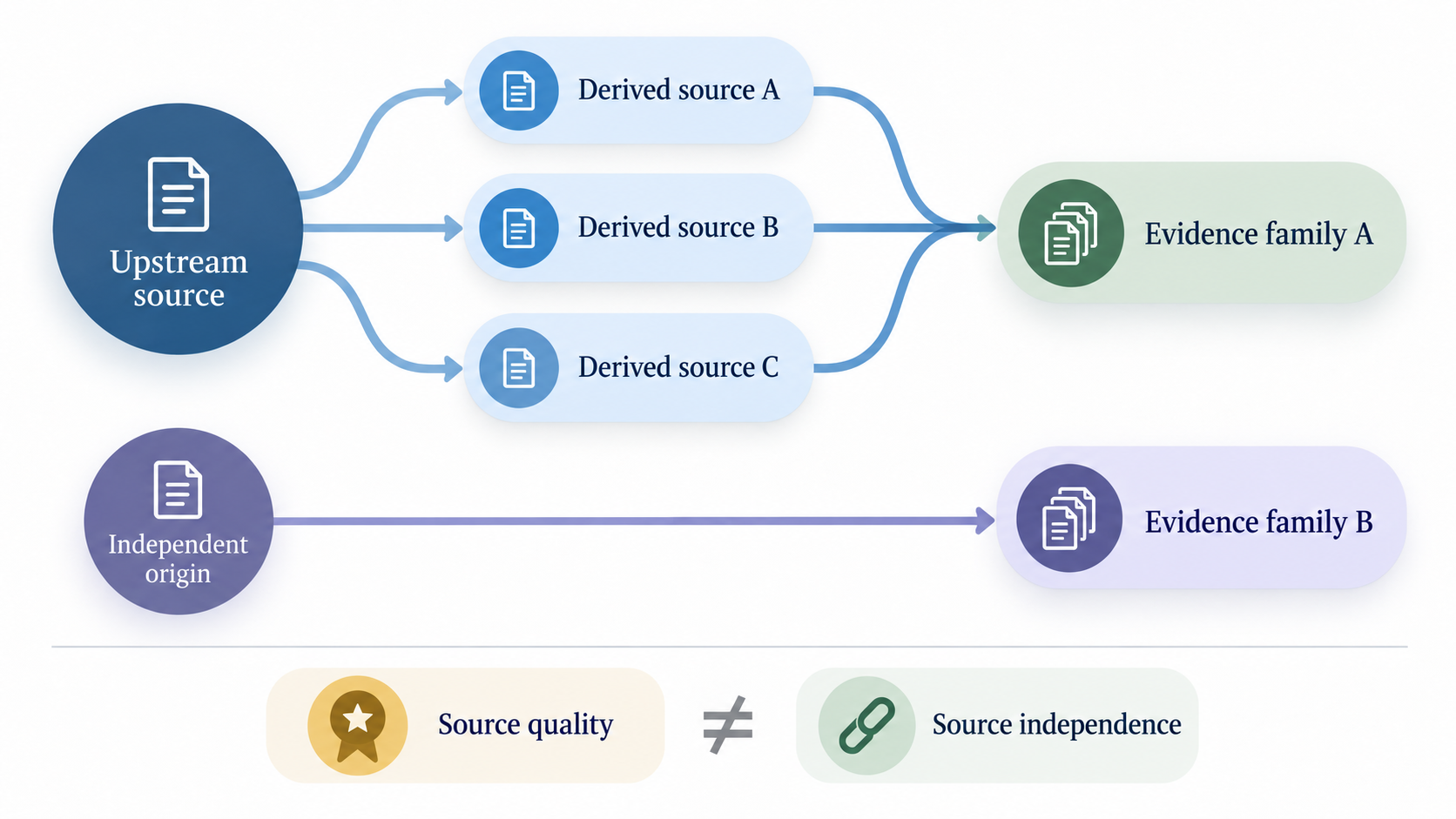
Five articles saying that Market B is growing quickly may look like corroboration. Trace the citations and the picture can collapse: four articles cite the same industry report and the fifth cites one of those articles.
Source quality and source independence answer different questions. Quality concerns method, sample, definitions, recency, directness and relevance to the claim. Independence concerns ancestry: whether two observations come from genuinely different datasets, methods, observers or original events.
For Market B, the evidence families might be separated as follows:
- the industry report and articles derived from it;
- official regulatory material;
- internal customer-behaviour data;
- Market B interviews, with their own sampling limits;
- competitor-pricing research, provided it compares like with like rather than mixing list price, realised price and different packages.
This prevents one upstream source from being counted several times. It does not mean that more independent families are always better. For a narrow factual question, one authoritative primary source can outweigh several independent but weak commentaries.
Triangulation Is Not Voting: Decompose the Conflict
Assume the Market B interviews are enthusiastic but pricing or transaction evidence is weak. Treating that as a vote produces the wrong argument because the sources may not be measuring the same thing.
Interviews can capture stated interest while transaction data capture willingness to pay. Early adopters can look very different from a broader customer population. Two datasets may cover different periods. Competitor offers may have different packages, contract lengths or service levels. Sampling and commercial incentives can also pull results in different directions.
Once those differences are made explicit, some apparent conflicts disappear. “Interested in the product” and “willing to pay this price under this contract” are different claims, so the evidence no longer needs to agree.
If two reasonably comparable evidence families still point in different directions, keep that conflict attached to the affected claim and specify what evidence could resolve it. Averaging incompatible estimates into a tidy midpoint can hide the uncertainty the decision maker needs to see.
Do Not Hide Every Uncertainty Behind One Confidence Number
A single confidence label can flatten four very different states in the same Market B analysis. Regulatory feasibility may have direct official support; directional demand may converge across several evidence families; willingness to pay may still rest on interview inference; local acquisition cost may be largely untested.
A compact uncertainty register can keep those states apart:
| State | What it means for the decision |
|---|---|
| Unknown | There is not yet enough information to judge the claim |
| Assumption-dependent | The answer changes materially if a transfer or model assumption changes |
| Conflict-driven | Relevant evidence families point in different directions |
| Relatively well supported | Credible, appropriately scoped evidence converges without a major unresolved conflict |
Likelihood and confidence also refer to different things. “Market B is more likely than not to clear the demand threshold” is a judgment about the proposition. “We have moderate confidence in that judgment” describes how much weight the evidence and reasoning deserve. ICD 203 likewise treats uncertainty and confidence as matters to communicate explicitly.
For the business decision, the next step is to identify which uncertainty is decision-material. If a variable can move across a plausible range without changing the choice between entry, pilot and deferral, reducing that uncertainty may have little decision value even if the topic remains interesting.
The Stopping Rule: Would Another Research Round Change the Decision?
With the decision-material uncertainty identified, compare the next research step using Value of Information, or VOI. The question is marginal: what can the next research step change?
NICE links important uncertainties to the value of further research and notes that Value of Information methods can help assess whether additional research is worthwhile. A commercial team does not need a formal EVPI or EVSI model for every decision. It still needs to compare the expected improvement in the decision with the cost and delay of obtaining the information.
For Market B, another article derived from the same industry report is usually low-value because it adds no new evidence family. Another interview wave can be useful if it reaches a materially different segment or tests a critical assumption; repeating the same sample and questions adds much less. A bounded pilot can carry high information value when actual payment or usage behaviour is the binding uncertainty, but only if the pilot is feasible, reversible and timely.
Information value is not enough on its own. A pilot may answer the right question and still be a poor next step if it is too expensive, legally premature, operationally disruptive or slower than the decision deadline.
Research can stop when the critical claims have credible support or a visible support-versus-challenge structure, major warnings are exposed, the next search round is likely to duplicate existing evidence families, and plausible new information is unlikely to change the action, commitment level or action design. The team can still carry residual uncertainty; reducing it further simply no longer earns back its marginal cost for this decision at this time.
Close the Decision, but Leave a Door to Reopen It
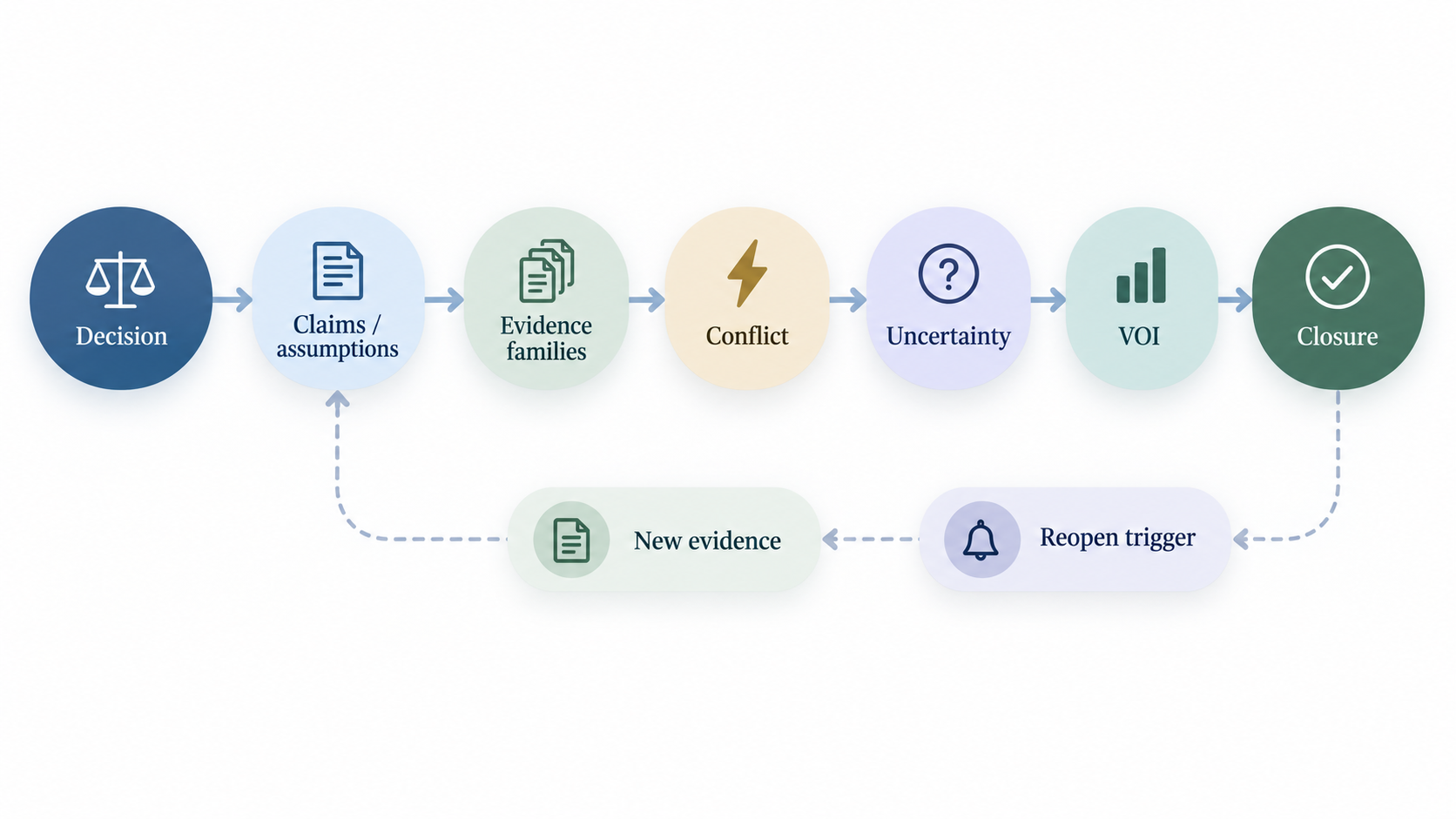
Stopping research should produce a decision record rather than an abandoned research folder. Someone reviewing the decision later needs to reconstruct:
- what was decided, when, and who owned it;
- which claims carried the decision, what evidence supported them, and what the confidence basis was;
- which assumptions and residual uncertainties were accepted;
- why research stopped at that point;
- which events should reopen the decision and which realised outcomes or benefits should be checked afterwards.
Completing the pilot or rollout only shows that the action was completed; it does not, by itself, show that the original decision was good. The W3C PROV family of specifications describes provenance through entities, activities, agents and relationships such as derivation and responsibility. In this research workflow, the useful lineage is source version → extraction or observation → evidence → claim → synthesis → decision. If a source changes, an assumption fails or observed outcomes diverge, the team can identify which part of the decision chain needs to be revisited. A fully traceable false claim remains false, so provenance supplies lineage rather than validation.
The Market B decision might close as: “Run a bounded pilot. Regulatory feasibility and directional demand are sufficiently supported for a reversible commitment, while willingness to pay remains decision-material uncertainty.” Reopen it if regulation changes, pilot payment behaviour falls below the level required by the model, acquisition economics deteriorate structurally, or new evidence invalidates a core assumption. At the next review, start with those triggers rather than restarting the research from zero.
References
- Office of the Director of National Intelligence, Objectivity / ICD 203
- W3C Provenance Working Group Publications
- NICE Research Recommendations Process
- PRISMA 2020, used here only as a boundary reference for systematic-review reporting guidance, not as a generic evidence-quality scoring framework