Northstar Group appears to have had a good year. Consolidated revenue rose from 100 to 120, net income was 14, and one operating segment reported record profit. During the same period Northstar obtained control of Aurora, recorded a foreign-currency translation movement in OCI, reported segment measures built for management rather than the consolidated IFRS view, impaired a cash-generating unit, and recognised a provision. Those facts can all coexist without the accounts being inconsistent.
The problem is comparability. A number can move because the economics changed, because the reporting boundary changed, or because both changed together.
Part 01 dealt with timing differences between recognition, balance-sheet positions and cash. This article deals with a different source of confusion. For Northstar, five boundaries matter: the entities inside the group numbers, the presentation of performance between profit or loss and OCI, management’s segment view, measurement based on estimates and uncertainty, and the going-concern premise beneath the statements. That is an analytical device, not an IFRS-defined framework.
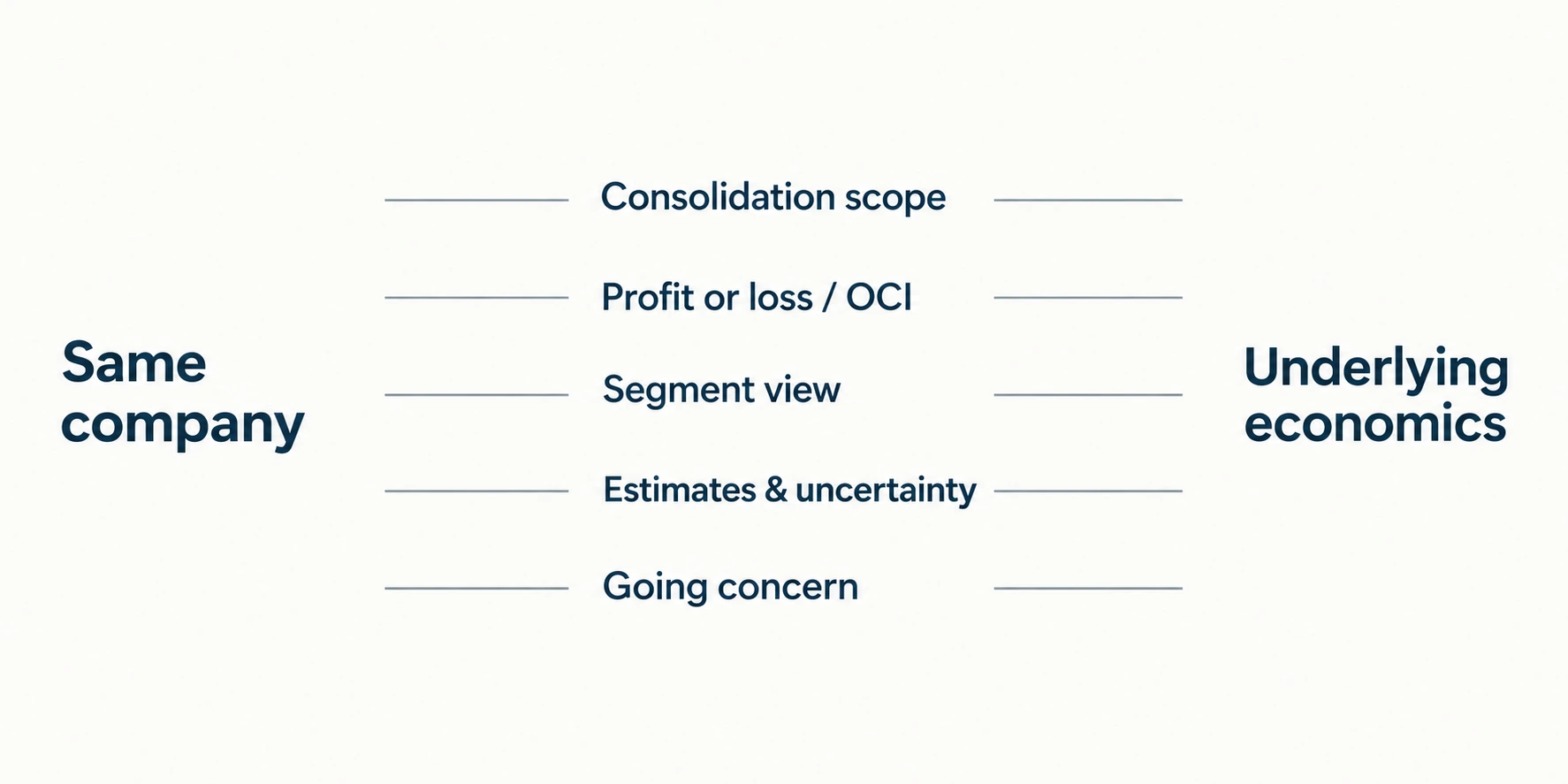
The figures below are deliberately simplified. Northstar is fictional, and the numbers are there to isolate the reading problem rather than reproduce a full set of accounts.
The denominator changed before the growth rate did
Start with revenue. Northstar reported 100 last year. Its existing businesses generated 105 this year. Aurora then entered the consolidation perimeter after Northstar obtained control and contributed 18. There were also intercompany transactions amounting to 3 between Northstar and Aurora that must be eliminated on consolidation.
The reported number is therefore:
105 + 18 - 3 = 120
A 20% increase from 100 to 120 is a correct description of reported consolidated revenue. It is not a 20% organic growth rate for the legacy businesses. On that narrower perimeter, 100 became 105, which is a 5% increase.
IFRS 10 makes control the basis for consolidation and presents a parent and its subsidiaries as a single economic entity. Once Aurora enters that perimeter, the population behind Northstar’s consolidated revenue has changed. Those intercompany transactions amounting to 3 also disappear from group revenue because a transaction inside the group is not external revenue merely because two legal entities recorded it.
This distinction does not make acquisition-led growth artificial. Aurora can bring customers, employees, assets and cash flows that are economically real. It simply means that reported growth and organic growth answer different questions.
A similar denominator problem appears in segment reporting, although for a different reason. Northstar reports two operating segments. Enterprise has segment operating profit of 16 and Consumer has 5. The segment page therefore shows 21 before corporate costs of -4 and elimination or unallocated items of -3 bring the consolidated operating result to 14.
IFRS 8 exposes the management view rather than forcing every segment metric to equal a consolidated IFRS measure. That is precisely why the disclosure is useful. It is also why a 30% segment margin should not be compared mechanically with another company’s group margin. The definition of the segment, the contents of the measure, the location of corporate or unallocated items, and the reconciliation back to the consolidated figures all matter.
Northstar can have a strong Enterprise business and a weaker consolidated result in the same period. No contradiction is required.
Profit or loss does not contain every performance movement
Northstar’s net income is 14. Its foreign operation also produces a -6 foreign-currency translation movement reported in OCI. In this simplified illustration, the broader comprehensive-income result is therefore 8.
The -6 should not be dismissed because it sits outside net income, but neither should all OCI be treated as a temporary holding area that will eventually recycle through profit or loss. The treatment depends on the individual component and the Standard that governs it.
For an analyst, that shifts the work from memorising an OCI label to identifying the exposure. What produced the movement? Why is it outside profit or loss now? Does the applicable Standard require later reclassification, and under what conditions? Net income of 14 and a broader result of 8 can then be read for what they are: different presentation layers of the same reporting period.
There is a date boundary here as well. IFRS 18 has been issued, but unless an entity applies it early, it is generally effective for annual reporting periods beginning on or after 1 January 2027. A 2026 analysis can discuss the coming presentation changes without assuming that every reporter has already adopted the Standard.
When the number depends on judgement, classify the change before interpreting it
A phrase such as ‘accounting adjustment’ removes more information than it adds.
Northstar previously estimated product returns at 2%. New product-mix information and observed return data lead management to revise the estimate to 3.5%. If the revision reflects new information and developments, it can be a change in accounting estimate rather than proof that the prior-period accounts were wrong. Estimate changes are generally recognised prospectively in the period of change and, where relevant, future periods.
A different diagnosis applies if the information already existed and last year’s treatment was wrong because of a calculation error or an incorrect application of an accounting requirement. That may be a prior-period error. IAS 8 distinguishes accounting policies, accounting estimates and prior-period errors because those labels carry different accounting consequences.
The same discipline helps with impairment. Northstar has a cash-generating unit with a carrying amount of 50. Demand and margin expectations deteriorate, and the updated recoverable amount is 42. Assuming IAS 36 applies, the simplified impairment is 8.
Nothing about that entry says that Northstar paid out 8 in cash on the recognition date. The number comes from an updated assessment of recoverable value. Demand, pricing, margins, discount rates, growth assumptions and sensitivity therefore matter more than the headline charge alone. A point estimate can look exact while the valuation behind it remains highly dependent on assumptions.
A provision has a different accounting mechanism. IAS 37 describes a provision as a liability of uncertain timing or amount and applies recognition and measurement requirements around a present obligation, the probability of an outflow and the best estimate of the expenditure required. Suppose a past event creates a legal obligation for Northstar and the recognition criteria are met. Management recognises a provision of 4. Payment may occur later, and the eventual amount may differ from 4.
Now suppose the provision falls from 4 to 1 next year and 3 is released through the income statement. Calling the 3 an efficiency gain would skip the causal question. The release could reflect lower legal exposure, a settlement, new information, the disappearance of an obligation or another reassessment. Whether it belongs in a view of recurring operating performance depends on that cause.
Impairment and provisions therefore belong in the same analytical conversation only at the level of uncertainty. They remain different accounting mechanisms.
Going concern changes the context, not just one line item
Assume Northstar has material debt of 25 falling due within the next 12 months, cash of 10 and uncertain refinancing.
Those facts do not prove that the company will fail. Going concern is not a mechanical threshold triggered by one liquidity ratio. Management must assess the entity’s ability to continue as a going concern and address the relevant disclosures when material uncertainties exist. The IFRS Foundation’s updated 2025 educational material treats that assessment as a judgement based on the wider facts and circumstances.
This is where the fifth boundary differs from the others. Consolidation, OCI, segments and estimates change how individual numbers should be read. Going-concern uncertainty can alter the decision context for the whole set of statements.
Northstar could still show 20% reported revenue growth, healthy segment economics and positive accounting profit while facing a financing or liquidity uncertainty that materially changes how useful those performance figures are for a decision. The reverse warning is equally important: going-concern uncertainty is not the same as inevitable failure.
Covenants, distress, restructuring and insolvency mechanics sit outside this article’s scope.
Northstar never needed one master story. Its 20% revenue growth is a claim about the current consolidated perimeter. The 5% growth of the existing businesses answers a narrower organic question. Segment profit of 21 and a consolidated result of 14 describe different views. Net income of 14 and the -6 OCI movement occupy different presentation layers. The impairment of 8 and provision of 4 depend on distinct recognition and measurement logic, while near-term debt of 25 against cash of 10 belongs in the going-concern assessment rather than in a profitability ratio.
That is enough to change the reading order. Before deciding whether the business improved, identify what population, presentation layer, management view or estimate produced the number. If going concern is a material uncertainty, apply that context to the set as a whole. Only then is the original commercial question well formed: did Northstar’s underlying economics improve or deteriorate?
References
- IFRS Foundation, IFRS 10 Consolidated Financial Statements
- IFRS Foundation, IFRS 8 Operating Segments
- IFRS Foundation, IAS 8 Accounting Policies, Changes in Accounting Estimates and Errors
- IFRS Foundation, IAS 36 Impairment of Assets
- IFRS Foundation, IAS 37 Provisions, Contingent Liabilities and Contingent Assets
- IFRS Foundation, Updated going concern educational material, May 2025
- IFRS Foundation, IFRS 18 Presentation and Disclosure in Financial Statements