A company can announce record bookings and still report only a modest increase in revenue. It can collect cash before much of that revenue is earned, or recognise revenue before the customer pays. RPO may rise at the same time, while backlog follows a definition written by management rather than an accounting standard.
None of those movements is contradictory on its own. They describe different parts of the contract lifecycle.
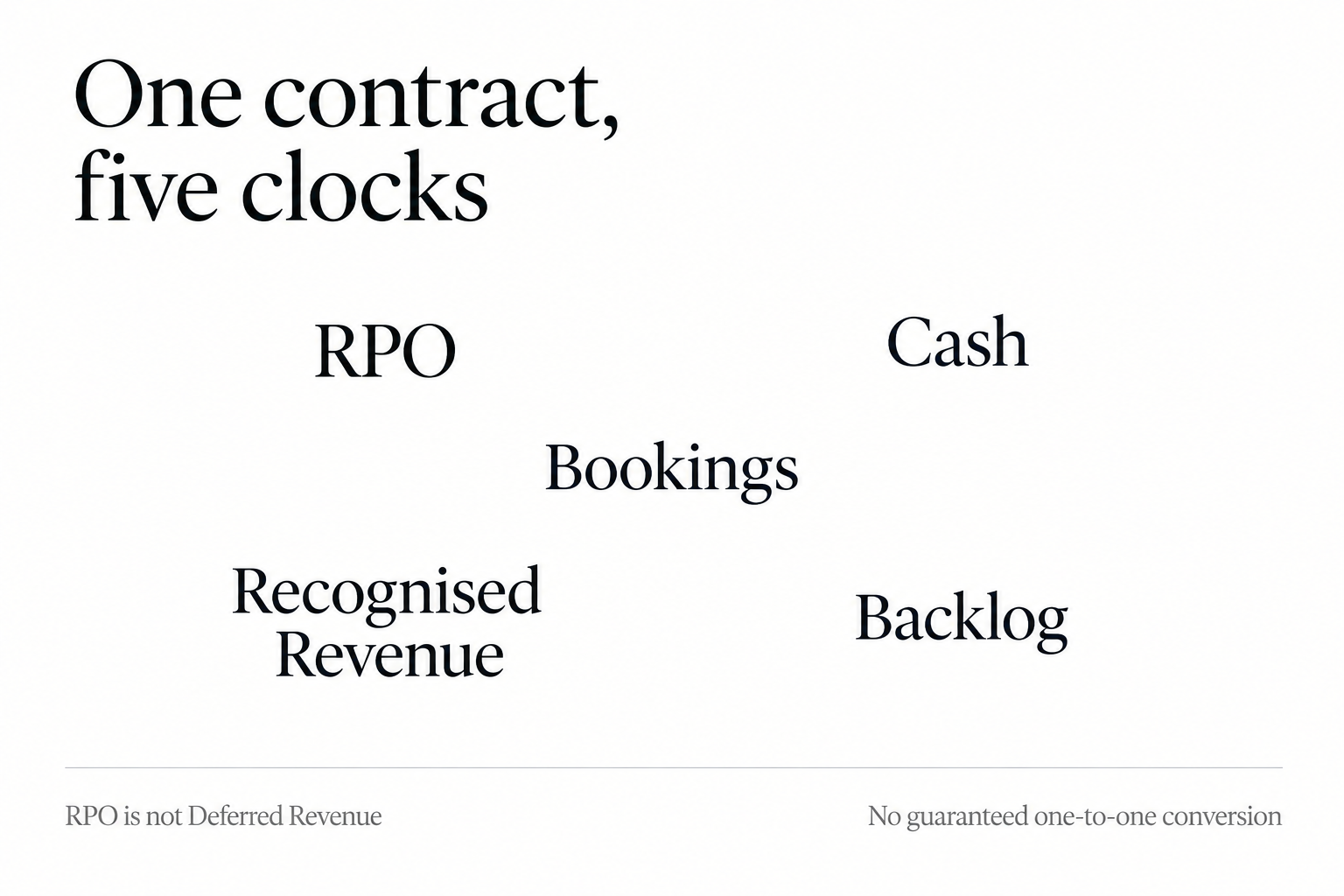
The useful analysis starts by separating the commercial promise from the remaining work, the accounting obligation, the earned revenue and the eventual collection.
1. Reconcile the signed amount before using it
Start with a multi-year software and services agreement carrying a headline value of 100. That number does not tell you when cash arrives. A customer might prepay. Another might be invoiced later. Neither payment pattern determines how much revenue has been earned.
The sales organisation may also count the contract, or a company-defined portion of it, in bookings at signature. Unfinished delivery may enter backlog. Revenue follows a different test: IFRS 15 and ASC 606 require the company to identify the contract and performance obligations, determine and allocate the transaction price, then recognise revenue when or as those obligations are satisfied.[1][2]
A usable reconciliation therefore needs six separate quantities:
- the amount management counted as bookings;
- the work management still includes in backlog;
- the transaction price allocated to unsatisfied or partially unsatisfied obligations;
- recognised revenue;
- invoiced amounts;
- collected cash.
The same contract can carry different values across those six lines on the same date.
2. Definitions come before growth rates
Bookings and backlog need issuer-specific reading first. A reported 30% rise in bookings is not automatically comparable with another company’s 30% rise if one uses annual contract value, another uses total contract value, or the inclusion rules differ. Backlog can vary with cancellability, order scope and delivery horizon.
RPO sits closer to the revenue-recognition framework. It concerns transaction price allocated to unsatisfied or partially unsatisfied performance obligations, subject to the relevant disclosure requirements and practical expedients.[1][2] Recognised revenue is the accounting output after performance. Cash records settlement timing.
| Metric | Main question | Nature | Main analytical risk |
|---|---|---|---|
| Bookings | How much commercial commitment did management count as won? | Usually management- or sales-defined | The definition can differ materially between companies |
| Backlog | What committed or ordered work does management say remains? | Usually company-defined | Cancellability, scope and time horizon may differ |
| RPO | How much transaction price is allocated to unsatisfied or partially unsatisfied performance obligations, subject to disclosure rules and practical expedients? | Revenue-disclosure lens | It is not a promise that the full amount will mechanically become future revenue |
| Recognised Revenue | How much has been earned through satisfying performance obligations? | Financial-statement accounting output | Signature, invoice and collection are not substitutes for performance |
| Cash | How much has been collected? | Settlement timing | It can lead or lag revenue |
3. One contract can contain several revenue clocks
A single enterprise agreement may bundle a licence, implementation work and ongoing support. The customer signs once, but the supplier still has to determine which promises are distinct, how consideration is allocated, and whether each obligation is satisfied at a point in time or over time.
That is where the five-step model enters:[1][2]
- Identify the contract with the customer.
- Identify the performance obligations.
- Determine the transaction price.
- Allocate the transaction price to those obligations.
- Recognise revenue when or as each obligation is satisfied.
A sales dashboard can therefore show the commercial deal in full while RPO retains a large unrecognised amount and the income statement records only the portion earned in the period.
The model itself remains current. In its 2024 post-implementation review of IFRS 15, the IASB concluded that the standard was working as intended overall, while keeping some application matters under further consideration.[4]
4. An uptime bonus shows where contract value and transaction price can separate
Suppose a service contract has a fixed fee plus an additional payment only if an uptime target is achieved. The extra payment may belong in the commercial discussion from day one. Revenue accounting still has to address the uncertainty attached to it.
IFRS 15 and ASC 606 require variable consideration to be estimated and subjected to the relevant constraint. The maximum amount written into a contract is not automatically the transaction price available for recognition.[1][2]
The same issue appears with volume discounts, rebates, service credits, performance bonuses, refunds, missed-SLA reductions and other adjustments tied to future events. If bookings includes some of that upside, a gap between bookings and revenue may reflect price uncertainty rather than weak delivery.
5. The original booking can become an outdated snapshot
Imagine the customer adds users and a module after signing. Another customer might reduce scope, extend the term or renegotiate price. The original bookings figure is now a snapshot of an earlier contract state; backlog, RPO and the expected timing of revenue can change with the revised scope or price.
Accounting for the modification depends on the facts. Depending on whether the added goods or services are distinct, how pricing relates to standalone selling prices, and how much of the original obligation has already been satisfied, the change may be treated as a separate contract, handled prospectively, or in some cases produce a cumulative catch-up adjustment.[1][2][3]
6. Four edge cases, three questions
For the boundaries below, the practical screen is narrow: does the term change what the supplier still owes, how certain the consideration is, or when performance occurs?
| Boundary | Question to ask | Common misreading |
|---|---|---|
| Contract acquisition / fulfilment costs | Does the cost qualify for capitalisation, and how is it amortised afterwards? | Treating every commission as an immediate expense, or assuming every commission can be capitalised |
| Returns / refunds | Can the customer return, claim a refund or obtain a price adjustment? | Looking only at gross contract value |
| Warranties | Is the warranty basic assurance, or a distinct additional service? | Treating all warranties as the same obligation |
| Licensing | What right has been promised, and is it satisfied at a point in time or over time? | Assuming every licence becomes revenue at signature |
IFRS 15 contains more detailed requirements and examples for these areas.[1][3]
7. Salesforce puts the RPO boundary in numbers
At 31 January 2026, Salesforce reported total RPO of about 35.1 billion.[5] Its filing describes RPO as contracted revenue not yet recognised and says that the measure includes both unearned and unbilled amounts.[5]
The word unbilled is the useful part. An amount can be inside RPO before the customer has been invoiced, and Salesforce states that this unbilled portion is not recorded on the balance sheet.[5]
Deferred revenue, commonly discussed through the contract-liability concept, looks at a different balance-sheet condition: consideration has been received, or is due, before the related performance is complete. RPO instead looks to unsatisfied or partially unsatisfied performance obligations and the transaction price allocated to them.[1][2] The two sets can overlap without being equal.
Salesforce also notes that RPO can move with seasonality, renewals, contract terms, foreign exchange and acquisitions.[5] Its 72.4 billion will appear as future revenue.
Backlog remains more issuer-specific still, particularly around cancellable orders and delivery horizons.
8. Put the contract on a timeline
Consider a fictional multi-year enterprise software agreement with an implementation deliverable, an ongoing stand-ready service, fixed consideration plus a performance-linked variable component, milestone billing and a later scope expansion.
The case stays qualitative. Inventing currency amounts would imply a precision that is not needed to show which metric can move at each event.
| Event | Bookings | Backlog | RPO | Revenue | Cash |
|---|---|---|---|---|---|
| 1. Contract signed | May rise under the company’s definition | May rise with remaining work | Unsatisfied allocated transaction price becomes relevant | Unperformed obligations do not become revenue merely because the contract is signed | May still be zero |
| 2. Advance invoice or prepayment | Usually no automatic change from payment alone | Remaining work still exists | Remaining obligations still exist | No additional performance means no automatic revenue increase | Rises when payment is collected |
| 3. First distinct deliverable completed and ongoing service begins | Usually no automatic change from performance itself | May decline if backlog tracks remaining work | Declines as obligations are satisfied | Rises with performance | May or may not change at the same time |
| 4. Variable-consideration estimate changes | Treatment depends on the company’s commercial definition | May or may not change | Can change if transaction price changes | May affect current or future recognition depending on the facts | No automatic effect |
| 5. Customer modifies the contract | May create incremental bookings | Remaining work may change | Remaining obligations and allocation can change | The path may be separate, prospective or catch-up depending on facts | No automatic effect from modification alone |
| 6. Later performance and collection | No necessary effect | Remaining work continues to fall | Unsatisfied obligations continue to fall | Revenue continues to rise with performance | Rises when the customer pays |
9. Read the mismatch before writing the story
A backlog growth rate far above RPO growth is often a definition question before it is a demand conclusion. Different delivery horizons, cancellable orders or management-defined inclusions can create that spread.
Revenue can rise while cash conversion weakens. A change in billing terms or collection timing may explain it; if the pattern persists, receivables, contract assets, collection terms and customer concentration deserve attention. Revenue quality spans recurrence, contractual commitment, concentration and cash conversion, not only the growth rate.[6][7][8]
A large increase in RPO can indicate stronger contractual commitment, but the current versus non-current split, exclusions, cancellability, comparability with the previous period and customer concentration still matter.
Strong bookings with flat revenue may simply reflect long-duration performance. It can also arise from implementation delays, product mix, uncertain variable consideration or contract modifications. The reported gap does not distinguish among those causes.
10. Nine checks for the next earnings release
When a company highlights bookings, backlog or RPO, these nine checks keep the analysis attached to the contract rather than the headline:
- Exact definition: What does the company actually mean by the metric?
- Cancellability and enforceability: Can the customer cancel, and how firm is the commitment?
- Remaining performance: What goods or services does the company still owe?
- Inclusions and exclusions: Which contracts, orders, periods or variable items are inside or outside the measure?
- Recognition trigger: What performance event causes revenue to be recognised?
- Variable consideration: How much depends on usage, rebates, bonuses, refunds or performance conditions?
- Contract modifications: Were there material expansions, reductions, extensions or renegotiations?
- Billing and contract balance: Has the amount been billed, and does it sit in receivables, a contract asset or a contract liability?
- Collection and comparability: When is cash collected, and is the current-period definition genuinely comparable with prior periods?
References
- IFRS Foundation, IFRS 15 Revenue from Contracts with Customers. https://www.ifrs.org/issued-standards/list-of-standards/ifrs-15-revenue-from-contracts-with-customers/
- Financial Accounting Standards Board, ASU 2014-09: Revenue from Contracts with Customers (Topic 606). https://storage.fasb.org/ASU%202014-09_Section%20A.pdf
- IFRS Foundation, IFRS 15 Illustrative Examples. https://www.ifrs.org/content/dam/ifrs/publications/html-standards/english/2024/issued/ifrs15-ie.html
- IFRS Foundation, Post-implementation Review of IFRS 15 Revenue from Contracts with Customers. https://www.ifrs.org/projects/completed-projects/2024/post-implementation-review-of-ifrs-15-revenue-from-contracts-with-customers/
- Salesforce, Q4 and FY2026 Results, SEC-filed Exhibit 99.1. https://www.sec.gov/Archives/edgar/data/1108524/000110852426000056/crm-q4fy26xexhibit991.htm
- PCAOB, AS 2110 Identifying and Assessing Risks of Material Misstatement. https://pcaobus.org/oversight/standards/auditing-standards/details/AS2110
- Yale School of Management, On the Nature of Revenue. https://som.yale.edu/sites/default/files/2025-04/On%20the%20Nature%20of%20Revenue.pdf
- Marqeta, 2024 Form 10-K. https://www.sec.gov/Archives/edgar/data/1522540/000152254025000027/mq-20241231.htm