Suppose a support agent receives a refund request.
It checks the order, confirms that the policy allows a refund, then calls the payment service. The request leaves the harness, but the connection times out before a response arrives.
What should happen next?
The most dangerous answer is: try again.
The payment provider may never have received the first request. It may also have completed the refund and lost only the response on the way back. If the harness treats a timeout as proof that nothing happened, the second call may create a duplicate refund.
Reliability failures in an agent system are often not reasoning failures. They are failures to answer a more operational set of questions:
- What class of failure occurred?
- Did the previous operation already create a side effect?
- Is it safe to repeat?
- Should the system retry, repair, fall back, replan, compensate or stop?
- How much time, cost and retry budget remains?
- After a worker crash, which state can the next worker trust?
Reliability does not mean adding more retries. It means giving each failure class a bounded, observable and recoverable path.
Failure class answers only half the question
In a chat product, failure may mean that no answer arrived. Once an agent can call tools, mutate state, and start background work, a useful decision needs three dimensions:
- Failure domain: model, schema, policy, dependency, state, capacity, or budget.
- Effect certainty: definitely not executed, possibly executed, partially complete, confirmed complete, or still unknown.
- Recovery eligibility: whether the current contract, deadline, cost, idempotency guarantee, and authority allow another action.
| Failure domain | Typical case | Effect certainty | Common direction |
|---|---|---|---|
| Model | Timeout, unavailable provider, truncated output | Usually no external side effect | Bounded retry, compatible fallback, continuation |
| Schema or validation | Tool arguments fail the contract | Not executed | Repair or regenerate arguments |
| Permission or policy | Missing authority or policy denial | Not executed | Stop, wait for approval, or choose an allowed route |
| Transient dependency | Rate limit or short network fault | Depends on the operation | Backoff, jitter, bounded retry, or reconciliation |
| Permanent business | Insufficient balance or non-refundable order | Usually a known failure | Report the reason; do not retry |
| State conflict | Version conflict or stale claim | Local commit failed; external state is separate | Reload canonical state, repair, or replan |
| Unknown outcome | Timeout after submission | A side effect may already exist | Reconcile; do not resend blindly |
| Partial outcome | Only part of a batch or saga completed | Some effects exist | Forward repair, compensate, or human review |
| Capacity or overload | Old queue item or unavailable sandbox | Work has not started or is stranded | Admission control, backpressure, or load shedding |
| Budget exhaustion | Cost, time, step, or retry budget consumed | Depends on the current step | Degrade, checkpoint, hand over, or stop |
This taxonomy is not decorative logging. It determines whether the next state transition is safe.
INVALID_ARGUMENTS and RATE_LIMIT may both fail a tool call, but resending the first request unchanged repairs nothing. PERMISSION_DENIED is not a network wobble. The most important separate state is UNKNOWN_OUTCOME: the caller lacks a result while the external world may already have changed.
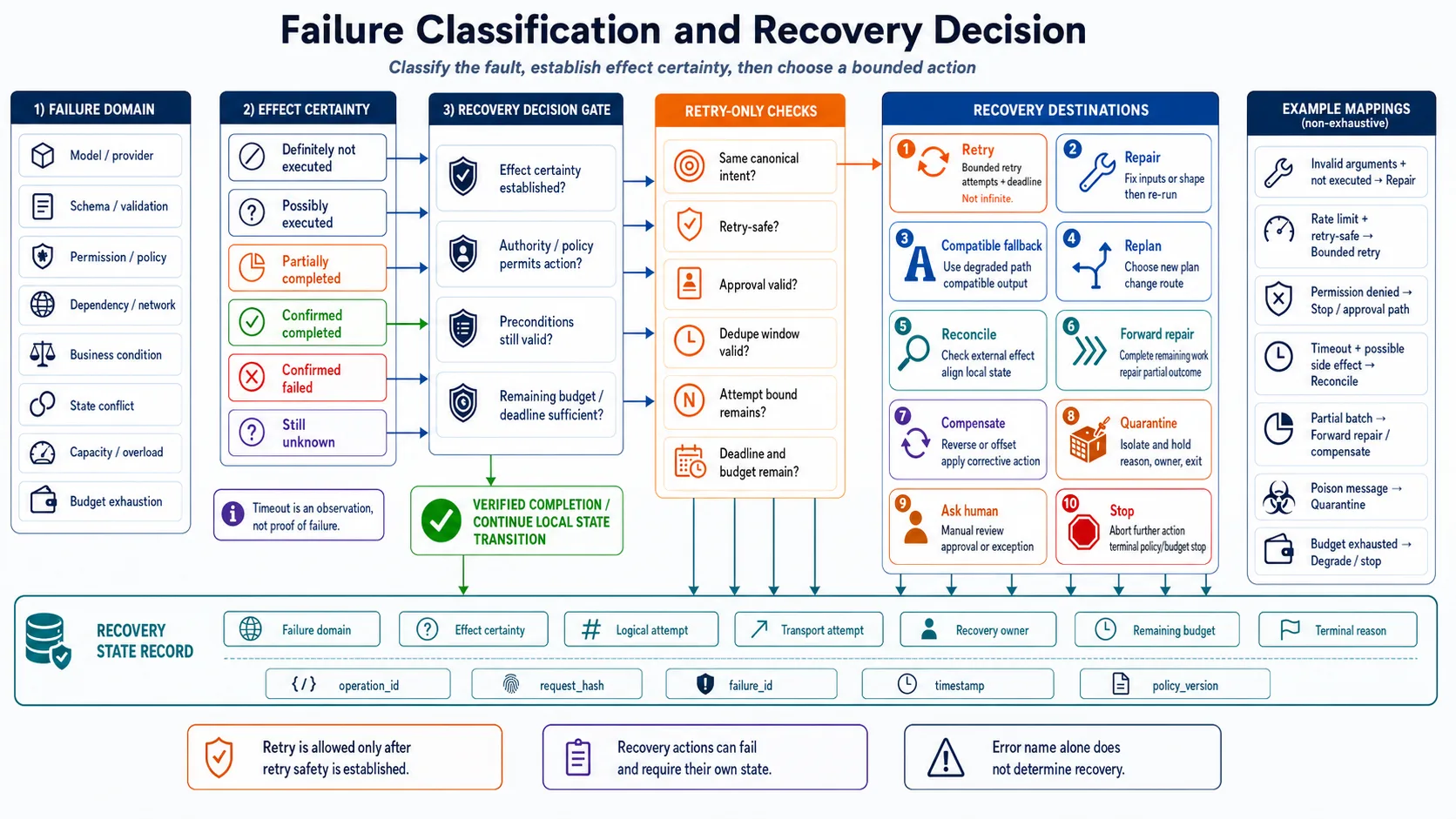
Figure 8-1 | A recovery decision combines failure domain, side-effect certainty, retry safety, and remaining budget rather than mapping every error class to one fixed action.
A recovery action is also a controlled state transition
Recovery should not be scattered across tool-wrapper try/except blocks or delegated wholesale to the model.
Common actions include:
- Retry: the fault may be transient, the operation is safe to repeat, and budget remains.
- Repair: correct schema, arguments, query, or missing input before another attempt.
- Fallback: move to a known-compatible model, provider, implementation, or degraded service path.
- Replan: the present path is blocked, but another authorised path may complete the task.
- Reconcile: inspect external authority because the outcome is unknown.
- Forward repair: preserve an established side effect and repair the state that follows it.
- Compensate: perform a new corrective action rather than pretending that time reversed.
- Quarantine: isolate a poison message, unknown version, or repeatedly failing work unit for bounded review.
- Ask a human: approval, commercial judgement, or high-risk ambiguity prevents autonomous recovery.
- Stop: policy, permanent error, information loss, or budget forbids continuation.
recovery_policy:
  RATE_LIMIT:
    action: retry
    owner: dependency_adapter
    max_attempts: 3
    backoff: exponential_with_jitter

  INVALID_TOOL_ARGUMENTS:
    action: repair
    owner: agent_controller
    max_repairs: 2

  PERMISSION_DENIED:
    action: stop

  UNKNOWN_SIDE_EFFECT_OUTCOME:
    action: reconcile
    blind_resend: false

  POISON_MESSAGE:
    action: quarantine

  BUDGET_EXCEEDED:
    action: stop
This YAML locates ownership, budget, and outcome for a recovery decision. It does not establish correct durable state, idempotency, external reconciliation, concurrency control, or error mapping.
RunState should retain at least:
- failure domain and effect certainty
- logical and transport attempts
- recovery owner
- last delay and
Retry-After - whether provider, model, or tool changed
- side-effect state and reconciliation cursor
- remaining budget
- terminal or quarantine reason
Recovery actions can fail too. Compensation, status queries, fallback, and notification need their own attempts, idempotency, and stopping rules. Otherwise the unbounded loop merely moves into the repair path.
Timeouts, retries and backoff solve different problems
These terms often appear together, but they have separate responsibilities.
A timeout bounds waiting
A timeout answers: how long may this operation remain unresolved?
A harness normally needs separate limits for:
- model calls
- individual tools
- the whole workflow or run
- approval expiry
- queue waiting time
A timeout is an observation made by the caller. It usually means only that no answer arrived within the deadline. It does not prove that the remote operation never started, or that it failed.
A retry trades another attempt for a higher chance of success
Retries suit transient faults such as short network interruptions, rate limits and recoverable provider errors. They add latency, cost and downstream load.
The AWS Builders’ Library describes retries as selfish: the caller increases its own probability of success while adding work to a dependency that may already be overloaded. When several service layers retry independently, traffic can multiply rather than merely increase.1
A retry policy should therefore define at least:
- maximum attempts
- total retry duration
- which layer owns retry authority
- retryable error codes
- whether the operation is idempotent
- whether the run deadline permits another attempt
- whether provider
Retry-Afterguidance applies
Backoff and jitter prevent synchronised retries
Exponential backoff increases the wait between attempts. Jitter adds randomness so that many clients do not fail together, wake together and produce another coordinated surge.
Neither mechanism makes a permanent error retryable, and neither makes a side effect idempotent. Adding jitter to duplicate payment requests merely gives the incident a more varied rhythm.
Budget and retry authority must be visible across layers
An agent can replan, retrieve again, regenerate tool arguments, change models, and rerun verification. Every recovery path spends resources.
Common budgets include:
- maximum steps
- maximum model and tool calls
- logical retry count
- transport retry count
- token and monetary budget
- wall-clock deadline
- retrieval depth
- context information-loss limit
The runtime must enforce and persist these limits. A prompt saying “try no more than three times” is not a control.
Hidden retries are more dangerous:
- the SDK retries three times
- the tool wrapper tries three more
- the agent loop invokes the tool again
- the queue redelivers after a consumer crash
Each layer appears conservative in isolation while the composition produces dozens of calls. A dependable design assigns one retry owner per boundary, or at least charges library retries to one shared attempt ledger.
Downstream calls should also receive the remaining deadline rather than owning timeouts longer than the parent run. When the remaining time cannot accommodate backoff, execution, and verification, another attempt should not be scheduled.
Retry traffic is load. The AWS Builders’ Library notes that a retry improves the caller’s chance of success while adding work to a dependency that may already be overloaded; layered retries amplify failure.1
Fallback must preserve the contract or declare degradation
The purpose of fallback is to maintain an acceptable service, not to find any provider that responds.
Before switching, check:
- tool and structured-output compatibility
- context capacity
- safety, policy, privacy, and data residency
- credentials, region, and network path
- quality floor and verification requirement
- cost, deadline, and rate limits
- whether the new adapter can interpret current RunState and checkpoints
- whether the new route changes side-effect or audit semantics
A primary model may support tool calling and a large context while a fallback supports text only. A successful API response does not preserve the original task contract.
Fallback can also mean a degraded service:
- live search uses a cache with visible freshness
- a high-precision reranker falls back to basic ranking
- browser automation becomes a read-only API path
- full analysis becomes sampling
The result needs an explicit degraded, partial, or comparable state and another completion check. Verification performed under the stronger path does not automatically survive a reduction in evidence quality.
Fallback also needs anti-oscillation control. Two providers configured as mutual fallbacks can bounce between failure surfaces without cooldown and a shared attempt budget.
Idempotency binds the same intent, scope, and operation identity
Idempotency is one foundation of safe retries. It does not mean that a request can be repeated at any future time.
A high-risk operation identity commonly binds:
- tenant, actor, and business intent
- canonical target and argument digest
- operation version
- idempotency key
- provider and account scope
- deduplication-retention window
- preconditions and expected receipt
{
  "operation_id": "refund-op-8f31",
  "idempotency_key": "order-4821-refund-v1",
  "request_hash": "sha256:illustrative-only",
  "actor": "support-agent-17",
  "tenant_id": "tenant-a",
  "action": "create_refund",
  "target": "payment_9027",
  "amount": 12800,
  "currency": "TWD",
  "precondition_version": 18,
  "status": "intent_committed",
  "provider_request_id": null,
  "dedupe_valid_until": "2026-07-09T10:00:00Z",
  "expected_receipt": "refund_id"
}
The example shows that intent, canonical request hash, and the deduplication boundary should be persisted before the side effect. It does not establish provider support, correct clocks or retention, or continuing validity of the business preconditions.
Stripe stores the first result for an idempotency key and rejects reuse with different parameters. Its documentation also gives the key a retention period, after which reuse may create a new request. That is a provider contract, not a permanent cross-system guarantee.23
“Always reuse the same key for the same business intent” is therefore incomplete. Safety requires that:
- canonical intent has not changed
- the request hash matches
- the key remains inside the provider’s deduplication window
- actor, tenant, and account scope match
- preconditions remain valid
- policy still permits retry
If one of these changes, the system needs a new operation version rather than disguising a new intent as an old retry.
Idempotent does not necessarily mean retry-safe. The eventual API state may be idempotent while approval has expired, inventory has changed, credentials have been revoked, or the deadline has passed. Retry safety is the wider judgement.
Unknown outcome: inspect authority before deciding whether to resend
Unknown outcomes are easily amplified by “try again”.
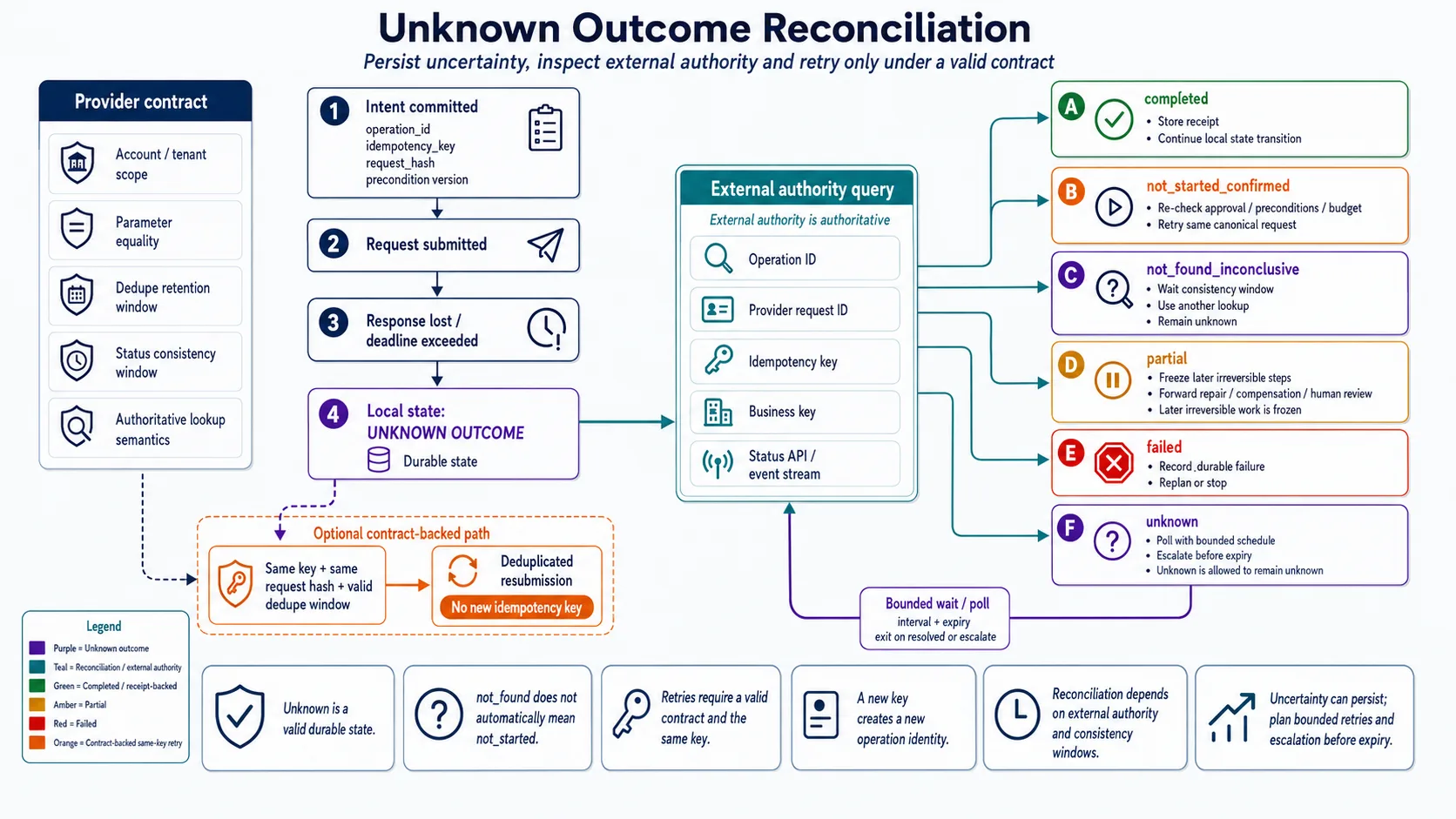
Figure 8-2 | After a timeout, the harness persists an unknown outcome and consults external authority under the provider contract. not_found supports retry only when consistency and deduplication conditions make that conclusion valid.
Intent committed
→ request submitted
→ external system may execute
→ response lost or deadline exceeded
→ local state = unknown
The harness reconciles through an operation identifier, idempotency key, provider request identifier, business key, or status API. The result may be:
completednot_started_confirmednot_found_inconclusivepartialfailedunknown
The dangerous simplification is treating not_found as not_started. A status index may be eventually consistent, limited to one region, or incomplete for the relevant time window. Whether negative evidence permits retry is part of the provider contract.
A safe next transition is usually:
completed: store the receipt and continue the local state transition.not_started_confirmed: retry only while budget, preconditions, and approval remain valid.not_found_inconclusive: wait for the consistency window, use another lookup, or retainunknown.partial: stop later irreversible work and enter forward repair, compensation, or human review.unknown: keep the state unknown and claim neither success nor failure.
If a provider explicitly guarantees deduplication for the same idempotency key inside a valid window, the system may resend the identical canonical request while the outcome remains unknown. That is a contract-backed deduplicated resubmission, not a blind retry. Without that guarantee, reconcile or escalate first.
Stripe’s low-level error guidance similarly notes that network faults can occur at several points in the request lifecycle, requiring idempotency and later state inspection.3
Exactly-once is normally a local property
Within one database transaction, constraints and atomic commit can control writes. Once a path crosses a network, queue, worker, and third-party API, no single component usually guarantees end-to-end exactly-once execution.
A practical design combines:
- at-least-once delivery
- stable operation or occurrence identifiers
- idempotent consumers
- inbox, outbox, or durable operation records
- deduplication windows
- reconciliation
- compensation or forward repair
- audit receipts
A queue may redeliver. A worker may complete an external operation and crash before acknowledging the message. A scheduler may repeat a trigger after failover. Every boundary must decide whether it represents the same intent rather than trusting “this is the first time I saw the message”.
Accordingly, exactly-once should be scoped to an explicit boundary, such as “one database unique key commits once”, rather than presented as a guarantee spanning the entire system.
Compensation and sagas: corrective actions can fail too
An email may already be delivered, a refund may have entered settlement, a deployment may have served traffic, or a webhook may have reached a third party. A database rollback cannot return the whole world to the same state.
The system may choose:
- forward repair
- a reversal transaction
- snapshot restoration
- disablement or quarantine
- corrective notification
- manual reconciliation
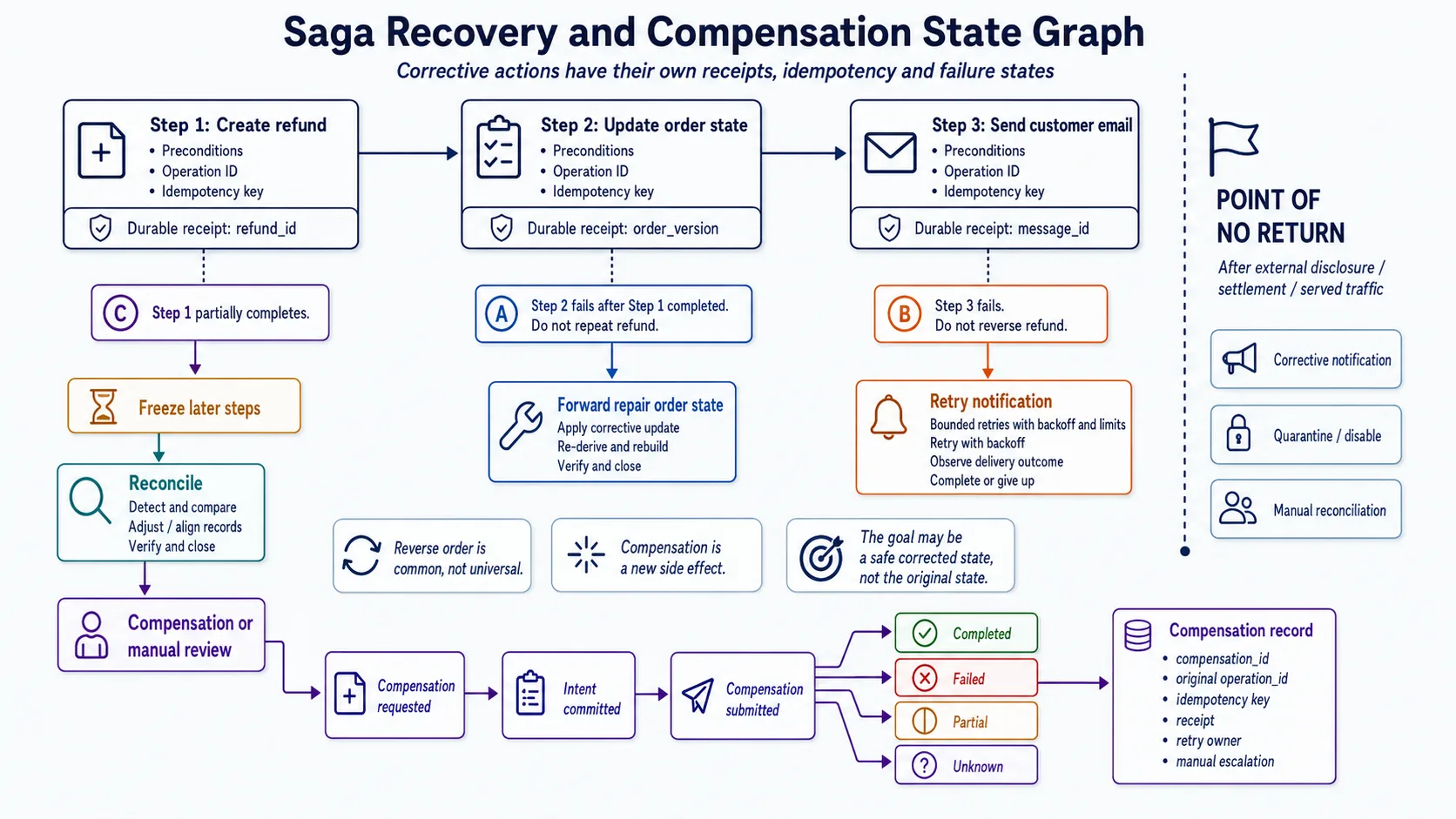
Figure 8-3 | Each forward step and compensation retains its own receipt, idempotency, and failure state. Recovery does not guarantee a return to the original world and need not always run in reverse order.
A saga divides a long transaction into local transactions. Each step should define:
- forward action and precondition
- durable receipt
- retry owner
- compensation or forward-repair action
- compensation idempotency key
- compensation receipt and failure state
- dependency order
- point of no return
- manual escalation path
Compensation is a new side effect and can time out, become partial, or remain unknown. It needs its own recovery state machine rather than an audit field saying rolled_back: true.
Reverse order is common, not universal. An email normally cannot be “unsent”. If a refund completed and the local order update failed, forward repair of local state is more appropriate than another financial reversal.
Create refund
→ update order state
→ send customer email- Refund succeeds and order update fails: retain the refund receipt and repair local state.
- Email fails: retry the notification; do not repeat the refund.
- Refund is partial: freeze later notification and enter compensation or manual review.
The value of a saga is not automatic time travel. It turns “the workflow failed” into local states that can be judged, traced, and recovered independently.
A circuit breaker protects a dependency; it does not choose every retry
When a provider fails continuously, retries increase queueing, latency, and cost. A circuit breaker fails new calls quickly after error rates or other health signals cross a threshold.
Common states are:
closed: calls pass normallyopen: new calls fail fast for a periodhalf_open: a small number of probes test recovery
Retry and circuit breaker patterns have different responsibilities: retries attempt to cross a transient fault, while a breaker prevents repeated calls that are likely to fail. Microsoft’s official pattern makes the same distinction.4
A reliable implementation needs:
- an explicit failure taxonomy that excludes business denials and validation failures from dependency-health signals
- a sensible scope by provider, operation class, region, or tenant
- rolling windows, cooldown, and probe budget
- isolated capacity for half-open probes
- shared state or explicit instance-local semantics
- fallback, queue, rejection, or degraded paths
- recovery evidence
A scope that is too broad lets one endpoint open the circuit for an entire provider. A scope that is too narrow lets every worker rediscover the same outage. Breaker state, retry budget, and admission control need coordination; otherwise one control says “stop” while another continues scheduling background retries.
Admission control: some work should not enter
Agent workloads can occupy models, sandboxes, browsers, external APIs and workers for minutes. A conventional request-per-second limit does not capture a run that lasts ten minutes, creates ten subagents and issues hundreds of tool calls.
Before admission, a harness may evaluate:
- tenant quota
- global and per-tenant concurrency
- model and tool capacity
- sandbox availability
- estimated cost
- priority
- deadline
- required region or credential
- side-effect risk
Accepting work when capacity is already unavailable only converts an immediate rejection into a much later failure.
Backpressure, bulkheads and load shedding
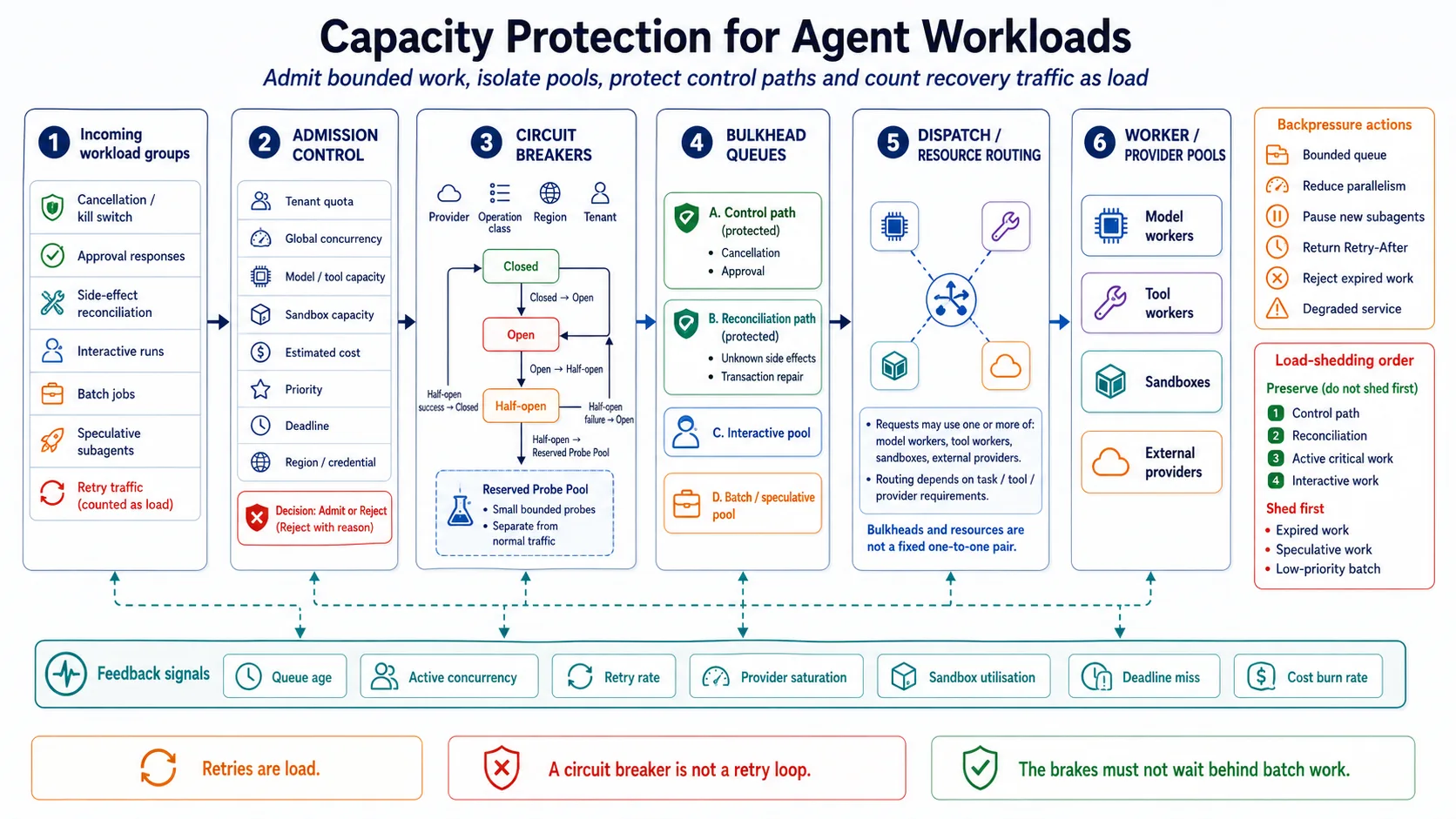
Figure 8-4 | Admission control protects the entrance, backpressure slows producers, bulkheads isolate resource pools, and load shedding preserves control and critical work during overload.
Backpressure tells the producer that the consumer is full
When a downstream service slows, the harness can:
- use bounded queues
- reduce parallelism
- pause new subagents
- delay low-priority work
- reject tasks that can no longer meet their deadline
- return queue position or
Retry-After - move to a compatible provider with available capacity
Google SRE treats overload as an explicit reliability problem and recommends early rejection, load shedding and degraded responses where appropriate. Allowing work to accumulate without a bound causes latency, timeouts and retries to reinforce one another.5
Bulkheads contain the blast radius
Resource pools can be separated by:
- tenant
- interactive versus batch work
- read-only versus side-effect work
- high-cost versus lower-cost models
- external provider
- evaluation traffic
- region
A large batch job for one tenant should not consume the capacity needed for interactive approvals and cancellation.
Load shedding should preserve control paths
Overload priority should not be based only on queue arrival time. A sensible order often preserves:
- kill switches and cancellation
- approval responses
- reconciliation for high-risk side effects already in flight
- active critical work
- interactive requests
- batch and speculative work
A particularly bad overload design puts cancellation and incident inspection behind the same saturated queue as the work causing the overload. The system loses control, and the brakes are also waiting for a slot.
Async work separates acceptance, execution, retention, and delivery
Slow tools, indexing jobs, benchmarks, background agents, and large extraction tasks need durable work identity.
Common execution states include:
accepted → queued → running → completed
                            ↘ failed
                            ↘ cancelled
                            ↘ expired
                            ↘ unknown
A work unit should retain:
- work identifier, type, and parent run
- owner and claim generation
- created, queued, started, heartbeat, and terminal timestamps
- current state and state version
- output or error reference
- retry, idempotency, and cancellation metadata
- notification and delivery state
- retention policy
Background acceptance is the terminal result of the original tool call
{
  "work_id": "work-391",
  "status": "accepted",
  "inspection_uri": "artifact://work-391/status",
  "cancellable": true,
  "side_effect_may_have_started": false
}
A later completed, failed, or cancelled record is a work-lifecycle event, not a second result for the original tool request.
Terminal work state is also distinct from result delivery. Separate at least:
- work terminal state committed
- result artefact retained
- completion event written to an outbox or event log
- subscriber delivery attempted
- subscriber acknowledgement or parent acceptance where the protocol supports it
- retention or tombstone transition
Result retention cannot depend on a vague “notified” flag
Some protocols have no reliable end-to-end acknowledgement. The system must not pretend that it knows the user saw the result. It should retain delivery records, attempts, subscriber cursors, and result expiry, allowing pull and replay.
Cleanup can proceed in stages:
- release large sandbox, browser, and worker resources
- retain terminal state and result artefact
- publish completion through a durable outbox
- reduce the record to an audit tombstone according to acknowledgement, cursor, and retention policy
notification_sent proves at most that a notification service accepted a message. It does not prove that the parent processed it, the user saw it, or the result was accepted.
Durable execution replays workflow state, not external side effects
Durable execution restores a workflow from event history and committed progress after process, worker, or infrastructure failure. Temporal’s model centres on durable workflow execution, event history, and deterministic replay.6
The boundary remains important:
- workflow orchestration code requires determinism and versioning
- external APIs, databases, and other non-deterministic work belong at activity or tool boundaries
- an activity may still execute at least once
- side effects still need idempotency and unknown-outcome reconciliation
- workflow upgrades require versioning or patching
- invalid business input does not become valid through durable retry
Temporal’s official versioning guidance similarly states that replay requires deterministic workflow code and that long-running executions need patching or Worker Versioning.7
Durability preserves “the workflow knows where it reached”. It does not automatically provide external exactly-once execution, compensation, or correct business decisions.
Layered context degradation: context limits need a recovery order
Context failure is also a reliability problem.
When model context approaches its limit, the harness should not send the entire transcript into one opaque summarisation pass. A safer degradation order is:
- persist oversized raw artefacts
- replace old reproducible tool payloads
- remove low-value middle dialogue
- create a schema-bound semantic summary
- use emergency compaction if necessary
- stop safely when critical state can no longer be preserved
Cutting must not separate:
- tool requests from correlated results
- approval requests from decisions
- background acceptance from work IDs
- side-effect operations from receipts
- task claims from ownership records
A summary should retain at least:
- current objective
- user constraints
- decisions and reasons
- modified resources
- tests and evidence
- open failures
- active operation IDs
- remaining work
- next safe action
If the result remains too large or compaction keeps failing, the harness needs a circuit breaker. Repeatedly asking a model to summarise the summary of its previous summary tends to produce thinner evidence rather than concentrated truth.
Scheduled work gives every occurrence its own identity
A scheduled agent task should not run the whole workflow inside a timer callback.
Schedule definition
→ occurrence created
→ queue delivery
→ agent consumer executes
→ terminal result retained
→ completion delivered
→ subscriber notified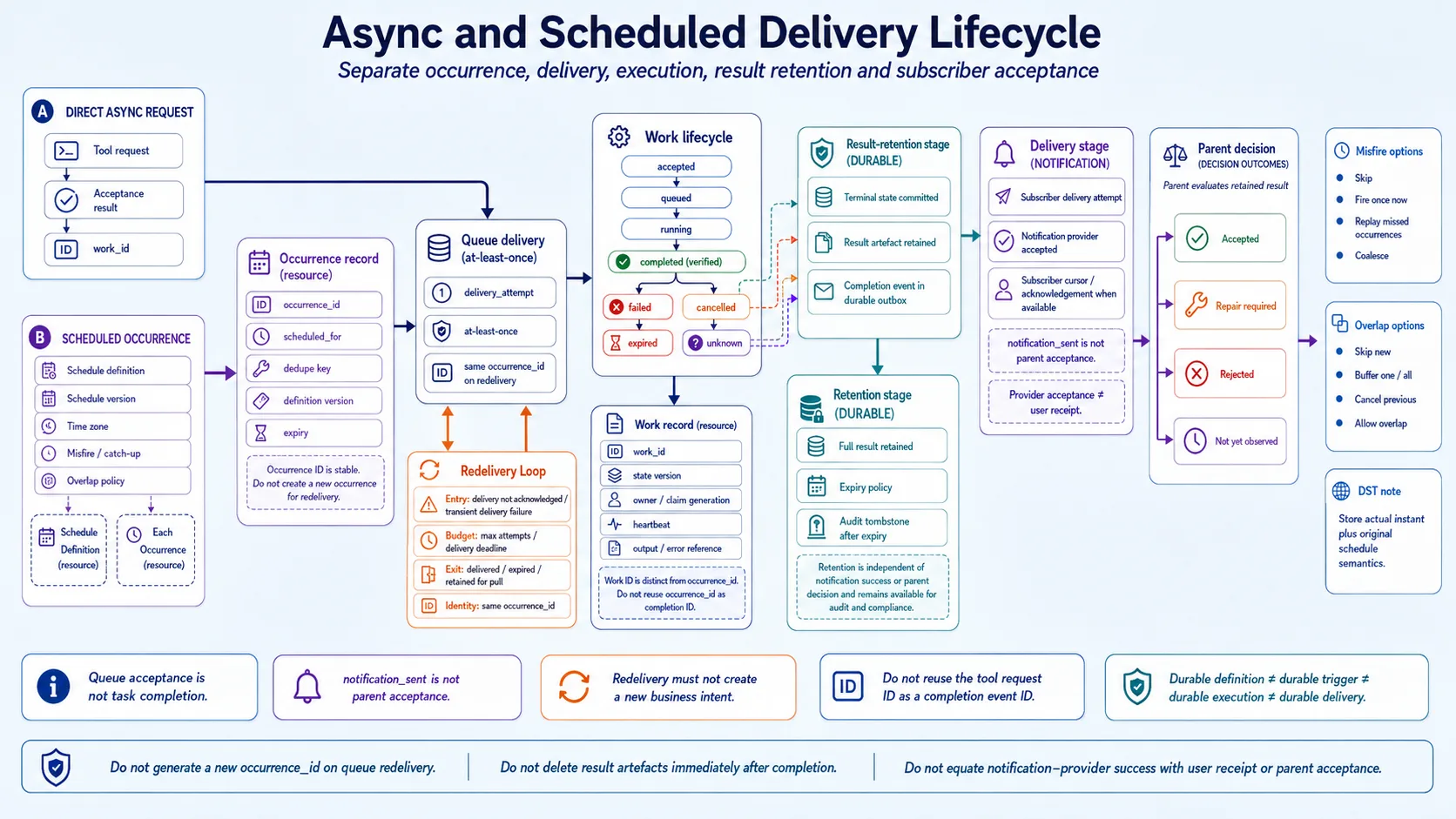
Figure 8-5 | Schedule definition, occurrence, queue delivery, work execution, result retention, and notification are distinct states. Redelivery does not create a new business intent.
A job definition should include:
- job identifier, schedule, and time zone
- tenant, owner, and payload reference
- recurring or one-shot mode
- misfire and catch-up policy
- overlap and concurrency policy
- expiry and deadline
- allowed agent-configuration version
- approval requirement
- schedule version
Each trigger also needs:
- occurrence identifier
- scheduled-for timestamp
- deduplication or idempotency key
- definition version
- delivery attempt
- work identifier
Queue redelivery and scheduler failover can then recognise “the same occurrence delivered again” instead of producing two reports or two payments.
Durable definition is not durable execution
- Durable definition: the schedule survives restart.
- Durable trigger: a due occurrence is persisted by an external scheduler or store.
- Durable execution: worker failure resumes from committed progress.
- Durable delivery: a terminal result can be pulled or replayed after notification failure.
A stored cron expression proves only that the system remembers when it intended to work.
Misfire, catch-up, and overlap require explicit policy
After a missed time, the system may:
- skip
- fire once now
- replay missed occurrences
- coalesce into one run
When a previous occurrence remains active, it also chooses whether to:
- skip the new occurrence
- buffer one or all
- cancel the previous occurrence
- allow overlap
Temporal’s schedule documentation likewise treats overlap policy and catch-up windows as separate controls; poor choices can create missed runs or a burst of replayed work after recovery.8
Time zones and daylight-saving changes also belong in the runtime contract. 02:30 may not exist or may occur twice on some dates, so occurrence identity should retain the actual instant and original schedule semantics.
Failure testing verifies invariants, not merely eventual success
Reliability tests should inject faults at precise boundaries:
- before and after intent commit
- before and after request submission
- after an external side effect but before receipt persistence
- after work completion but before queue acknowledgement
- during compensation
- during a half-open circuit probe
- around schedule-trigger persistence
- around notification-outbox commit
Cover at least:
- model and tool timeouts
- rate limits and provider outages
- duplicate delivery
- partial batch failure
- worker crash and checkpoint recovery
- unknown outcome and eventually consistent status queries
- stale-claim submission
- queue backlog and retry storms
- open and half-open circuits
- context-compaction failure
- scheduled misfire and overlap
- notification redelivery
The test should inspect more than whether the workflow eventually succeeded:
- duplicate side effects
- bounded attempts, cost, and deadline
- recoverable run state
- complete receipts or explicit unknown states
- queue amplification from retries
- honest user-visible state
- effective stop and quarantine paths
- compensation audit trails
Chaos testing is not complete because several workers were killed at random. Each test needs a hypothesis, injected fault, expected transition, forbidden outcome, and recovery evidence. Without an invariant, fault injection is only noise.
Walking through the refund recovery
Return to the refund at the beginning.
1. Persist the intent
The harness creates an operation_id and idempotency key, then stores the order, amount, tenant, actor, policy decision and expected receipt.
2. Send the refund request
The tool adapter calls the payment provider. Run state becomes submitted, not completed.
3. The call times out
The classifier records UNKNOWN_SIDE_EFFECT_OUTCOME, not an ordinary TOOL_TIMEOUT.
4. Reconcile
The harness queries refund status using the idempotency key, provider request ID or payment ID.
- If completed, store the refund receipt and update local order state.
- If confirmed not started, retry within budget using the same idempotency key.
- If partial, pause the customer email and start compensation or human review.
- If still unknown, retain
unknown, poll later and do not claim completion.
5. The order-state update conflicts
The database reports a version conflict. This is not a reason to issue another refund. The harness reloads canonical state and retries only the local state transition.
6. Customer notification fails
The email provider rate-limits the notification. The email operation uses its own message ID and follows Retry-After. The refund is not repeated.
7. Completion gate
The verifier checks:
- the provider refund receipt
- canonical order refund state
- notification state
- operation record and audit trail
The model’s sentence “the refund has been processed” is not completion evidence.
This single run encountered an unknown outcome, a state conflict and a rate limit. All three were errors. None required the same recovery action.
Fifteen questions for reviewing a reliability harness
- Does failure state include both domain and side-effect certainty?
- Which component owns recovery decisions?
- Do logical attempts, SDK retries, and queue redelivery enter one ledger?
- Is the deadline propagated downwards, or restarted at every layer?
- Which operations define idempotency scope, request hash, and deduplication window?
- Does retry safety re-check approval, preconditions, credentials, and budget?
- How is external authority queried after a timeout, and can
not_foundbe merely not-yet-consistent? - Can an unknown outcome remain unknown rather than being guessed into success or failure?
- Does compensation have its own idempotency, receipt, failure state, and manual path?
- Does fallback preserve tools, policy, region, evidence quality, and the completion contract?
- Do circuit breaker, retry budget, and admission control use a coherent scope?
- Is capacity reserved for cancellation, approval, and reconciliation?
- Are background completion, result retention, delivery, and parent acceptance separate?
- Does each scheduled occurrence have stable identity, overlap, misfire, catch-up, and expiry policy?
- Have duplicate delivery, crash, unknown, partial, and overload faults been tested at commit boundaries?
If the main answers remain “run it again”, “the queue handles that”, “the workflow engine probably remembers”, or “check the result at the end”, reliability is still based on hope.
From theory to implementation: Part 08 checklist
- The failure model retains domain, effect certainty, and recovery eligibility.
- A recovery state machine assigns authority for retry, repair, fallback, reconciliation, compensation, quarantine, and stop.
- Retry has one owner or a shared attempt ledger and is bounded by deadline, cost, backoff, and jitter.
- Fallback declares degradation and passes compatibility and completion checks again.
- A high-risk operation persists canonical intent, request hash, operation identifier, idempotency scope, and expected receipt before execution.
- Retry validates deduplication window, preconditions, approval, credentials, and the same canonical request.
- Unknown outcome has its own state; negative lookup is not treated as
not_startedwithout provider-contract support. - External side effects have receipts, missing-receipt or unknown states, and reconciliation paths.
- A saga supports forward repair; compensation has its own idempotency, receipt, failure, and manual escalation.
- Circuit breakers exclude business errors and define scope, cooldown, half-open probes, and recovery evidence.
- Admission, backpressure, bulkheads, and load shedding preserve capacity for cancellation, approval, and reconciliation.
- Async work separates acceptance, execution, terminal result, retention, delivery, and parent acceptance.
- Durable execution is not mistaken for external exactly-once; workflow replay and activity side effects are separate.
- Context degradation persists evidence first and preserves request/result, approval/decision, and operation/receipt pairs.
- Scheduled work uses occurrence identifiers and defines time zone, DST, misfire, catch-up, overlap, expiry, and configuration version.
- Failure tests verify state transitions, forbidden outcomes, and recovery evidence at durable boundaries.
Part 09 addresses a separate boundary: an operation may execute reliably and still lack authority. The next article builds the safety chain from identity, permission, approval, sandboxing, credentials, tenant boundaries, and egress policy.
References
Footnotes
-
Amazon Web Services, Timeouts, retries, and backoff with jitter, accessed 8 July 2026. ↩ ↩2
-
Stripe, Idempotent requests, accessed 8 July 2026. ↩
-
Stripe, Advanced error handling, accessed 8 July 2026. ↩ ↩2
-
Microsoft Azure Architecture Center, Circuit Breaker pattern, accessed 8 July 2026. ↩
-
Google, Handling overload and Addressing cascading failures, accessed 8 July 2026. ↩
-
Temporal, Temporal Platform Documentation and Understanding Temporal, accessed 8 July 2026. ↩
-
Temporal, Safely deploying changes to Workflow code, accessed 8 July 2026. ↩
-
Temporal, Schedule and Troubleshoot missed Schedule Actions, accessed 8 July 2026. ↩