An on-time-delivery metric turns red. The weekly review discusses it. A month later it is still in the monthly pack. At quarter-end the same issue appears on a risk slide.
Nothing about that sequence proves that management has been inactive. It does reveal the question worth asking: what changed each time the issue crossed a review boundary?
A useful cadence leaves a trail. The evidence becomes sharper, a decision is made at the appropriate level, someone accepts a commitment, and the next review tests whether the action worked. If the decision required has changed, the issue may need a different forum. If it has not, copying the issue upwards adds ceremony rather than control.
That is the operating problem behind dashboards, WBRs, MBRs and QBRs.
Test the path from signal to action
Start with the first red flag. At that point the organisation has an observation, not yet a diagnosis. The next management move should create something inspectable: a better explanation, an authorised response, a commitment, or a clearer statement of what remains unknown.
A useful review can therefore be tested by its output. What did the team learn? Who had the authority to decide? Who left accountable for an action? What evidence will the next cycle inspect?
Green status deserves the same discipline. A dashboard can look healthy while a team postpones a necessary trade-off or fails to learn from a near miss. Colour is a navigation aid. Management begins when credible evidence changes what someone does.
Build a trustworthy shared view before asking for a decision
Tableau’s dashboard overview describes dashboards as surfaces that bring related visual information together for monitoring and decision support. That is a useful boundary: the dashboard can make state visible, but it does not define decision rights or close an action.
The visual design should serve the question being asked. The UK Government Analysis Function’s data visualisation guidance ties chart choice to the statistical relationship and message being communicated. A management surface should make the relevant comparison, distribution or change legible rather than reward density for its own sake.
Trust in the underlying data comes first. The UK government’s statement on delayed COVID-19 case reporting documented a technical problem that delayed valid observations from appearing in reports. The lesson transfers cleanly: a chart can render correctly while the operating picture is still incomplete because the data load is stale or missing records.
Before a review relies on the page, the group should know the cut-off time, whether feeds are complete, which sources have been reconciled and where uncertainty remains. In this article, a dashboard is primarily the monitoring and diagnostic surface, while a scorecard makes objectives, targets, ownership and performance judgement more explicit. Organisations use the labels differently; the distinction is a practical one for this framework.
Define the decision contract before setting the meeting frequency
A review forum needs a job description. For this article, the Cadence Contract is a design aid rather than an external management standard.
It asks eight things. First, what horizon is the forum responsible for: days and weeks, a monthly trajectory, or a longer allocation problem? Second, which evidence cut is treated as the common input? Third, what class of decision can the forum make: immediate action, forecast or risk response, resource allocation, or a change in an important assumption? The remaining questions concern decision rights, required outputs, closure evidence, the next check and the condition that would move the issue into a different decision class.
Those answers should drive frequency. A fast-arriving signal with a short recovery window may need a frequent loop; a slower issue involving cumulative evidence may not. Weekly, monthly and quarterly are common patterns, but signal arrival, cost of delay, recovery time and available authority are the stronger design variables.
Role clarity helps for the same reason. Google’s SRE Incident Management Guide is an incident-response guide, so its roles should not be copied into a business review. The transferable mechanism is separation: coordination, communication and operational execution are easier to govern when their responsibilities are explicit. A business review likewise needs clarity over who assembles evidence, who decides and who executes.
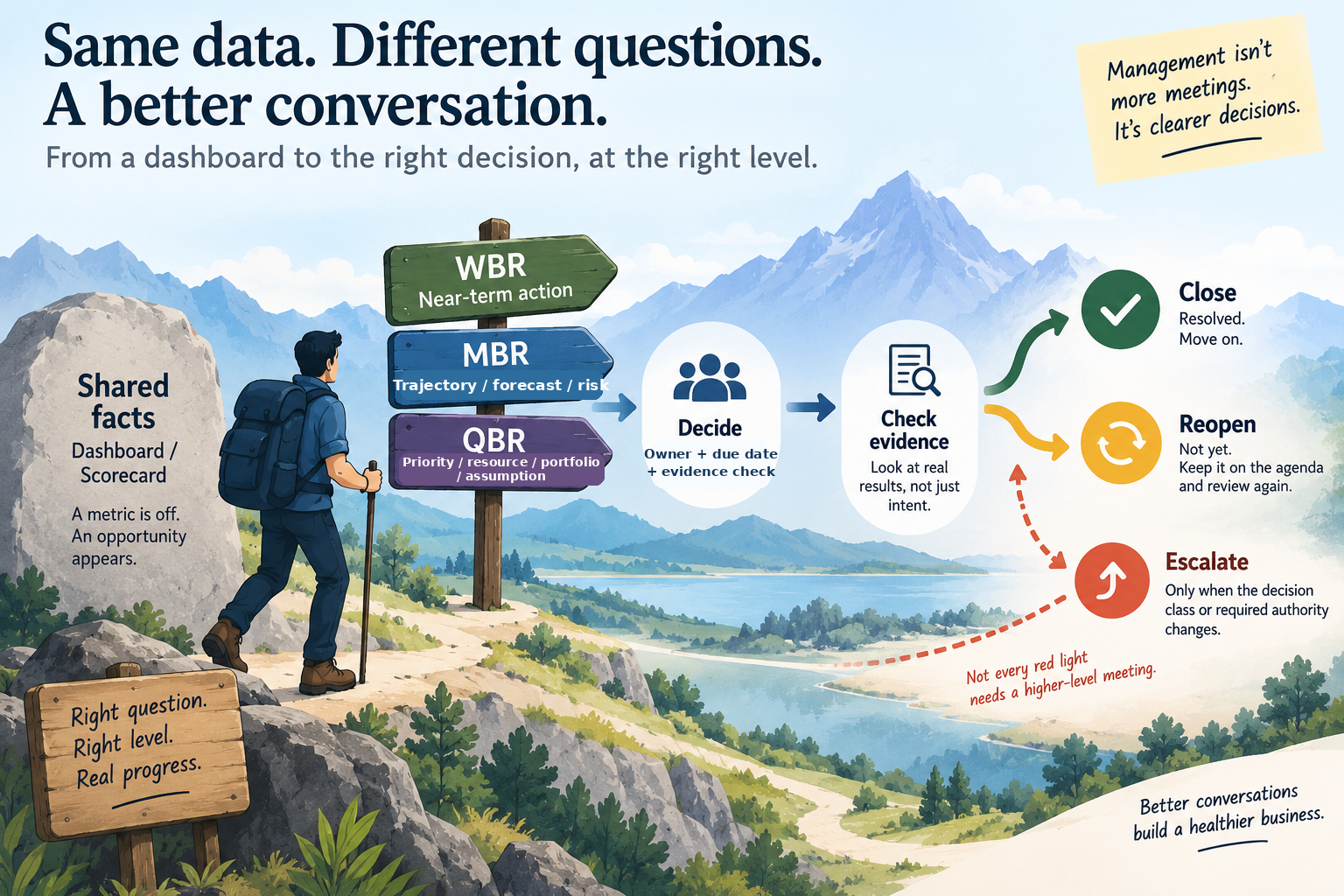
WBR: turn short-cycle exceptions into testable commitments
A Weekly Business Review is best used for issues that can be acted on within a short operating horizon. Stable health measures can move quickly; material exceptions deserve the discussion time.
The pre-read should separate observed facts, working hypotheses, unknowns and any explicit decision request. Amazon’s 2017 shareholder letter describes meetings that begin with participants silently reading a six-page narrative memo. The relevant mechanism is shared written context before debate. The six-page format is Amazon-specific, not a general WBR rule.
Scale can be large without becoming a target. An AWS case study on Amazon Worldwide Returns & ReCommerce reports an analytics migration involving 16 WBR reports and more than 1,000 metrics. That shows how substantial the instrumentation can become. It does not imply that a larger metric count makes a review better.
What gives the WBR a control function is the commitment that survives the meeting: a named owner, a specific action or outcome, a due date, relevant dependencies and an agreed evidence check. “Keep monitoring” is too vague to test. “Continue optimising” does not tell the next review what success would look like.
When the next WBR opens by checking the previous commitment against evidence, the loop has memory. Without that memory, the meeting can run every week and still behave like a fresh status update.
MBR: use accumulated evidence to revise the forward view
The monthly layer has a different information problem. Certified actuals, prior commitments, the latest forecast, material risks and changed assumptions can now be considered together.
Suppose several weekly actions have been completed but the underlying service trajectory is still deteriorating. The monthly question is no longer just which local action to try next. Management may need to revise the forecast, broaden the corrective response or change its risk assessment.
Short-cycle exceptions that remain local should stay in the shorter loop. Moving every open WBR item into the MBR only creates a warehouse of unresolved work.
AWS’s Operational Excellence guidance comes from cloud operations rather than corporate performance management. It nevertheless supports the mechanism behind this layer: recurring operations should incorporate learning and adaptation. A company still has to design its own monthly decision rights and agenda.
An MBR has earned a distinct role when it can change the forward view or authorise a response that the weekly layer could not.
QBR: make the trade-offs that shorter loops cannot
By the quarterly horizon, the evidence may point beyond execution. Capacity, cross-functional constraints, investment priorities, forecast range and important assumptions can all become management decisions.
Return to the delivery example. The WBR may have fixed process problems. The MBR may have concluded that the miss is persistent and reflected it in the forecast. The next question could require a different kind of authority: add capacity, move people from another product line, narrow a service commitment, or change investment priority.
This is also where the boundary with a strategic review becomes important. The OECD’s Strategic Foresight Toolkit and its work on supporting decision making with strategic foresight are primarily public-policy resources. They are useful here for one bounded principle: under uncertainty, decision-makers can examine multiple plausible futures, challenge assumptions and connect those insights to present choices. They are not corporate QBR standards.
A full strategic review goes further than the quarterly operating layer by challenging the strategic thesis and longer-horizon portfolio of choices. Scenario planning, annual operating planning and strategy deployment sit outside this article’s scope.
Move the issue only when the decision class changes
The distinction between the three review layers can be kept compact:
| Horizon | Question | Typical output |
|---|---|---|
| WBR | What near-term action or coordination is required? | action, owner, due date, evidence check |
| MBR | Has trajectory, forecast or risk changed? | corrective response, forecast/risk refresh, next check |
| QBR | Are priorities, resources, portfolio choices or key assumptions still right? | resource or trade-off decision, refreshed commitments |
That table does not create an automatic escalation ladder. An unsuccessful action may simply need another short-cycle attempt. A monthly trajectory can worsen without requiring a portfolio decision. The issue moves upward when the evidence creates a question that the current layer does not have the authority to answer.
Three outcomes are useful to distinguish. Close when the commitment is complete and the agreed evidence shows an acceptable state. Reopen when the action failed, evidence is inconclusive or the earlier diagnosis no longer holds. Escalate when new evidence shows that the current decision authority is insufficient.
Elapsed time alone is weak evidence for escalation. “Red for three weeks” says how long the issue has existed, not why a different class of decision is now required.
Trace one recurring issue through the whole system
You can audit an operating cadence without redesigning every meeting. Pick one KPI exception that has appeared several times and reconstruct its history.
Begin with the first dashboard signal. Was the evidence complete enough to trust? Which forum received it, and did that forum have authority over the decision being requested? Look at the meeting output next. A vague request to “look into it” is very different from a named owner, a due date and an explicit evidence test.
Then inspect the next cycle. Did the review start by testing the previous commitment, or did the group simply present the new status? If the issue moved into an MBR or QBR, write down what changed in the decision question. A shift in trajectory, forecast, risk, capacity or resource allocation provides a reason; persistence by itself does not.
The history should end in one of three places: close, reopen or escalate. If none applies, the issue is probably still circulating through the reporting system.
One final deletion test is useful. If a forum disappeared tomorrow, which decision would the organisation lose? A review with no distinct decision class, authority, evidence requirement or output may be better consolidated, redesigned or replaced by asynchronous reporting.
A dashboard creates visibility. The cadence does the harder work: it turns evidence into a decision, a decision into an accountable action, and the action back into evidence that can close the loop.