The funding question starts after the spreadsheet
A project can pass the spreadsheet test and still fail the company test.
That is the capital-allocation problem in one sentence. The project team may show a high ROI, a clean IRR, a short payback period and a positive NPV. None of those signals is useless. Each one says something real about the proposal. The mistake is treating those signals as a funding decision.
Companies do not allocate capital in empty space. They allocate it while cash is limited, managers are distracted, engineers are already committed, sales capacity is finite, and timing windows close. Approving one project usually means postponing, shrinking or rejecting another feasible use of the same money and attention.
Two questions need to stay separate:
Investment appraisal: under explicit assumptions, is this project economically attractive?
Capital allocation: among the feasible choices, should this project receive scarce capital now?
The first question judges the project. The second judges the choice set. A good project earns entry into the queue; capital allocation decides whether it should move to the front.
Start with the thing being measured
Before comparing ROI, NPV or IRR, define the object of appraisal. Otherwise the model can look precise while measuring the wrong thing.
The object may be an entire product line, a one-off capex decision, a software implementation, a hiring plan, a market-entry experiment, or one incremental choice inside a larger programme. The baseline matters just as much. Are we comparing the project with doing nothing, with a smaller version of itself, or with another live alternative?
A useful appraisal works from incremental cash flows. If the company chooses this project rather than the baseline, which cash inflows change, which cash outflows change, and which side effects become economically relevant? Costs already sunk should not drive the approval decision. Scarce resources used here should be charged against the best feasible alternative they displace.
Several boundary checks usually matter before the formula does:
| Boundary | What must be made explicit |
|---|---|
| Baseline | What the project is being compared against. |
| Investment base | Whether the spend includes only direct vendor or asset cost, or also people, implementation, training and maintenance. |
| Horizon | Whether the decision is about one-year recovery, multi-year value creation, or both. |
| Opportunity cost | What the capital, team or time slot would otherwise be used for. |
| Risk treatment | Whether risk is reflected in cash flows, scenarios, discount rates or constraints, without deducting the same risk repeatedly. |
This is why a sentence such as “our borrowing cost is 5%, so any project above 5% IRR should be approved” is too blunt for most real decisions. Borrowing cost is one part of financing cost. WACC reflects the weighted cost of the firm’s capital structure. A hurdle rate is a screening threshold. IRR is the rate implied by the project’s own cash-flow pattern. They are related, but they are not interchangeable.
When the measurement boundary is wrong, a more elegant model only makes the mistake harder to spot.
What each metric is allowed to decide
ROI, payback, NPV and IRR should not be forced into one role. They answer different operating questions.
ROI is an efficiency lens. It asks how large the return is relative to the investment base. That makes it easy to discuss, but the number is only meaningful once its contract is visible. Is the numerator operating profit, cost saving, after-tax cash flow or incremental gross profit? Is the denominator initial spend, average invested capital or cumulative investment? Is the period one year, three years or the full life of the project?
A claim like “the ROI is 80%” is under-specified. “Over three years, using incremental after-tax cash flow divided by initial implementation investment, the estimated ROI is 80%” is a usable statement because the reader can inspect the basis.
Payback is a liquidity and exposure lens. It asks how long the project takes to recover its initial investment. That can be a serious constraint for a cash-tight company, a high-uncertainty initiative, or a leadership team trying to limit downside quickly. Its weakness is equally important: simple payback ignores the time value of money and ignores cash flows after the recovery point. Discounted payback deals with the first issue, but it still does not measure total value after recovery.
NPV is the absolute-value lens. It discounts future incremental cash flows back to a common valuation date and asks how much net value the project creates after investment. For mutually exclusive projects, that absolute measure often gives a better answer than percentage return alone. It still depends on the cash-flow forecast, discount rate, risk treatment and horizon. A positive NPV says the project is attractive under those assumptions; it does not say the project should outrank every alternative use of capital.
IRR is a return-rate lens. It is the discount rate that makes the project’s NPV equal zero. The percentage format makes it easy to communicate and easy to compare with a hurdle rate. It is also easy to misuse. Non-conventional cash flows can produce multiple IRRs, and mutually exclusive projects with different scale or timing can make the highest IRR point away from the greatest value creation.
So IRR stays in the toolkit. It just should not become the allocator.
A small case where the rankings split
Assume a company has a USD 2.0 million investment budget this year. Management can absorb one large change programme and one small experiment. Three proposals reach the table.
| Project | Initial investment | Rough cash-flow shape | Payback | IRR | NPV | First read |
|---|---|---|---|---|---|---|
| A: automation tool | USD 300k | Quick cost savings, limited scale | 1.3 years | 42% | USD 90k | Efficient, fast recovery |
| B: platform upgrade | USD 1.6m | Heavy upfront work, steadier later cash flow | 3.2 years | 18% | USD 420k | Lower rate, larger value |
| C: new platform stage one | USD 250k now, possible USD 1.2m later | Uncertain early cash flow, possible new-market access | Unstable | Not suitable alone | Unclear as a base case | Strategic option value |
Project A wins the efficiency conversation. It is small, fast and has a very high IRR.
Project B wins the absolute-value conversation. Its IRR is much lower, but the NPV is far larger.
Project C needs a different treatment. Forcing the entire future platform into one confident base case would be too neat. Rejecting it because the full NPV is hard to prove may also be too crude. The disciplined version is a staged investment: commit USD 250k to a validation stage, set gates, and decide later whether the next USD 1.2m deserves approval.
The spreadsheet has not produced a single winner. It has exposed the nature of the trade-off:
- highest IRR may favour a small project with a strong percentage;
- fastest payback may favour early risk reduction;
- largest NPV may require more capital, more time and more organisational capacity;
- strategic option value may need gates instead of a fully monetised forecast.
If the company ranks by IRR, A probably wins. If it ranks by payback, A probably wins again. If it ranks by absolute value, B has the stronger case. If it designs a portfolio for this year’s capital, bandwidth and strategic priorities, the answer may be B plus a small C validation stage, A plus C, or a pause on C. The right answer depends on the constraints.
That is where investment appraisal hands the problem to capital allocation.
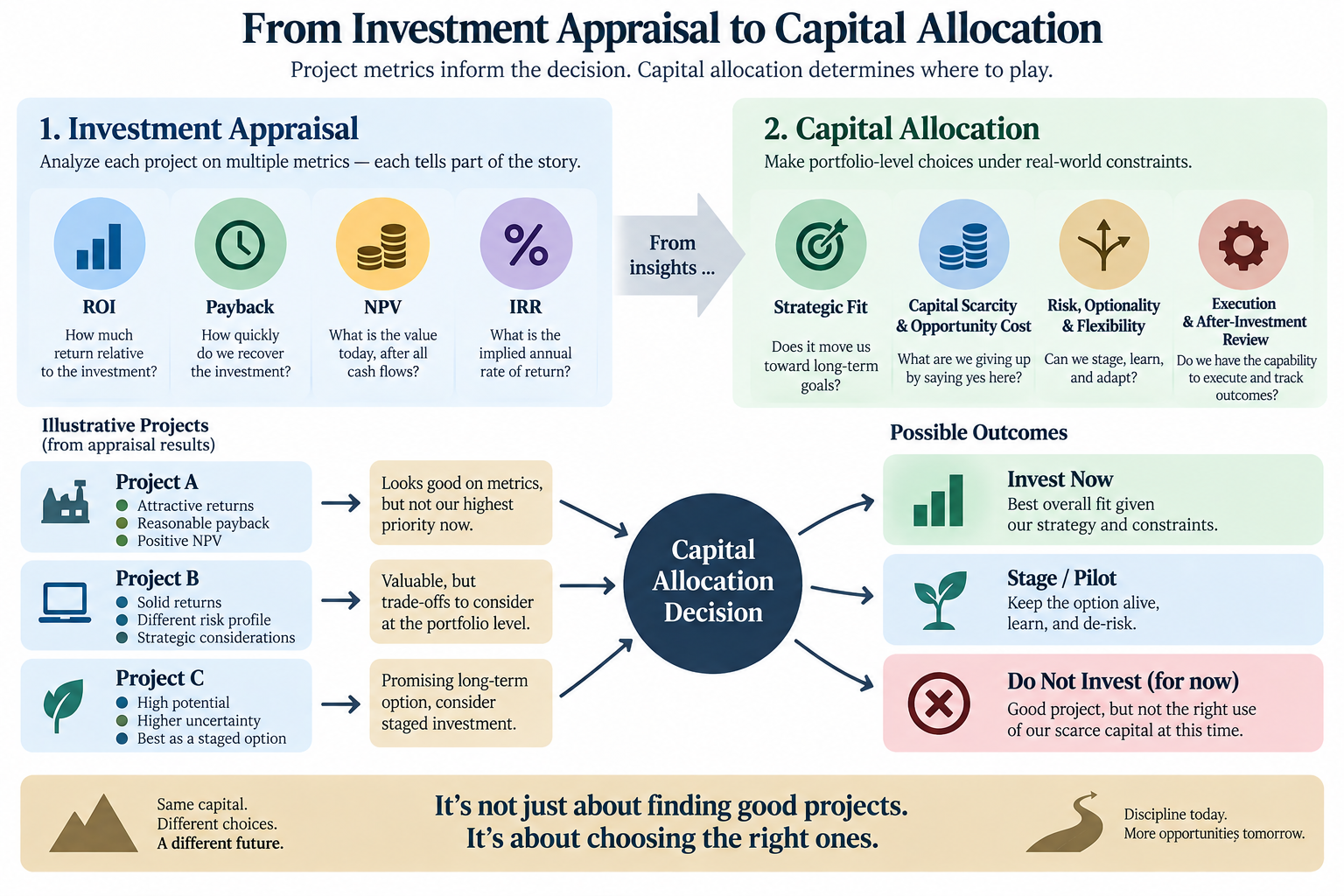
ROI, payback, NPV and IRR are investment-appraisal lenses; capital allocation adds scarcity, opportunity cost, strategy gates and review discipline before money moves.
Scarcity changes the question
A positive NPV is an entry condition, not a crown. Under one set of assumptions, the project appears to create value. The company still has to ask what the same capital could do elsewhere.
Capital competes across more than project proposals. The same dollar may be used to expand capacity, improve operations, hire scarce talent, build a new product, enter a new market, pursue M&A or strategic investment, reduce debt, preserve cash, strengthen resilience, or return capital to shareholders.
Ranking every proposal by ROI will miss several realities. Some investments are indivisible; a company cannot buy 37% of a machine and receive 37% of the benefit. Some opportunities have timing windows. Some initiatives consume the same engineers, sales team or executive attention. Some profitable projects make the company too fragile under a stress case.
A better capital-allocation question is:
Given limited capital, capability, time and risk capacity, which set of choices best supports the company’s value creation and strategic priorities?That question can still use ROI, payback, NPV and IRR. It simply refuses to let any one metric pretend that scarcity does not exist.
Treat strategy as a testable claim
Strategic value is where many capital decisions become foggy.
Project C may arrive with a persuasive story: it is a platform, it opens a new market, it creates learning, it may unlock future revenue. Those statements may be true. The danger starts when the story is quietly buried inside precise-looking cash flows. A team raises year-five revenue a little, lowers the discount rate a little, calls the result “strategic”, and the NPV turns positive.
That is wishful modelling, not strategic finance.
Strategy can belong in the decision. Brand, data, capability, distribution, technical learning and access to a new market can all matter before they can be measured with precision. The fix is not to delete strategy from the model. The fix is to expose the mechanism.
| Strategic claim | Better test |
|---|---|
| “This opens a new market.” | Which market, which customer segment, and which leading indicator would show that access is opening? |
| “This creates synergy.” | Is the synergy in revenue, cost, distribution, technology or procurement, and has it already been counted in the base case? |
| “This is a platform investment.” | Which future choices does the platform create, and does today’s spend create a real ability to delay, expand or abandon? |
| “This is too important not to do.” | What evidence must appear in the first stage, who owns the gate, and when do we stop? |
Real-options thinking is useful only when a real option exists. After the first tranche, the company must have a contingent decision it can actually exercise: delay, expand, shrink, abandon, redirect, or wait for better information before committing more capital.
For Project C, that means the full USD 1.45m should not be approved just because the strategic story is attractive. Nor should the project be valued at zero because the later cash flows are uncertain. A cleaner decision is to approve USD 250k for validation, define what must be true in three months, and release the next tranche only if customer evidence, technical feasibility, early unit economics and strategic milestones clear the gate.
Strategic value should become criteria, gates, options and accountable ownership. Otherwise it becomes a costume for a weak forecast.
Approval starts the review loop
The allocation decision is not finished when the budget is signed. Approval is where the investment thesis becomes testable.
At approval, the important inputs are still assumptions: market response, implementation cost, adoption speed, team capability, competitor reaction and availability of follow-on capital. Each material investment should therefore leave behind a short thesis that can be reviewed later:
- why the project deserved capital;
- which alternatives it beat;
- which assumptions mattered most;
- which indicators would show those assumptions working;
- which signals would trigger a stop, shrink or redirect decision;
- who owns the review and when it happens.
This is not mainly about blame. It prevents story drift.
When a project underperforms, organisations can rewrite the original expectation. The project was never about short-term cash flow. The learning was the value. The cost overrun was strategic. Sometimes those statements are valid. Without a frozen thesis and baseline, it is hard to separate real learning from self-protection.
Return to the three projects. If A pays back quickly, expansion still needs evidence that the savings repeat and that enough similar use cases exist. If B falls behind early, the review should distinguish timing lag, execution failure and a broken demand assumption. If C misses its validation signals, the next tranche should not be released merely because the first tranche has already been spent.
Capital allocation is a loop: allocate, observe, revise, recycle and allocate again.
Pre-approval checklist
Before a promising project receives capital, run the decision in this order:
- Define the object. Which incremental decision is being evaluated, and against which baseline?
- Draw the cash-flow boundary. Which cash flows are incremental, which costs are sunk, and which side effects matter?
- Make the ROI contract visible. What are the numerator, denominator, time period and investment base?
- Check payback. How quickly does the project reduce cash exposure, and what post-payback value is excluded?
- Check NPV. Under consistent assumptions, how much absolute value does the project create?
- Check IRR. Does the return rate clear the relevant threshold, and does the cash-flow shape distort the signal?
- Resolve metric conflict. Do highest IRR, fastest payback and largest NPV point to different projects? If so, why?
- Compare alternative uses. What else could receive the capital: hiring, capex, M&A, debt reduction or cash preservation?
- Name the binding constraint. Is the bottleneck money, talent, attention, timing or risk capacity?
- Make strategy inspectable. What is the mechanism, gate, owner and evidence signal?
- Freeze the thesis. Why does the project win, when will it be reviewed, and when should it expand or stop?
- Keep reallocating. When evidence changes, last year’s story should not trap this year’s capital.
The useful conclusion is not “ignore IRR” or “always trust NPV”. Use each metric for the job it can do, then force the project to compete inside the company’s real capital-allocation problem.
A project being worth doing only gets it through the first door. The harder door asks whether this is the future the company should fund before the others, given its finite money, time, capability and risk capacity.
References
- Aswath Damodaran, NYU Stern, Measuring Investment Returns I: The Mechanics of Investment Analysis.
- Aswath Damodaran, NYU Stern, Chapter 5: Measuring Return on Investments and related corporate finance materials.
- ACCA, The Internal Rate of Return; Payback and Discounted Payback; Modified Internal Rate of Return.
- CFA Institute, Capital Investments and Capital Allocation, 2026 refresher reading.
- HM Treasury and Infrastructure and Projects Authority, Guide to Developing the Project Business Case.
- HM Treasury, The Green Book: Central Government Guidance on Appraisal and Evaluation.
- U.S. Office of Management and Budget, Circular A-94 Appendix D.
- Aswath Damodaran, NYU Stern, Real Options: Fact and Fantasy.
- McKinsey & Company, How to put your money where your strategy is and Admit it, your investments are stuck in neutral.