Review baseline: July 1, 2026
This article intentionally discusses named frameworks. APIs, package names, deployment services, support status, and migration guidance can change. Recheck official documentation and pin tested versions before implementation.
The first nine parts focused on architecture patterns rather than products.
That separation matters:
- ReAct is not owned by one SDK.
- A state machine is not a feature checklist.
- Multi-agent is not a collection of personas.
- Memory is not a vector database.
- Human approval is not a callback.
- A checkpoint is not a business transaction.
- A trace is not an audit record.
Frameworks can reduce repeated engineering. They can also hide the architecture until the team can no longer explain what the system does without naming package classes.
The correct order is:
Domain Contract
  -> Architecture and Control Pattern
  -> Framework or Runtime
  -> Infrastructure and Operations
Not:
Framework
  -> Whatever the tutorial makes easy
This article compares the main implementation paths available in 2026 and shows how to keep domain state, tool contracts, verification, policy, and side effects outside framework-specific gravity wells.
The framework question arrives after the architecture decision
A framework is useful when it provides an abstraction or runtime that the system genuinely needs.
Examples:
- durable state and resume
- an agent loop
- graph or event orchestration
- tool schemas
- handoffs
- streaming
- tracing
- human interruption
- multi-agent messaging
- provider integrations
A framework does not decide:
- which data the user may access
- whether an action is legally authorised
- what counts as completion
- whether a retry is safe
- which evidence supports a claim
- whether a side effect happened exactly once
- who owns the final result
Those are application and governance decisions.
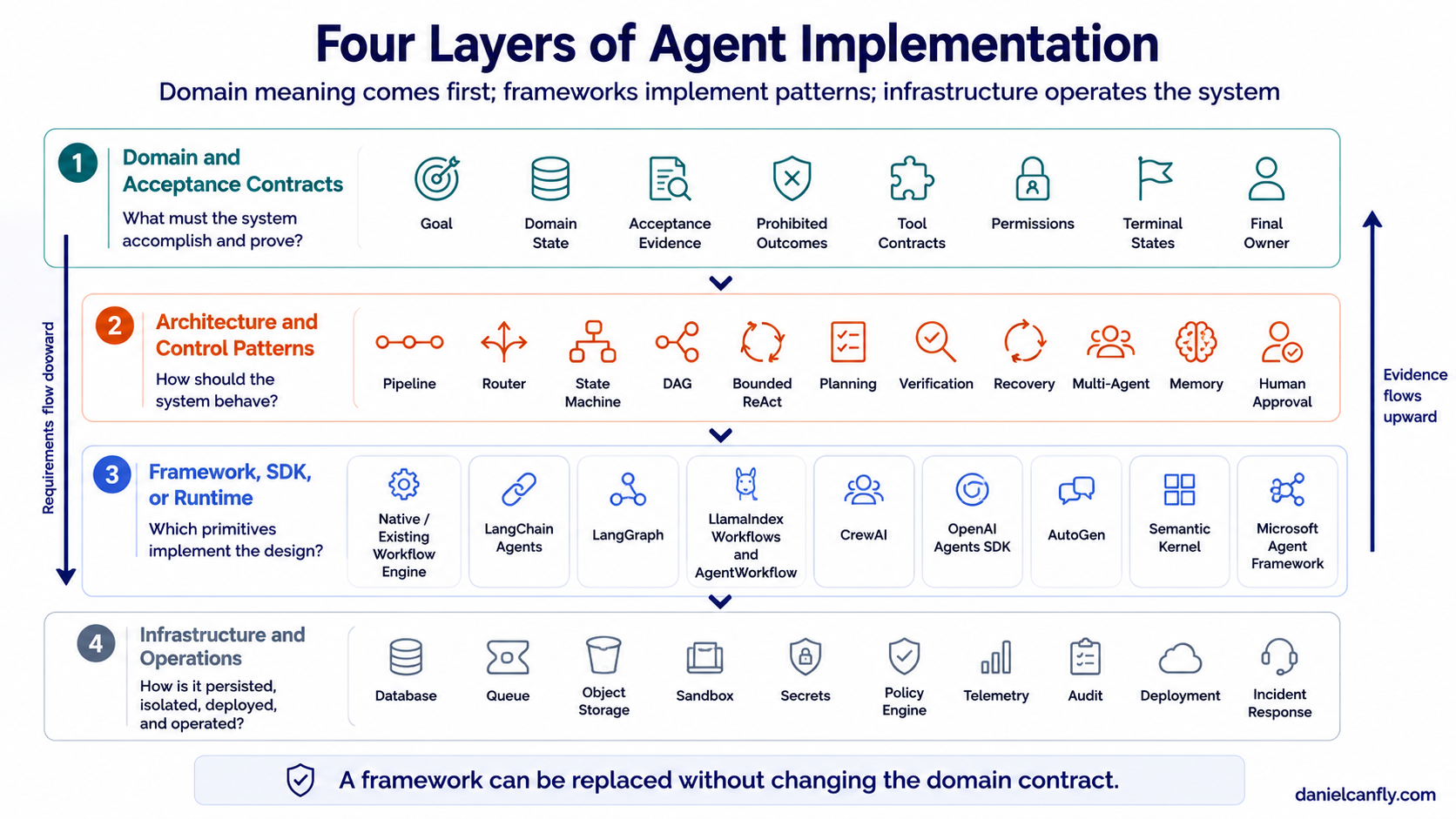
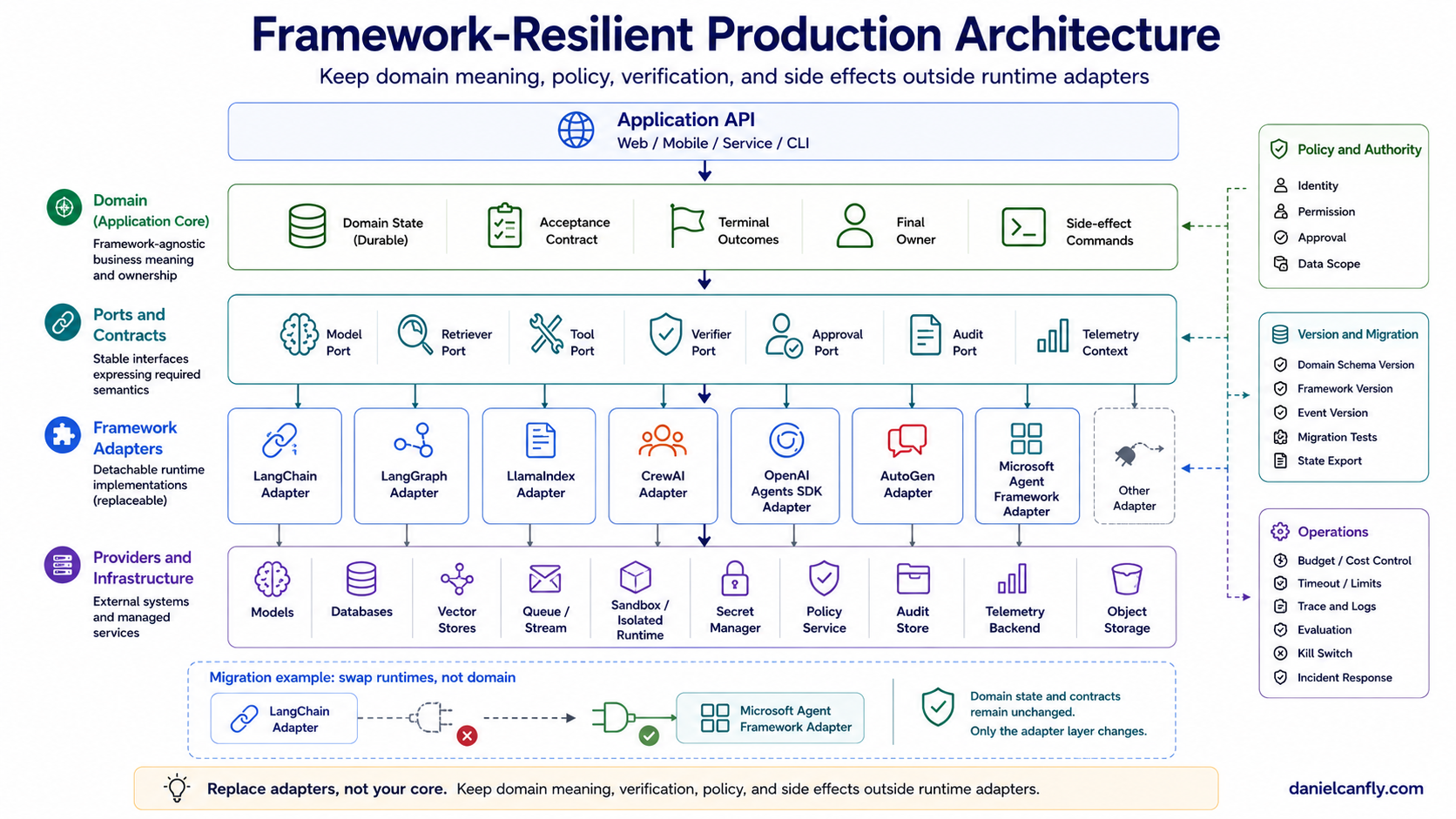
A four-layer implementation model
The previous version used three layers: patterns, frameworks, and infrastructure.
That model missed one layer that should be above all of them: the domain contract.
Layer 1: domain and acceptance contracts
This layer defines:
- user goal
- domain state
- accepted evidence
- prohibited outcomes
- tool and side-effect contracts
- permissions
- terminal outcomes
- final owner
Examples:
A research answer is complete only when every material claim has approved evidence.

A code repair is complete only when the required tests, build, and diff checks pass.

A payment is executable only after deterministic validation and authorised approval.
Framework types should not define these contracts.
Layer 2: architecture and control patterns
This layer defines how the system behaves:
- Direct
- Pipeline
- Router
- State Machine
- DAG
- bounded ReAct
- Plan-and-Execute
- adaptive replanning
- Generate-and-Test
- Supervisor–Worker
- Verifier
- Human Approval
- Working Memory
A framework may implement several of these patterns. No single framework name explains which ones are present.
Layer 3: framework, SDK, or workflow runtime
This layer supplies implementation primitives:
- Native Code or an existing workflow engine
- LangChain agents
- LangGraph
- LlamaIndex Workflows and AgentWorkflow
- CrewAI
- OpenAI Agents SDK
- AutoGen
- Semantic Kernel
- Microsoft Agent Framework
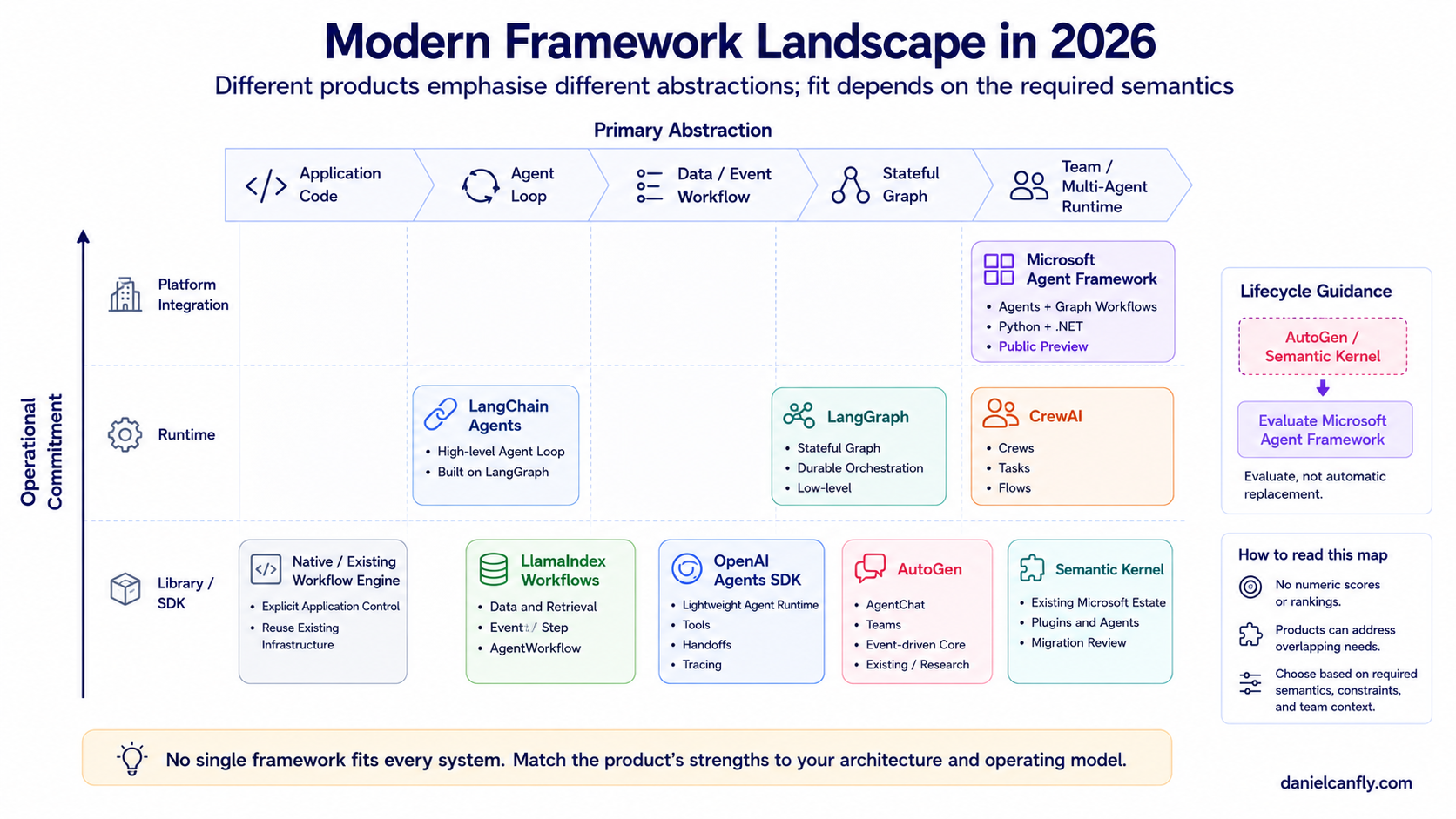
These products are not identical categories. Some provide a high-level agent loop. Some provide low-level orchestration. Some centre on data and retrieval. Some centre on teams. Some are migration paths inside a larger platform ecosystem.
Layer 4: infrastructure and operations
This layer supplies:
- databases
- queues
- object storage
- sandboxes
- secret management
- policy enforcement
- deployment
- telemetry backends
- business audit
- backups
- incident response
- disaster recovery
A checkpointer API does not automatically provide tenant isolation, retention policy, backup recovery, or transactional side-effect safety.
Define framework-neutral contracts first
Framework portability does not come from wrapping every call in one generic interface.
It comes from owning the semantics that matter.
Domain state
Define state in application terms:
from enum import StrEnum
from pydantic import BaseModel, Field


class RunStatus(StrEnum):
    ADMITTED = "admitted"
    RETRIEVING = "retrieving"
    VERIFYING = "verifying"
    WAITING_FOR_APPROVAL = "waiting_for_approval"
    COMPLETED = "completed"
    PARTIAL = "partial"
    FAILED = "failed"


class ResearchState(BaseModel):
    task_id: str
    tenant_id: str
    original_query: str
    rewritten_query: str | None = None
    source_ids: list[str] = Field(default_factory=list)
    retry_count: int = 0
    plan_version: int = 1
    status: RunStatus = RunStatus.ADMITTED
The framework may serialise this state, but the business meaning belongs to the application.
Tool port
from typing import Protocol


class RetrieverPort(Protocol):
    async def retrieve(
        self,
        query: str,
        tenant_id: str,
        limit: int,
    ) -> list["SourceRecord"]:
        ...
Framework adapters can expose this port as:
- a LangGraph node dependency
- a LlamaIndex step dependency
- an OpenAI Agents SDK function tool
- a CrewAI tool
- an AutoGen tool
- a Microsoft Agent Framework function
Verification result
class VerificationResult(BaseModel):
    status: str
    failed_checks: list[str] = Field(default_factory=list)
    evidence_ids: list[str] = Field(default_factory=list)
    required_action: str | None = None
Do not let every runtime invent a different meaning for PASS.
Side-effect command
A side effect should be an explicit command:
class SendEmailCommand(BaseModel):
    command_id: str
    recipient: str
    subject: str
    body_ref: str
    approved_by: str | None = None
The command boundary can enforce:
- idempotency
- permission
- approval
- validation
- audit
- reconciliation
Do not bury the write inside a conversational persona.
Trace context
At minimum preserve:
- trace ID
- task ID
- user and tenant
- parent span
- model version
- prompt version
- framework version
- policy version
- state-schema version
Framework tracing may enrich this context. It should not own the identity model.
Native Code and existing workflow engines
“Native Code” means ordinary application code, not an absence of architecture.
It may use:
- functions
- typed state
- database rows
- queues
- background workers
- retry libraries
- schedulers
- an existing workflow engine
- OpenTelemetry
- policy middleware
Choose this path when
- the flow is small and explicit
- existing orchestration already satisfies durability
- business rules dominate model behaviour
- no open-ended agent loop is needed
- the team needs maximum control over state and side effects
- introducing a new runtime would duplicate existing capabilities
Benefits
- low abstraction leakage
- direct tests
- explicit state transitions
- easier migration
- fewer framework-specific event types
- precise side-effect boundaries
Responsibilities you still own
- persistence
- resume
- concurrency
- cancellation
- human approval
- streaming
- tool loop
- trace instrumentation
- state migrations
- deployment and scaling
The decision should not use an arbitrary number of steps or lines of code.
Use this test instead:
Does a new runtime remove meaningful, repeated engineering without weakening control or duplicating infrastructure?
LangChain agents and LangGraph
Current LangChain documentation positions LangChain agents as a higher-level agent abstraction and LangGraph as the low-level orchestration framework and runtime underneath advanced stateful workflows.
LangChain agents
A suitable starting point when the requirement is primarily:
- a standard tool-using loop
- model and tool integration
- a prebuilt agent abstraction
- rapid implementation without designing every graph edge
Use it when the prebuilt loop matches the contract.
Move lower only when you need more explicit control.
LangGraph
LangGraph is designed for long-running, stateful orchestration with:
- explicit nodes and edges
- durable execution
- persistence
- streaming
- human-in-the-loop interrupts
- deterministic and agentic steps in one graph
A useful mental model is:
Application State
  -> Node
  -> State Update
  -> Conditional Transition
  -> Checkpoint
Important persistence semantics
LangGraph checkpoints graph state. That does not make arbitrary side effects transactional.
Official interrupt guidance explicitly warns that side effects before an interrupt should be idempotent because a node may replay on resume.
Therefore:
- checkpoint before or after a write is not enough
- side effects need command identity
- resume must reconcile external state
- approval must be revalidated
- state schema needs migration planning
Choose LangGraph when
- state transitions are central
- pause and resume are required
- approval interrupts are required
- deterministic and agentic nodes must coexist
- repair and replan loops are explicit
- graph-level control is worth the lower abstraction level
Main risks
- graph spaghetti
- framework state leaking into domain state
- treating checkpoint replay as exactly-once execution
- assuming trace equals audit
- adding a graph where a fixed pipeline was enough
LlamaIndex Workflows and AgentWorkflow
LlamaIndex remains strongly oriented toward data, documents, indices, retrievers, query engines, and RAG.
Workflows add an event and step model. AgentWorkflow adds single-agent and multi-agent orchestration inside the same ecosystem.
Mental models
Workflow:
Event
  -> Step
  -> New Event
  -> Another Step
AgentWorkflow:
Agent
  -> Tool or Handoff
  -> Workflow State
  -> Structured Result
Choose this path when
- retrieval and document abstractions are central
- the system already uses LlamaIndex
- data events drive the workflow
- agent steps need close access to retrievers and query engines
- structured output and evidence objects are first-class concerns
Important boundary
A data framework is not the source-of-truth policy.
You still need to define:
- tenant filtering
- document permissions
- source lineage
- citation mapping
- version handling
- prompt-injection boundaries
- deletion propagation
- acceptance verification
Migration lesson
LlamaIndex’s older QueryPipeline documentation now points users toward Workflows for orchestration.
This is a useful reminder:
Even within one ecosystem, preferred abstractions change. Keep the domain workflow independent of framework event classes.
CrewAI: Crews and Flows solve different problems
CrewAI exposes two important abstractions.
Crews
Crews are useful for:
- role-based collaboration
- bounded specialised tasks
- sequential or hierarchical processes
- rapid multi-agent experiments
Flows
Flows are useful for:
- start, listen, and route control
- explicit state
- persistence and resume
- event-driven execution
- embedding a Crew inside a controlled workflow
Recommended composition
Flow controls the business process
  -> deterministic step
  -> bounded Crew for an open-ended subtask
  -> verifier
  -> continue or stop
Not:
Every function
  -> another persona
  -> another conversation
Choose CrewAI when
- role collaboration is the primary hypothesis
- the team needs to prototype that hypothesis quickly
- a Flow can maintain the outer control boundary
- worker output contracts and a final owner are explicit
Main risks
- persona inflation
- hidden side effects inside tools
- unclear final ownership
- treating role labels as independent responsibility
- using expected-output prose instead of an executable acceptance contract
OpenAI Agents SDK
The OpenAI Agents SDK provides a lightweight agent runtime with a small set of primitives, including:
- agents and runners
- function tools
- agents as tools
- handoffs
- guardrails
- sessions
- human-in-the-loop
- tracing
The SDK uses the Responses API by default for OpenAI models while owning the orchestration loop around turns, tools, guardrails, handoffs, and sessions.
Choose it when
- a compact tool-using agent loop is sufficient
- manager and handoff patterns are clear
- built-in tracing is useful
- OpenAI models or hosted capabilities are already part of the stack
- a large graph runtime is unnecessary
Guardrail scope matters
Guardrails are not a universal policy engine.
Current SDK documentation notes that handoffs follow a different path from ordinary function tools, and tool guardrails do not automatically apply to the handoff call itself.
Therefore:
- map every enforcement point
- keep business authorisation outside model instructions
- validate tool inputs at the execution boundary
- do not assume one guardrail covers all runtime paths
Sessions are not a business workflow database
Sessions can support conversational context. A resumable regulated business process still needs:
- durable domain state
- state versioning
- approval records
- transaction reconciliation
- audit
- migration and incident handling
Tracing is not audit
Built-in tracing records agent runs, tool calls, handoffs, guardrails, and custom events.
An audit record additionally requires:
- business meaning
- actor identity
- immutable retention
- legal and compliance fields
- evidence of approval
- side-effect outcome
Sensitive trace content also needs deliberate handling.
AutoGen, Semantic Kernel, and Microsoft Agent Framework
Microsoft’s framework landscape changed materially.
Official Microsoft documentation describes Microsoft Agent Framework as the direct successor to both AutoGen and Semantic Kernel, and currently labels it public preview.
That does not make existing systems obsolete overnight.
AutoGen
AutoGen still provides:
- AgentChat
- Teams
- Swarm and other team presets
- Core
- event-driven messaging
- distributed runtime concepts
- code execution extensions
Choose it when:
- an existing AutoGen system is working
- research or multi-agent experimentation is central
- AgentChat or Core fits the existing architecture
- migration cost outweighs immediate benefit
For a new Microsoft-centred production system, perform an explicit comparison with Microsoft Agent Framework.
Semantic Kernel
Semantic Kernel remains relevant for existing applications and integrations.
Use it when:
- the existing codebase depends on it
- current capabilities satisfy the contract
- migration creates no demonstrated value
- platform support and lifecycle fit the organisation
Do not rewrite a stable system solely because a successor exists.
Microsoft Agent Framework
Microsoft Agent Framework combines:
- agent abstractions
- graph-based workflows
- session state
- type-safe routing
- checkpointing
- middleware
- telemetry
- human-in-the-loop
- MCP and provider integrations
- Python and .NET support
Choose it for evaluation when:
- the organisation is Microsoft or Azure centred
- graph workflows and agents need one ecosystem
- Python and .NET interoperability matters
- the team accepts preview risk
Preview rule
A preview framework in a critical path needs:
- pinned versions
- adapter boundaries
- migration tests
- a pilot
- rollback
- checkpoint compatibility tests
- owner acceptance of support and change risk
Map one architecture onto several runtimes
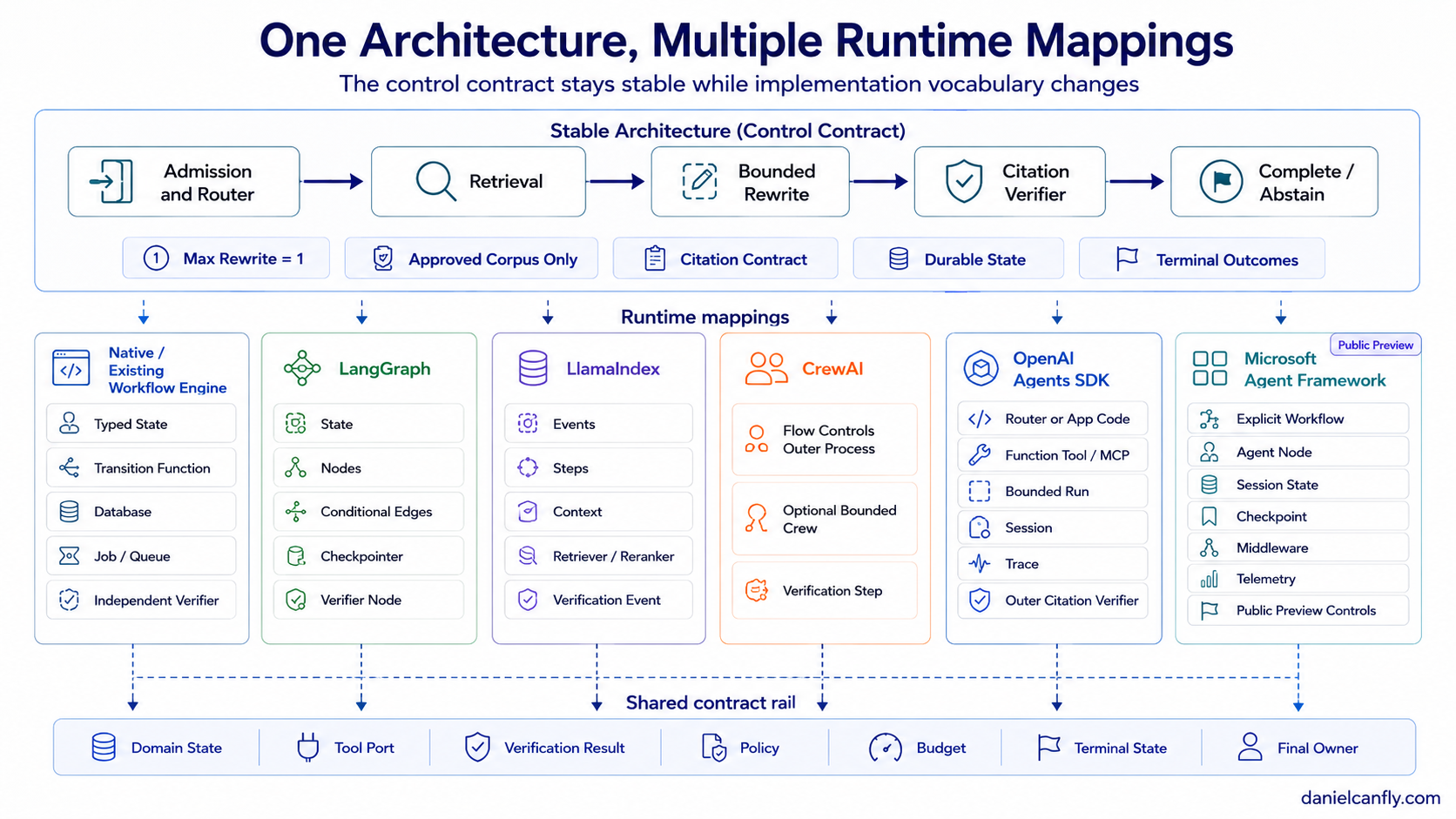
Consider this requirement:
Build a resumable blog research workflow. Route answerable questions directly. Otherwise retrieve approved articles. If evidence is weak, rewrite once. Publish only after citation verification. Otherwise abstain.
The architecture is:
Admission and Router
  -> Retrieval Pipeline
  -> Bounded Rewrite
  -> Citation Verifier
  -> Complete or Abstain
Native Code or existing workflow engine
Use:
- typed state
- database persistence
- explicit transition function
- retry counter
- queue or workflow job
- independent verifier
LangChain agent
Use the prebuilt tool loop only for the bounded adaptive node.
Keep routing, retry limits, and final verification in application code.
LangGraph
Use:
- explicit application state
- route node
- retrieval node
- rewrite node
- verifier node
- conditional edges
- checkpointer
- interrupt if approval is required
LlamaIndex Workflows
Use:
- request event
- retrieval step
- evidence event
- rewrite event
- verification event
- Context or store
- LlamaIndex retriever and reranker
CrewAI
Use a Flow for the outer process.
Use a Crew only if a bounded research subtask genuinely benefits from role collaboration.
OpenAI Agents SDK
Use:
- application or router agent
- retrieval function tool or MCP
- bounded run control
- output and tool validation
- session where appropriate
- built-in tracing
Keep the rewrite count and citation contract in application state.
AutoGen
Use AgentChat or Core only if their team or event model solves a real requirement.
A single-agent retrieval workflow does not need a team.
Microsoft Agent Framework
Use:
- explicit workflow
- agent node only where adaptation is needed
- session state
- checkpointing
- middleware
- telemetry
- preview-risk controls
The architecture remains the same. Only the implementation vocabulary changes.
Checkpoint, session, memory, transaction, and audit are different
These terms are commonly collapsed.
Checkpoint
A saved execution state used for resume or replay.
Session
A continuity boundary for conversational or agent-run context.
Memory
Information intended to influence future reasoning or tasks.
Transaction
A business operation with atomicity, consistency, idempotency, reconciliation, or compensation requirements.
Audit record
An accountable record of who did what, under which authority, using which evidence, with what result.
A checkpoint can say:
The workflow reached SEND_PAYMENTIt does not prove:
The payment executed exactly onceA session can preserve messages. It does not prove that the state is safe to resume after a policy change.
Safe side-effect pattern
Workflow State
  -> Create Typed Command
  -> Validate Policy and Approval
  -> Execute with Command ID
  -> Persist External Result
  -> Reconcile
  -> Advance Workflow State
On resume:
Look up Command ID
  -> Already completed?
       yes -> reuse result
       no  -> determine whether safe to execute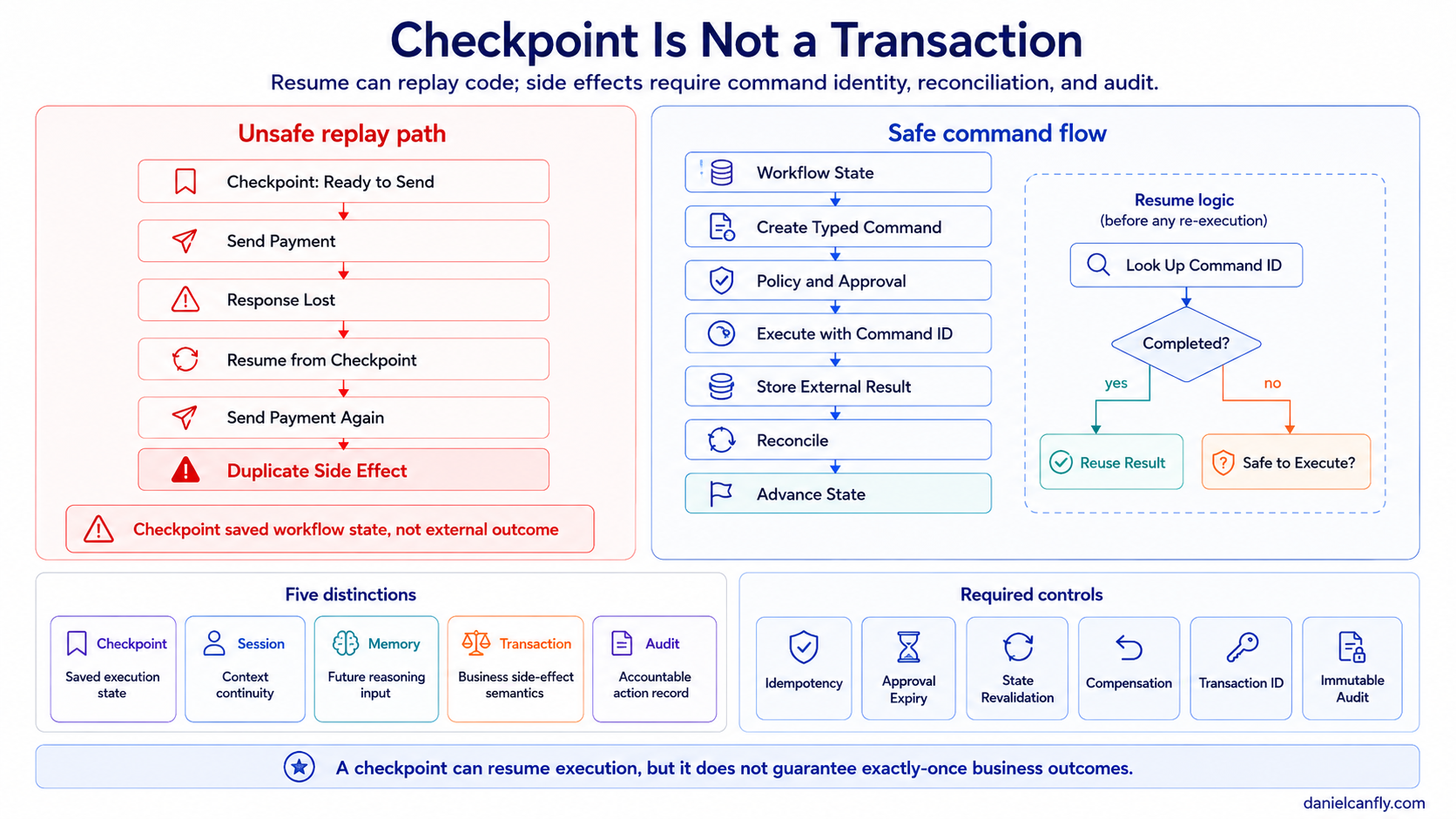
Multi-agent implementation requires contracts, not avatars
Different runtimes can create several agents easily.
The hard part remains:
- task assignment
- context transfer
- output schema
- shared-state permission
- conflict resolution
- termination
- aggregation
- final ownership
- budget
- observability
Supervisor–Worker contract
Supervisor input:
- goal
- task graph
- worker capability registry
- budget
- acceptance criteria
Worker output:
- status
- result
- evidence
- unresolved items
- cost
- side effects
- provenance
Aggregator output:
- merged result
- conflicts
- missing work
- acceptance status
Handoff contract
A handoff should specify:
- reason
- target capability
- context subset
- permissions
- expected result
- return path
- stop condition
Broadcasting the entire conversation is not a neutral default.
Framework mapping
- CrewAI expresses roles, tasks, crews, and flows.
- AutoGen AgentChat expresses teams and speaker or handoff patterns.
- AutoGen Core expresses event-driven actors.
- OpenAI Agents SDK expresses manager, agents-as-tools, and handoffs.
- LangGraph can model agents as graph nodes.
- LlamaIndex AgentWorkflow supports agent handoffs and agent-as-tool patterns.
- Microsoft Agent Framework combines agents and explicit workflows.
No runtime removes the need for a final owner.
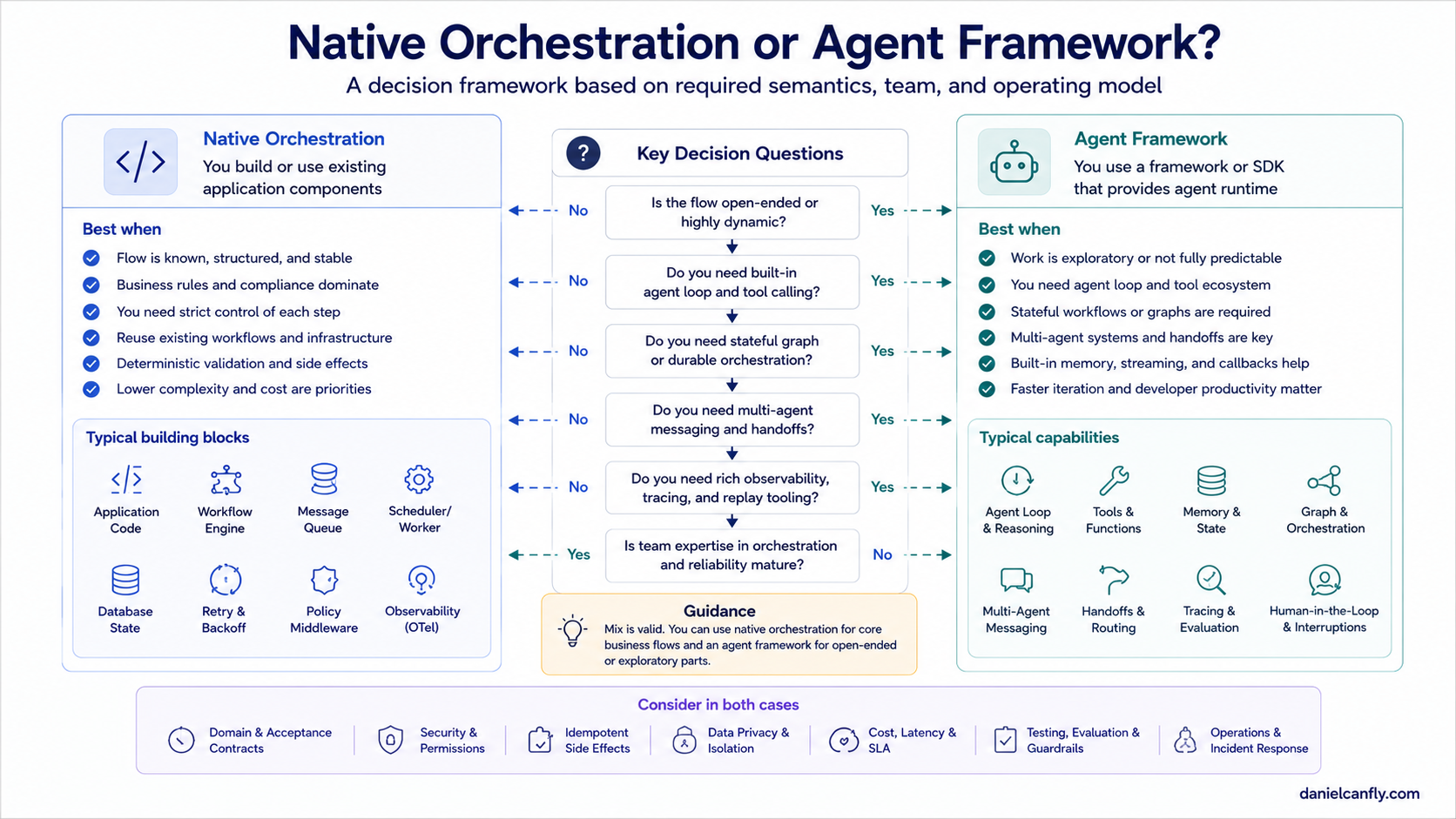
Decide between native orchestration and a framework
Do not use a fixed “three to five steps” rule.
Prefer native code or the existing workflow platform when
- current primitives express the flow clearly
- durability is already solved
- the agentic portion is small
- the team can test and operate the workflow directly
- a new runtime would duplicate queue, state, or approval infrastructure
- framework-specific types would dominate the domain model
Prefer a framework when
- it removes meaningful repeated engineering
- its state and resume semantics match the contract
- the agent loop is a real requirement
- human interruption is difficult to implement correctly
- graph, event, or team primitives improve clarity
- the runtime is observable and testable
- migration and lifecycle risks are acceptable
Reject a framework when
- its abstraction obscures side effects
- its persistence cannot meet state requirements
- policy enforcement depends on prompts
- the team cannot test replay and resume
- the support status is incompatible with risk
- migration requires rewriting domain logic
Choose frameworks by fit, not universal strength scores
A comparison table should not label one framework “very strong” in a capability without a shared benchmark.
Use qualitative fit questions.
| Option | Primary abstraction | Natural fit | Questions to verify |
|---|---|---|---|
| Native or existing workflow engine | Functions, jobs, state, queues | Small or business-dominant workflows | What must be built or operated manually? |
| LangChain agents | High-level agent loop | Standard tool-using agents | Does the prebuilt loop match the contract? |
| LangGraph | State, nodes, edges, checkpoints | Long-running stateful orchestration | Are replay and side effects safe? |
| LlamaIndex Workflows | Events, steps, context, data abstractions | RAG and data-centric workflows | Can domain contracts stay outside event types? |
| CrewAI | Crews, tasks, processes, flows | Role collaboration inside controlled flows | Is each role a real responsibility boundary? |
| OpenAI Agents SDK | Agent, runner, tool, handoff, guardrail | Lightweight tool and handoff runtime | Which paths are covered by guardrails and state? |
| AutoGen | AgentChat teams and event-driven Core | Existing systems, research, multi-agent experiments | What is the migration and lifecycle plan? |
| Semantic Kernel | Kernel, plugins, agents, enterprise integrations | Existing Microsoft applications | Is migration actually justified? |
| Microsoft Agent Framework | Agents plus graph workflows | New Microsoft-centred evaluation | Can preview change risk be accepted? |
The answer may be a mixed stack:
Existing Workflow Engine
  + LangGraph for one complex stateful subflow
  + LlamaIndex retriever
  + OpenTelemetry
  + independent policy and audit
Framework purity is not an architecture requirement.
Build framework-resilient code
Keep domain models outside adapters
Do not expose framework Event, Message, RunContext, or Agent types across the domain boundary.
Keep tool ports narrow
The application should depend on capabilities:
- retrieve evidence
- execute query
- run tests
- send approved message
- write validated record
Not on a framework’s tool decorator.
Keep verification independent
The verifier should accept domain artefacts and evidence, not framework transcripts.
Keep policy outside prompts
Use:
- typed validation
- authorisation service
- tool gateway
- network and credential boundaries
- approval service
- deterministic transaction service
Keep observability portable
Use application trace IDs and OpenTelemetry-compatible semantics where practical.
Framework traces can be linked as child spans or diagnostic artefacts.
Keep event schemas versioned
Persisted events and checkpoints may outlive a framework version.
Store:
- schema version
- framework version
- migration version
- producer
- timestamp
- correlation ID
Maintain a migration seam
For each framework dependency, record:
- why it exists
- what contract it fulfils
- what data it persists
- how to replace it
- how to export state
- how to replay tests
- who owns the migration
Test framework semantics, not only business output
A workflow can produce the correct final answer and still be unsafe to operate.
Unit tests
- domain state transitions
- tool validation
- verifier rules
- policy
- idempotency keys
Contract tests
- framework adapter input and output
- provider replacement
- tool schemas
- event translation
- trace propagation
Workflow tests
- normal path
- retry
- fallback
- repair
- replan
- pause and resume
- cancellation
- terminal states
Replay and side-effect tests
- node replay
- duplicate command
- lost response
- resume after approval
- state migration
- partial checkpoint
- worker crash
Security tests
- prompt injection
- tool escalation
- cross-tenant access
- secret exposure
- unsafe handoff
- memory poisoning
- unauthorised side effect
Evaluation
- task success
- evidence support
- false pass and false fail
- latency
- cost
- human-review load
- recovery rate
Upgrade tests
Before changing framework version:
- run golden set
- read release and migration notes
- load old checkpoints
- resume active workflows
- compare traces
- test rollback
- verify adapter compatibility
Common implementation anti-patterns
Framework-first architecture
The runtime is chosen before the contract.
Framework type leakage
Domain logic depends on framework events and messages.
Agent for every function
Deterministic steps are converted into conversational actors.
Hidden side effects
Writes occur inside opaque tools or personas.
Checkpoint equals transaction
Replay duplicates external operations.
Session equals durable workflow
Conversation continuity is mistaken for resumable business state.
Guardrail equals policy engine
One SDK hook is assumed to cover every execution path.
Trace equals audit
Diagnostic telemetry is mistaken for accountable business evidence.
Multi-agent by persona
Role names replace actual responsibility boundaries.
Preview framework in an unprotected critical path
No adapter, pilot, rollback, or compatibility test exists.
Tutorial code becomes production code
Authentication, tenancy, budgets, failure paths, security, and operations are absent.
No exit strategy
The system cannot export state or replace the runtime.
Production checklist
Architecture
- Domain contract exists before framework selection
- Adaptive nodes are identified individually
- State, memory, session, and transaction are separated
- Side effects have explicit command boundaries
- Final owner is named
Framework fit
- Required semantics are documented
- Official support status is recorded
- Tested versions are pinned
- Persistence and replay behaviour are tested
- Framework types do not dominate domain models
- A migration path exists
Reliability
- Retry, repair, fallback, and replan are separate
- Every loop has a limit
- Checkpoint resume does not duplicate side effects
- Approval expires and state is revalidated
- Terminal outcomes include partial and unsupported
Security
- Tool permissions are enforced outside prompts
- Untrusted content cannot change policy
- Cross-tenant access is tested
- Secrets are excluded or redacted from traces
- High-impact actions require appropriate authority
- Kill switch and incident response exist
Testing and operations
- Adapter contract tests exist
- Failure and replay paths are tested
- Old checkpoints are included in upgrade tests
- Evaluation covers quality, cost, and latency
- Trace and business audit are separate
- Rollback has been rehearsed
Final selection guidance
Use the following questions, not a universal leaderboard.
Is an agent loop needed?
If no, use ordinary code, a pipeline, or the existing workflow engine.
Is durable stateful orchestration the core problem?
Evaluate LangGraph, an existing workflow platform, or Microsoft Agent Framework if its preview status is acceptable.
Is data and retrieval the core problem?
Evaluate LlamaIndex Workflows, possibly inside a broader orchestrator.
Is role collaboration the main hypothesis?
Evaluate CrewAI, AutoGen, LlamaIndex AgentWorkflow, OpenAI Agents SDK handoffs, LangGraph nodes, or Microsoft Agent Framework against the same worker contracts.
Is a lightweight tool and handoff runtime enough?
Evaluate OpenAI Agents SDK or a high-level LangChain agent.
Is this an existing AutoGen or Semantic Kernel estate?
Compare staying, adapting, and migrating. “Successor exists” is not a sufficient business case.
Is the system high risk?
Prefer the runtime whose semantics the team can prove through tests, replay, policy enforcement, incident response, and support commitments.
Conclusion
Frameworks are leverage, not architecture.
A sound implementation owns:
Domain State
+ Tool and Side-effect Contracts
+ Verification
+ Policy and Authority
+ Terminal Outcomes
+ Evaluation
+ Operational Ownership
The framework may supply:
Agent Loop
+ Graph or Event Runtime
+ Checkpointing
+ Handoffs
+ Streaming
+ Tracing
+ Integrations
Infrastructure supplies:
Persistence
+ Queue
+ Sandbox
+ Secrets
+ Deployment
+ Audit
+ Monitoring
+ Incident Response
The best framework is not the one with the longest feature list.
It is the one whose semantics match the architecture, whose lifecycle risk fits the task, and whose removal would not require rewriting the meaning of the system.
References
- LangChain Documentation, LangChain overview
- LangGraph Documentation, LangGraph overview
- LangGraph Documentation, Persistence
- LangGraph Documentation, Interrupts
- LlamaIndex Documentation, Workflows
- LlamaIndex Documentation, AgentWorkflow and structured output
- CrewAI Documentation
- OpenAI, Agents SDK
- OpenAI Agents SDK, Guardrails
- OpenAI Agents SDK, Tracing
- AutoGen Documentation
- Microsoft, Microsoft Agent Framework overview
- Microsoft, Agent Framework migration guides
- OpenTelemetry Documentation