檢查基準:2026 年 7 月 1 日
本文刻意討論具名 Framework。API、Package Name、Deployment Service、Support Status 與 Migration Guidance 都可能改變。正式實作前必須重新核對官方文件並固定通過測試的版本。
前九篇聚焦 Architecture Pattern,而不是產品。
這個分離很重要:
- ReAct 不屬於某一套 SDK。
- State Machine 不是 Feature Checklist。
- Multi-agent 不是一組 Persona。
- Memory 不是 Vector Database。
- Human Approval 不是 Callback。
- Checkpoint 不是 Business Transaction。
- Trace 不是 Audit Record。
Framework 可以減少重複工程,也可能把 Architecture 藏起來,最後 Team 只能用 Package Class Name 解釋系統。
正確順序是:
Domain Contract
  -> Architecture and Control Pattern
  -> Framework or Runtime
  -> Infrastructure and Operations
而不是:
Framework
  -> Whatever the Tutorial Makes Easy
本文比較 2026 年的主要實作路線,並說明如何讓 Domain State、Tool Contract、Verification、Policy 與 Side Effect 遠離 Framework-specific Gravity Well。
Framework 問題應出現在 Architecture Decision 之後
Framework 真正提供系統所需的 Abstraction 或 Runtime 時,才有價值。
例如:
- Durable State 與 Resume
- Agent Loop
- Graph 或 Event Orchestration
- Tool Schema
- Handoff
- Streaming
- Tracing
- Human Interruption
- Multi-agent Messaging
- Provider Integration
Framework 不會替你決定:
- User 可以讀哪些 Data
- Action 是否有法律授權
- 什麼才算完成
- Retry 是否安全
- 哪個 Evidence 支持 Claim
- Side Effect 是否只發生一次
- 誰負責 Final Result
這些是 Application 與 Governance Decision。
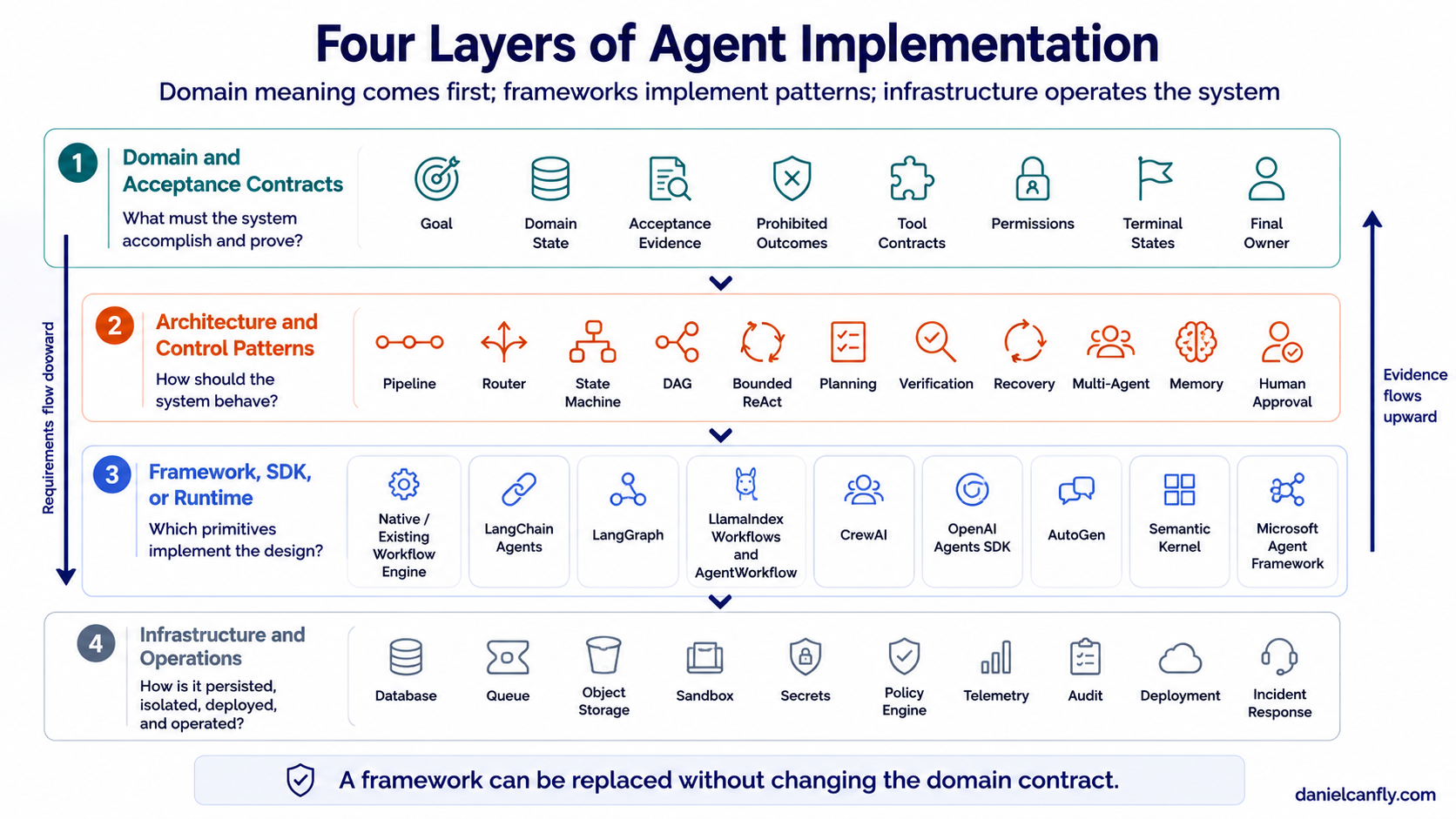
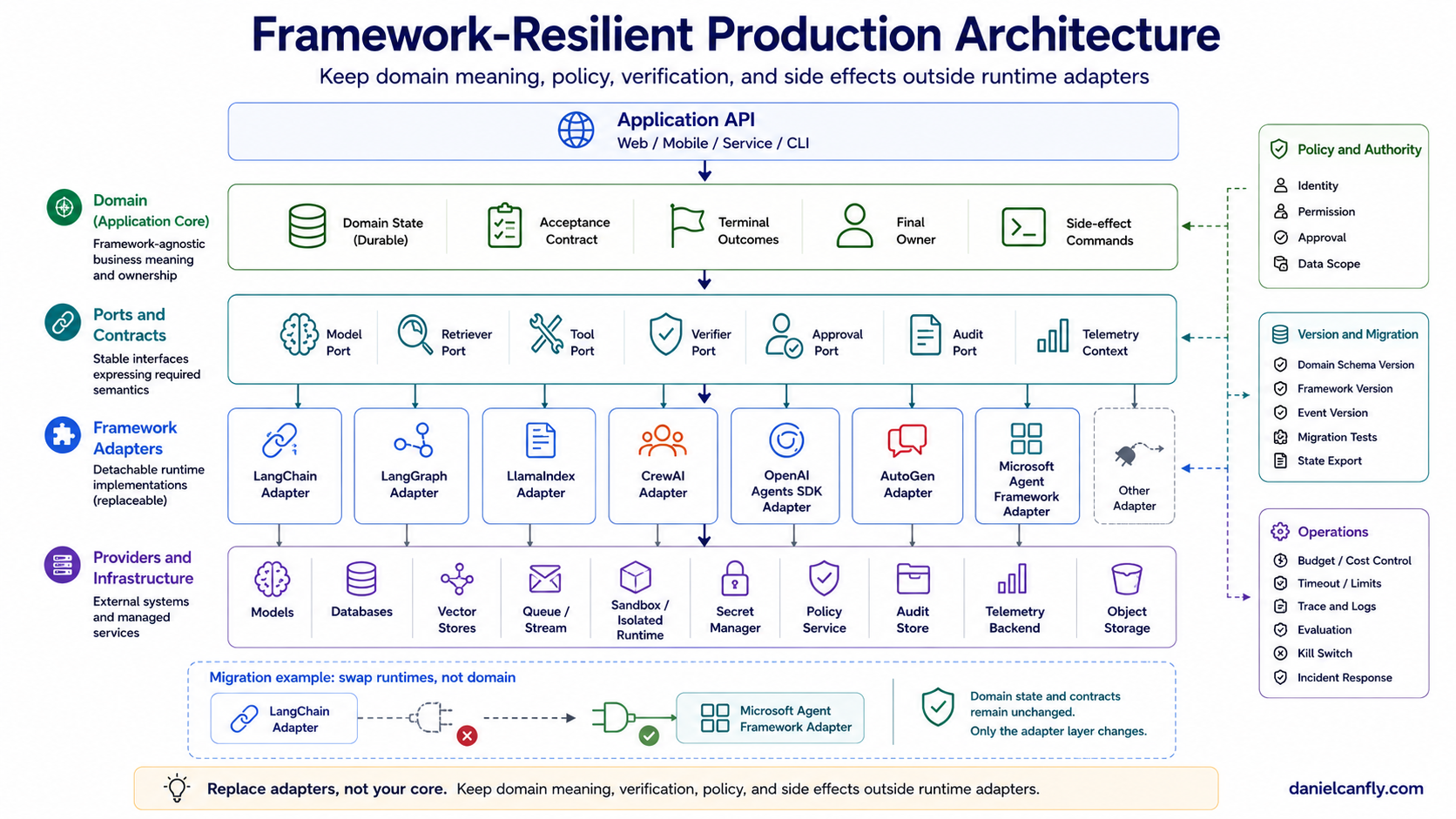
四層實作模型
舊版使用 Pattern、Framework、Infrastructure 三層。
它缺少一個應位於所有層上方的結構:Domain Contract。
Layer 1:Domain 與 Acceptance Contract
這一層定義:
- User Goal
- Domain State
- Accepted Evidence
- Prohibited Outcome
- Tool 與 Side-effect Contract
- Permission
- Terminal Outcome
- Final Owner
例如:
Research Answer 只有在每個 Material Claim 都有 Approved Evidence 時才算完成。

Code Repair 只有在 Required Test、Build 與 Diff Check 通過時才算完成。

Payment 只有在 Deterministic Validation 與 Authorised Approval 後才可執行。
這些 Contract 不應由 Framework Type 定義。
Layer 2:Architecture 與 Control Pattern
這一層定義 System 如何運作:
- Direct
- Pipeline
- Router
- State Machine
- DAG
- Bounded ReAct
- Plan-and-Execute
- Adaptive Replanning
- Generate-and-Test
- Supervisor–Worker
- Verifier
- Human Approval
- Working Memory
一套 Framework 可以實作多種 Pattern。單一 Framework Name 無法說明 System 用了哪些模式。
Layer 3:Framework、SDK 或 Workflow Runtime
這一層提供 Implementation Primitive:
- Native Code 或 Existing Workflow Engine
- LangChain Agents
- LangGraph
- LlamaIndex Workflows 與 AgentWorkflow
- CrewAI
- OpenAI Agents SDK
- AutoGen
- Semantic Kernel
- Microsoft Agent Framework
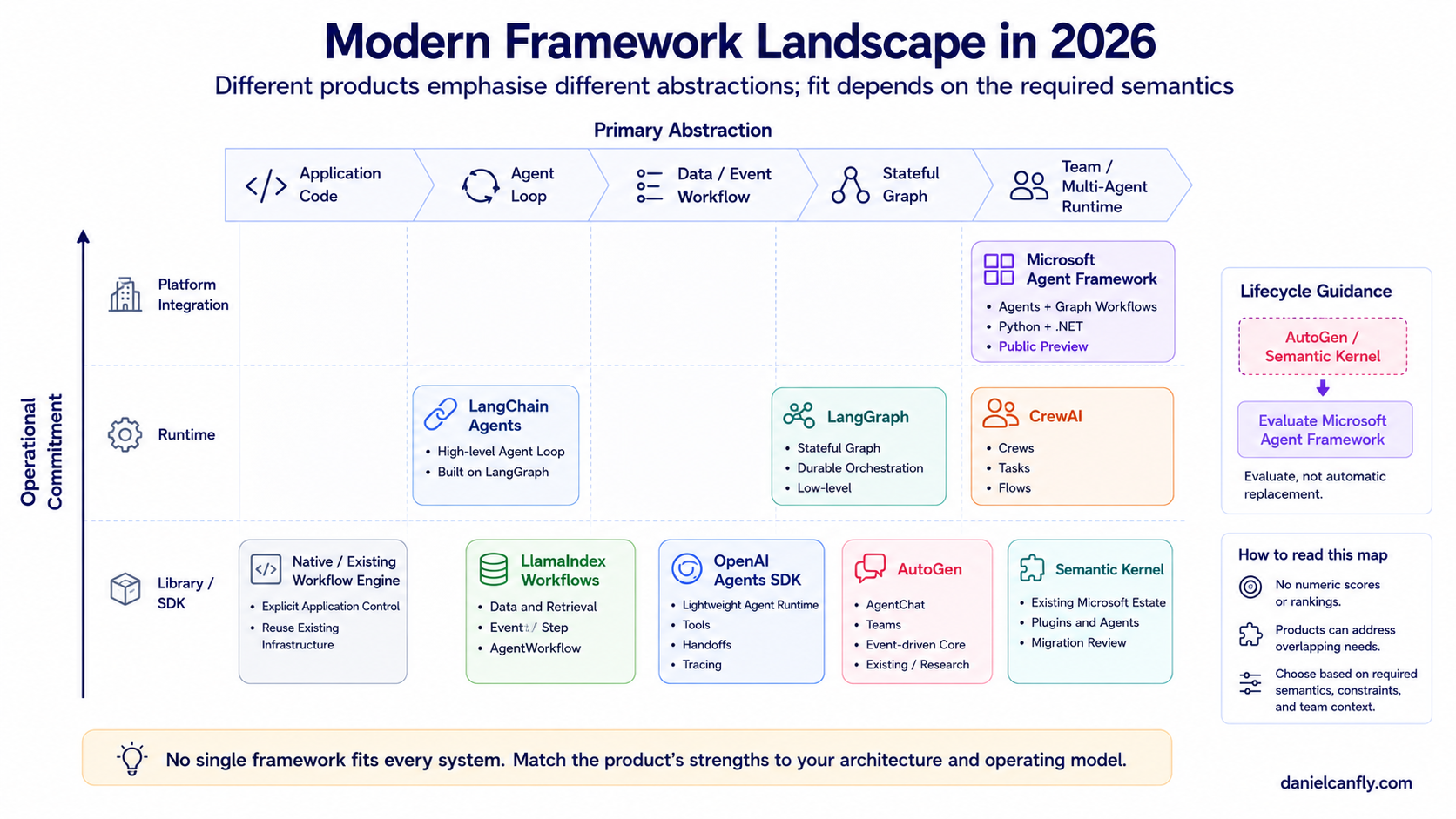
這些產品不是相同類別。有些提供 High-level Agent Loop,有些提供 Low-level Orchestration,有些以 Data 與 Retrieval 為中心,有些以 Team 為中心,有些是大型 Platform Ecosystem 內的 Migration Path。
Layer 4:Infrastructure 與 Operations
這一層提供:
- Database
- Queue
- Object Storage
- Sandbox
- Secret Management
- Policy Enforcement
- Deployment
- Telemetry Backend
- Business Audit
- Backup
- Incident Response
- Disaster Recovery
Checkpoint API 不會自動提供 Tenant Isolation、Retention Policy、Backup Recovery 或 Transactional Side-effect Safety。
先定義 Framework-neutral Contract
Framework Portability 不是把所有 Call 包進一個 Generic Interface 就完成。
真正需要由 Application 擁有的是關鍵 Semantics。
Domain State
用 Application Term 定義 State:
from enum import StrEnum
from pydantic import BaseModel, Field


class RunStatus(StrEnum):
    ADMITTED = "admitted"
    RETRIEVING = "retrieving"
    VERIFYING = "verifying"
    WAITING_FOR_APPROVAL = "waiting_for_approval"
    COMPLETED = "completed"
    PARTIAL = "partial"
    FAILED = "failed"


class ResearchState(BaseModel):
    task_id: str
    tenant_id: str
    original_query: str
    rewritten_query: str | None = None
    source_ids: list[str] = Field(default_factory=list)
    retry_count: int = 0
    plan_version: int = 1
    status: RunStatus = RunStatus.ADMITTED
Framework 可以 Serialise 這份 State,但 Business Meaning 屬於 Application。
Tool Port
from typing import Protocol


class RetrieverPort(Protocol):
    async def retrieve(
        self,
        query: str,
        tenant_id: str,
        limit: int,
    ) -> list["SourceRecord"]:
        ...
Framework Adapter 可以把這個 Port 暴露成:
- LangGraph Node Dependency
- LlamaIndex Step Dependency
- OpenAI Agents SDK Function Tool
- CrewAI Tool
- AutoGen Tool
- Microsoft Agent Framework Function
Verification Result
class VerificationResult(BaseModel):
    status: str
    failed_checks: list[str] = Field(default_factory=list)
    evidence_ids: list[str] = Field(default_factory=list)
    required_action: str | None = None
不要讓每個 Runtime 發明不同版本的 PASS。
Side-effect Command
Side Effect 應是顯式 Command:
class SendEmailCommand(BaseModel):
    command_id: str
    recipient: str
    subject: str
    body_ref: str
    approved_by: str | None = None
Command Boundary 可以執行:
- Idempotency
- Permission
- Approval
- Validation
- Audit
- Reconciliation
不要把 Write 藏在 Conversational Persona 裡。
Trace Context
至少保存:
- Trace ID
- Task ID
- User 與 Tenant
- Parent Span
- Model Version
- Prompt Version
- Framework Version
- Policy Version
- State-schema Version
Framework Tracing 可以補充 Context,但不應擁有 Identity Model。
Native Code 與既有 Workflow Engine
「Native Code」代表普通 Application Code,不代表沒有 Architecture。
它可以使用:
- Function
- Typed State
- Database Row
- Queue
- Background Worker
- Retry Library
- Scheduler
- Existing Workflow Engine
- OpenTelemetry
- Policy Middleware
適合此路線的情況
- Flow 小且明確
- Existing Orchestration 已解決 Durability
- Business Rule 比 Model Behaviour 更重要
- 不需要 Open-ended Agent Loop
- Team 需要最大 State 與 Side-effect Control
- 新 Runtime 只會重複既有能力
優點
- 低 Abstraction Leakage
- 直接 Test
- State Transition 明確
- Migration 容易
- 較少 Framework-specific Event Type
- Side-effect Boundary 精確
仍需自行負責
- Persistence
- Resume
- Concurrency
- Cancellation
- Human Approval
- Streaming
- Tool Loop
- Trace Instrumentation
- State Migration
- Deployment 與 Scaling
Decision 不應依賴任意的 Step 或 Code Line 數量。
應問:
新 Runtime 是否能移除有意義的重複工程,同時不降低控制,也不複製現有 Infrastructure?
LangChain Agents 與 LangGraph
目前 LangChain 官方文件將 LangChain Agents 定位為 High-level Agent Abstraction,LangGraph 則是支援 Advanced Stateful Workflow 的 Low-level Orchestration Framework 與 Runtime。
LangChain Agents
適合以下需求的起點:
- Standard Tool-using Loop
- Model 與 Tool Integration
- Prebuilt Agent Abstraction
- 不想自行設計每條 Graph Edge
Prebuilt Loop 與 Contract 相符時使用。
需要更明確 Control 時才往下使用 LangGraph。
LangGraph
LangGraph 針對 Long-running、Stateful Orchestration,提供:
- Explicit Node 與 Edge
- Durable Execution
- Persistence
- Streaming
- Human-in-the-loop Interrupt
- Deterministic 與 Agentic Step 共存
Mental Model:
Application State
  -> Node
  -> State Update
  -> Conditional Transition
  -> Checkpoint
重要的 Persistence Semantics
LangGraph Checkpoint 保存 Graph State,不會讓任意 Side Effect 自動具有 Transaction Semantics。
官方 Interrupt Guidance 明確提醒,Interrupt 前的 Side Effect 應具 Idempotency,因為 Resume 時 Node 可能 Replay。
因此:
- Write 前後有 Checkpoint 仍不夠
- Side Effect 需要 Command Identity
- Resume 必須 Reconcile External State
- Approval 必須重新驗證
- State Schema 需要 Migration Plan
適合 LangGraph
- State Transition 是核心
- 需要 Pause 與 Resume
- 需要 Approval Interrupt
- Deterministic 與 Agentic Node 必須共存
- Repair 與 Replan Loop 明確
- Lower-level Control 的收益高於成本
主要風險
- Graph Spaghetti
- Framework State 滲入 Domain State
- 把 Checkpoint Replay 當 Exactly-once Execution
- 把 Trace 當 Audit
- Fixed Pipeline 足夠時仍建立 Graph
LlamaIndex Workflows 與 AgentWorkflow
LlamaIndex 仍以 Data、Document、Index、Retriever、Query Engine 與 RAG 為重要核心。
Workflows 提供 Event 與 Step Model;AgentWorkflow 則在同一 Ecosystem 中提供 Single-agent 與 Multi-agent Orchestration。
Mental Model
Workflow:
Event
  -> Step
  -> New Event
  -> Another Step
AgentWorkflow:
Agent
  -> Tool or Handoff
  -> Workflow State
  -> Structured Result
適合此路線
- Retrieval 與 Document Abstraction 是核心
- System 已使用 LlamaIndex
- Data Event 驅動 Workflow
- Agent Step 必須緊密使用 Retriever 與 Query Engine
- Structured Output 與 Evidence Object 是 First-class Concern
重要邊界
Data Framework 不是 Source-of-truth Policy。
仍需定義:
- Tenant Filtering
- Document Permission
- Source Lineage
- Citation Mapping
- Version Handling
- Prompt-injection Boundary
- Delete Propagation
- Acceptance Verification
Migration Lesson
LlamaIndex 舊版 QueryPipeline 文件目前已建議改用 Workflows 做 Orchestration。
這提醒我們:
即使在同一個 Ecosystem,Preferred Abstraction 也會改變。Domain Workflow 不應依賴 Framework Event Class。
CrewAI:Crews 與 Flows 解決不同問題
CrewAI 提供兩個重要 Abstraction。
Crews
適合:
- Role-based Collaboration
- Bounded Specialised Task
- Sequential 或 Hierarchical Process
- 快速 Multi-agent Experiment
Flows
適合:
- Start、Listen 與 Route Control
- Explicit State
- Persistence 與 Resume
- Event-driven Execution
- 在 Controlled Workflow 中嵌入 Crew
建議組合
Flow Controls Business Process
  -> Deterministic Step
  -> Bounded Crew for an Open-ended Subtask
  -> Verifier
  -> Continue or Stop
而不是:
Every Function
  -> Another Persona
  -> Another Conversation
適合 CrewAI
- Role Collaboration 是主要 Hypothesis
- Team 需要快速 Prototype
- Flow 能維持外層 Control Boundary
- Worker Output Contract 與 Final Owner 明確
主要風險
- Persona Inflation
- Side Effect 藏在 Tool
- Final Ownership 不清楚
- 把 Role Label 當成 Independent Responsibility
- 用 Expected-output Prose 取代 Executable Acceptance Contract
OpenAI Agents SDK
OpenAI Agents SDK 提供 Lightweight Agent Runtime,主要 Primitive 包括:
- Agent 與 Runner
- Function Tool
- Agent as Tool
- Handoff
- Guardrail
- Session
- Human-in-the-loop
- Tracing
SDK 對 OpenAI Model 預設使用 Responses API,同時負責 Turn、Tool、Guardrail、Handoff 與 Session 周圍的 Orchestration Loop。
適合此路線
- Compact Tool-using Agent Loop 足夠
- Manager 與 Handoff Pattern 清楚
- Built-in Tracing 有價值
- Stack 已使用 OpenAI Model 或 Hosted Capability
- 不需要大型 Graph Runtime
Guardrail Scope 很重要
Guardrail 不是 Universal Policy Engine。
目前 SDK 文件指出,Handoff 使用的 Runtime Path 與一般 Function Tool 不同,Tool Guardrail 不會自動套用到 Handoff Call 本身。
因此:
- 必須列出所有 Enforcement Point
- Business Authorisation 放在 Model Instruction 外
- Tool Input 在 Execution Boundary 驗證
- 不假設一組 Guardrail 能覆蓋所有 Runtime Path
Session 不是 Business Workflow Database
Session 可以支援 Conversation Continuity。可恢復的受監管 Business Process 仍需要:
- Durable Domain State
- State Versioning
- Approval Record
- Transaction Reconciliation
- Audit
- Migration 與 Incident Handling
Tracing 不是 Audit
Built-in Tracing 可以記錄 Agent Run、Tool Call、Handoff、Guardrail 與 Custom Event。
Audit Record 還需要:
- Business Meaning
- Actor Identity
- Immutable Retention
- Legal 與 Compliance Field
- Approval Evidence
- Side-effect Outcome
Sensitive Trace Content 也需要明確處理。
AutoGen、Semantic Kernel 與 Microsoft Agent Framework
Microsoft 的 Framework Landscape 已發生重大改變。
Microsoft 官方文件把 Microsoft Agent Framework 定位為 AutoGen 與 Semantic Kernel 的直接後繼者,目前仍標示為 Public Preview。
這不代表 Existing System 明天就失效。
AutoGen
AutoGen 仍提供:
- AgentChat
- Teams
- Swarm 與其他 Team Preset
- Core
- Event-driven Messaging
- Distributed Runtime Concept
- Code-execution Extension
適合:
- Existing AutoGen System 正常運作
- Research 或 Multi-agent Experiment 是核心
- AgentChat 或 Core 已符合 Architecture
- Migration Cost 高於 Immediate Benefit
新的 Microsoft-centred Production System 應正式比較 Microsoft Agent Framework。
Semantic Kernel
Semantic Kernel 對 Existing Application 與 Integration 仍有價值。
適合:
- Existing Codebase 已依賴
- 目前能力能滿足 Contract
- Migration 沒有可證明的 Value
- Platform Support 與 Lifecycle 符合 Organisation
不能只因為出現 Successor 就重寫 Stable System。
Microsoft Agent Framework
Microsoft Agent Framework 結合:
- Agent Abstraction
- Graph-based Workflow
- Session State
- Type-safe Routing
- Checkpointing
- Middleware
- Telemetry
- Human-in-the-loop
- MCP 與 Provider Integration
- Python 與 .NET
適合評估:
- Organisation 以 Microsoft 或 Azure 為中心
- Graph Workflow 與 Agent 希望在同一 Ecosystem
- Python 與 .NET Interoperability 很重要
- Team 能接受 Preview Risk
Preview Rule
Critical Path 使用 Preview Framework 時需要:
- Pinned Version
- Adapter Boundary
- Migration Test
- Pilot
- Rollback
- Checkpoint Compatibility Test
- Owner 接受 Support 與 Change Risk
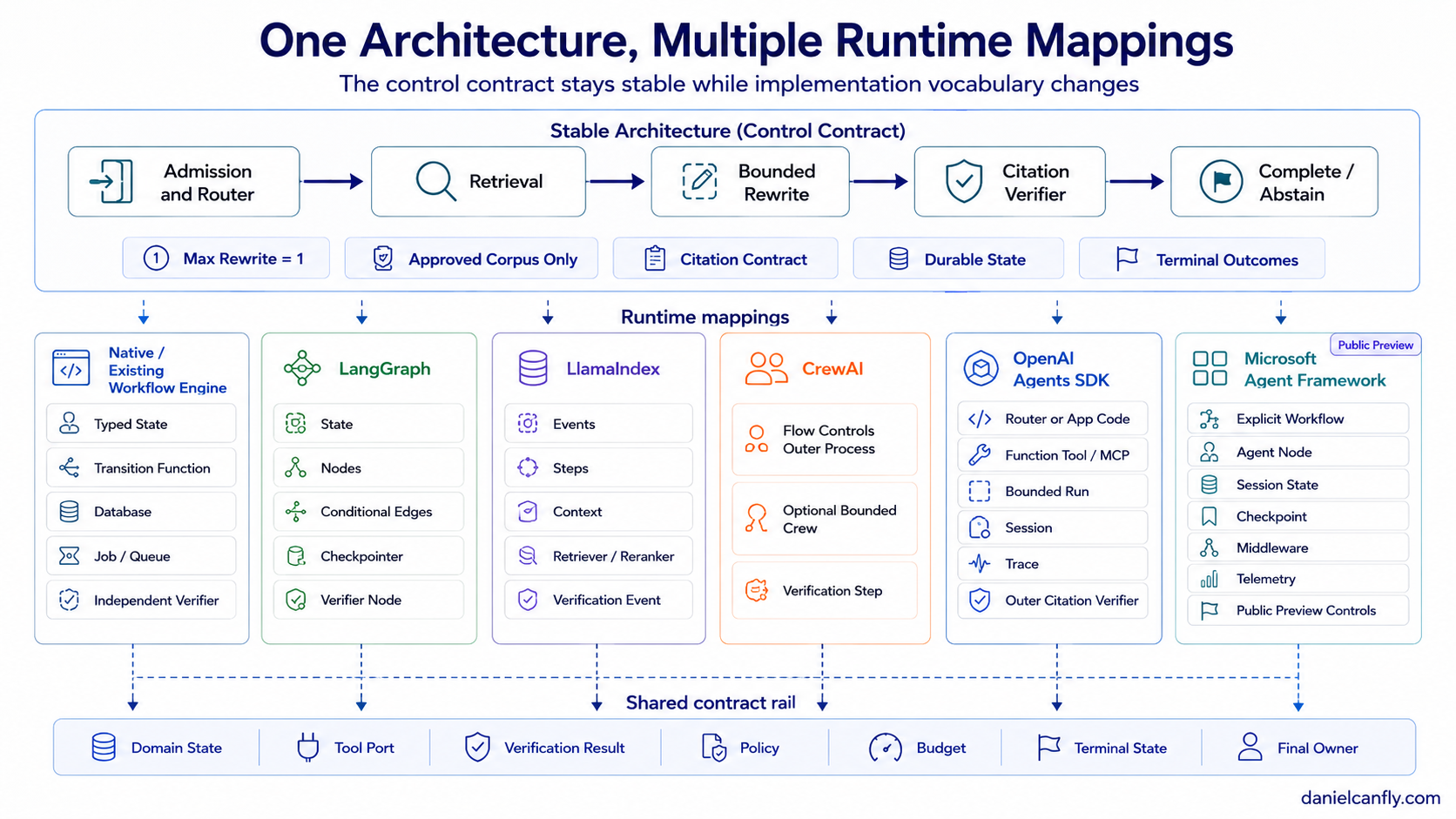
同一 Architecture 映射到不同 Runtime
Requirement:
建立可恢復的 Blog Research Workflow。可直接回答時走 Direct;否則 Retrieval Approved Article。Evidence 不足時最多 Rewrite 一次。Citation Verification 通過後才輸出,否則 Abstain。
Architecture:
Admission and Router
  -> Retrieval Pipeline
  -> Bounded Rewrite
  -> Citation Verifier
  -> Complete or Abstain
Native Code 或 Existing Workflow Engine
使用:
- Typed State
- Database Persistence
- Explicit Transition Function
- Retry Counter
- Queue 或 Workflow Job
- Independent Verifier
LangChain Agent
只在 Bounded Adaptive Node 使用 Prebuilt Tool Loop。
Routing、Retry Limit 與 Final Verification 由 Application Code 控制。
LangGraph
使用:
- Explicit Application State
- Route Node
- Retrieval Node
- Rewrite Node
- Verifier Node
- Conditional Edge
- Checkpointer
- 需要 Approval 時加入 Interrupt
LlamaIndex Workflows
使用:
- Request Event
- Retrieval Step
- Evidence Event
- Rewrite Event
- Verification Event
- Context 或 Store
- LlamaIndex Retriever 與 Reranker
CrewAI
Outer Process 使用 Flow。
只有 Bounded Research Subtask 確實受益於 Role Collaboration 時才使用 Crew。
OpenAI Agents SDK
使用:
- Application 或 Router Agent
- Retrieval Function Tool 或 MCP
- Bounded Run Control
- Output 與 Tool Validation
- 適用時使用 Session
- Built-in Tracing
Rewrite Count 與 Citation Contract 保存在 Application State。
AutoGen
只有 AgentChat 或 Core 的 Team/Event Model 解決真實 Requirement 時才使用。
Single-agent Retrieval Workflow 不需要 Team。
Microsoft Agent Framework
使用:
- Explicit Workflow
- 只有需要 Adaptation 的地方使用 Agent Node
- Session State
- Checkpointing
- Middleware
- Telemetry
- Preview-risk Control
Architecture 不變,只是 Implementation Vocabulary 改變。
Checkpoint、Session、Memory、Transaction 與 Audit 不同
這些名詞常被混在一起。
Checkpoint
用於 Resume 或 Replay 的 Saved Execution State。
Session
Conversation 或 Agent-run Context 的 Continuity Boundary。
Memory
預期影響 Future Reasoning 或 Task 的資訊。
Transaction
具有 Atomicity、Consistency、Idempotency、Reconciliation 或 Compensation 要求的 Business Operation。
Audit Record
記錄誰在什麼 Authority 下、使用什麼 Evidence、做了什麼並得到什麼 Result 的 Accountable Record。
Checkpoint 可以表示:
Workflow Reached SEND_PAYMENT它不能證明:
Payment Executed Exactly OnceSession 可以保存 Message,不能證明 Policy 改變後 State 仍可安全 Resume。
Safe Side-effect Pattern
Workflow State
  -> Create Typed Command
  -> Validate Policy and Approval
  -> Execute with Command ID
  -> Persist External Result
  -> Reconcile
  -> Advance Workflow State
Resume 時:
Look Up Command ID
  -> Already Completed?
       yes -> Reuse Result
       no  -> Determine Whether Safe to Execute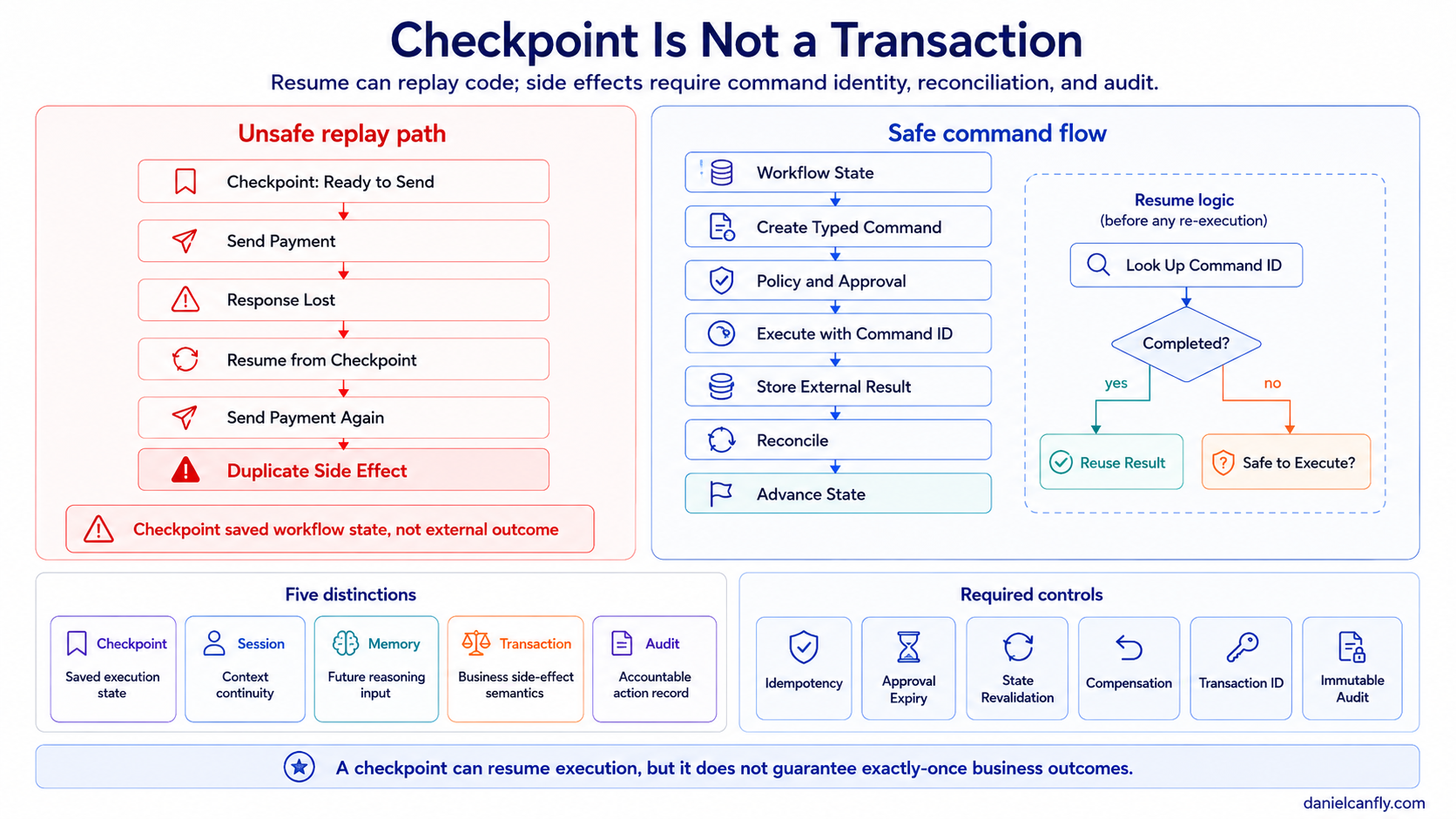
Multi-agent 實作需要 Contract,不是 Avatar
不同 Runtime 都能輕鬆建立數個 Agent。
真正困難的是:
- Task Assignment
- Context Transfer
- Output Schema
- Shared-state Permission
- Conflict Resolution
- Termination
- Aggregation
- Final Ownership
- Budget
- Observability
Supervisor–Worker Contract
Supervisor Input:
- Goal
- Task Graph
- Worker Capability Registry
- Budget
- Acceptance Criteria
Worker Output:
- Status
- Result
- Evidence
- Unresolved Item
- Cost
- Side Effect
- Provenance
Aggregator Output:
- Merged Result
- Conflict
- Missing Work
- Acceptance Status
Handoff Contract
Handoff 應指定:
- Reason
- Target Capability
- Context Subset
- Permission
- Expected Result
- Return Path
- Stop Condition
Broadcast 整段 Conversation 不是 Neutral Default。
Framework Mapping
- CrewAI 以 Role、Task、Crew 與 Flow 表示。
- AutoGen AgentChat 以 Team 與 Speaker/Handoff Pattern 表示。
- AutoGen Core 以 Event-driven Actor 表示。
- OpenAI Agents SDK 以 Manager、Agent-as-tool 與 Handoff 表示。
- LangGraph 可以把 Agent 表示為 Graph Node。
- LlamaIndex AgentWorkflow 支援 Agent Handoff 與 Agent-as-tool Pattern。
- Microsoft Agent Framework 結合 Agent 與 Explicit Workflow。
沒有任何 Runtime 能移除 Final Owner 的必要性。
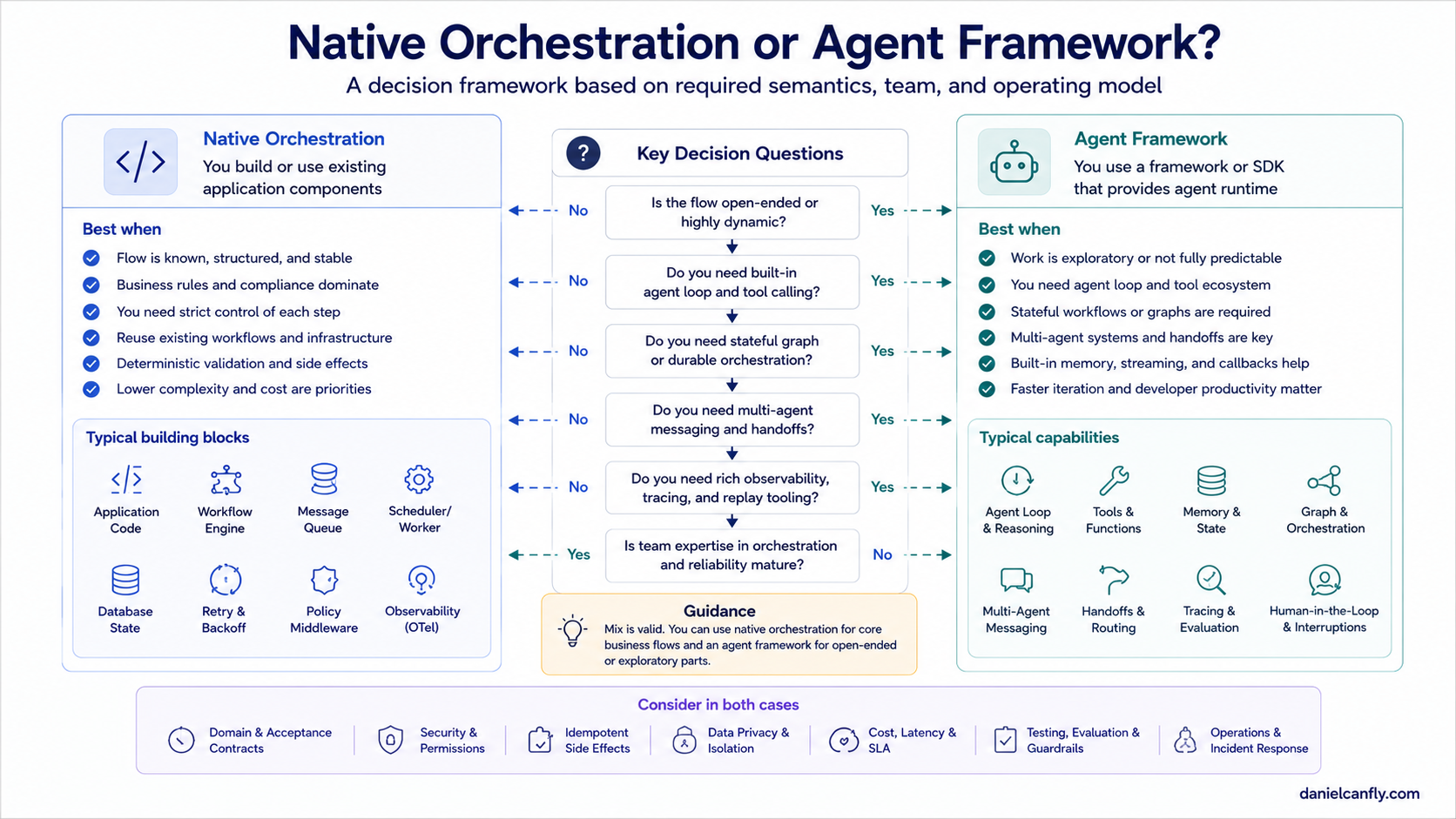
Native Orchestration 或 Framework?
不要使用固定的「三到五個 Step」規則。
優先 Native Code 或 Existing Workflow Platform
- Current Primitive 能清楚表示 Flow
- Durability 已解決
- Agentic Portion 很小
- Team 可以直接 Test 與 Operate
- 新 Runtime 只會重複 Queue、State 或 Approval Infrastructure
- Framework-specific Type 會主導 Domain Model
優先 Framework
- 能移除有意義的重複工程
- State 與 Resume Semantics 符合 Contract
- Agent Loop 是真實 Requirement
- Human Interruption 很難自行正確實作
- Graph、Event 或 Team Primitive 提升清晰度
- Runtime 可觀測且可測試
- Migration 與 Lifecycle Risk 可接受
拒絕 Framework
- Abstraction 隱藏 Side Effect
- Persistence 無法滿足 State Requirement
- Policy Enforcement 依賴 Prompt
- Team 無法測試 Replay 與 Resume
- Support Status 不符合 Risk
- Migration 需要重寫 Domain Logic
以 Fit 選擇 Framework,不用通用 Strength Score
沒有 Shared Benchmark 時,不應在 Comparison Table 將某 Framework 標成某能力的「Very Strong」。
應改用 Qualitative Fit Question。
| Option | Primary Abstraction | Natural Fit | Questions to Verify |
|---|---|---|---|
| Native 或 Existing Workflow Engine | Function、Job、State、Queue | Small 或 Business-dominant Workflow | 哪些 Runtime 能力需自行建置? |
| LangChain Agents | High-level Agent Loop | Standard Tool-using Agent | Prebuilt Loop 是否符合 Contract? |
| LangGraph | State、Node、Edge、Checkpoint | Long-running Stateful Orchestration | Replay 與 Side Effect 是否安全? |
| LlamaIndex Workflows | Event、Step、Context、Data Abstraction | RAG 與 Data-centric Workflow | Domain Contract 能否留在 Event Type 外? |
| CrewAI | Crew、Task、Process、Flow | Controlled Flow 內的 Role Collaboration | 每個 Role 是否真的是 Responsibility Boundary? |
| OpenAI Agents SDK | Agent、Runner、Tool、Handoff、Guardrail | Lightweight Tool 與 Handoff Runtime | Guardrail 與 State 覆蓋哪些 Path? |
| AutoGen | AgentChat Team 與 Event-driven Core | Existing System、Research、Multi-agent Experiment | Migration 與 Lifecycle Plan 是什麼? |
| Semantic Kernel | Kernel、Plugin、Agent、Enterprise Integration | Existing Microsoft Application | Migration 是否真的有價值? |
| Microsoft Agent Framework | Agent 與 Graph Workflow | New Microsoft-centred Evaluation | Preview Change Risk 是否可接受? |
Final Answer 可以是 Mixed Stack:
Existing Workflow Engine
  + LangGraph for One Complex Stateful Subflow
  + LlamaIndex Retriever
  + OpenTelemetry
  + Independent Policy and Audit
Framework Purity 不是 Architecture Requirement。
建立 Framework-resilient Code
Domain Model 留在 Adapter 外
不要讓 Framework Event、Message、RunContext 或 Agent Type 穿越 Domain Boundary。
Tool Port 保持狹窄
Application 應依賴 Capability:
- Retrieve Evidence
- Execute Query
- Run Test
- Send Approved Message
- Write Validated Record
而不是依賴 Framework Tool Decorator。
Verification 保持獨立
Verifier 應接受 Domain Artefact 與 Evidence,而不是 Framework Transcript。
Policy 留在 Prompt 外
使用:
- Typed Validation
- Authorisation Service
- Tool Gateway
- Network 與 Credential Boundary
- Approval Service
- Deterministic Transaction Service
Observability 可攜
盡量使用 Application Trace ID 與 OpenTelemetry-compatible Semantics。
Framework Trace 可以連結成 Child Span 或 Diagnostic Artefact。
Event Schema 必須 Versioned
Persisted Event 與 Checkpoint 可能比 Framework Version 活得更久。
保存:
- Schema Version
- Framework Version
- Migration Version
- Producer
- Timestamp
- Correlation ID
維持 Migration Seam
每個 Framework Dependency 都要記錄:
- 為什麼存在
- 滿足哪個 Contract
- Persist 哪些 Data
- 如何替換
- 如何 Export State
- 如何 Replay Test
- 誰負責 Migration
測試 Framework Semantics,不只測 Business Output
Workflow 可以產生正確 Final Answer,卻仍不適合運營。
Unit Test
- Domain State Transition
- Tool Validation
- Verifier Rule
- Policy
- Idempotency Key
Contract Test
- Framework Adapter Input 與 Output
- Provider Replacement
- Tool Schema
- Event Translation
- Trace Propagation
Workflow Test
- Normal Path
- Retry
- Fallback
- Repair
- Replan
- Pause 與 Resume
- Cancellation
- Terminal State
Replay 與 Side-effect Test
- Node Replay
- Duplicate Command
- Lost Response
- Resume after Approval
- State Migration
- Partial Checkpoint
- Worker Crash
Security Test
- Prompt Injection
- Tool Escalation
- Cross-tenant Access
- Secret Exposure
- Unsafe Handoff
- Memory Poisoning
- Unauthorised Side Effect
Evaluation
- Task Success
- Evidence Support
- False Pass 與 False Fail
- Latency
- Cost
- Human-review Load
- Recovery Rate
Upgrade Test
Framework Version 改變前:
- Run Golden Set
- Read Release 與 Migration Note
- Load Old Checkpoint
- Resume Active Workflow
- Compare Trace
- Test Rollback
- Verify Adapter Compatibility
常見 Implementation Anti-pattern
Framework-first Architecture
Contract 尚未定義,Runtime 已被選定。
Framework Type Leakage
Domain Logic 依賴 Framework Event 與 Message。
Agent for Every Function
Deterministic Step 被轉成 Conversational Actor。
Hidden Side Effect
Write 發生在 Opaque Tool 或 Persona 內。
Checkpoint Equals Transaction
Replay 重複執行 External Operation。
Session Equals Durable Workflow
Conversation Continuity 被誤認為 Resumable Business State。
Guardrail Equals Policy Engine
一個 SDK Hook 被假設能覆蓋所有 Execution Path。
Trace Equals Audit
Diagnostic Telemetry 被誤認為 Accountable Business Evidence。
Multi-agent by Persona
Role Name 取代真實 Responsibility Boundary。
Preview Framework in an Unprotected Critical Path
沒有 Adapter、Pilot、Rollback 或 Compatibility Test。
Tutorial Code Becomes Production Code
Authentication、Tenancy、Budget、Failure Path、Security 與 Operations 全部缺席。
No Exit Strategy
System 無法 Export State 或 Replace Runtime。
Production Checklist
Architecture
- Framework Selection 前已有 Domain Contract
- Adaptive Node 被逐一標出
- State、Memory、Session 與 Transaction 已分離
- Side Effect 有 Explicit Command Boundary
- Final Owner 已命名
Framework Fit
- Required Semantics 已記錄
- Official Support Status 已記錄
- Tested Version 已 Pin
- Persistence 與 Replay Behaviour 已測試
- Framework Type 沒有主導 Domain Model
- Migration Path 存在
Reliability
- Retry、Repair、Fallback 與 Replan 分開
- 每個 Loop 有 Limit
- Checkpoint Resume 不會 Duplicate Side Effect
- Approval 會 Expire,State 會 Revalidate
- Terminal Outcome 包含 Partial 與 Unsupported
Security
- Tool Permission 在 Prompt 外 Enforcement
- Untrusted Content 無法改變 Policy
- Cross-tenant Access 經測試
- Secret 從 Trace 排除或 Redact
- High-impact Action 需要適當 Authority
- Kill Switch 與 Incident Response 存在
Testing and Operations
- Adapter Contract Test 存在
- Failure 與 Replay Path 經測試
- Upgrade Test 包含 Old Checkpoint
- Evaluation 涵蓋 Quality、Cost 與 Latency
- Trace 與 Business Audit 分離
- Rollback 已演練
最終選型指引
使用以下問題,不使用 Universal Leaderboard。
是否需要 Agent Loop?
不需要時使用 Ordinary Code、Pipeline 或 Existing Workflow Engine。
Durable Stateful Orchestration 是否為核心問題?
評估 LangGraph、Existing Workflow Platform,或在能接受 Preview Status 時評估 Microsoft Agent Framework。
Data 與 Retrieval 是否為核心?
評估 LlamaIndex Workflows,必要時放在更大的 Orchestrator 內。
Role Collaboration 是否為主要 Hypothesis?
以相同 Worker Contract 比較 CrewAI、AutoGen、LlamaIndex AgentWorkflow、OpenAI Agents SDK Handoff、LangGraph Node 或 Microsoft Agent Framework。
Lightweight Tool 與 Handoff Runtime 是否足夠?
評估 OpenAI Agents SDK 或 High-level LangChain Agent。
是否為 Existing AutoGen 或 Semantic Kernel Estate?
比較 Stay、Adapt 與 Migrate。「有 Successor」不是充分 Business Case。
System 是否 High Risk?
優先選擇 Team 能透過 Test、Replay、Policy Enforcement、Incident Response 與 Support Commitment 證明其 Semantics 的 Runtime。
結論
Framework 是槓桿,不是 Architecture。
可靠 Implementation 自己擁有:
Domain State
+ Tool and Side-effect Contracts
+ Verification
+ Policy and Authority
+ Terminal Outcomes
+ Evaluation
+ Operational Ownership
Framework 可以提供:
Agent Loop
+ Graph or Event Runtime
+ Checkpointing
+ Handoffs
+ Streaming
+ Tracing
+ Integrations
Infrastructure 提供:
Persistence
+ Queue
+ Sandbox
+ Secrets
+ Deployment
+ Audit
+ Monitoring
+ Incident Response
最好的 Framework 不是 Feature List 最長的那一個。
而是 Semantics 與 Architecture 相符、Lifecycle Risk 符合 Task,且移除它時不需要重寫整個 System Meaning 的那一個。
參考資料
- LangChain Documentation, LangChain overview
- LangGraph Documentation, LangGraph overview
- LangGraph Documentation, Persistence
- LangGraph Documentation, Interrupts
- LlamaIndex Documentation, Workflows
- LlamaIndex Documentation, AgentWorkflow and structured output
- CrewAI Documentation
- OpenAI, Agents SDK
- OpenAI Agents SDK, Guardrails
- OpenAI Agents SDK, Tracing
- AutoGen Documentation
- Microsoft, Microsoft Agent Framework overview
- Microsoft, Agent Framework migration guides
- OpenTelemetry Documentation