Suppose a company receives two acquisition offers. A is worth 100 million in total. Ninety million is paid at closing, the remainder sits in a standard escrow, buyer financing is complete and the restrictions are limited. B is shown as 105 million of headline consideration. That 105 million already includes up to 15 million of contingent payment, so only 90 million is fixed. Of the fixed amount, 70 million arrives at closing; the rest is delayed. B also carries a financing condition, a larger holdback and a longer non-compete.
The front page gives B a five per cent advantage. The economics may not.
Payment timing, control, the conditions attached to contingent value, closing certainty and future restrictions can easily outweigh that extra headline amount. Negotiation therefore needs a comparison method that survives once the price box is no longer the only thing on screen.
Same Price, Different Deal
A negotiated outcome is an executable package. Its economic effect may sit in cash timing, dilution or ownership, approval rights, covenants, contingent payments, remedies, closing risk or the options that remain after signing. Some of those effects are easy to value; others are better represented as scenarios, constraints or unresolved risks.
The comparison still needs a baseline. The useful baseline is the best outside option that can actually be executed, not the counterparty’s previous offer and not a hypothetical alternative that depends on approvals or timing you do not yet have.
That point changes the objective of negotiation. The aim is not to maximise a visible number in isolation. It is to secure a package that is preferable to the alternative once the material consequences are included.
Define the Walk-Away Boundary Before You Bargain
BATNA is often discussed as if it were a synonym for bargaining confidence. It is more demanding than that. An alternative buyer, investor or lender becomes useful only when it is sufficiently real to take if the current negotiation fails. A second investor who has not completed diligence, lacks investment-committee approval and cannot close before the runway ends is still a possible route, not a dependable BATNA.
Preparation should therefore distinguish objectives, executable alternatives, assumptions about those alternatives, approval constraints and timing. Once that picture is clear, the reservation value can be set as a package boundary rather than a single price.
Consider a seller who informally calls 90 million the minimum acceptable price. A 95 million offer with a large escrow, a long earnout, a restrictive non-compete and uncertain financing may deliver less value than a 90 million mostly-cash offer with few conditions and high closing certainty. The seller’s real walk-away point has to reflect those differences.
ZOPA comes after that. A Zone of Possible Agreement exists if the parties’ acceptable ranges overlap, but those boundaries are rarely observable. The range is normally estimated from incomplete information and updated as financing, approvals, competing bids, deadlines and diligence change the picture.
The operating sequence is:
BATNA → Reservation Value → Estimated ZOPA
If the proposed package falls below the pre-committed boundary, or cannot be authorised and executed in the required timeframe, walking away can be the correct result. Agreement itself is not the objective function.
Stop Comparing Price Alone: Convert Terms into Deal Economics
The opening example can now be written as one numerical contract:
| Economic effect | Offer A | Offer B |
|---|---|---|
| Headline consideration | 100m | 105m, including up to 15m contingent payment |
| Fixed consideration | 100m | 90m |
| Cash at close | 90m | 70m |
| Deferred / contingent | 10m standard escrow | 20m deferred + up to 15m contingent |
| Control / approvals | Fewer conditions | More buyer approval rights |
| Downside / remedies | Standard escrow | Larger holdback, longer claim period |
| Execution certainty | Financing complete | Financing condition outstanding |
| Future flexibility | Fewer restrictions | Longer non-compete |
The table makes the accounting of the example explicit: the 15 million contingent component is already part of B’s 105 million headline number. It is not an additional 15 million on top.
A practical comparison then asks eight recurring questions. When is cash actually received? How does the transaction change ownership or dilution? Who gains veto or approval rights? Which covenants reduce future room to act? How much value is conditional? Who carries downside and what remedies are available? Can the transaction actually close? Which future options remain after signing?
Not every answer should be forced into a single NPV. If the probability of receiving contingent value is poorly supported, or a control provision cannot be monetised credibly, the uncertainty should remain visible. False precision is worse than a labelled unknown.
Under this view, B’s extra five million is only one input. Its lower cash at close, contingent component, financing condition and restrictions may leave the risk-adjusted package below A.
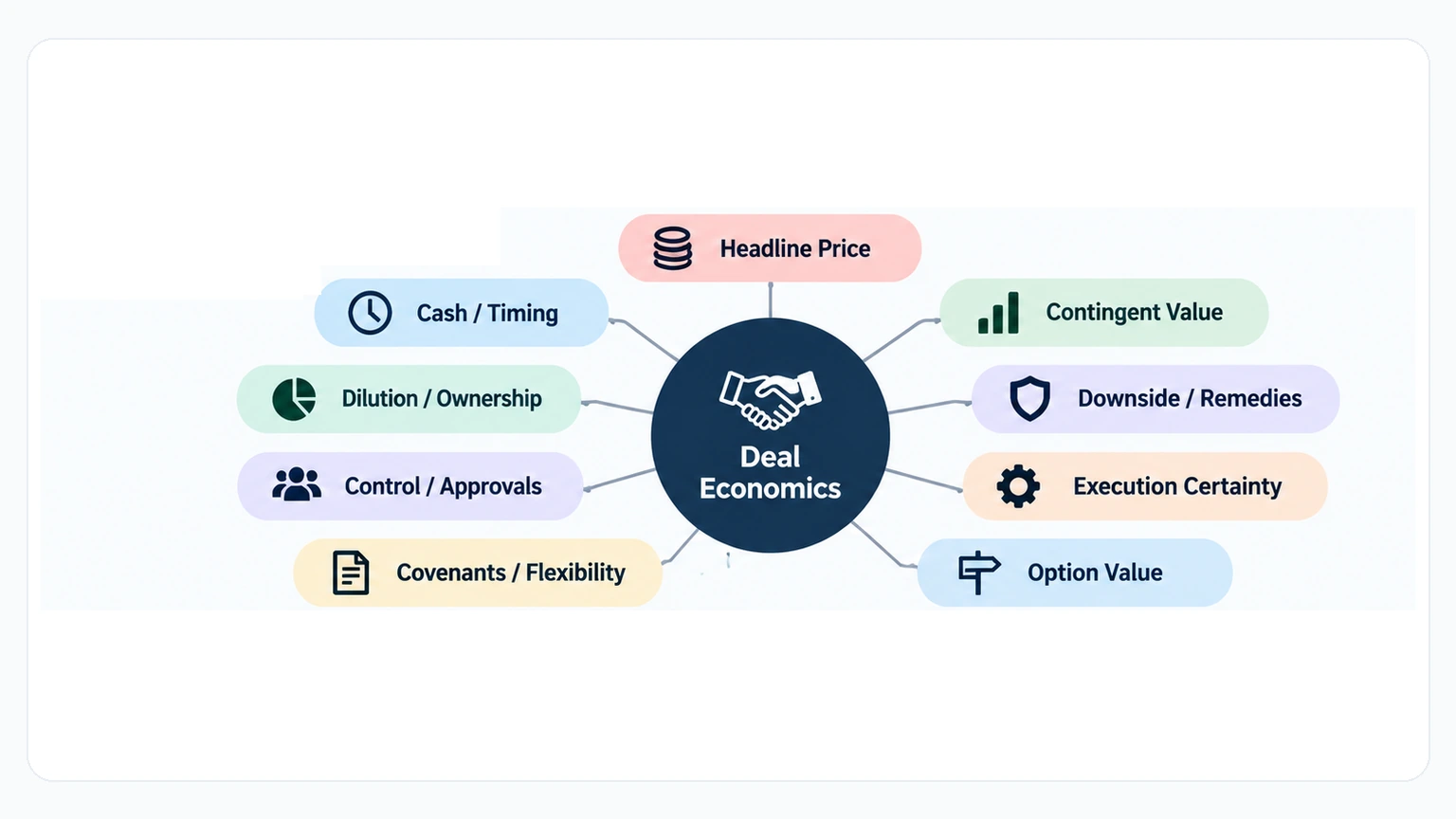
Deal economics is a package, not a headline price.
What Do Leverage, Deadlines, Concessions, and MESOs Actually Change?
A negotiation tactic is useful when it changes an economic state or reveals information.
Leverage can come from executable alternatives, scarcity, switching costs, timing, financing certainty, approval constraints or an information advantage. The quickest diagnostic is to ask what happens if the counterparty ignores it. If there is no observable consequence beyond signalling seriousness, the alleged leverage is still unproven.
Deadlines need the same treatment. A Friday expiry matters if missing Friday causes financing to lapse, an approval window to close, a regulatory path to slip or another option to disappear. If Saturday changes nothing, the deadline may simply be pressure language.
Concessions affect the package directly. A price move might buy faster payment; a higher liability cap might be exchanged for a longer commitment; control rights might be traded for stronger economics or downside protection. The purpose is not mechanical reciprocity. It is to stop a sequence of unilateral discounts from quietly crossing the reservation boundary.
MESOs, Multiple Equivalent Simultaneous Offers, are useful for a different reason. They vary the issue mix while keeping the packages broadly comparable from the offeror’s perspective. A counterparty choosing between more cash upfront, more contingent upside or fewer control rights can reveal relative preferences. The method only works if the offeror has actually evaluated the packages as economically similar; three arbitrary proposals are not a MESO set.
First offers can anchor subsequent bargaining, but the effect depends on context, information and experience. Auctions, bilateral negotiations and hybrid processes also produce different distributions of competition, disclosure and relationship investment. These mechanisms can shape the path to a deal; none deserves a universal rule.
One Deal-Economics Grid, Four Different Transaction Contexts
The economic questions travel across transaction types. The documents and legal consequences do not.
Fundraising. Two term sheets can carry the same pre-money valuation and still produce different founder outcomes. Option-pool treatment changes dilution. Liquidation preference affects the distribution of value in liquidation or deemed-liquidation scenarios. Anti-dilution provisions can change preferred conversion economics after lower-priced issuances, while pro rata rights may allow an investor to maintain ownership in later rounds. Board and protective provisions change who can approve important actions. Valuation has to be read with ownership, preference, control and future flexibility.
Venture or growth debt. The interest rate is one cost item among fees, tenor, amortisation or interest-only periods, covenants, warrants, prepayment terms and default provisions. Covenant headroom deserves particular attention because debt can become strategically restrictive before scheduled interest is unaffordable. Depending on the agreement and applicable rules, a breach may affect lender control, classification, waivers or refinancing before a payment default occurs.
Commercial contracts. A 20 per cent first-year discount can coexist with automatic renewal, a narrow termination window, expensive switching, weak remedies and warranties that allocate more risk to the buyer. The discount may be real without representing the economics of the whole relationship. The legal effect of any particular clause is jurisdiction- and document-specific, so the portable lesson here is limited to the economic mechanism.
M&A. Purchase price sits alongside consideration form, working-capital adjustments, earnouts, escrow or holdbacks, indemnity and closing conditions. Strategic value also needs decomposition. Revenue synergy, cost synergy, CAPEX, working-capital effects, tax and dis-synergy should not be collapsed into a single run-rate number, and estimated magnitude should be separated from execution certainty. Customer access, geography, capability, capacity, vertical integration and talent or IP each imply different evidence and integration risks.
A common grid helps comparison. It does not make a venture financing clause, a debt covenant, a SaaS renewal term and an acquisition earnout legally interchangeable.
Contingencies Can Bridge Disagreement, but They Do Not Eliminate Uncertainty
Contingent consideration is useful when the parties hold different views of the future. If a seller expects next year’s revenue to exceed 50 million while the buyer is willing to underwrite only 30 million, part of the price can depend on what is later observed.
That construction reallocates uncertainty. It does not remove it.
For a contingent term to be interpretable, the metric and measurement period need to be defined, manipulation needs to be constrained, operational control has to be understood, verification rights need to exist and the consequences of meeting or missing the trigger must be clear. Dispute handling also belongs in the design.
Take a 10 million acquisition earnout triggered by next year’s revenue exceeding 50 million. If the buyer controls pricing, sales headcount, marketing spend and the product roadmap after closing, then control over the metric-generating system affects the value of the earnout. A probability estimate for “revenue above 50 million” is incomplete unless it reflects that control.
Ambiguous definitions, disputable data or accounting choices that can cheaply move the result create another layer of risk. Contingencies can bridge different beliefs, but poorly governed contingencies may simply defer the disagreement.
‘This Is a Good Deal’ Is Not a Conclusion: Make the Deal Thesis Falsifiable
A deal thesis is usually a set of assumptions hidden behind a compact sentence. An acquisition may depend on cross-selling, limited churn and cost synergies appearing within 18 months. A financing round may assume the capital lasts until the next milestone without unacceptable control concessions. A commercial agreement may depend on implementation finishing on time and savings surviving switching costs.
A driver tree helps show which quantities move the economics. In an acquisition those drivers may include revenue synergy, cost synergy, integration cost, customer churn, working capital and tax effects. A hypothesis tree serves another purpose: it turns the proposed value mechanisms into managerial working hypotheses that evidence can weaken. This is not formal statistical H0/H1 testing.
Suppose one hypothesis is:
We can sell the target product into our existing enterprise customer base within 12 months and generate 20 million of incremental revenue.
Diligence should then test the mechanism rather than collect documents indiscriminately. The team can examine overlap between the existing customer base and the target product’s ICP, historical cross-sell conversion, sales compensation, integration timing and the observations that would force the 20 million estimate down.
Diligence requests, representations, verification rights, conditions and staged disclosure can reduce information asymmetry when they affect a hypothesis, a term, a remedy or a decision. A complete data room improves traceability; it does not validate the deal thesis by itself.
The Final Question Is Not ‘Did We Close?’
The final review can be reduced to four actions.
TAKE when the complete package clears the reservation boundary, the material value claims have enough support, and the authority, financing, approvals and execution path are credible.
REDESIGN when the transaction is attractive but payment timing, control, covenants, contingencies, remedies or other package terms can still improve the allocation of value and risk.
VERIFY when the apparent advantage depends on an unresolved deadline, estimated ZOPA, synergy, financing certainty, approval, metric integrity or implementation condition. The next move may be evidence collection rather than another price round.
WALK AWAY when the package is below the boundary, the BATNA is better, a major downside cannot be reallocated, or the deal cannot be authorised and executed at an acceptable level of risk.
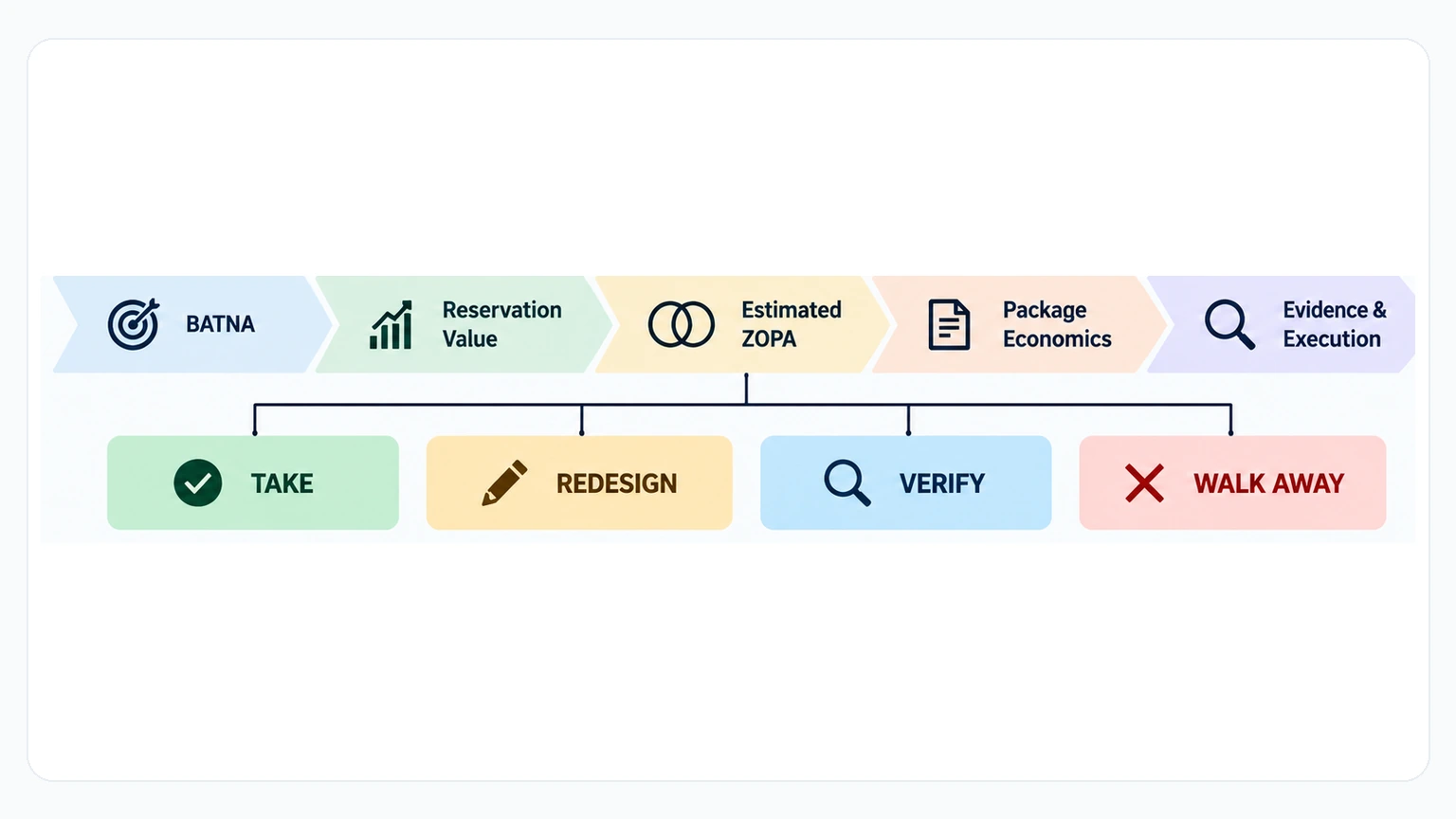
Move from alternatives and deal economics to a decision you can execute.
Offer B now looks different from the front page. Its 105 million figure already includes the 15 million contingent component, only 70 million arrives at closing, and financing, holdback and restrictions still matter. If those terms leave B below A or below the best executable alternative, the extra headline five million has not improved the decision.
A signature records agreement. A good decision requires the executable package, judged with the evidence available at the time, to be better than the alternative.
References
- Negotiation Journal, BATNAs in Negotiation: Common Errors and Three Kinds of No.
- Program on Negotiation at Harvard Law School, Negotiation Preparation Strategies.
- Program on Negotiation at Harvard Law School, Value Claiming in Negotiation.
- Organizational Behavior and Human Decision Processes, Multiple equivalent simultaneous offers reduce the negotiator dilemma.
- Program on Negotiation at Harvard Law School, Negotiation Design Dimensions: A Checklist.
- Program on Negotiation at Harvard Law School, Contingency Contracts in Business Negotiations.
- National Venture Capital Association, Model Legal Documents.
- Y Combinator, Venture Debt 101: Basics and Approach.
- Andreessen Horowitz, 16 Things to Know About Raising Debt for Startups.
- Cornell Legal Information Institute, UCC § 2-719: Contractual Modification or Limitation of Remedy.
- Cornell Legal Information Institute, UCC § 2-316: Exclusion or Modification of Warranties.
- SRS Acquiom, M&A Working Capital Purchase Price Adjustment Study 2026.
- Harvard Law School Forum, The Art and Science of Earn-Outs in M&A.
- Strategic Management Journal, A capabilities-based perspective on target selection in acquisitions.
- Strategic Management Journal, Deliberate learning in corporate acquisitions.
- 《問題結構化研究施工報告》, Driver Tree / Hypothesis Tree section, internal research report, 15 July 2026.