Suppose an agent system has been running for a while.
It has a planner agent, a review agent, memory, more than a dozen tools, several hooks, two retry layers, a long rules file, task-specific prompt templates and a fallback path nobody is willing to dismantle.
Then the model changes. The tool provider adds native capabilities as well.
The team can no longer answer a few basic questions:
- Which component still catches a real failure mode?
- Which rule is merely a patch for the previous model?
- Which review agent improves quality, and which one only adds tokens and latency?
- Who still owns the memory store?
- Which tools now duplicate runtime features?
- Would quality actually fall if one of these layers disappeared?
A large component count can look like architectural maturity. If nobody can answer those questions, it may be a well-organised warehouse of technical debt instead.
The later stage of Harness Engineering is not about adding more parts. It is about building a method through which controls emerge from observed behaviour and risk, then become simpler, conditional or removable when their assumptions stop holding.
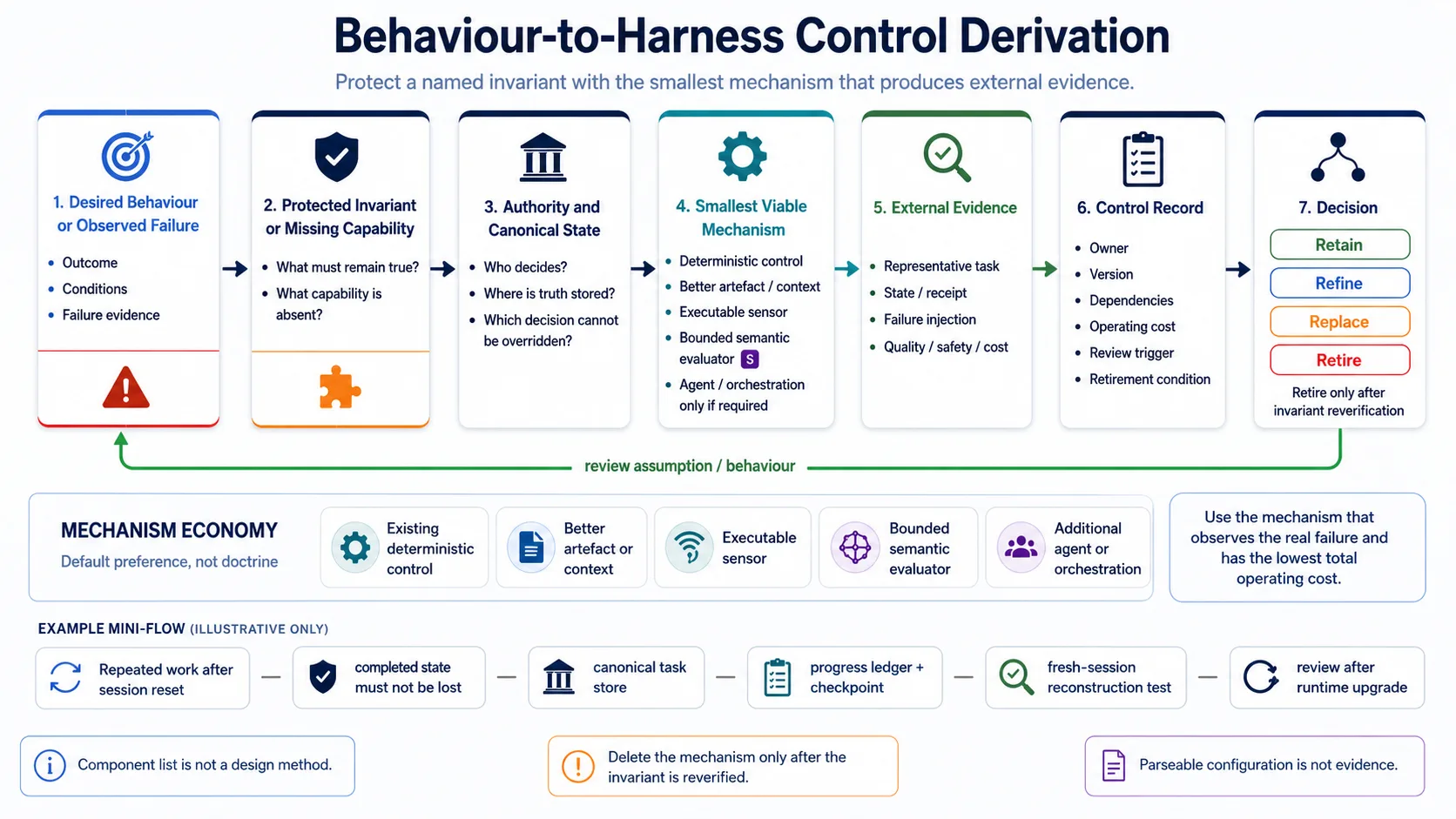
Figure 12-1 | Start with a desired behaviour or observed failure, then derive the missing control, smallest mechanism, external evidence and deletion condition.
Do not start with a component list
The first questions in a harness design discussion are often:
- Should we add memory?
- Should we introduce MCP?
- Do we need a multi-agent system?
- Should there be another reviewer?
- Should we buy an agent platform?
All of them arrive too early.
They jump to a solution before naming the behaviour that must change, the failure that must be prevented, or the evidence that would show the mechanism works.
A more defensible derivation order is:
Desired behaviour or observed failure
→ Protected invariant or missing capability
→ Authority and canonical state
→ Smallest viable mechanism
→ External evidence and operating cost
→ Owner, review trigger and retirement condition
This turns a harness component from something the architecture is expected to contain into something responsible for a named problem.
A simple example
Suppose an agent must continue a long task the next day without rescanning the repository.
Observed failures include:
- a fresh session does not know what the previous one completed
- earlier side effects cannot be confirmed
- completed work is repeated
- task state exists only in the transcript
The protected invariants are:
- completed work is not treated as unstarted
- external side effects have queryable receipts
- a fresh session can reconstruct from durable evidence
- only canonical authority advances task state
The smallest useful mechanism may be:
- a structured progress ledger
- a runtime-managed checkpoint
- referenceable artefacts
- session-bootstrap validation
- side-effect operation identifiers
Only then is there a reason to add the long-running mechanisms discussed in Part 7. If one small ledger solves the problem, a multi-agent coordination platform is unnecessary.
Record why each control exists
A control record may contain:
control_id: durable-progress-ledger
failure_addressed: repeated work after session reset
protected_invariant: completed task state is not lost
authority: canonical-task-store
evidence:
  - fresh-session-reconstruction-test
  - duplicate-work-rate
cost:
  latency: low
  maintenance: medium
owner: agent-platform
review_triggers:
  - runtime upgrade
  - task model change
retirement_condition: native runtime state proves equivalent behaviour
This is not permanent residency for the component. It records why the control exists, who owns it, how it is verified, and when changed underlying capabilities should trigger review.
Mechanism economy
A failure mode may have several treatments. A useful default preference is:
- use an existing deterministic control
- improve the artefact or context
- add an executable sensor
- use a narrowly scoped semantic evaluator
- add another agent or orchestration layer only when required
This is a default, not a doctrine. If a deterministic mechanism cannot express the semantic risk, or its maintenance cost exceeds that of a bounded evaluator, compare them with representative evidence.
A JSON Schema should reject malformed arguments without another model call. An architecture test should enforce dependency direction rather than leaving the rule in a long prompt for repeated interpretation.
Models are useful for semantics, uncertainty, and open exploration. They should not replace constraints that can already be encoded clearly.
Deterministic-first does not mean anti-agent
Deterministic-first fixes boundaries that must not drift, then gives the model discretion where judgement genuinely improves the result.
The following usually belong in deterministic control:
- authentication and authorisation
- tenant and resource scope
- input validation
- retry, timeout, and budget limits
- state transitions
- destructive or financial commits
- required verification gates
- audit and release authority
Model-driven decisions are more appropriate for:
- decomposing ambiguous tasks
- semantic routing
- open-ended search strategy
- generating candidate solutions
- content judgement that cannot be enumerated fully
This does not trap an agent in a rigid workflow. It asks:
Which freedoms improve task outcomes, and which merely increase unpredictability?
Anthropic distinguishes workflows with predefined paths from agents whose paths are directed dynamically by the model, and recommends adding agentic complexity only when it demonstrably improves outcomes.[1]
Preserve the invariant, not necessarily the implementation
“Payment requires valid approval” is an invariant. It may be implemented by a policy engine, workflow gate, or controlled transaction service. A platform may later provide a better native implementation, but a product claim that it “supports approval” is not sufficient evidence to delete the invariant.
Similarly:
- a custom retry wrapper may disappear, but attempt budgets and unknown-outcome control must remain
- a secondary reviewer may disappear, but independent evidence for blocking criteria must remain
- a memory store may be replaced by native session state, but the transcript must not become the sole state authority
Build-to-delete therefore does not mean fewer controls at any cost. It means:
Preserve the required invariant through the lowest-cost mechanism with the clearest responsibility.
Exceptions and escape paths need governance
A legitimate exception to a deterministic gate must not be a model bypass. It needs:
- an explicit exception type
- authority
- scope
- expiry
- evidence
- an audit record
- a revalidation trigger
Otherwise flexibility becomes an unnamed second policy system.
Correct components in the wrong order still fail
A harness is shaped not only by whether it contains policy, hooks, memory, and verification, but by where each mechanism enters the loop and which decision may override another.
A stable order can be reduced to:
Receive event
→ Authenticate actor and resolve tenant
→ Load canonical state and control signals
→ Apply pre-discovery visibility and data policy
→ Build bounded context and capability snapshot
→ Call model
→ Inspect proposed operation
→ Canonicalise resource and arguments
→ Apply per-operation authorisation and approval
→ Execute or accept background work
→ Persist receipt, effect state and audit record
→ Append correlated observation
→ Verify terminal candidate
→ Commit completion, checkpoint or continuation
There are two policy boundaries:
- Pre-discovery policy controls which data, tool metadata, and resources may be visible.
- Per-operation policy authorises the concrete operation after resource and arguments have been canonicalised.
Collapsing both into one vague policy_check() allows visibility and final authorisation to substitute for each other.
Order carries security and reliability meaning:
- authorisation before path canonicalisation can be invalidated by
../, symlinks, or aliases - a changed dynamic tool set with an old prompt catalogue creates impossible plans
- compaction that removes side-effect receipts can cause duplicate payment or email
- marking a task
completedbefore verification leaks pass state - a scheduled trigger that bypasses identity and policy is another unauthorised entry point
- a background completion returned through the original tool-result channel may be mistaken for a second synchronous result
A production harness may be distributed across event-driven services rather than one literal loop. Protocol order, authority, correlation, and state transitions must survive the decomposition.
Ten anti-patterns are ten forms of escaped responsibility
An anti-pattern matters because it hides a responsibility the system still needs to carry.
| Anti-pattern | Surface implementation | Responsibility that disappeared |
|---|---|---|
| Prompt-only control | Permission, budget and retry rules live in the prompt | Runtime enforcement |
| Model self-certification | The model reports completion and the run passes | Independent verification |
| Blind retry | Every exception gets the same retry policy | Error classification, idempotency and reconciliation |
| Hidden control flow | Hooks and callbacks have no documented order | Traceability and authority |
| Tool equals function | A callable function is treated as a complete tool | Schema, permission, timeout, receipt and error taxonomy |
| Split-brain state | Planner, tool layer and verifier each store their own truth | Canonical state authority |
| Final-answer-only evaluation | Only the final text is graded | Trajectory, side effects, safety and cost |
| Separate fake evaluation pipeline | Evaluation uses a simplified path | Production parity |
| Context dumping | All history, documents and results enter the prompt | Selection, budget and freshness |
| Framework-first | A platform is chosen before the workload is defined | Failure mode and completion contract |
The most dangerous case is not one component making a mistake. It is a team gradually becoming comfortable with the assumption that another layer will handle it.
The planner assumes the tool layer validates inputs. The tool layer assumes policy ran upstream. The verifier assumes the transcript is canonical state. Each layer owns a fragment of truth and no layer owns the responsibility.
A pattern catalogue is a vocabulary, not an architecture
This series has introduced patterns such as:
- deterministic-first orchestration
- fresh-context iteration
- workspace isolation
- task-portfolio delegation
- review-feedback promotion
- artefact pipelines
- entropy management
- build-to-delete
A catalogue gives repeated problems a vocabulary of composable solutions. It does not mean that every harness should install every pattern.
Each pattern should have a qualification record:
pattern: fresh-context-iteration
problem: quality degrades across long sessions
applicability:
  - task can checkpoint safely
  - startup reconstruction is reliable
counterconditions:
  - low-latency conversational task
required_authority:
  - canonical progress state
required_evidence:
  - fresh-session reconstruction test
known_costs:
  - startup latency
status: conditional
owner: agent-platform
review_by: 2026-10-01
Before adoption, answer:
- Which failure mode or protected invariant does it address?
- Which state and authority does it require?
- What runtime, security, and operational costs does it add?
- Which evidence would show that it works?
- Which counterconditions or interaction effects matter?
- When should it be retested, demoted, or removed?
Pattern status may be:
candidatetrialadoptedconditionaldeprecatedretired
A pattern that works only for one model, repository, or workload should remain conditional rather than becoming an engineering law. The catalogue is a governed living document, not an architecture shopping list.
Harnesses are not limited to code
Any task that exposes inputs, constraints, intermediate artefacts, evidence and acceptance conditions can be organised as a harnessed workflow.
A domain-agnostic artefact pipeline may be:
Analyse
→ Build task-specific instructions
→ Draft
→ Critique
→ Revise
→ Validate
→ Publish
It can support:
- research reports
- translation and localisation
- financial documents
- data cleaning
- regulatory comparison
- technical articles
- diagrams and slide production
The important design choice is not the number of model passes. It is the separation of artefacts and authority between stages.
The critique stage may diagnose only, while revision applies changes. Validation should use independent rules, sources or reviewers rather than allowing the drafting agent to approve its own output.
Large artefacts can be split into parallel chunks, but every worker needs the same:
- glossary
- style contract
- source snapshot
- global outline
- cross-chunk reference rules
Passing every local section does not prove the complete document has no duplication, contradiction or argument drift. Global validation remains necessary after assembly.
Capability-tiered coordination should follow risk and verifiability, not price alone
A workload may contain a small amount of high-judgement work and a large volume of mechanical reading, classification, transformation, and querying.
A stronger coordinator may handle:
- task decomposition
- ambiguity resolution
- cross-worker conflict
- coverage review
- final synthesis
Less expensive or faster workers may handle:
- bounded retrieval
- format conversion
- classification
- structured extraction
- local checks with an existing rubric
“Plan with the strong model, execute with the cheap model” is not a universal saving formula.
Routing should consider:
- task difficulty
- failure blast radius
- evidence of worker capability
- verifier coverage
- escalation cost
- data and tool permission
- latency objectives
- total cost rather than token price
Tiering is a poor fit when:
- subtasks are tightly coupled
- worker errors are hard for a coordinator or verifier to detect
- every step requires high-level judgement
- coordination and verification cost exceed the saving
- failure blast radius is large
- child output becomes trusted parent instruction without verification
Each routing rule should retain segment-level outcome, cost, and escalation evidence. Routing only by token price often sends the hardest-to-detect errors down the cheapest path and spends the saving during incident response.
Build, Buy, and Compose are boundary decisions rather than one system-wide choice
A harness rarely needs to be entirely built, entirely bought, or entirely assembled from open-source components. A more useful decision is made at each boundary:
- canonical state
- agent loop or runtime
- sandbox
- tool and protocol integration
- approval and policy
- evaluation
- observability
- operator interface
- scheduling and queue
- knowledge and artefact store
Build
Build is suitable when:
- the core flow is highly differentiated
- security, data, or deployment constraints are unusual
- low-level runtime control is required
- existing systems already provide many primitives
- the team can own maintenance, on-call, and upgrades
The cost includes reliability, observability, protocol compatibility, migration, incidents, and staff turnover, not only initial development.
Buy or adopt
Adoption is suitable when:
- standard flows are needed quickly
- the workload fits the product’s assumptions
- the vendor’s state model and control plane are acceptable
- SLA, data governance, export, and incident processes meet requirements
Risks include:
- lock-in
- hidden state
- policy or identity mismatch
- data residency
- pricing change
- capability or protocol drift
- difficult export or migration
Compose
A small set of components may form the stack:
Issue tracker
+ Task runner
+ Coding agent
+ Container sandbox
+ Existing CI
Replaceability may improve, but integration contracts, state hand-off, version compatibility, security patches, and incident ownership remain yours.
Write down shared responsibility
For each boundary, answer:
| Question | Required answer |
|---|---|
| State authority | Who owns canonical state? |
| Security | Who owns identity, credentials, patches, and incidents? |
| Recovery | How are crashes, timeouts, and unknown outcomes handled? |
| Evidence | Which logs, receipts, evaluations, and audits can be exported? |
| Change | Who migrates API, schema, or pricing changes? |
| Exit | How is the component disabled, moved, or rolled back? |
Tool selection needs an evidence profile, not one ladder
Marketing, READMEs, demos, tests, trials, and production use have different credibility, but evidence is not one simple staircase.
Evaluate at least five dimensions:
- Source authority: official specification, repository, or secondary description
- Environment fidelity: demo, sandbox, representative workload, or production
- Failure coverage: happy path, crash, cancellation, recovery, and security
- Recency: version, commit, and review date
- Exitability: export, migration, open contracts, and rollback
A tool may have excellent official documentation but no failure evidence for your workload. Another may work in one production case while providing no export path. A single L5 should not flatten these differences.
Due diligence should ask:
- Is it a coding agent, runtime, task runner, orchestrator, protocol, or full platform?
- Does it create new canonical state?
- How are state, permission, cancellation, retry, observability, and export handled?
- What are the licence, security policy, release, migration, and bus-factor conditions?
- Can it recover after a crash, and does cleanup work?
- Can kill switch, export, and provider outage be exercised?
- What are success, intervention, cost, and evidence completeness on your workload?
A material decision should include an exit drill: export a real run, restore its artefacts and audit, and show that the work remains intelligible after the provider is disabled.
A coding agent, orchestrator, MCP server, and full lifecycle platform occupy different layers. Combining them in one weighted ranking produces a precise score that cannot support procurement.
The OpenAI App Server exposes threads, turns, streaming, approval, and client integration as product interfaces, illustrating that productisation is about stable contracts and lifecycle rather than a polished interface alone.[2]
Adoption is not one route; each task class needs an operating mode
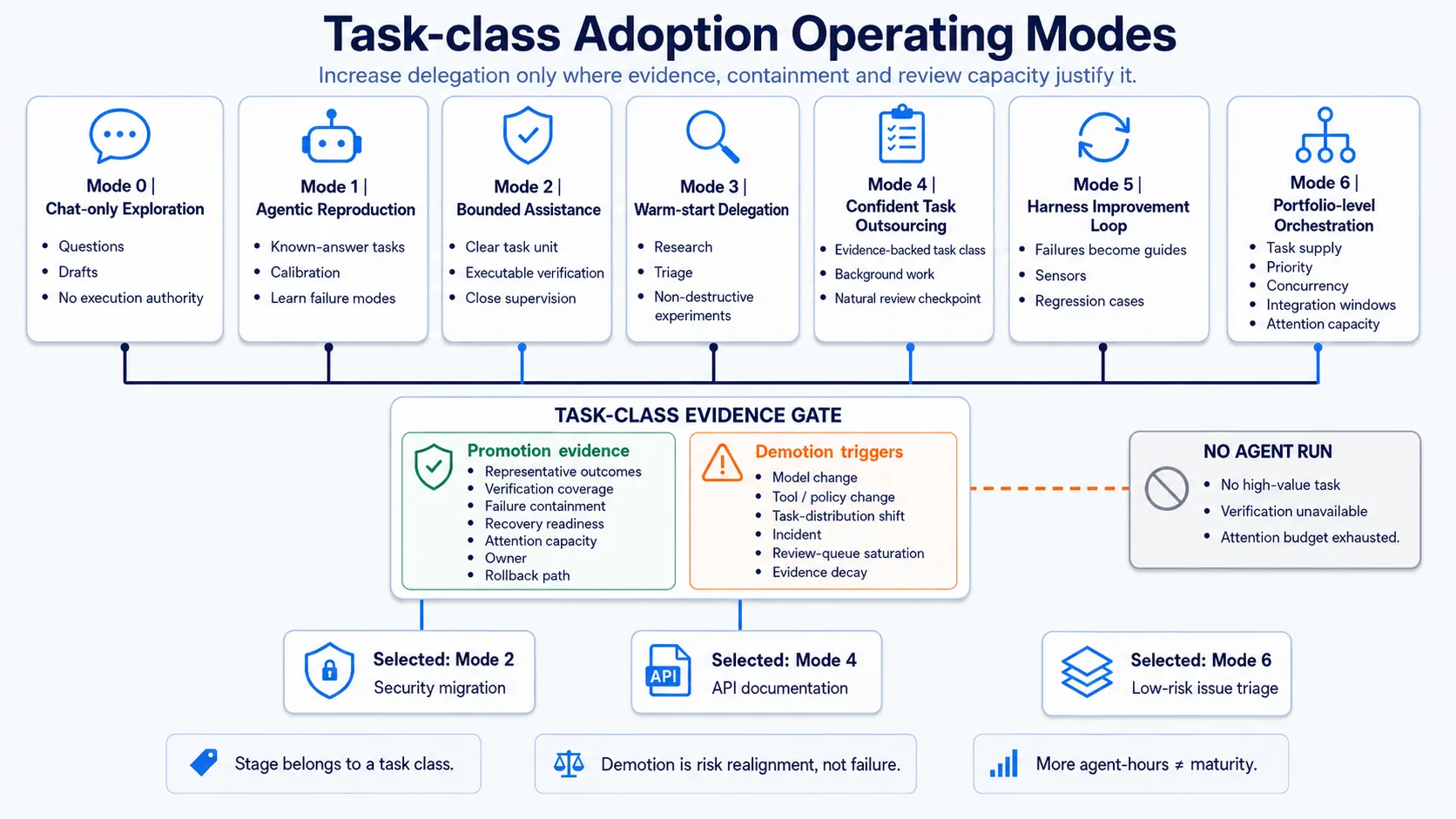
Figure 12-2 | Different task classes may remain in different operating modes. Promotion and demotion require evidence gates; an organisation does not need one universal highest stage.
Adoption maturity is measured through verified outcomes, controlled delegation, and recovery capability rather than the number of agents running each day.
Seven stages can be used as operating modes.
Stage 0: Chat-only exploration
Suitable for questions, drafts, and local explanation. It lacks repository context, direct execution, and external verification.
Stage 1: Agentic reproduction
Choose work whose correct answer is already known and ask the agent to reproduce it without seeing the manual solution.
The purpose is calibration rather than saving time: task size, context, verification, and failure patterns. Mitchell Hashimoto’s adoption account likewise used reproduction of his own work to build judgement before increasing delegation.[3]
Stage 2: Bounded assistance
Work is divided into clear, verifiable units and begins to use repository tools, tests, scripts, and completion criteria.
Stage 3: Warm-start delegation
Research, triage, bounded experiments, or non-destructive review run during natural gaps and produce a starting artefact for the next work period.
Stage 4: Confident task outsourcing
Only task classes with strong success evidence run in the background. People inspect evidence at natural checkpoints rather than supervising every step.
Stage 5: Harness improvement loop
Repeated failures drive changes to guidance, tools, sensors, executable rules, and regression evaluations.
Stage 6: Portfolio-level orchestration
The organisation manages a task portfolio, priorities, concurrency, human attention, and integration windows.
A stage belongs to a task class, not to the company
The same team may:
- run API documentation at Stage 4
- keep a security migration at Stage 2
- keep open-ended research at Stage 3
- move low-risk triage to Stage 6
A promotion gate should require:
- representative outcomes
- verification coverage
- failure containment
- human-attention cost
- incident and recovery readiness
- an owner
- a rollback or demotion path
When the model, tool, policy, task distribution, or risk changes, a task class may return to a more bounded mode. That is risk realignment, not organisational regression.
Anthropic’s Managed Agents engineering article makes the point directly: harnesses encode assumptions about model weaknesses, and those assumptions can go stale after a model upgrade; a previously useful context-reset mechanism became dead weight on a newer model.[4]
When there is no high-value task, verification is immature, or the review queue is saturated, choosing not to run an agent is a mature decision.
Productisation adds capabilities; it does not require the highest level
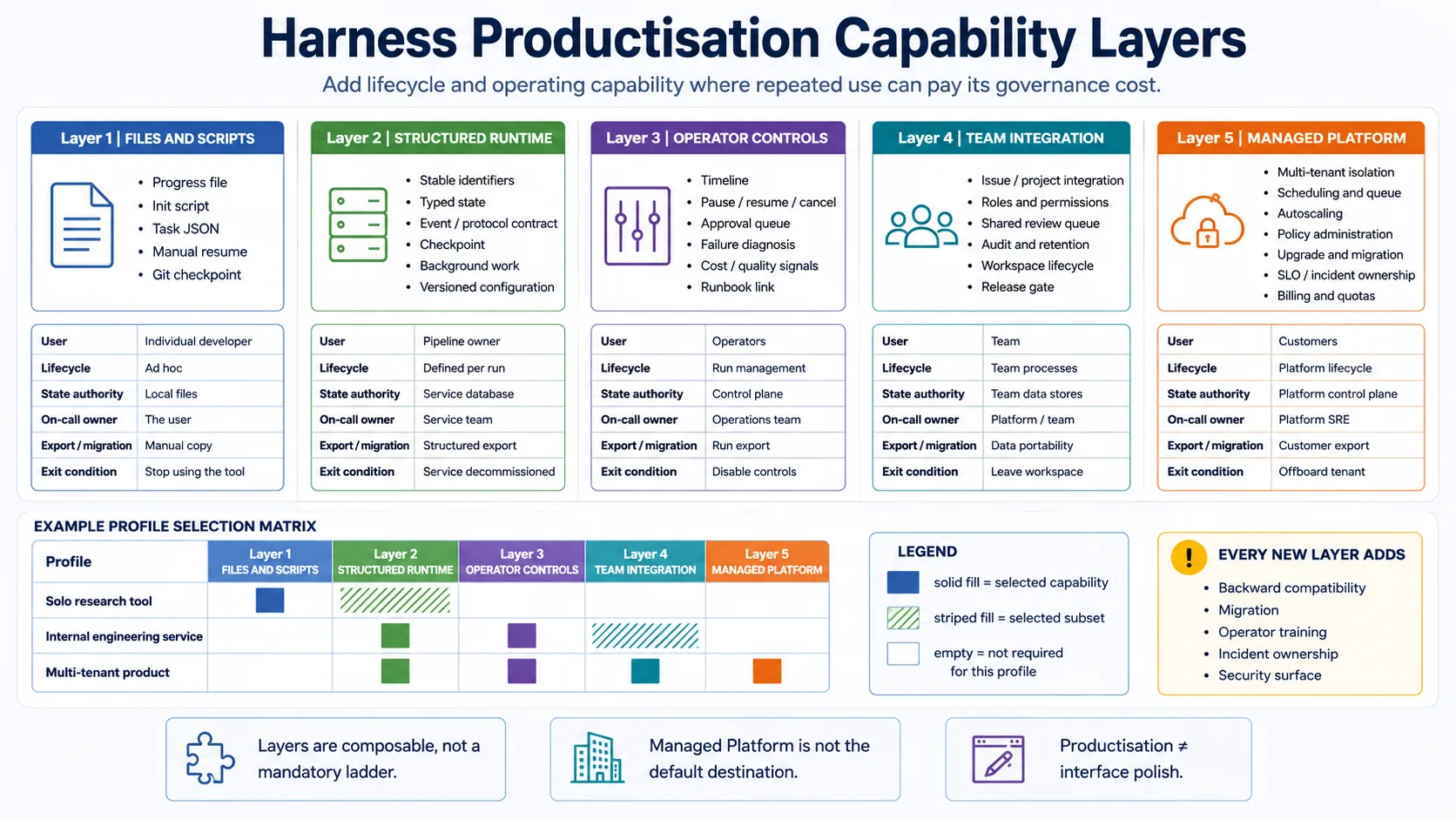
Figure 12-3 | Files and Scripts, Structured Runtime, Operator Controls, Team Integration, and Managed Platform are composable capability layers. Each needs a user, responsibility, and exit condition.
Progress files, shell scripts, task JSON, and Git checkpoints may prove that a pattern works. They do not yet make it a dependable team product.
Layer 1: Files and scripts
- progress file
- initialisation script
- task JSON
- manual resume
- Git checkpoint
Suitable for an individual or an early experiment.
Layer 2: Structured runtime
- stable identifiers
- typed state
- event and protocol contracts
- checkpoints
- background work
- versioned configuration
Layer 3: Operator controls
- timeline
- pause, resume, and cancel
- approval queue
- failure diagnosis
- cost, quality, and attention signals
- runbook links
Layer 4: Team integration
- issue and project integration
- roles and permissions
- shared review queue
- audit and retention
- branch and workspace lifecycle
- release gates
Layer 5: Managed platform
- multi-tenant isolation
- scheduling and queues
- autoscaling
- policy administration
- upgrades and migration
- SLO and incident ownership
- billing and quotas
Layers are not a mandatory sequence or a value ranking
An internal tool may need durable runtime from Layer 2 and team integration from Layer 4 without a complete managed platform. A high-risk service may need operator controls before it expands its team surface.
For each layer, answer:
- Who is the user?
- Which lifecycle is being productised?
- Which state or authority is added?
- Who is on call?
- How does export and migration work?
- Which failure occurs without this layer?
- When is further productisation uneconomic?
Productisation is not a script with a polished interface. The OpenAI Codex App Server turns long-lived threads, turns, streaming, approvals, and client integration into stable interfaces; Anthropic Managed Agents decouples session, harness, and sandbox so implementations may change behind stable boundaries. Both show that lifecycle contracts and replaceability are the core.[2][4]
A platform also creates governance debt: migration, backward compatibility, tenant isolation, operator training, and incident ownership. Add layers only when reuse, collaboration, or operational demand can pay those costs.
Templates reduce variety and can also freeze the wrong architecture
Organisations often build a small number of recurring topologies:
- API business services
- event processors
- batch pipelines
- data dashboards
Each topology can have a versioned harness template containing:
- repository structure
- architecture guides
- executable dependency rules
- approved toolchain
- bootstrap, run and test workflows
- observability contract
- security baseline
- deployment checks
- evaluator rubric
The template narrows the legal solution space, allowing guides and sensors to cover more changes while leaving local implementation freedom. MartinFowler.com describes a harness as a regulating system that combines feedforward guides and feedback sensors; a topology template can package those controls into a reusable environment.[5]
Templates also drift.
They need at least:
- a template version
- a distinction between generated and owned files
- an upgrade path
- compatibility tests
- a local override policy
- a contribution path back upstream
Where domains differ substantially, or a template forces an unnatural architecture, variety reduction becomes accelerated replication of the wrong decision.
Promote repeated review, but treat it as a hypothesis first
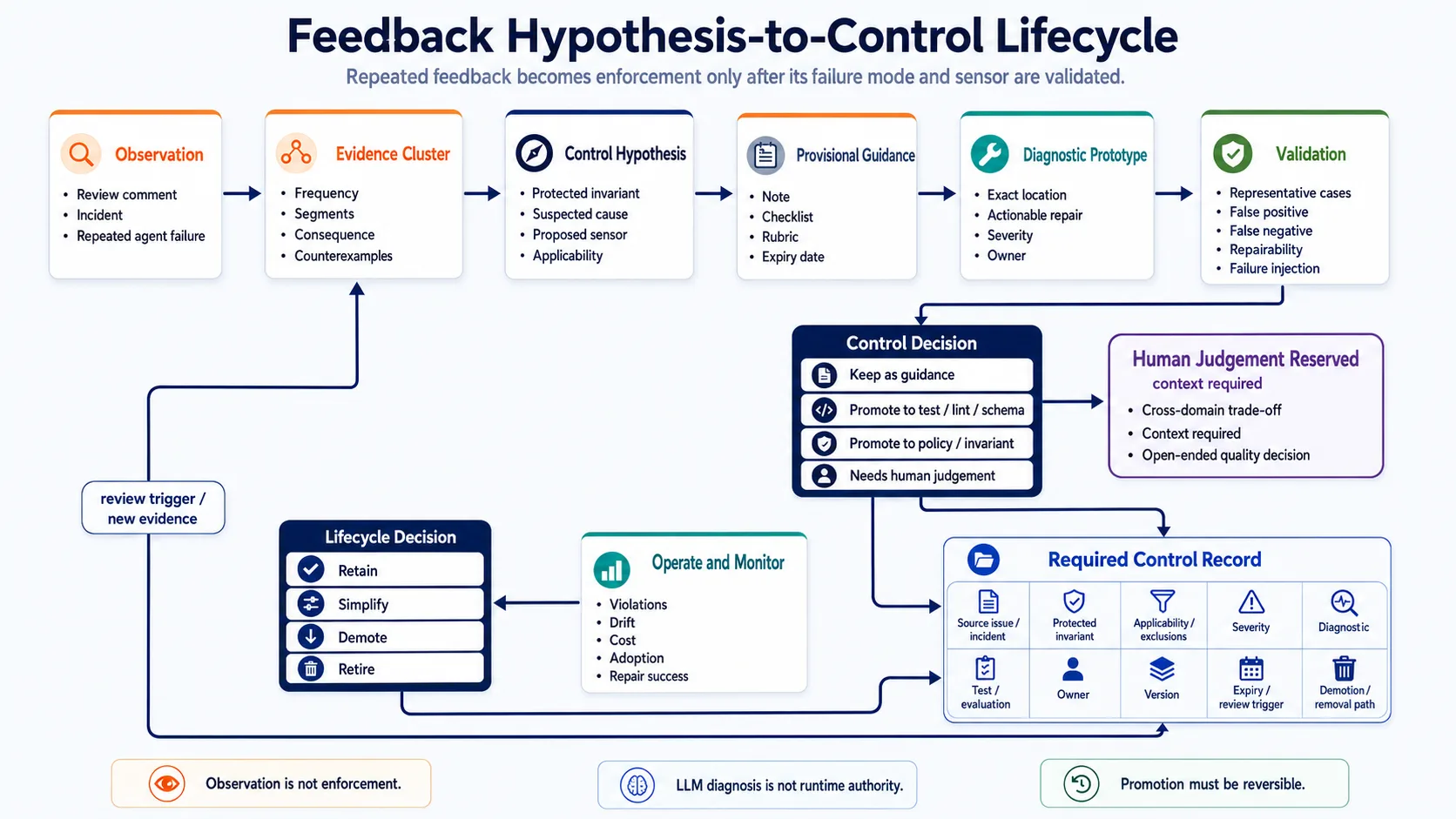
Figure 12-4 | Review feedback becomes a testable hypothesis before representative cases, false-positive checks, and failure injection justify a diagnostic, executable gate, or runtime invariant. Rules may also be demoted or retired.
A problem that appears repeatedly in code review, incidents, or agent runs should not depend forever on a person repeating the same comment.
Repetition does not mean the root cause is understood. A safer lifecycle is:
Observation
→ Cluster repeated evidence
→ Form a control hypothesis
→ Provisional guidance or checklist
→ Build diagnostic and representative cases
→ Evaluate false positive, false negative and repairability
→ Promote to executable gate when justified
→ Monitor, demote or retire
OpenAI’s harness-engineering account describes a similar movement: recurring feedback and inconsistency are promoted into repository knowledge, tooling, mechanical checks, and cleanup processes.[6]
Google Conductor’s Automated Reviews places specification and plan compliance, test execution, guidelines, and basic security checks into a post-implementation verification step, showing how review feedback can become rerunnable evidence rather than remain a comment.[7]
Promotion is most suitable when a problem is:
- repeated and representative
- bounded clearly
- costly when violated
- observable by a sensor
- measurable for false positives and false negatives
- able to produce an agent-actionable diagnostic
- owned and reversible
Poor candidates include:
- contextual design taste
- one-off exceptions
- incidents whose cause is not understood
- judgement requiring cross-domain trade-offs
- vague preferences without distinguishable good and bad cases
A promoted rule should retain:
- source incident or review
- protected invariant
- applicability and exclusions
- severity
- diagnostic
- test or evaluation
- owner
- version
- expiry or review trigger
- demotion and removal path
Promotion is not one-way. A gate with excessive false positives may return to a diagnostic or checklist, and an obsolete control may retire after underlying capabilities improve. Otherwise the improvement loop becomes a compost heap of rules.
Harness entropy grows out of success
As a harness produces more output, entropy accumulates gradually:
- duplicate prompts and conflicting instructions
- stale tool schemas
- ownerless memory
- dead configuration and feature flags
- progress ledgers that disagree with the repository
- documentation referring to removed code
- duplicate hooks
- evaluations testing obsolete behaviour
- local wrappers duplicating native platform capability
- three components maintaining the same invariant
- deprecated components without a consumer inventory
OpenAI’s agent-first repository account notes that agents copy existing patterns, including inconsistent and undesirable ones, which creates a need for golden principles, mechanical checks, and ongoing cleanup.[6]
Entropy needs an inventory and dependency graph
The system should be able to query:
- component, rule, or knowledge artefact
- owner
- protected invariant
- upstream and downstream dependencies
- active consumers
- last use
- last verification
- cost
- replacement candidate
- deprecation status
- retirement blocker
Without a consumer inventory, an apparently unused hook may fail only during a month-end job. Without an invariant map, merging two rules may erase one safety boundary.
Prefer deterministic cleanup sensors
Examples include:
- broken-link and freshness checks
- duplicate and dead-code analysis
- schema-compatibility tests
- architecture fitness functions
- unused-tool telemetry
- state-to-repository reconciliation
- dependency and security scanning
- feature-flag age
- unowned artefact and rule reports
An LLM may propose suspected problems, clusters, and repair candidates. Deleting a tool, rule, memory item, policy, or artefact still requires evidence, dependency checks, and authority.
Give maintenance complexity a budget
Possible signals include:
- active control count
- controls without owners
- rules beyond review date
- duplicate authority
- deprecated but active components
- mean time to explain a run
- upgrade and migration work
- false-positive review cost
- telemetry and storage overhead
These are triage signals rather than a maturity score. Reducing component count blindly can create the opposite failure because five clear components may be easier to maintain than one universal controller.
The target is complexity that cannot be explained, has overlapping responsibility, lacks evidence, or cannot retire.
Operational knowledge needs lifecycle and authority
When repository documents, specifications, skills, runbooks, and evaluation cases become operational knowledge, they need governance comparable to code.
Each knowledge artefact should retain:
- owner
- status
- last verified date
- canonical source and source authority
- related code, schema, or policy
- supersedes and superseded-by relationships
- review cadence
- generated or hand-authored status
- consumers and retrieval surfaces
- retention and archive rules
A documentation-gardening loop may be:
Scan
→ Classify stale, orphaned, duplicate or conflicting knowledge
→ Open a bounded repair
→ Verify against code or authority
→ Update indexes and links
→ Archive, supersede or delete safely
Google Conductor moved project context from ephemeral chat logs into version-controlled specifications and plans, then used Automated Reviews to verify implementation against those artefacts. Operational knowledge gains value from being versioned, referenceable, and verifiable rather than merely abundant.[7]
A knowledge score is a triage signal rather than a substitute for findings. A knowledge base scoring 92 may still contain an obsolete runbook that directs an agent to the wrong production credential.
Separate core, reference, watchlist, and expired material
Sending every new item into the core degrades retrieval and maintenance together.
Possible tiers are:
- Core knowledge: general, high-signal, well sourced, and maintainable
- Reference or source-only: useful to inspect but product- or version-dependent
- Watchlist: emerging, disputed, or awaiting trials
- Rejected or expired: obsolete, duplicate, incorrect, or more expensive to maintain than its value
Agents may fetch, summarise, deduplicate, and suggest a tier. Admission to core remains a governance decision through a human gate.
Archive and deletion are also different:
- content referenced by historical runs, audits, or citations needs an immutable archive or tombstone
- content with no consumers or legal and audit need, and with complete supersession, may be deleted
- retrieval indexes and caches must invalidate when status changes
For each new item, ask:
Is the retrieval and decision value greater than the maintenance entropy it introduces?
An ecosystem radar is a decision queue, not a popularity ranking
The agent-harness ecosystem changes quickly. Placing every repository, product feature, and market number in the stable theory core turns it into archaeology.
A radar may use four rings:
- Adopt: verified in the organisation’s environment and meeting safety and quality thresholds
- Trial: controlled proof of concept with a hypothesis, owner, and exit condition
- Assess: worth investigating but not yet tested
- Hold: obsolete, overlapping, risky, unmaintained, or unsuitable
A ring is an organisational adoption decision rather than a global product score. The same product may be Adopt for one team and Hold for another because of data residency.
A candidate record may contain:
name: example-runner
category: task-runner
primary_use_case: issue-to-isolated-run
source_snapshot: 2026-07-08
licence: verify-from-primary-source
deployment_model: self-hosted
provider_dependency: none
state_authority: external-database
evidence_profile:
  source: official-repository
  environment: executable-example
  failure_coverage: incomplete
  recency: current
  exitability: untested
ring: assess
owner: platform-team
known_risks:
  - incomplete cancellation semantics
  - no verified export path
next_review: 2026-08-15
The record explains research status. It does not establish reliability or promote the product automatically.
A promotion path may be:
Discovery
→ Primary-source review
→ Architecture classification
→ Sandbox trial
→ Failure injection
→ Security and data review
→ Measured comparison
→ Exit drill
→ Adopt
GitHub stars, community attention, awesome lists, and polished demos can prioritise Assess work but are not production evidence. An awesome list should be retained with a snapshot commit and review date, while each tool returns to primary sources for verification.[8]
Landscape snapshots need dates and review-by dates; coding agents, runtimes, orchestrators, task runners, platforms, and protocols should be compared within their layers. When a product is renamed, acquired, abandoned, or absorbed by a model-native capability, it should be possible to demote, replace, or retire it.
The radar’s value is not keeping up with every new noun. It makes “why have we not adopted this?” a defensible answer.
Every component needs an assumption ledger
A harness component is not a law of nature. Each one contains a claim:
Without this component, the model, tool, or environment will fail in a particular way.
An assumption ledger may contain:
component: secondary-review-agent
version: reviewer-7
protected_invariant: cross-module regressions require independent evidence
assumption: primary agent and deterministic suite miss a material class of regressions
failure_addressed: unverified integration changes
dependencies:
  - integration-test-suite@12
  - completion-contract@5
baseline: primary-agent-plus-deterministic-suite
evidence:
  - eval-run-2026-07-08
segments:
  - high-risk-invoice
  - ordinary-invoice
cost:
  latency: high
  tokens: high
  operations: medium
risk_floor:
  security_non_inferiority: required
ablation:
  method: shadow-disable-reviewer
  primary_variable: reviewer
  success_margin: no material loss on blocking criteria
decision: conditional
owner: quality-platform
last_tested_model: model-profile-v7
next_review_trigger:
  - model upgrade
  - verifier coverage increase
  - task distribution change
retirement_condition: equivalent evidence with lower cost
A useful ledger answers:
- Which invariant does the component protect?
- Which weakness is assumed to remain?
- Which other components does it depend on?
- What are the baseline and representative segments?
- Which evidence supports it?
- What cost and failure surface does it add?
- Which safety or quality floors may not decline?
- Who may change the decision?
- When should it be retested, demoted, or retired?
decision: retain is not permanent residency. It means that evidence supports retention under a particular model, task distribution, verifier, and cost environment.
Review triggers may include:
- model upgrade
- tool or runtime improvement
- changed context window or strategy
- improved codebase architecture
- changed task distribution or risk mix
- cost or latency pressure
- evaluator recalibration
- native capability replacement
- incident or near miss
Anthropic’s 2026 Managed Agents engineering article provides a concrete example: context resets needed by an older model became dead weight for a newer model. The lesson is not that harnesses are useless, but that the assumption ledger must reopen.[4]
Build-to-delete removes a mechanism while preserving its invariant
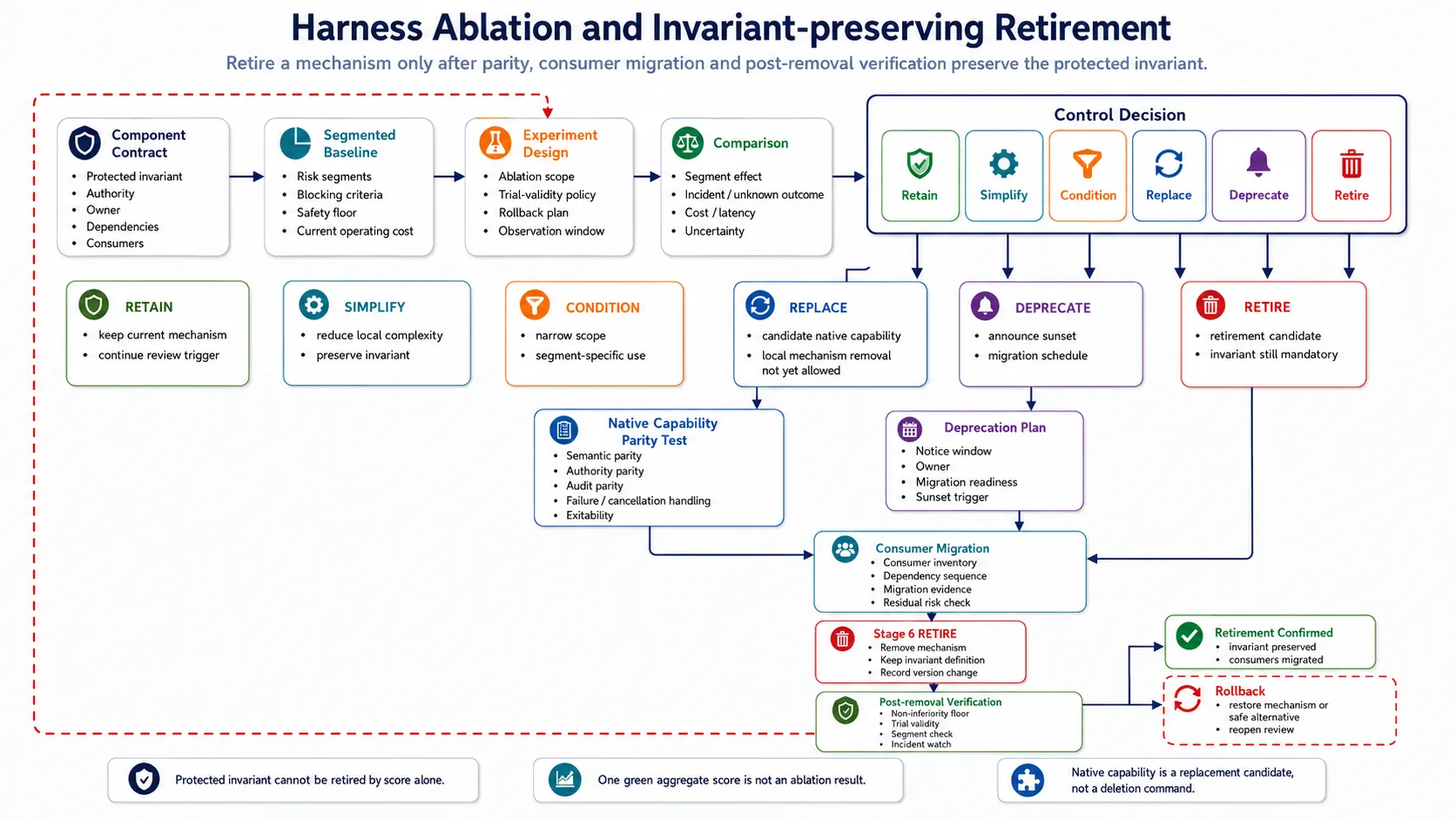
Figure 12-5 | A component moves from assumption, baseline, experiment, and segmented evidence to Retain, Simplify, Condition, Replace, or Retire. Consumers migrate and the protected invariant is verified after removal.
When designing a component, prepare:
- feature flag or shadow mode
- stable or replacement interface
- independent metrics and evidence
- clear ownership
- dependency and consumer inventory
- rollback path
- an executable ablation experiment
- deprecation, migration, and removal plans
Ablation is not casually turning off a flag
A basic flow is:
Define protected invariant and baseline
→ choose representative tasks and segments
→ disable, bypass or replace one primary mechanism
→ run shadow, paired, canary or isolated trials
→ compare quality, safety, cost and failure modes
→ inspect uncertainty and interaction effects
→ retain, simplify, condition, replace or deprecate
→ migrate consumers
→ verify invariant after removal
Changing one primary variable is a useful default, but components may interact with prompts, verifiers, tools, and state schemas. Where interactions matter, use paired trials, factorial experiments, or staged migration. The aim is to avoid changing five things and receiving one unexplained green score.
Compare at least:
- blocking criteria and task success
- safety violations and hard invariants
- segment-level quality
- trajectory efficiency
- latency and critical path
- token and monetary cost
- human intervention
- maintenance burden
- incident and unknown-outcome rate
- trial validity and uncertainty
A non-inferiority floor comes before average benefit
A reviewer whose removal reduces average pass rate by 0.2% may still be essential if the loss is concentrated in high-risk invoices or a cross-tenant or financial invariant loses protection. The average does not have decision authority.
An ablation decision should separate:
- mandatory safety and quality floors
- allowed non-inferiority margin
- segment
- confidence and uncertainty
- operational saving
- migration cost
Decisions extend beyond Retain and Remove
- Retain: still load-bearing.
- Simplify: preserve the invariant with fewer layers or lower cost.
- Condition: enable only for a risk or task segment.
- Replace: move the invariant to a native capability or clearer mechanism.
- Deprecate: stop new consumers and begin migration.
- Retire: consumers are removed and evidence shows the invariant still holds.
High-risk, regulated, and complex systems may need more control. The candidate for deletion is a mechanism with no measured value, overlapping responsibility, or an invalid assumption, not the protected invariant represented by permission, tenant boundaries, audit, or independent verification.
Native capability is a replacement candidate, not a deletion command
When a model, runtime, or platform adds a native feature, run parity, failure, and migration tests:
- Is the meaning actually equivalent?
- Do authority and audit remain?
- Are failure, cancellation, and recovery complete?
- Can old data and state still be read?
- What happens during provider outage?
- How do cost and lock-in change?
After those checks, the local mechanism may be replaced. Before them, “the platform has this now” is only a new assumption.
Build-to-delete maturity is not the number of deleted components. It is the ability to prove safely that the protected behaviour survives when a mechanism leaves.
A complete evolution example
Suppose a team wants an agent to review internal invoices.
Version one: make it work
The team adds:
- a long system prompt
- an invoice lookup tool
- an email tool
- a reviewer agent
Problems appear quickly:
- The agent sometimes treats a test invoice as a live invoice.
- An email completes but the response times out, so a retry sends it twice.
- The reviewer sees only the final answer, not the tool side effect.
- The rules file keeps growing.
Derive controls from failures
Instead of adding more prompt text, the team introduces:
- tenant and environment scope
- an idempotency key and email receipt
- canonical task state
- a completion contract
- tool trajectory verification
- an approval gate for external email
Bounded adoption
Known invoices are reproduced first. The system then handles non-destructive review before high-confidence task classes are allowed to run in the background.
Productisation
Progress files and scripts become:
- durable runs
- an operator timeline
- an approval queue
- failure diagnosis
- team roles and audit
Feedback promotion
A repeated tax-number formatting error becomes schema validation.
A special contractual clause that depends on legal interpretation remains a human review point rather than becoming a brittle rule.
Ablation
After the model and deterministic integration suite improve, the team disables the secondary reviewer in a controlled comparison.
If integration errors remain stable while cost and latency fall, the reviewer can be simplified or removed. If errors rise only for high-risk invoices, the reviewer remains conditional on that risk tier.
The maturity of this harness is not the number of agents left at the end. It is that every control has a failure, evidence, owner and exit condition.
The final maturity test
A mature harness is not necessarily the one with the most components or the greatest number of autonomous agent-hours.
It usually has:
- clear boundaries and authority
- one canonical state
- classified and recoverable failures
- external evidence for important behaviour
- correlated and observable execution
- replaceable components
- owned and fresh knowledge
- patterns with applicability and counterconditions
- retestable assumptions
- feedback that can be promoted and demoted
- queryable consumers and dependencies
- mechanisms that can retire safely
- protected invariants that survive simplification
The first eleven parts covered context, capability, runtime, reliability, safety, quality, and observability.
The final judgement is:
A harness is a continuously calibrated control system, not a component collection with no exit door.
When a team can explain why each component exists, who owns it, how its value is demonstrated, what depends on it, and when it should be simplified, replaced, or retired, the harness has moved from scaffold to maintainable engineering capability.
The more precise objective is a minimum sufficient harness:
- sufficient to protect required invariants
- sufficient for representative work
- sufficient for recovery and investigation
- free of redundant, overlapping, or ownerless controls
- recalibrated when models and platforms change
From theory to implementation: Part 12 checklist
- Every major component has a failure or protected invariant, authority, owner, evidence, and retirement condition.
- Deterministic controls fix safety, state, budgets, and pass authority; model freedom is reserved for semantic judgement.
- Build, Buy, and Compose decisions are made per boundary, with shared responsibility, export, outage, and exit drills.
- Each task class has its own adoption mode, promotion or demotion gate, and human-attention capacity.
- Patterns, templates, rules, knowledge, and ecosystem candidates have versions, status, consumers, review dates, and demotion paths.
- Repeated feedback becomes a testable hypothesis before promotion is decided through false-positive, false-negative, and repair evidence.
- Expensive or overlapping components have assumption ledgers, segmented baselines, safety floors, ablation experiments, and migration plans.
- After deletion or replacement, the protected invariant is reverified rather than inferred from lower cost alone.
This series now completes the theoretical map of harness engineering. Implementation should begin with one bounded workload, a named failure mode, canonical state, and an executable completion contract rather than an all-purpose agent city.
References
- Anthropic, Building effective agents, 19 December 2024.
- OpenAI, Unlocking the Codex harness: how we built the App Server, 4 February 2026.
- Mitchell Hashimoto, My AI Adoption Journey, 5 February 2026. This is a first-person adoption account used as one practical path rather than a universal maturity model.
- Anthropic, Scaling Managed Agents: Decoupling the brain from the hands, 8 April 2026.
- Birgitta Böckeler, MartinFowler.com, Harness engineering for coding agent users, 2 April 2026.
- OpenAI, Harness engineering: leveraging Codex in an agent-first world, 11 February 2026.
- Google Developers Blog, Conductor Update: Introducing Automated Reviews, 13 February 2026.
- AutoJunjie, Awesome Agent Harness, repository snapshot reviewed 7 July 2026. Used only as an ecosystem discovery index; individual tools require primary-source verification.