一個 Agent 正執行到長任務的一半。
它已經:
- 搜尋三個官方來源
- 排除兩個誤導頁面
- 完成七個步驟中的四個
- 得知使用者不接受第三方定價資料
- 發現某個 API 需要額外權限
- 記錄了一項不應重複的失敗
接著 Context Window 被壓縮、Process 重啟,或任務改由另一個 Worker 接手。
系統再次搜尋相同頁面、重做已被否決的 Action、忘記使用者限制,甚至推翻自己先前的結論。
這不只是 Model Capability 問題,通常更是資訊架構問題。
系統沒有正確區分:
- Context:模型現在能看見什麼
- Workflow State:執行現在在哪裡
- Working Memory:Active Task 正在使用什麼
- Long-term Memory:哪些資訊可跨 Step 或跨 Run 重用
- External Knowledge:哪些資訊由其他 Source 管理
- RAG:如何把 External 或 Stored Information 取回 Current Context
接上 Vector Database 不會自動產生 Memory;保存每一段對話也不會自動產生有用 Memory。兩者都可能只造出一間塞滿無標籤紙箱的閣樓。
Production Memory Design 必須回答:
什麼值得保存?
它屬於哪一種資訊?
誰擁有它?
誰可以讀取或修改?
什麼證據支持它?
有效期限多長?
與新資訊衝突時怎麼辦?
何時應刪除、過期或 Supersede?
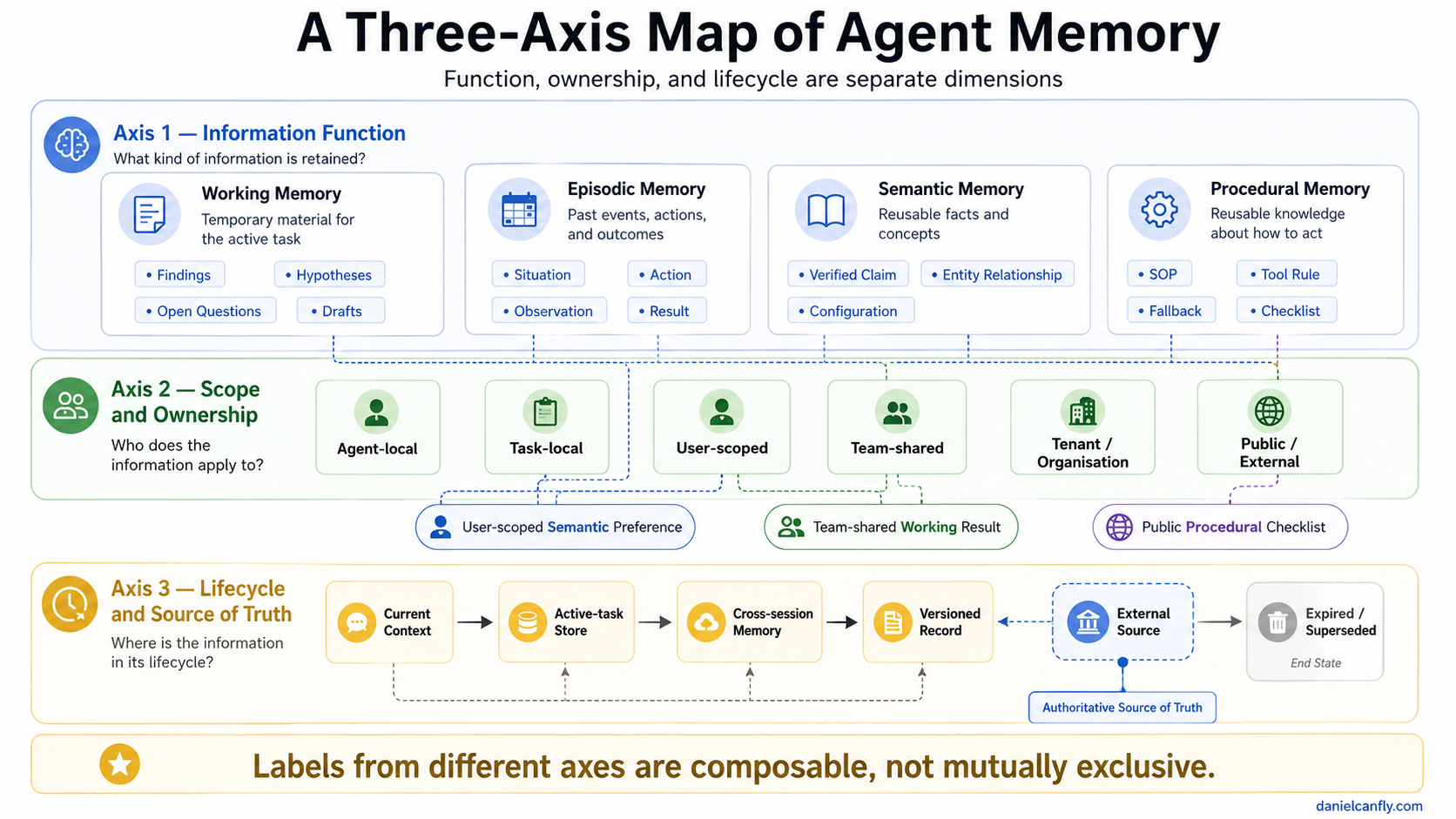
本文會以三個彼此分離的軸建立實務模型:
- Function:保留的是哪一類資訊
- Scope and Ownership:資訊適用於誰
- Lifecycle:資訊如何寫入、檢索、更新與遺忘
把這三個軸拆開,可以修正 Agent Memory 最常見的分類錯誤。
Memory Taxonomy 需要不只一個軸
常見清單包括:
- Working Memory
- Episodic Memory
- Semantic Memory
- Procedural Memory
- User Memory
- Shared Memory
- External Memory
問題是,這些名稱並不是在描述同一種屬性。
Axis 1:Information Function
這個軸描述資訊代表什麼。
- Working Memory:暫時性的 Task Material
- Episodic Memory:過去 Event、Action 與 Outcome
- Semantic Memory:可重用 Fact 與 Concept
- Procedural Memory:可重用的行動知識
Axis 2:Scope and Ownership
這個軸描述資訊屬於誰,或誰可以使用。
- Agent-local
- Task-local
- User-scoped
- Team-shared
- Tenant 或 Organisation-scoped
- Public 或 External
User-scoped Item 可以是 Semantic:
使用者偏好繁體中文。也可以是 Episodic:
使用者在上一次 Task 拒絕第三方定價。Shared Memory 可以保存 Working Notes、Verified Facts 或 Procedures。「Shared」並不能說明 Content Type。
Axis 3:Lifecycle and Source of Truth
這個軸描述資訊來自哪裡,以及應存在多久。
- Immediate Model Context
- Active-task Storage
- Cross-session Memory
- Externally Managed Source
- Immutable Event Log
- Versioned Knowledge Store
- Expiring Cache
同一個 Fact 可能經過數個 Lifecycle Stage:
Tool Result
  -> Current Context
  -> Working-memory Candidate
  -> Verified Semantic-memory Entry
  -> Source 更新後被 Supersede
這些標籤可以組合,不應被硬塞成一條垂直階梯。
Context、State、Memory、External Knowledge 與 RAG
這些概念彼此相關,但回答不同問題。
Context
Context 是模型在當前 Inference 或 Reasoning Step 中可以使用的輸入。
它可能包含:
- System Instruction
- Current User Request
- 被選中的 Conversation History
- Workflow State Summary
- Retrieved Document
- Tool Result
- Selected Memory Entry
- Applicable Procedure
Context 是被組裝出來的,不等於系統的完整歷史。
資訊如果沒有進入 Current Model Input,也無法透過 Action 取得,模型在這一步就不能直接使用。
Workflow State
Workflow State 保存執行控制資訊。
常見欄位:
workflow_id
current_node
step_status
retry_count
plan_version
pending_approval
worker_assignment
remaining_budget
last_error
terminal_status
State 回答:
目前 Run 在哪裡、已經發生什麼,以及下一個合法 Transition 是什麼?
這些欄位通常需要精確與 Atomic Update。把 retry_count: 2 摘要成自然語言,之後再從 Conversation 反推數字,是一齣袖珍但高機率上映的行政災難。
Working Memory
Working Memory 是 Active Task 的暫時資訊工作區。
可能包含:
- Intermediate Finding
- Current Hypothesis
- Resolved 與 Unresolved Requirement
- Source Summary
- Rejected Candidate
- Temporary Calculation
- Draft Artefact
- Local Decision
Working Memory 回答:
Active Task 目前知道什麼,又還在處理什麼?
每個 Step 只需把其中相關部分放入 Model Context。
Long-term Memory
Long-term Memory 保留超過單一步驟,有時也跨越不同 Run 的可重用資訊。
可能包含:
- Past Episode
- Verified Fact
- Validated Procedure
- User-approved Preference
- Durable Organisation Convention
「Long-term」不代表「永遠」。所有 Durable Memory 都需要 Retention 與 Invalidation Policy。
External Knowledge
External Knowledge 由 Agent Memory Lifecycle 之外的 Source 管理。
例如:
- Official Documentation
- Product Catalogue
- Policy Repository
- Code Repository
- Database
- Wiki
- Document Archive
- Knowledge Graph
- Web Source
External System 仍然是 Source of Truth。
RAG
Retrieval-augmented Generation 將 Non-parametric Source 的 Retrieval 與 Generation 結合。在 Application Architecture 中,實務流程是:
Query
  -> Retrieve Candidates
  -> Filter and Rerank
  -> Put Selected Evidence into Context
  -> Generate or Decide
RAG 是 Retrieval 與 Context Construction Mechanism,不等於 Memory。
Memory Store 可以使用 Retrieval;External Document Collection 也可以使用 Retrieval。兩者甚至可共用 Retriever,但 Governance 與 Source-of-truth Rule 仍然不同。
一行版區別
Context:
模型現在能使用什麼

State:
執行現在在哪裡

Working Memory:
Active Task 正在維護與使用什麼

Long-term Memory:
系統保留什麼供之後重用

External Knowledge:
其他 Source 管理什麼

RAG:
如何把選定資訊取回 Context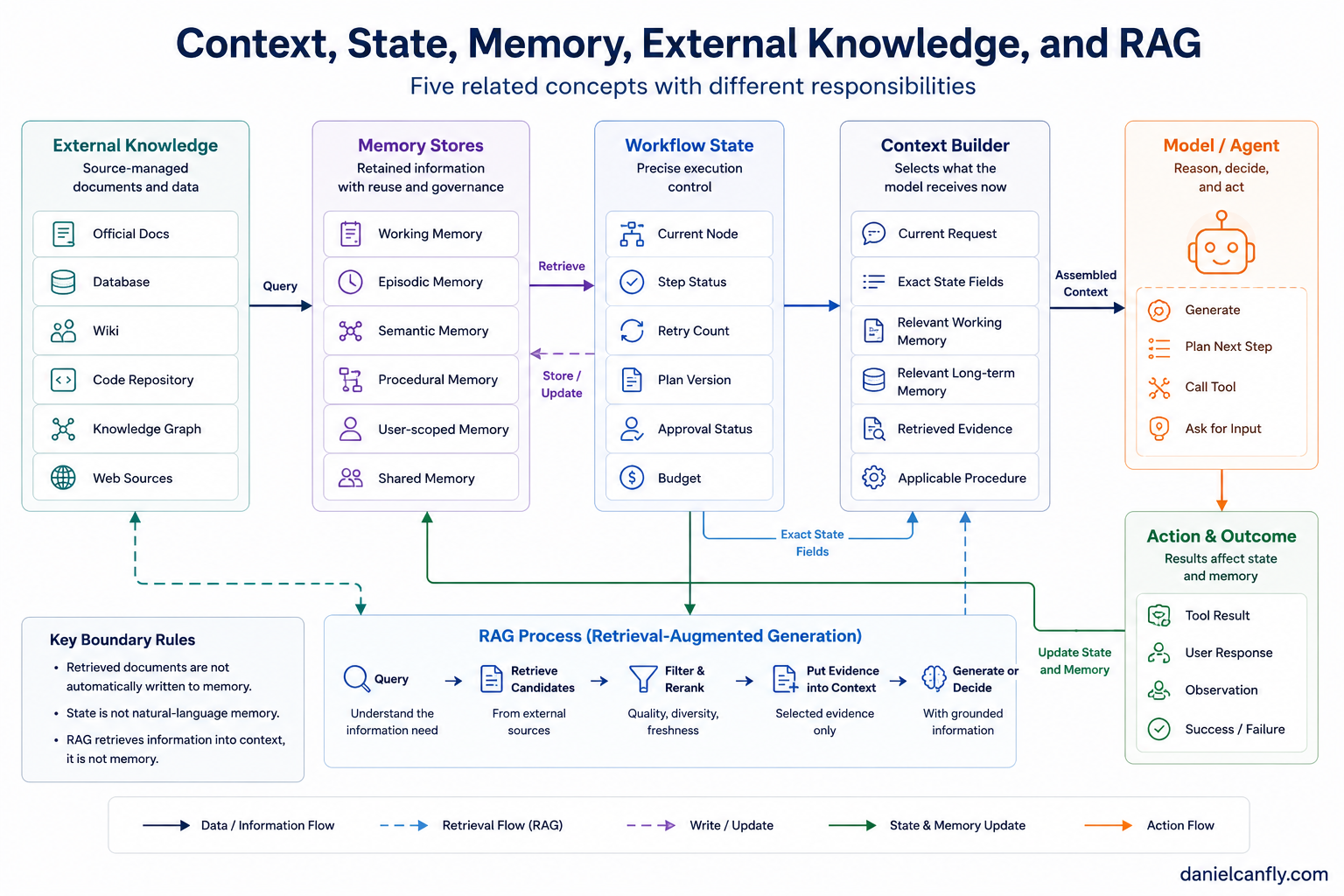
Stateless 是合理設計
Stateless System 不跨 Request 保留 Application Memory。
Request
  -> Bounded Processing
  -> Response
  -> Discard Task Data
適合:
- 翻譯
- 單次改寫
- Classification
- Fixed Extraction
- Format Conversion
- 沒有 Persistence 需求的 Sensitive Task
- Caller 會提供所有必要 State 的操作
優點:
- Behaviour 更簡單
- Privacy 與 Retention Risk 較低
- 更容易 Reproduce
- 不受 Stale Memory 污染
- Deletion Obligation 較少
- Storage 與 Retrieval Cost 較低
Stateless 不代表 Runtime 沒有 Log 或 Operational Record,而是這些紀錄不會在沒有獨立目的與 Policy 的情況下被重用成 Agent Memory。
預設值不應該是「全部記住」,而應該是:
Future Value 不足以抵銷 Governance Cost 時,就不要持久化。
Working Memory:Active Task Workspace
Working Memory 支援目前執行中的 Task。
例如:
Goal:
比較三個 Orchestration Framework

Verified:
- Framework A 支援 Durable Checkpoint
- Framework B 需要 External Persistence

Unresolved:
- Framework C 的 Observability Model

Rejected:
- Third-party Pricing Claim

Next:
閱讀 Framework C 官方 Tracing Documentation
Working Memory 不等於 Context Window
Context Window 是某一步的 Model Input。
Working Memory 可以:
- 大於單次 Model Context
- 使用 Structured Format
- 儲存在 Model 外部
- 被選擇性注入
- 與 Workflow Runtime 共用
- 在同一 Task 的 Process Restart 後保留
Context Builder 選擇下一次 Call 要帶入什麼:
Current Request
+ Exact Workflow Fields
+ Relevant Working-memory Items
+ Selected Long-term Memory
+ Retrieved External Evidence
+ Applicable Procedure
Working Memory 需要 Trust State
不要把所有 Entry 混成一袋。
可使用:
- proposed
- observed
- verified
- rejected
- superseded
- unresolved
Draft Hypothesis 不應被取回後當成 Accepted Fact。
典型 Retention
Working Memory 通常保留到:
- Task 完成
- Task 取消
- Task 過期
- Task Archived
- 達到 Retention Limit
其中部分 Artefact 可以之後被 Promotion 成其他 Memory Type,但 Promotion 必須是明確動作。
State 不是另一種自然語言 Memory
State 可以與 Task Memory 存在同一個 Database,但語意不同。
比較:
Working Memory:
兩個 Official Source 支持這項 Claim。

Workflow State:
current_node = VERIFY
retry_count = 1
approval_status = PENDING
Working Memory 常可摘要或壓縮。
Control State 則可能需要:
- Exact Value
- Transactional Update
- Concurrency Control
- Checkpoint
- Idempotency
- Legal-transition Validation
把 State 當成 Unstructured Conversation Summary,可能造成:
- Retry Counter 重設
- 已完成 Step 再次執行
- Approval Status 遺失
- 兩個 Worker 同時 Claim Task
- 舊 Plan Version 重新成為 Active
Storage Technology 可以共用,Contract 不應混用。
Episodic Memory:過去 Event 與 Outcome
Episodic Memory 表示某個具體情境中發生了什麼。
有效 Episode 可以包含:
Goal:
取得完整 Job Description

Situation:
Stored Description 為空

Action:
Fetch Source URL

Observation:
Page 只暴露 Partial Content

Fallback:
使用 Public Job-posting Endpoint

Outcome:
取得完整 Description

Environment:
Source Version 與 Access Date

Evidence:
Request Trace 與 Retrieved Document

Reflection Candidate:
偵測到 Partial Page 後使用 Public Endpoint
Episode 的用途
- 診斷重複 Failure
- 取得 Similar Case
- Replay Action History
- 支援 Long-running Work
- Personalise Future Interaction
- 評估哪些 Strategy 有效
- 產生有 Evidence 的 Reflection Candidate
Generative Agents 使用 Experience Memory Stream、Reflection 與 Retrieval 支援 Planning;Reflexion 把過去 Trial 的 Verbal Feedback 存進 Episodic Buffer。這些是 Experience Reuse 的例子,不代表每個 Event 都值得永久保存。
主要風險
Surface Similarity
兩個 Episode 表面相似,Critical Constraint 可能不同。
Misattribution
系統可能只記住 Success 前一個 Action,卻沒找出真正 Cause。
Staleness
API、Product、Permission 與 Environment 會改變。
Privacy
Episode 可能包含 User Data、Tool Output 或敏感 Operation Detail。
Volume
Raw Event History 會淹沒 Retrieval。
Episode 應保留 Evidence 與 Context,同時足夠精簡,能被 Retrieval 與 Inspection。
Semantic Memory:可重用 Fact 與 Concept
Semantic Memory 保存可重用 Declarative Knowledge。
例如:
- Product Capability
- Organisation Definition
- Tenant Configuration
- Approved Domain Term
- Stable User Setting
- Verified Entity Relationship
Production Semantic-memory Record 應像 Versioned Claim,而不是漂浮句子。
Claim:
Enterprise Plan 支援 SSO

Source:
Official Product Documentation

Source Version:
2026-06

Effective Scope:
Enterprise Plan, Global Region

Validation:
Verified

Valid From:
2026-06-01

Last Checked:
2026-07-01
Fact 需要 Provenance 與 Time
沒有 Source 或 Effective Period 的 Fact 很難:
- Verify
- Update
- Supersede
- Audit
- 依 Scope 限制
Model-generated Inference 不應被寫成有來源的 Fact。
可使用狀態:
- proposed
- verified
- disputed
- superseded
- expired
- revoked
Semantic Memory 與 RAG
Semantic Memory 描述 Information 的 Role 與 Lifecycle。
RAG 描述如何把 Information 取回 Model。
Semantic-memory Store 可以透過:
- Metadata Filter
- SQL
- Vector Search
- Graph Traversal
- Keyword Search
Official Document Store 使用同樣 Retrieval Technique,也不會因此變成 Agent Memory。
Procedural Memory:如何行動的可重用知識
Procedural Memory 保存 Reusable Behaviour 或 Task Procedure。
例如:
- Validated SOP
- Tool-selection Rule
- Escalation Sequence
- Fallback Policy
- Verification Checklist
- Handoff Contract
- Safe Retry Procedure
- Approved Output Schema
範例:
Procedure:
取得完整 Job Description

Trigger:
Stored JD 為空或 Partial

Preconditions:
Source URL 存在
使用者可存取 Listing

Steps:
1. 開啟 Source URL
2. 檢查是否包含完整 Responsibilities 與 Requirements
3. Page 只有 Partial Content 時使用 Approved Public Endpoint
4. 仍無法取得完整 JD 時標記 Pending
5. 絕不只根據 Title 評分

Scope:
Job-scoring Workflow

Owner:
Recruiting-automation Team

Version:
3.2

Validation:
Approved
Procedure 與 Prompt
Prompt 是 Instruction 的一種 Delivery Mechanism。
Procedural Memory 是可被 Selection、Version、Test 與 Governance 的 Knowledge,之後可以被插入 Prompt 或 Tool Policy。
Application 不應盲目取得每個語義相似 Procedure,必須檢查:
- Trigger
- Preconditions
- Scope
- Version
- Permissions
- Conflicts
- Expiry
- Approval Status
Voyager 與 Reusable Skill
Voyager 在 Embodied Environment 中展示保存與取得 Executable Code Behaviour 的 Skill Library,是 Reusable Procedural Capability 的一個例子。但 Production Procedure 也可以是 Natural-language SOP、Workflow Definition、Code、Policy 或 Tool Schema。
主要風險
- Outdated Procedure
- Conflicting Rule
- Accidental Lesson 被升級成 Global Rule
- Scope 遺失
- Unsafe Procedure 被錯誤 User 或 Environment 取用
- Procedure 未經 Review 就被修改
High-impact Procedure 需要 Owner、Test、Version 與 Rollback。
User Memory 是 Scope,不是第五種 Cognitive Content Type
User Memory 保存 User-scoped Information。
它可以是:
- Semantic:Stable Preference
- Episodic:過去被接受的 Decision
- Procedural:User-specific Workflow Rule
- Task-working:只與 Active Request 相關的 Preference
可能值得明確保存的項目:
- Preferred Language
- Preferred Output Format
- Accessibility Requirement
- Stable Notification Setting
- User-approved Workflow Rule
- 會改變 Future Execution 的 Persistent Restriction
不應隨意保存:
- Personality Guess
- One-off Emotion
- 從無關內容推測的 Sensitive Attribute
- Transient Conversation Detail
- Third-party Personal Data
- 使用者不合理預期會持久化的資訊
User-memory Design 應支援:
- Clear Purpose
- Understandable Consent 或 User Action
- View
- Correction
- Deletion
- Scope
- Retention
- Access Control
- Auditability
設計目標不是最大化情感熟悉感,而是在 User Control 下保留能可預測改善 Future Work 的資訊。
Shared Memory 是 Coordination Scope
Shared Memory 讓多個 Agent 或 Service 透過共同資訊協作。
它可能包含:
- Task Goal
- Current Plan
- Verified Facts
- Open Questions
- Worker Assignment
- Structured Result
- Conflict Flag
- Accepted Decision
- Shared Procedure
「Shared」描述 Access 與 Coordination,底層 Entry 仍有 Content Type 與 Trust State。
Blackboard 是一種 Shared-memory Architecture
Blackboard Architecture 中,多個 Knowledge Source 或 Worker 讀寫共同 Problem-solving Space。Controller 或 Scheduling Mechanism 可以決定下一個 Contribution。
Production Blackboard 不只是 Shared Text Field,至少需要:
- Typed Entry
- Author
- Source
- Version
- Validation Status
- Write Permission
- Conflict Rule
- Subscription 或 Task Trigger
- Audit Log
- Retention
Local Memory 與 Shared Memory 應分開
Agent-local Working Memory 可以包含:
- Raw Note
- Temporary Hypothesis
- Tool Log
- Private Scratch Artefact
Shared Memory 只應包含 Coordination 需要的資訊:
- Structured Result
- Verified Fact
- Open Question
- Accepted Decision
- Task Status
這能降低 Noise、Privacy Spread 與 Accidental Reuse。
Shared-memory Permission
可定義操作:
- read
- propose
- validate
- approve
- supersede
- revoke
- delete
不是每個 Worker 都能 Overwrite Verified Fact 或把 Item Promotion 進 Long-term Memory。
External Knowledge 應保留自己的 Source Identity
External Knowledge Store 包括:
- Document
- Database
- Wiki
- Policy
- Manual
- Code Repository
- Catalogue
- Knowledge Graph
- Web Page
它們通常由其他系統管理,並有自己的 Update 與 Permission Model。
常見錯誤:
Retrieve 一個 Paragraph
  -> Summarise
  -> 把 Summary 存成 Permanent Fact
  -> Source 與 Version 消失
更好的 Record 會保留 Link:
Derived Memory:
Scoped Summary

Derived From:
document_id
document_version
section
retrieval_time
access_policy
能保存 Source-of-truth Reference 時,不要預設把整份 Source Copy 進 Memory。
RAG 可以再取回:
- Original External Evidence
- Derived Memory
- 或兩者同時取回,但採用不同 Trust 與 Freshness Rule
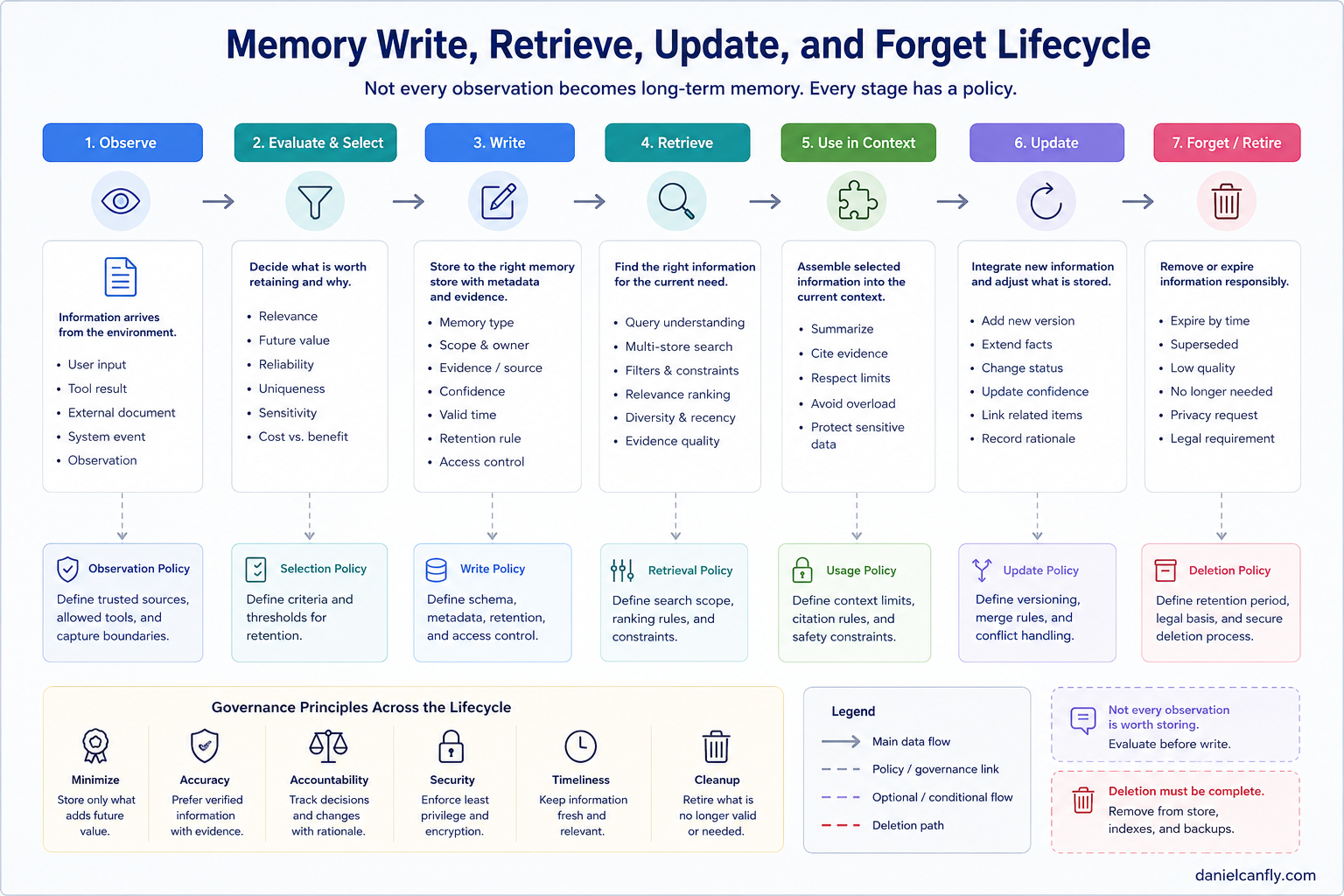
Memory 是 Lifecycle,不是 Database
完整 Memory System 至少包含:
Observe
  -> Decide Whether to Write
  -> Classify Type and Scope
  -> Normalise
  -> Validate
  -> Store
  -> Retrieve Candidates
  -> Filter and Rerank
  -> Assemble Context
  -> Use
  -> Evaluate Usefulness
  -> Update, Supersede, Expire, or Delete
1. Observe
Candidate 可能來自:
- User Input
- Tool Result
- Workflow Event
- Accepted Output
- Verifier Result
- Human Decision
- Reflection
Observe 不代表自動 Approved。
2. Write Decision
詢問:
- Future 是否會再用?
- 是否已存在?
- 是否只是 Temporary State?
- 是否包含 Sensitive Data?
- 是否有 Source?
- User 或 Policy 是否允許持久化?
- 是否可重新取得 Original Source?
正確 Write Target 可能是 none。
3. Classify
指定:
- Content Type
- Owner and Scope
- Retention Class
- Sensitivity
- Trust State
- Source-of-truth Relationship
4. Normalise
將 Candidate 轉為 Structured Record。
5. Validate
檢查:
- Evidence
- Accuracy
- Scope
- Consent 或 Authority
- Duplication
- Conflict
- Policy
- Retention
- Write Permission
6. Store
根據 Access Pattern 與 Contract 選擇:
- Relational Database
- Document Store
- Key-value Store
- Vector Index
- Graph Database
- Event Log
- Object Storage
同一 Memory Record 可以有數個 Physical Index。Vector Index 通常是 Access Path,不是完整 Source of Truth。
7. Retrieve
根據:
- Task 與 Query
- Type
- User 或 Tenant
- Project
- Time
- Permission
- Status
- Source
- Semantic Relevance
- Exact Identifier
取得 Candidate。
8. Filter and Rerank
Semantic Similarity 只是其中一個 Signal。
可以加入:
- Applicability
- Scope Match
- Recency
- Source Authority
- Validation Status
- Confidence
- Contradiction
- User 或 Tenant Match
- Cost of Use
不要假裝一條 Universal Weighted Formula 適用所有 Memory Type。Hard Permission Mismatch 應直接 Filter Out,而不是只扣三分。
9. Assemble Context
Context Builder 決定:
- 哪些 Exact State Field 必須帶入
- 哪些 Working-memory Item 相關
- 哪些 Long-term Memory 適用
- 需要哪些 External Evidence
- 每個 Category 分配多少 Token Budget
10. Use and Evaluate
追蹤 Retrieved Memory 是否:
- 改變 Decision
- 改善 Task Success
- 避免重複工作
- 造成 Error
- 被忽略
- 已 Stale 或 Irrelevant
11. Update、Supersede、Expire 或 Delete
Memory 必須能被 Correction 與 Forgetting。
Retrieval:先判斷 Applicability,再看 Similarity
Semantic Similar Item 仍可能不可用,因為它:
- 屬於另一個 User
- 適用另一個 Product Version
- 已過期
- 尚未 Verified
- 與 Current Policy 衝突
- 已 Superseded
- 需要 Current Agent 沒有的 Permission
Robust Retrieval Pipeline:
Permission and Scope Filter
  -> Lifecycle-status Filter
  -> Candidate Retrieval
  -> Semantic and Lexical Relevance
  -> Recency and Authority Reranking
  -> Contradiction Check
  -> Context-budget Selection
Hard Filter
例如:
- Tenant
- User
- Project
- Region
- Memory Type
- Access Policy
- Active Status
- Effective Date
- Expiry
- Sensitivity Class
Ranking Signal
例如:
- Semantic Relevance
- Exact-key Match
- Source Authority
- Recency
- Prior Usefulness
- Confidence
- Task Compatibility
- Novelty
Retrieval Budget
限制:
- Memory 數量
- Token
- 每種 Type 的 Entry 數
- Age Range
- Minimum Confidence
- Duplicate Content
- Conflicting Candidate 數量
LongMemEval 顯示 Long-term Memory 能力不只是 Raw Recall,還包含 Information Extraction、Multi-session Reasoning、Temporal Reasoning、Knowledge Update 與 Abstention。
Memory System 若很有信心地找回過時 Preference,不能只因為「找到東西」就算成功。
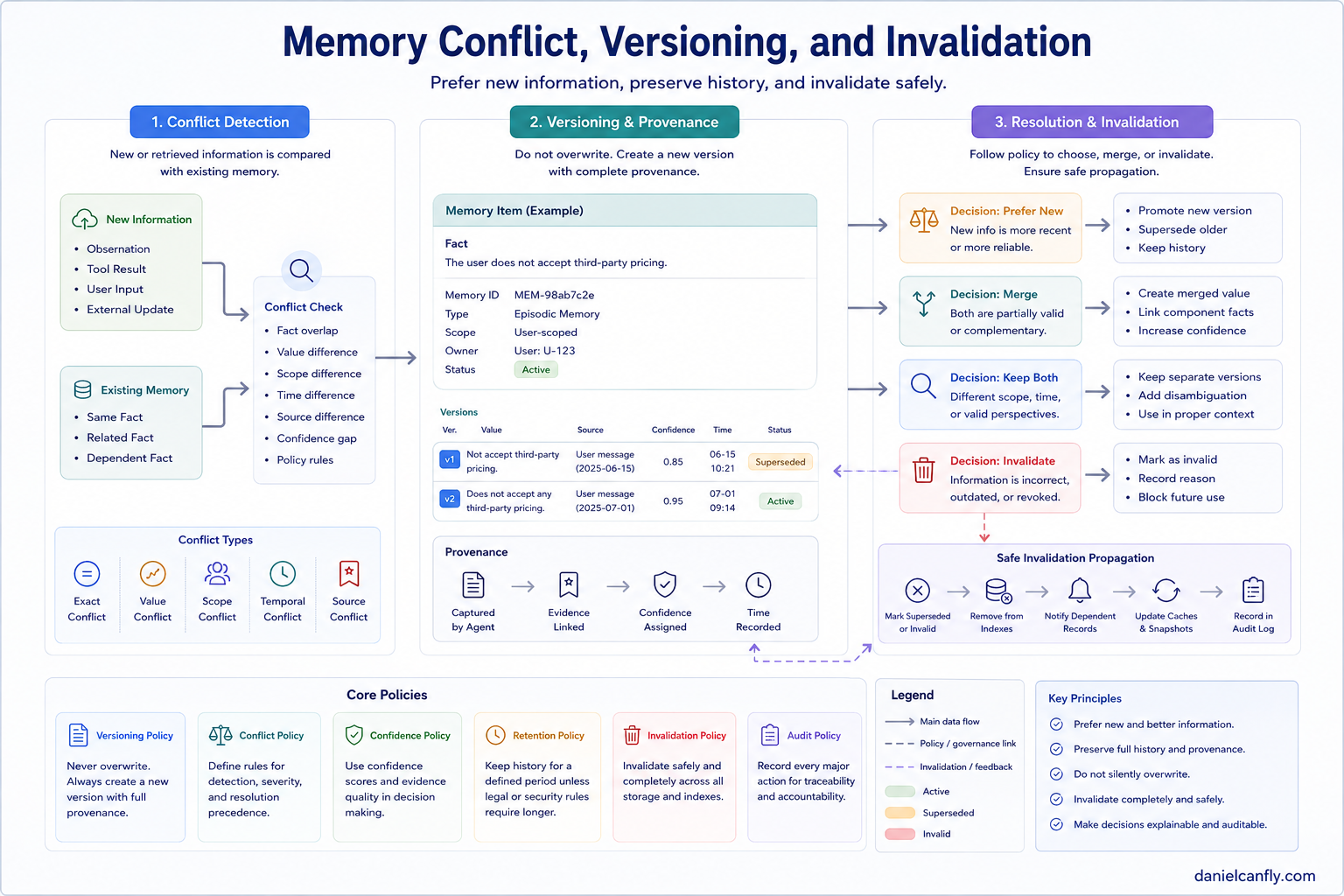
Conflict 與 Version Governance
Memory Conflict 很正常。
例如:
Procedure v1:
使用 Billing API v1

Procedure v2:
使用 Billing API v2
五月紀錄的 Preference:
使用簡短回答
七月紀錄的 Preference:
技術主題提供詳細解釋Conflict Type
- Temporal:Old 與 New Version 不同
- Scope:不同 User、Region、Project、Plan 或 Environment
- Source:Official 與 Secondary Source 不一致
- Procedural:兩個 Rule 指定不同 Action
- Identity:兩筆 Record 可能是同一或不同 Entity
- Preference:User Choice 因時間或 Task 不同
- Derived-fact:結論來自不同 Evidence
Resolution Order
實務順序:
- 確認 Entity 與 Scope
- 比較 Effective Time
- 檢查 Source Authority 與 Provenance
- 比較 Validation Status
- 檢查 Supersession Link
- 判斷是否可在不同 Condition 下並存
- 標記 Unresolved Conflict
- High-impact Ambiguity 進 Escalation
不要靜默 Overwrite History
使用 Version Model:
Memory v1
status: superseded

Memory v2
status: active
supersedes: v1
reason: official API migration
Version History 支援:
- Audit
- Rollback
- Debug
- Behaviour-change Analysis
- Source Refresh
Invalidation 應傳播
Semantic Fact 改變時,由它衍生的 Item 也可能需要 Review。
External Document Updated
  -> Semantic Claim Superseded
  -> Cached Summary Invalidated
  -> Dependent Procedure Flagged
  -> Affected Shared Decision Reverified
因此 Provenance 本質上像 Graph,即使 UI 看起來只是一張 Table。
Forgetting 是功能,不是缺陷
沒有 Forgetting 的 Memory System,時間越久可能越不可靠。
應 Forget 或 Retire 的原因:
- Task 完成
- Retention Period 結束
- User Delete
- Source Revoked
- Policy 改變
- Item 被 Superseded
- Confidence 低於 Threshold
- Memory 從未有用
- Privacy 或 Security Requirement
- Duplicate Consolidation
- Incorrect Inference
「Forget」可能代表:
- 不再進 Active Retrieval
- Expire
- Archive
- Revoke
- Tombstone
- Physical Delete
- Delete Derived Index
- 只保留必要 Audit Record
Deletion 必須涵蓋 Secondary Artefact:
- Vector Index
- Cache
- Summary
- Replica
- Derived Profile
- Shared Copy
否則系統只是在儀式上忘記,資料則在六個 Index 裡繼續過著精彩人生。
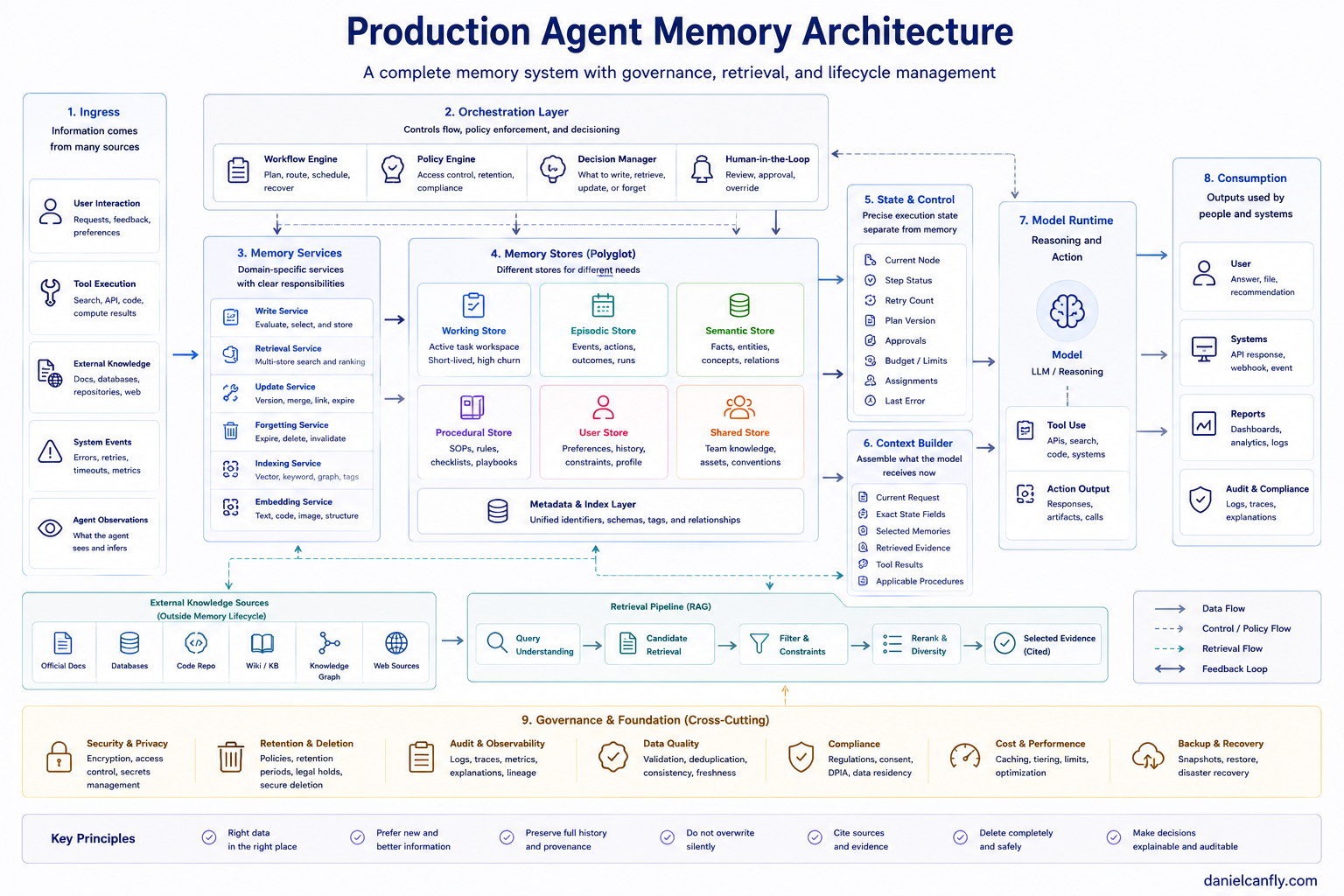
Production Memory Architecture
Production Architecture 應分離 Control、Storage、Retrieval 與 Governance。
Context Builder
從以下來源組裝 Model Input:
- Current Request
- Exact Workflow State
- Selected Working Memory
- Applicable Long-term Memory
- Retrieved External Evidence
- Procedure
- Policy Instruction
Memory Router
決定 Candidate 應寫到:
- No Storage
- Working Memory
- Episodic Memory
- Semantic Memory
- Procedural Memory
- User-scoped Memory
- Shared Memory
Write Validator
檢查:
- Source
- Scope
- Duplication
- Conflict
- Sensitivity
- Authority
- Retention
- Write Permission
- User Control
Typed Store
不同 Memory Contract 可使用不同 Storage 與 Index。
例如:
- Workflow State 放 Transactional Store
- Episode 放 Event 或 Document Store
- Semantic Claim 放 Relational 或 Graph Model
- Procedure 放 Versioned Registry
- User Preference 放 Scoped Profile Store
- Large Source Document 放 Object Storage
- Vector Index 作 Retrieval Accelerator
Retrieval Layer
支援:
- Metadata Filter
- Exact Lookup
- Semantic Search
- Keyword Search
- SQL
- Graph Traversal
- Time-aware Retrieval
- Authority 與 Version Reranking
Shared-memory Gateway
控制哪些 Local Result 能被其他 Agent 看見。
它會執行:
- Task Scope
- Typed Handoff
- Trust State
- Read and Write Permission
- Conflict Flag
- Final-owner Decision
Governance Layer
控制:
- Version
- Supersession
- Expiry
- Deletion
- Access
- Audit
- Retention
- Approval
- Source Refresh
- Organisation 所定義的 Legal 或 Policy Requirement
Observability
追蹤:
- Write-candidate Rate
- Accepted-write Rate
- Retrieval Hit Rate
- Useful-memory Rate
- Stale-memory Rate
- Conflict Rate
- Privacy-deletion Completion
- Memory-caused Error Rate
- Retrieval Latency
- Context Token Cost
- Abstention Quality
如何評估 Memory System
Memory Demo 常只問:
系統能不能記得上一次 Conversation 的一個 Fact?
Production Evaluation 需要更多。
Recall
需要的 Item 是否被取回?
Precision
是否避免取回 Irrelevant 或 Prohibited Item?
Temporal Correctness
是否使用當前時間有效的 Version?
Update Handling
New Fact 是否正確 Supersede Old Fact?
Scope Correctness
Item 是否適用於正確 User、Tenant、Project 與 Region?
Abstention
沒有 Reliable Memory 時,系統是否承認不知道?
Privacy and Access
是否阻止 Cross-user 或 Unauthorized Retrieval?
Usefulness
Memory 是否改善 Downstream Outcome?
Harm
Stale 或 Incorrect Memory 是否造成更差 Decision?
Evaluation Set 應包含:
- Conflicting Update
- Similar but Inapplicable Episode
- Revoked User Preference
- Expired Procedure
- Cross-tenant Trap
- Unsupported Question
- Deletion Request
- Source-version Change
Long Context 不能取代這些能力。MemGPT、LongMem、MemoryBank 等系統探索不同 Extended-memory Mechanism;LongMemEval 類 Benchmark 則讓 Update、Temporal 與 Abstention 問題可被看見。
不應保存什麼
每段 Raw Conversation
大部分內容沒有 Future Value。
Unverified Guess
使用者可能偏好……Guess 不應成為 Profile Fact。
每個 Transient Failure
一次 Timeout 不應建立 Permanent Procedure。
Sourceless Claim
沒有 Provenance,Correction 只能靠猜。
預設保存整份 External Document
除非 Duplicate 有清楚目的,否則保存 Reference 與 Index。
沒有 Defined Need 的 Sensitive Information
Persistence 必須有目的與控制。
Finished Workflow Counter 當成 Long-term Knowledge
retry_count = 2 通常隨 Run 結束而失效。
Raw Model Reasoning 取代 Audit
應保存 Decision、Action、Evidence 與 Outcome,而不是無限制 Private Reasoning Text。
不可撤銷的結論
High-impact Memory 必須能 Correction、Supersede 或 Remove。
完整範例:Job-scoring Agent 的 Memory Design
Task:
必須閱讀完整 Job Description 後,判斷職缺是否值得投遞。
Context
目前 Model Call 可見:
- Current Job Description
- CV Summary
- Scoring Rubric
- Applicable Procedure
- Exact Row Identifier
- Relevant User Constraint
Workflow State
row_id: 253
jd_status: COMPLETE
scoring_status: IN_PROGRESS
retry_count: 0
current_node: SCORE
Working Memory
Required Capabilities Found:
- Product Strategy
- AI / ML
- Stakeholder Management

Potential Gap:
- Local-language Requirement

Unresolved:
- Visa Sponsorship
Episodic Memory
Past Event:
Situation:
LinkedIn Page 只包含 Partial JD

Action:
Fetch Approved Public Endpoint

Outcome:
取得完整 JD

Evidence:
Request Trace 與 Source Identifier
Similar Partial-page Failure 出現時,可取回此 Episode。
Procedural Memory
Trigger:
Stored JD 為空或 Partial

Procedure:
1. Fetch Source URL
2. 確認 Responsibilities 與 Requirements 完整
3. 必要時使用 Approved Public Endpoint
4. 仍無完整內容時標記 Pending
5. 絕不只根據 Title 評分
User-scoped Memory
Preference:
只考慮分數 80 以上職缺

Source:
Explicit User Instruction

Scope:
Job-scoring Workflow
Semantic Memory
Claim:
Scoring Threshold 為 80

Scope:
Current Workflow Version

Validation:
Approved

Version:
2.1
這也可能純粹放在 Procedural 或 Configuration Data。關鍵是 Source 與 Scope 清楚。
External Knowledge
- Current Job Listing
- Company Careers Page
- Public Job-posting Endpoint
- Visa-policy Source
它們仍是 External Source,應重新 Retrieval 或 Version。
Shared Memory
多個 Worker 參與時,只分享:
- Complete JD
- Verified Extracted Requirement
- Unresolved Question
- Final Score Component
- Source Reference
不要分享每個 Browser Log 與 Draft Hypothesis。
Forgetting
Task 完成後:
- Working Note 過期
- Exact Workflow Counter 被移除
- Accepted Score 與 Source Reference 可依 Policy 保留
- Invalid Draft 不會 Promotion
- Outdated Listing Content 依 Retention Rule 處理
價值來自記住正確 Contract 與 Evidence,不是記住最多文字。
常見反模式
把 Vector Store 當完整 Memory System
有 Similarity,卻沒有 Version、Ownership、Trust 與 Deletion。
把 Content Type 與 Ownership Scope 混在一起
User、Shared、Episodic 被寫成互斥 Category。
State 以 Prose 保存
Exact Workflow Control 變得 Lossy。
信任每個 Retrieved Result
沒有 Applicability、Permission、Status 或 Source Check。
Verification 前就寫 Memory
Model Inference 直接變成 Durable Fact。
Overwrite Old Memory
Provenance 與 Rollback 消失。
External Document Copy 進 Memory 卻不保留 Reference
Source of Truth 消失。
Shared Memory 有 Universal Write Access
任何 Worker 都能 Overwrite Accepted Information。
Retrieval 只優化 Recall
系統非常擅長找到錯誤 User 的舊 Preference。
沒有 Deletion Propagation
Visible Record 刪除了,Embedding 與 Cache 還在。
Memory Success 只靠 Anecdotal Recall
沒有測 Update、Conflict、Scope、Abstention 與 Harm。
Production Checklist
Classification
- Function、Ownership 與 Lifecycle 是否分開?
- Workflow State 是否與 Working Memory 分開?
- User 與 Shared Memory 是否被視為 Scope?
- External Knowledge 是否與 Derived Memory 分開?
Writing
- 是否有 Write Decision?
- 是否允許答案是
do not store? - 是否記錄 Source、Scope、Authority 與 Retention?
- 是否防止 Guess 變成 Verified Fact?
- 是否執行 User Control?
Retrieval
- Hard Permission 與 Scope Filter 是否先執行?
- Similarity 是否只是其中一個 Ranking Signal?
- 是否檢查 Expiry、Supersession 與 Conflict?
- Context Budget 是否按 Type 分配?
- 系統是否可以 Abstain?
Updating and Forgetting
- Version 是否互相連結?
- Record 是否能 Supersede 或 Revoke?
- Invalidation 是否傳播到 Derived Artefact?
- Delete Request 是否涵蓋 Index 與 Cache?
- Expiry 與 Retention Job 是否可觀測?
Shared Memory
- Local Scratch Work 是否與 Shared State 分開?
- Write 是否 Typed 且有 Permission?
- 是否有 Final Owner?
- Proposed 與 Verified 是否分開?
- Conflict 是否明確?
Evaluation
- Recall 與 Precision 是否都量測?
- 是否測試 Temporal Update?
- 是否測試 Cross-user 與 Cross-tenant Failure?
- 是否量測 Downstream Usefulness?
- 是否追蹤 Memory-caused Error?
結論
把三個軸拆開後,Agent Memory 會清楚很多:
- Function:Working、Episodic、Semantic、Procedural
- Scope:Local、Task、User、Shared、Organisation
- Lifecycle:Context、Active Task、Cross-session、External Source、Expired 或 Superseded
Context、State、Memory、External Knowledge 與 RAG 也各自回到正確位置:
Context:
Current Model Step 的 Assembled Input

State:
精確的 Execution Control

Memory:
具有 Reuse Lifecycle 的 Retained Information

External Knowledge:
Source-managed Information

RAG:
把資訊取回 Current Context 的 Mechanism
Production Memory System 不是一個有 Embedding Endpoint 的 Storage Product,而是一個 Governed Loop:
選擇什麼值得成為 Memory
  -> 分類 Type 與 Ownership
  -> 驗證 Source 與 Authority
  -> 帶著 Version 與 Retention 保存
  -> 依 Scope 與 Permission 取回
  -> 評估 Usefulness
  -> Update、Supersede 或 Forget
最重要的設計問題不是:
Agent 可以記住多少?
而是:
哪些資訊應影響 Future Decision、在什麼條件下生效,以及這個影響如何被修正或移除?
Part 8 將從單一 Pattern 進入完整 Production Architecture:
Routing、Planning、Tool、Verification、Memory、Human Approval、Budget 與 Observability,如何組合成一套受控制的系統?
參考資料
- Sumers et al., Cognitive Architectures for Language Agents
- Park et al., Generative Agents: Interactive Simulacra of Human Behavior
- Packer et al., MemGPT: Towards LLMs as Operating Systems
- Lewis et al., Retrieval-Augmented Generation for Knowledge-Intensive NLP Tasks
- Shinn et al., Reflexion: Language Agents with Verbal Reinforcement Learning
- Wang et al., Voyager: An Open-Ended Embodied Agent with Large Language Models
- Zhong et al., MemoryBank: Enhancing Large Language Models with Long-Term Memory
- Wu et al., LongMemEval: Benchmarking Chat Assistants on Long-Term Interactive Memory