前八篇介紹了主要積木:
- Direct、Pipeline、Router、State Machine、DAG 與 Event-driven Workflow
- Fixed Decision、Bounded ReAct、Plan-and-Execute、Adaptive Replanning 與 HTN
- Single-path、Sampling、Ranking、Tree、Graph、MCTS 與 LATS
- Retry、Fallback、Repair、Verification、Generate-and-Test 與 Reflexion
- Single-agent 與 Multi-agent Organisation
- State、Memory、External Knowledge 與 Production Control
知道這些名字,不等於完成架構設計。
Architecture 是一個決策流程,把 Requirement 轉成:
- Execution Path
- Permission Boundary
- Acceptance Contract
- Recovery Policy
- State Model
- Operational Envelope
- Named Owner
目標不是挑出看起來能力最強的 Pattern,而是:
選擇能以足夠證據、控制與可恢復性滿足 Contract 的最小系統。
架構選型是一個受限制的決策
只有 Pattern 能解決真實 Requirement 時,才應被加入。
錯誤選型流程通常像:
Task 很困難
  -> 加 Planning
  -> 加 Tree Search
  -> 加 Multi-Agent
  -> 加 Long-term Memory
Production Decision 應改問:
什麼條件成立才算完成?
Execution 過程中什麼可能改變?
哪些 Action 有 Side Effect?
哪種 Evidence 能證明成功?
哪些 State 必須 Persist?
哪些 Failure 可以 Recovery?
有哪些 Limit 與 Authority?
Architecture 是回答這些問題所需的 Mechanism,不是一串時髦名詞。
Gate 0:選 Pattern 前先定義 Contract
在判斷是否需要 Agent 前,先定義工作。
Desired Outcome
用可觀測方式描述 Result。
弱定義:
研究市場並提供有用答案較強定義:
比較三個指定產品的八個必要欄位。
使用 Approved Source。
缺少資料時明確標記。
揭露 Conflict。
依 Evaluation Criteria 產生 Recommendation。
Acceptance Evidence
找出可以證明 Result 的訊號。
例如:
- Schema Validation
- Executable Test
- Source 與 Citation Support
- Post-condition
- Rule 或 Solver
- Authorised Human Judgement
- Transaction Record
沒有可信 Acceptance Signal 的 Task,不適合高自主性。
Prohibited Outcome
例如:
- Unsupported Claim
- Unauthorised Data Access
- 偷偷修改 Test
- Duplicate Payment
- 未批准的 External Publication
- Unverified Content 寫入 Permanent Memory
Terminal Outcome
不能只有 Success 與 Failure:
- completed
- partial
- blocked
- pending
- unsupported
- inconclusive
- cancelled
- expired
- requires human action
Operating Envelope
定義:
- Latency
- Monetary Cost
- Model 與 Tool Call
- Retry 與 Replan
- Concurrency
- Data Residency
- Availability
- Retention
- Human-response Time
選型應從 Contract 開始,不是從 Framework 首頁開始。
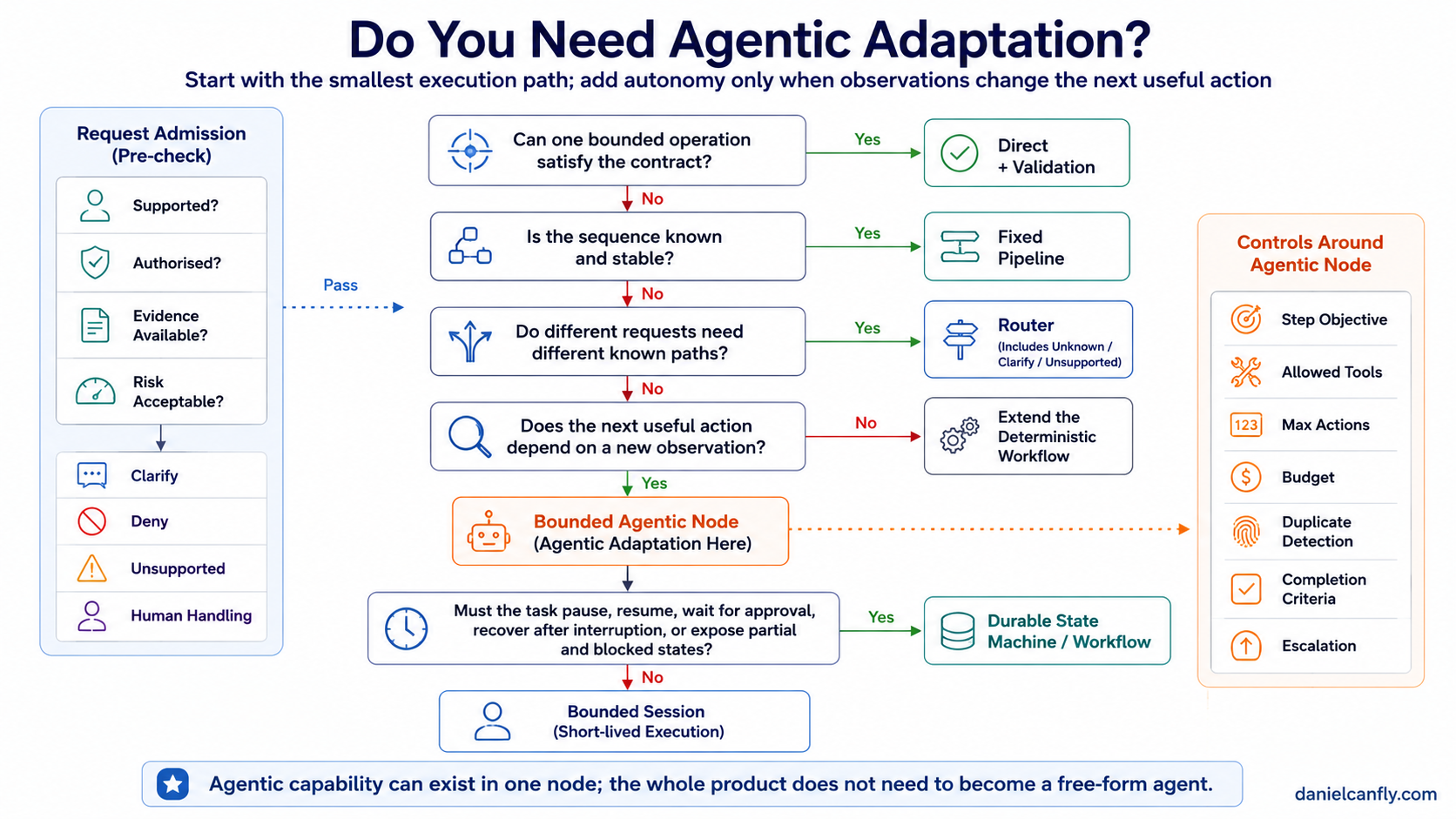
Gate 1:Task 是否需要 Agentic Adaptation?
Agent 不是 Default Route。
使用 Direct
- 一個 Bounded Operation 足夠
- 所需資訊都在 Input
- 不需要動態 Tool Selection
- Output 可以直接 Check
- Risk 低或由外部控制
Direct 仍可包含 Input Validation、Output Schema、Policy 與 Logging。
使用 Pipeline
- Step 已知
- Order 穩定
- 每個 Stage 有 Contract
- Failure 有預定處理
- Observation 不會要求新 Strategy
Upload
  -> Parse
  -> Validate
  -> Transform
  -> Store
加入 Router
- 不同 Request 需要不同 Path
- Data Source 不同
- Cost 或 Risk Class 不同
- 某些 Task 應交給人
- 某些 Request 不被支援
Router 必須支援:
- unknown
- ambiguous
- clarification required
- unsupported
- denied
加入 Bounded Agentic Adaptation
- 下一個有效 Action 依賴 Tool Result
- 無法合理列舉完整 Route
- Environment 是 Partially Observable
- 需要 Local Exploration
- 系統必須在 Approved Tool 中動態選擇
加入 Durable State
- Task 可能 Pause 或 Resume
- Approval 是 Async
- Execution 為 Long-running
- Retry 與 Replan 跨越 Process Boundary
- Partial Completion 有意義
- 需要 Interruption Recovery
核心差異不是「簡單或聰明」,而是:
Current Observation 出現前,是否能安全決定下一個有效 Action?
Gate 2:把 Requirement 轉成可檢查的 Property
不要直接從 User Story 跳到 Architecture Label。
Task Dynamics
- Single-step 或 Multi-step
- Fixed 或 Observation-dependent
- Branching
- Loop
- Dependency
- Parallelism
- Event 或 Schedule Trigger
- Pause 與 Resume
- Long-running Duration
Data 與 Trust
- Source of Truth
- Freshness
- Version
- Sensitivity
- Tenant 與 User Scope
- External 或 Internal
- Structured 或 Unstructured
- Untrusted-content Boundary
- Retrieval 或 Live Access
Tool 與 Side Effect
- Read 或 Write
- Reversible 或 Irreversible
- Idempotent 或 Non-idempotent
- Deterministic 或 Probabilistic
- Permission Level
- Sandbox Availability
- Rate Limit
- Failure Taxonomy
- Reconciliation Support
Verification
- 是否有 Objective Test
- 是否有 Source Support
- 是否有 Post-condition
- 是否需要 Human Judgement
- False-positive Cost
- False-negative Cost
- 是否允許 Partial
- 是否允許 Abstention
Operations
- Latency Ceiling
- Cost Ceiling
- Throughput
- Availability Target
- Observability
- Reproducibility
- Audit
- Retention
- Incident Response
- Kill Switch
Responsibility
- Request Owner
- System Owner
- Final Completer
- Approver
- Data Owner
- Incident Owner
- Separation-of-duties Requirement
這些 Property 才是 Architecture Input。
先選 Execution Structure
Execution Structure 回答:
Work 如何在 System 中移動?
這些選項可以組合,不是互斥 Badge。
Direct
一個 Bounded Operation。
Pipeline
Stable Sequence。
Router
不同 Input 走不同 Path。
State Machine
Legal Transition、Loop、Waiting、Recovery 或 Terminal State 很重要時使用。
DAG
Task 有 Dependency Constraint,可以平行再 Join 時使用。
DAG 本身不提供 Recovery Loop。Replanning 後可以由 Outer Workflow 啟動新 DAG。
Event-driven Workflow
Work 由 Event、Schedule、Queue 或 Async Change 啟動時使用。
Long-running Monitor 可以組合:
Event Trigger
  -> State Machine
  -> Fixed Pipeline
  -> Notification Gate
問題不是哪一個名字代表整個 Product,而是哪些 Structure 控制哪些部分。
只在需要的位置加入 Decision 與 Planning
Decision Strategy 回答:
Execution Structure 內部如何選擇下一個 Action?
Fixed Decision Logic
Route 與 Fallback 已知時使用。
Bounded ReAct
下一個 Local Action 依賴最新 Observation 時使用。
必要 Control:
- Step Objective
- Allowed Tools
- Maximum Actions
- Duplicate Detection
- Budget
- Completion Criteria
- Escalation
- Structured Observation
Plan-and-Execute
適合:
- Task 有數個明確 Deliverable
- 遺漏成本高
- Dependency 很重要
- Progress 必須可見
- Delegation 或 Budget 很重要
Plan 必須定義 Executable Step Contract,不是重述 Task。
Adaptive Replanning
只有 Remaining Plan 可能失效時才加入。
要求:
- Replan Trigger
- Plan Version
- Plan Diff
- Preserved Completed Work
- Invalidated Steps
- Replan Limit
- Verifier Approval
HTN
Domain 有可重用且受治理的 Decomposition Method 與 Primitive Action 時使用。
HTN 不只是很長的 Checklist,而是依賴 Domain Task、Method、Constraint 與 Operator。
Planning 是 Architecture 內的 Capability,不是它一定能成功的 Evidence。
Evaluator 能引導時才加入 Multi-path Search
Search 回答:
系統是否應保存並比較 Alternative Candidate?
保留 Single Path
- 一個 Candidate 通常足夠
- External Verification 強
- Latency 很重要
- First Choice 選錯成本低
使用 Self-consistency
- 有一個可正規化 Answer
- Sample Variance 是重要 Error Source
- Agreement 可以計算
- Fact Verification 仍另外執行
使用 Generate-and-Rank
- 多個完整 Alternative 有價值
- Reliable Evaluator 可以比較
- Invalid Candidate 先被淘汰
使用 Beam Search
- Partial Candidate 逐 Layer 發展
- 只能負擔 Bounded Frontier
- Intermediate State 可以 Score
使用 Tree of Thoughts 或其他 Tree Search
- Early Choice 強烈影響後續
- Intermediate State 有意義
- Pruning 與 Backtracking 有用
- Evaluator 可信
使用 Graph of Thoughts
- Intermediate Result 必須 Merge
- Result 必須 Reuse
- Dependency、Invalidation 與 Provenance 可治理
使用 MCTS-style Search 或 LATS
- Action 會與 Environment 互動
- Repeated Visit 與 Value Update 有價值
- Execution 在 Sandbox 或可 Reversible
- Environment Feedback 真正反映 Goal
不要先買 Search Tree,再去找 Evaluator。否則 System 只會長出 Branch,卻不知道哪裡有果實。
增加自主性前先定義 Verification 與 Recovery
Verification 回答:
什麼 Evidence 可以接受或拒絕 Result?
Recovery 回答:
Failure 發生後,最小合理回應是什麼?
Evidence 必須對應 Claim
| Claim | Preferred Evidence |
|---|---|
| Output Structurally Valid | Schema 或 Parser |
| Code Behaves Correctly | Test、Execution、Build |
| SQL Permitted and Valid | Parser、Read-only Policy、Execution |
| RAG Answer Supported | Claim-to-source Verification |
| Browser Task Succeeded | Functional Post-condition |
| Transaction Completed Once | Transaction Record 與 Reconciliation |
| Open-ended Output Acceptable | Rubric 與 Authorised Judgement |
Recovery 必須對應 Failure
| Failure | Primary Response |
|---|---|
| Transient 且可安全重做 | Retry |
| Input Parameter 錯誤 | Parameter Repair |
| Current Implementation 不可用 | Fallback |
| Current Artefact 錯誤 | Repair 或 Generate-and-Test |
| Evidence 缺少 | Retrieve、Clarify 或 Abstain |
| Remaining Plan 無效 | Replan |
| Policy Deny Action | Deny 或 Request Approval |
| Capability 或 Data 不存在 | Stop 或 Unsupported |
Verifier 必須可以 Fail、Abstain 與回傳 Inconclusive。Recovery Controller 必須可以 Stop。
只有真正的責任邊界才加入 Multiple Agents
Organisation 回答:
哪些可獨立定址的 Execution Entity 負責 Work?
Default:One Agent 或 One Workflow
單一 Orchestration 仍可包含:
- Planner Stage
- Executor Stage
- Critic Stage
- Verifier Stage
- Deterministic Tool
Role Name 不會自動創造 Multiple Agents。
Supervisor 與 Workers
適合:
- Subtask 自然可分
- Bounded Parallelism 有幫助
- Worker 需要不同 Tool 或 Context
- Supervisor 能分派與驗收
- 一個 Final Owner 整合 Result
Debate 與 Voting
它們是 Decision Protocol,不是通用 Multi-agent Upgrade。
Agent 必須互相 Challenge 並更新立場時使用 Debate。
Independent Choice 可以 Aggregate 時使用 Voting。
兩者都不能取代 External Evidence。
Blackboard
多個 Agent 透過 Typed Shared Problem State 協作時使用。
Blackboard 需要:
- Schema
- Read 與 Write Permission
- Versioning
- Conflict Handling
- Provenance
- Scheduling
- Final Owner
Peer-to-peer 或 Swarm-style Coordination
只有 Central Coordination 確實不適合,且 System 能定義以下項目時才使用:
- Local Rule
- Task Claiming
- Convergence
- Duplicate Suppression
- Global Budget
- Stop Condition
- Kill Switch
- Final Accountability
Multi-agent 應由 Responsibility 與 Communication Need 驗證,不是因為想在圖上放更多 Avatar。
分開定義 State、Memory 與 External Knowledge
Workflow State
Exact Control Information:
- Current Step
- Status
- Attempts
- Approvals
- Plan Version
- Terminal Outcome
Working Memory
Current Reasoning 所需的 Task-local Intermediate Information。
Episodic Memory
可能支援 Future Task 的 Past Event 與 Outcome。
Semantic Memory
Governed Stable Knowledge。
Procedural Memory
Reusable Method、SOP、Tool Rule 與 Acceptance Procedure。
User-scoped Memory
由 User Authorise 的 Preference 或 Fact,並支援 Access、Correction、Deletion 與 Expiry。
Shared Memory
Coordination Scope,不是 Cognitive Type。
External Knowledge
需要時 Retrieval 的 Source of Truth。
以下情況不要建立 Long-term Memory:
- Task 是 One-off
- Data Sensitive
- Information 很快 Expire
- Source of Truth 可以 Query
- 沒有 Consent
- Delete 無法 Propagate
Memory Selection 必須定義 Source、Scope、Version、Status、Expiry 與 Write Authority。
Architecture Selection Gate 與 Capability Module
實務選型順序:
1. Define Contract and Risk
2. Select Simplest Execution Structure
3. Add Adaptive Local Decision Only Where Observation Requires It
4. Add Planning Only Where Global Decomposition Provides Value
5. Add Search Only Where Evaluation Can Guide It
6. Add Multiple Agents Only Where Responsibility Boundaries Justify Coordination
7. Add Memory Only Where Future Value Exceeds Governance Cost
8. Apply Identity, Policy, Budget, Evaluation, Observability, and Human Control
這不是要求每個 Category 都必須被填滿。
合法 Output 可以是:
Fixed RAG Pipeline
+ One Bounded Query-rewrite Node
+ Citation Verifier
+ No Multi-agent
+ No Long-term Memory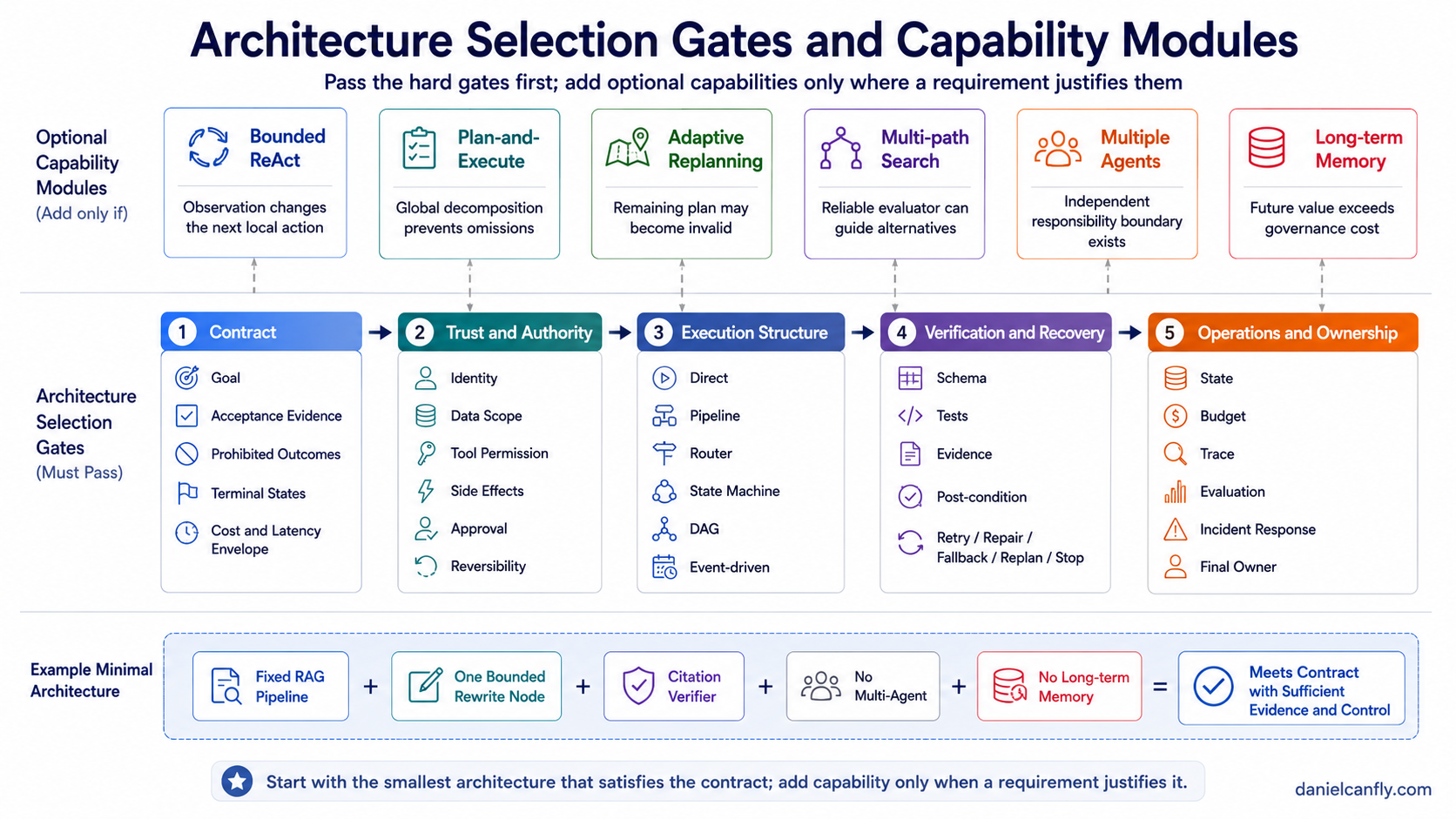
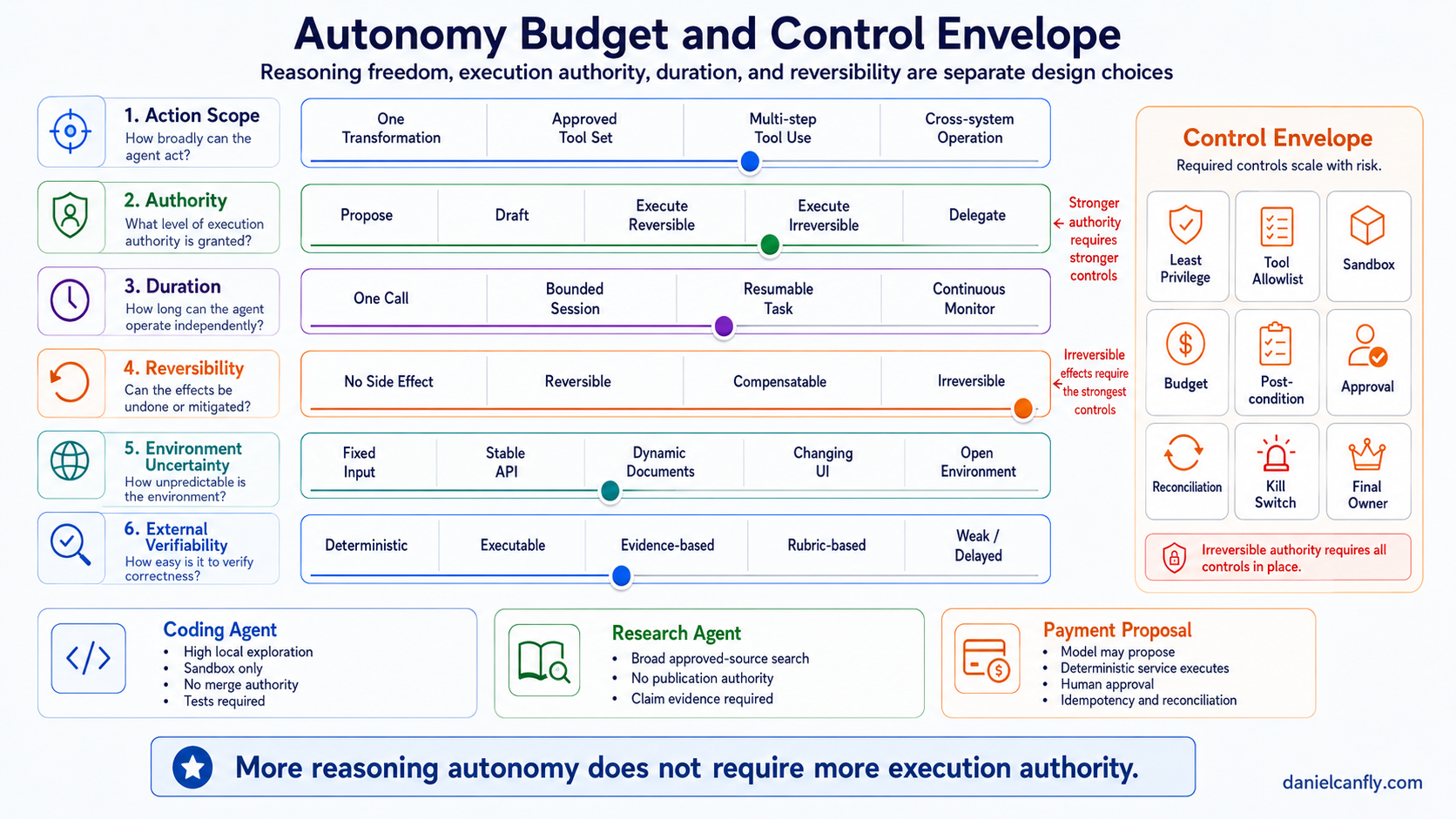
用 Autonomy Budget 取代 Autonomy Ladder
Autonomy 不是單一 Scalar Property。
System 可以在 Query Rewrite 上高度自主,卻在 Data Access 與 Side Effect 上完全受限。
沿六個維度定義 Autonomy。
Action Scope
- One Transformation
- Several Approved Tools
- Arbitrary Tool Sequence
- Cross-system Operation
Authority
- Propose
- Draft
- Execute Reversible Action
- Execute Irreversible Action
- Delegate Authority
Duration
- One Call
- One Bounded Session
- Resumable Task
- Continuous Monitor
Reversibility
- No Side Effect
- Reversible Side Effect
- Compensatable Side Effect
- Irreversible Action
Environment Uncertainty
- Fixed Input
- Stable API
- Dynamic Document
- Changing Interface
- Open Environment
External Verifiability
- Deterministic
- Executable
- Evidence-based
- Rubric-based
- Weak or Delayed Feedback
高 Impact 不一定要求更少 Reasoning Autonomy,而是要求對 Authority、Side Effect、Evidence 與 Approval 有更強限制。
Coding Agent 可以在 Disposable Branch 裡自由探索,但完全沒有 Merge Permission。
Research Agent 可以在 Approved Source 內廣泛 Search,但沒有 Publish Permission。
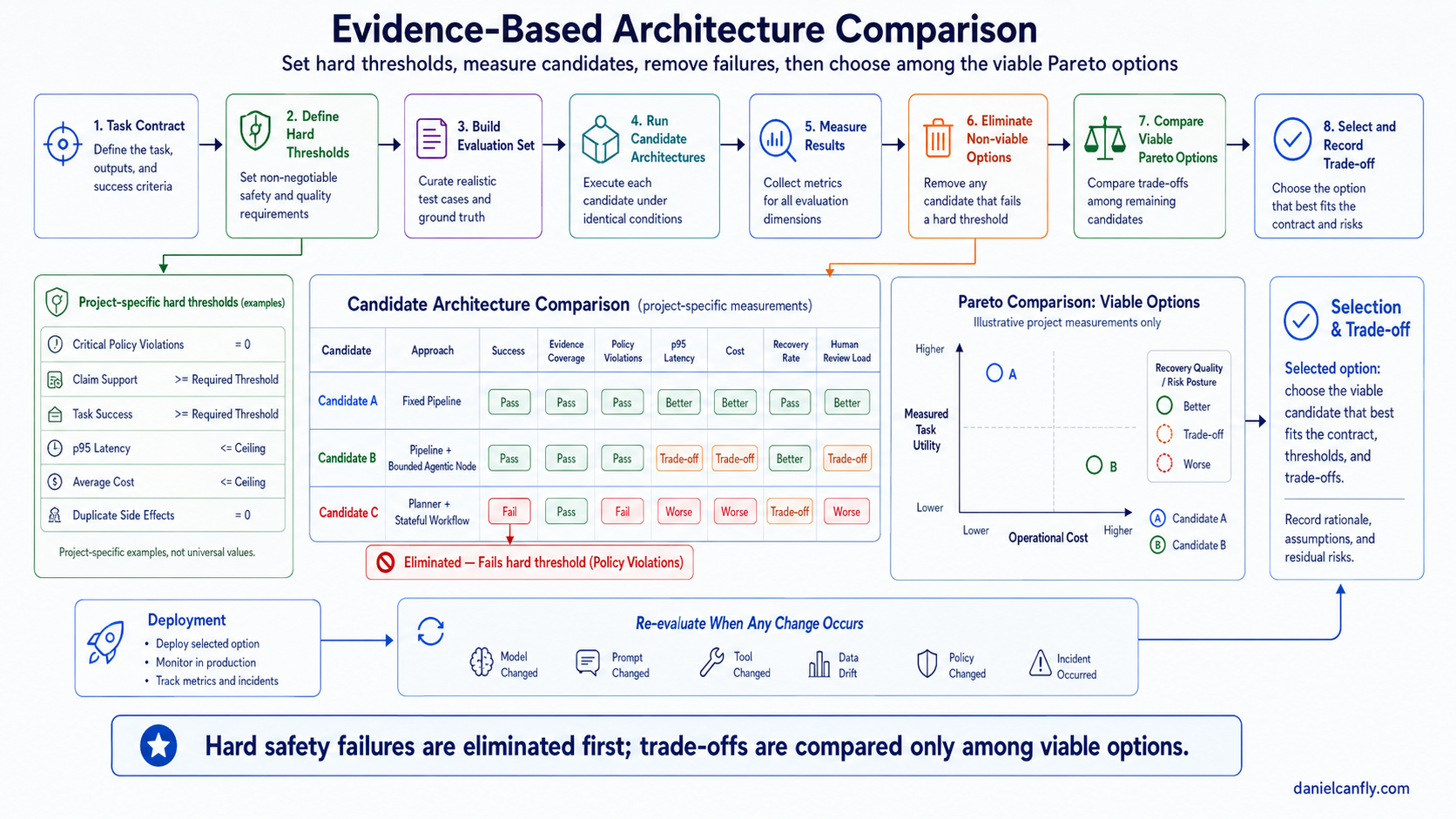
用實測 Evidence 比較 Architecture,不用通用分數
不存在以下通用真理:
- Direct 的 Quality 永遠較低
- Multi-Agent 永遠以相同倍數增加成本
- Adaptive Planning 永遠降低 Controllability
- RAG 永遠是 Medium Latency
這些 Property 取決於 Implementation 與 Task。
先定義 Required Threshold
例如:
- Claim Support 至少 98%
- Task Success 至少 90%
- Critical Policy Violation 等於 0
- p95 Latency 低於 8 秒
- Average Cost 低於指定上限
- Duplicate Side Effect 等於 0
- Human Escalation 低於可接受比例
評估 Candidate Architecture
每個 Candidate 實測:
- Task Success
- False Pass 與 False Fail
- Evidence Coverage
- Policy Violation
- Latency Distribution
- Cost Distribution
- Retry 與 Replan Rate
- Human-review Load
- Failure Recovery
- Operator Effort
淘汰 Non-viable Option
任何 Hard Safety 或 Quality Threshold 失敗的 Architecture,即使更便宜也必須淘汰。
從 Viable Option 選擇
使用 Pareto Reasoning:
如果不存在另一個方案在所有必要維度都更便宜且更好,這個方案才可能保留。
Architecture A 可能更快,B 更便宜,C 的 Recovery 更強。Final Choice 取決於 Contract 與 Risk Appetite。
Change 後重新評估
Model、Prompt、Tool、Data、Policy 與 Environment 都會 Drift。
Release Evaluation 應包含:
- Representative Task
- Regression
- Adversarial Case
- Permission Test
- Failure Path
- Recovery Path
- Cost 與 Latency
- Canary 或 Shadow Deployment
NIST AI RMF 與 GenAI Profile 將 Risk Management 放在 Design、Development、Deployment、Use 與 Evaluation 的完整 Lifecycle,而不是只做 Launch-day Scorecard。
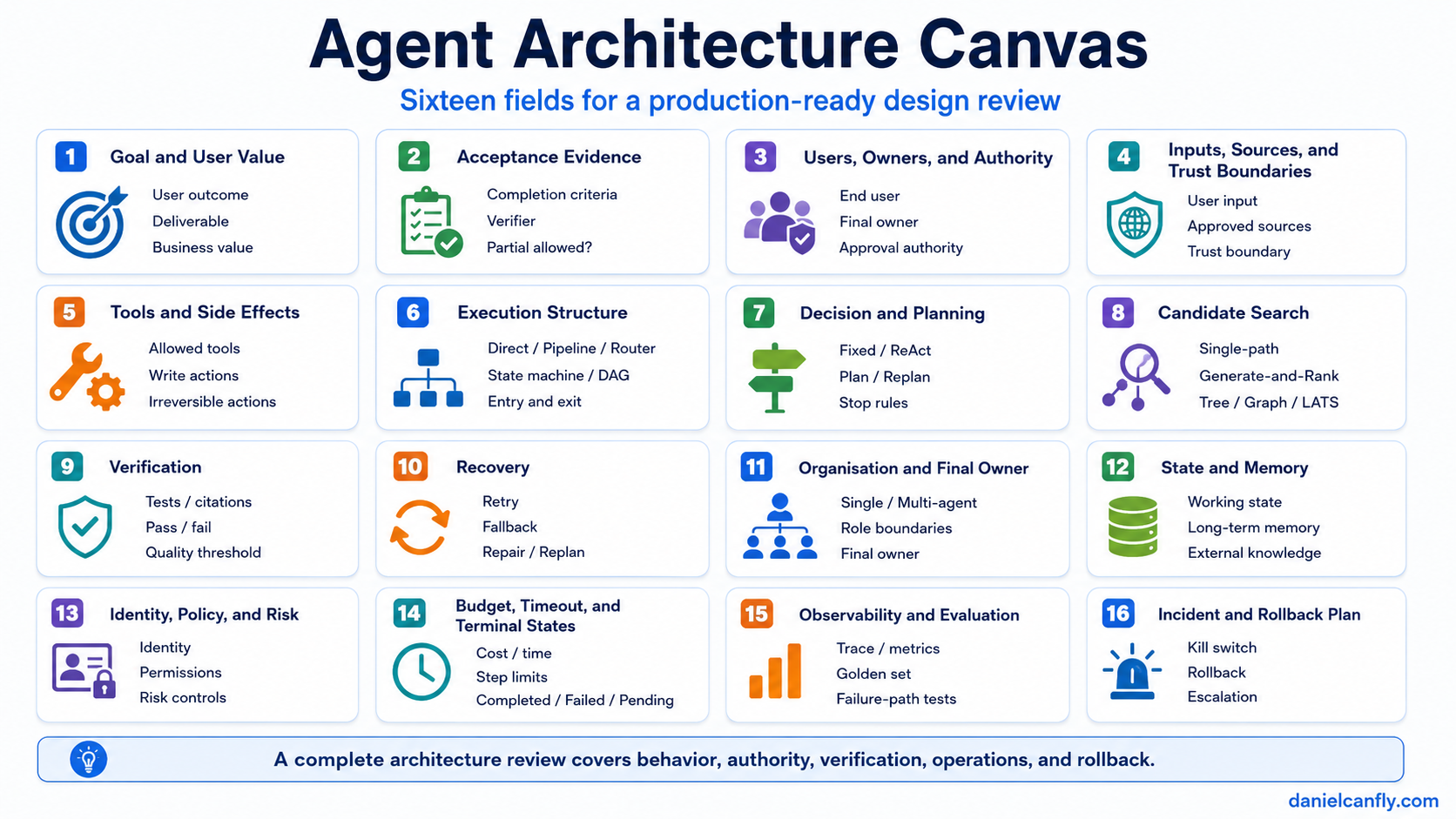
Agent Architecture Canvas
完整 Design Review 應回答十六個欄位。
1. Goal and User Value
真正重要的 Outcome 是什麼?
2. Acceptance Evidence
什麼可以證明完成?
3. Users, Owners, and Authority
誰 Request、Operate、Approve 並擁有 Result?
4. Inputs, Sources, and Trust Boundaries
Data 從哪裡來,哪些 Content 是 Untrusted?
5. Tools and Side Effects
什麼能力可以 Read、Write、Send、Publish、Pay、Delete 或 Delegate?
6. Execution Structure
Direct、Pipeline、Router、State Machine、DAG、Bounded Loop 或 Event-driven Workflow。
7. Decision and Planning
Fixed Logic、Bounded ReAct、Plan-and-Execute、Adaptive Replanning 或 HTN。
8. Candidate Search
Single Path、Sampling、Ranking、Tree、Graph 或 Environment Search。
9. Verification
Schema、Test、Evidence、Post-condition、Policy、Rubric 或 Human Judgement。
10. Recovery
Retry、Parameter Repair、Fallback、Repair、Replan、Escalation 與 Stop。
11. Organisation and Final Owner
One Workflow、Multiple Agents、Communication Protocol、Aggregator 與 Completer。
12. State and Memory
哪些資訊 Exact、Temporary、Persistent、Shared、Versioned 或 External?
13. Identity, Policy, and Risk
Permission、Data Scope、Sandbox、Approval 與 Irreversible-action Rule。
14. Budget, Timeout, and Terminal States
Limit、Cancellation、Expiry、Partial Outcome 與 Safe Stop。
15. Observability and Evaluation
Trace、Metric、Audit、Replay、Regression Suite 與 Release Gate。
16. Incident and Rollback Plan
如何 Suspend System、Revoke Credential、Correct Memory 與 Reconcile Side Effect?
每個 Field 應記錄:
- Decision
- Rationale
- Limit
- Evidence
- Owner
- Unresolved Risk
Go、Pilot 或 No-Go
Release State 必須以 Evidence 決定。
Go
適合:
- Acceptance Criteria 明確
- Representative Evaluation 通過
- Critical Policy Violation 為 0
- Permission 為 Least Privilege
- Failure 與 Recovery Path 已測試
- State 可以安全 Resume
- Observability 與 Incident Response 已準備
- High-impact Action 有 Durable Approval 與 Reconciliation
- Remaining Risk 已由 Owner 接受
Pilot
適合:
- Core Path 可運作
- Scope、User、Data 與 Tool 受限
- Human Monitoring 持續
- 有快速 Kill Switch
- 部分 Non-critical Failure Mode 仍需 Evidence
- Rollback 簡單
- Pilot 有明確 Exit Decision 與 Date
No-Go
以下情況必須 No-Go:
- 沒有可信 Verifier
- System 可以在無 Approval 下造成 Irreversible Harm
- Unauthorised Data 可能進入 Model
- Side Effect 沒有 Idempotency 或 Reconciliation
- Task 無法 Persist 或 Recover 必要 State
- 沒有 Budget 或 Stop Condition
- Memory Governance 未定義
- 缺少 Incident Owner 與 Kill Switch
- Evaluation 未通過 Hard Threshold
No-Go 不是 Review 失敗,而是 Safety Mechanism 正常運作。
完整範例:Blog Ask AI
Requirement:
User 可以詢問 Blog Article。System 只根據網站文章回答並附 Citation。Retrieval 弱時可以 Rewrite Query,但不能自由 Browse Open Web,也不能無限 Retry。
Contract
- 只根據 Authorised Blog Corpus 回答
- 每個 Material Claim 都有 Citation
- Unsupported Question 回傳 Insufficient Evidence
- 不使用 Open-web Search
- 不跨 Tenant 讀取 Data
- Latency 與 Retrieval Cost 有上限
Execution Structure
Admission and Router
  -> Fixed RAG Pipeline
  -> Claim-to-Evidence Verifier
  -> Answer / Clarify / Abstain
Adaptive Capability
只有一次 Bounded Rewrite Decision:
Low Retrieval Coverage
  -> Rewrite Once
  -> Retrieve Again
  -> Stop
不需要 General ReAct Loop。
Search
- Hybrid Retrieval
- Reranking
- Source Diversity
- No Tree Search
- No Multi-agent Debate
Verification
- ACL
- Citation Coverage
- Claim Support
- Document Version
- Answerability
- Unsupported-claim Count
State
- Original Query
- Rewritten Query
- Selected Document ID 與 Version
- Citation Map
- Verifier Result
- Retry Count
- Terminal Outcome
Memory
不需要 Unrestricted Long-term User 或 Episodic Memory。
Policy
- Blog Corpus Only
- Retrieved Content 是 Untrusted Data
- No External Web Access
- No Unsupported Claim
- Query 不得直接寫入 Permanent Memory
Budget and Stop
- Maximum Retrieval Attempts:2
- Maximum Rewrite:1
- Bounded Context 與 Answer Token
- Latency Ceiling
- Terminal Insufficient-evidence State
Organisation
One Workflow 已足夠。Multiple Agents 只會增加 Hand-off 與 Shared-state Cost,卻沒有解決新的 Requirement。
Release Evidence
評估:
- Answer Correctness
- Citation Support
- Answerability Classification
- Permission Isolation
- Latency
- Cost
- Adversarial Prompt-injection Content
- Insufficient-evidence Behaviour
Final Architecture 不是「完整自主 Agent」,而是:
Controlled RAG Pipeline
+ One Bounded Adaptive Node
+ Independent Evidence Verification
這不是降級,而是 Architecture Restraint 正在發揮作用。
常見 Anti-pattern
Framework-first Selection
Task Contract 還沒出現,Framework Name 已經決定。
Pattern Shopping
所有 Named Pattern 都因為存在而被加入。
把 Agent 當成 Binary Label
Team 爭論整個 Product 是否為 Agent,而不是把 Adaptive Capability 放在特定 Node。
Universal Autonomy Ranking
Pattern 在無視 Tool、Permission 與 Side Effect 的情況下被賦予固定 Autonomy Score。
Universal Cost-quality Matrix
沒有 Benchmark Data 的示意估算被當成 Fact。
Multi-agent Inflation
Role Label 被誤認為 Independent Agent。
Search Without Evaluator
沒有可信 Selection Signal,卻持續增加 Candidate。
Memory Without Governance
所有資訊進入同一 Vector Store,沒有 Scope、Status、Expiry 或 Delete。
Human Approval Theatre
Reviewer 只看到 Approve Button,看不到 Exact Action、Evidence、Impact 與 Expiry。
Demo Success Becomes Production Readiness
一條 Happy Path 取代 Failure、Permission、Recovery 與 Incident Evaluation。
Observability Replaces Evaluation
每個錯誤 Decision 都有漂亮 Trace。
Evaluation Replaces Ownership
高 Benchmark Score 被當成 Operate Authority。
No Final Owner
多個 Component 產生 Work,卻沒有人負責 Completion。
Architecture Review Checklist
Contract
- Desired Outcome 可觀測
- Acceptance Evidence 已定義
- Prohibited Outcome 已定義
- 支援 Partial 與 Unsupported Outcome
- Latency 與 Cost Envelope 明確
Execution
- 已考慮最簡單可行 Execution Structure
- 每個 Adaptive Node 個別標出
- 每個 Loop 有 Limit
- Pause、Resume 與 Recovery 已定義
- Terminal State 明確
Tools and Authority
- Read 與 Write Capability 分離
- Least Privilege 在 Prompt 外 Enforcement
- Side Effect 定義 Idempotency 與 Reconciliation
- Untrusted Content 無法改變 Policy
- Irreversible Action 需要適當 Authority
Verification and Recovery
- Verifier 可以 Fail 或 Abstain
- 能使用 Objective Signal 時優先使用
- Acceptance Artefact 受到保護
- Retry、Repair、Fallback 與 Replan 分開
- Duplicate 與 No-progress Condition 會停止 Loop
State and Memory
- Workflow State 與 Memory 分離
- 每個 Persistent Record 有 Source、Scope、Version、Status 與 Expiry
- User 與 Tenant Isolation 經測試
- Unverified Content 無法寫入 Durable Memory
- 支援 Update、Supersede、Delete 與 Audit
Operations
- Global 與 Per-component Budget 存在
- Timeout 與 Cancellation 已定義
- Trace、Metric 與 Audit 可用
- 存在 Offline 與 Regression Evaluation
- Incident Response、Kill Switch 與 Rollback 已準備
Responsibility
- Final Owner 已命名
- Approver Authority 已定義
- 需要時使用 Separation of Duties
- Approval 會 Expire,Execution 前重新驗證 State
- Go、Pilot 或 No-Go Evidence 已記錄
最終原則
- 從 Contract 開始,不從 Framework 開始。
- 使用能滿足 Task 的最簡單 Execution Structure。
- 只有 Observation 真的會改變下一個 Action 時才放入 Autonomy。
- 增加自主性前先定義 Verification。
- 只有 Reliable Evaluator 存在時才加入 Search。
- 只有真實 Responsibility 與 Communication Boundary 才加入 Multiple Agents。
- 只有 Future Value 高於 Governance Cost 時才保存 Memory。
- 將 Authority、Side Effect 與 Reversibility 和 Reasoning Capability 分開。
- 以實測 Evidence 與 Hard Threshold 比較 Architecture。
- 讓 Formal Failure、Abstention 與 No-Go 成為 First-class Outcome。
結論
選擇 Agent Architecture 不是一場 Taxonomy Quiz。
它是一連串帶有 Evidence 的 Decision:
Contract
  -> Simplest Execution Structure
  -> Necessary Adaptive Capability
  -> Verification and Recovery
  -> State and Memory
  -> Policy and Authority
  -> Budget and Stops
  -> Evaluation and Ownership
最好的 Architecture 不是自主性最高的那一個。
而是能以最少必要複雜度完成 Task、證明 Result、限制 Authority、安全 Recovery,並在有人負責的 Control 下停止的那一個。
Part 10 會從 Architecture Selection 進入 Implementation:
如何把這些 Pattern 對應到 Modern Framework,同時避免 Framework Abstraction 取代 System Design?
參考資料
- Lewis et al., Retrieval-Augmented Generation for Knowledge-Intensive NLP Tasks
- Yao et al., ReAct: Synergizing Reasoning and Acting in Language Models
- Yao et al., Tree of Thoughts: Deliberate Problem Solving with Large Language Models
- Zhou et al., Language Agent Tree Search Unifies Reasoning, Acting, and Planning in Language Models
- Wu et al., AutoGen: Enabling Next-Gen LLM Applications via Multi-Agent Conversation
- NIST, Artificial Intelligence Risk Management Framework: Generative Artificial Intelligence Profile
- OWASP, Agentic AI Threats and Mitigations
- LangGraph Documentation, Persistence
- LangGraph Documentation, Interrupts
- OpenTelemetry Documentation