前七篇把 Agent 設計拆成六個實務維度:
- 執行路徑
- 決策與規劃
- 推理與搜尋
- 驗證與恢復
- Agent 組織
- 狀態與記憶
真正的 Production 設計,是把這些維度組合到一項真實任務周圍,同時面對真實權限、真實失敗模式與必須有人負責的終止結果。
Production Agent 並不只是:
Prompt
  -> Model
  -> Tools
  -> Answer
更誠實的描述是:
Admission
  -> Orchestration
  -> Execution
  -> Acceptance

Cross-cutting:
Identity · Policy · State · Memory · Budget · Observability · Human Control
目標不是最大自主性,而是把自主性限制在一個能回答以下問題的系統裡:
- 誰提出這個 Action?
- Request 是否被允許?
- Task 走過哪條 Path?
- 哪些 State 已經改變?
- Result 有什麼 Evidence?
- 哪些 Check 通過或失敗?
- 再次嘗試是否安全?
- 誰負責 Final Decision?
- 哪個 Terminal State 會結束 Run?
本文提供六種 Production Recipe:
- Production RAG
- Deep Research Agent
- Coding Agent
- Browser/Computer-use Agent
- High-risk Enterprise Automation
- Long-running Monitor
它們不是通用藍圖,而是可調整的 Reference Composition。實際系統仍必須依 Task、Data、Risk、Latency 與 Operating Environment 修改。
Production-ready 是相對於風險的判斷
「Production-ready」不能只代表架構圖上有很多企業感 Box。
低風險的內部 Summary Tool 與 Payment Automation,不需要相同強度的 Control。需要多少 Evidence,應隨以下因素增加:
- Reversibility
- Financial 或 Legal Impact
- Data Sensitivity
- Permission Scope
- Duration
- Side-effect Count
- Environment Uncertainty
- False Positive Cost
- False Negative Cost
只有 Control 與 Risk 相匹配,才能稱為 Ready。
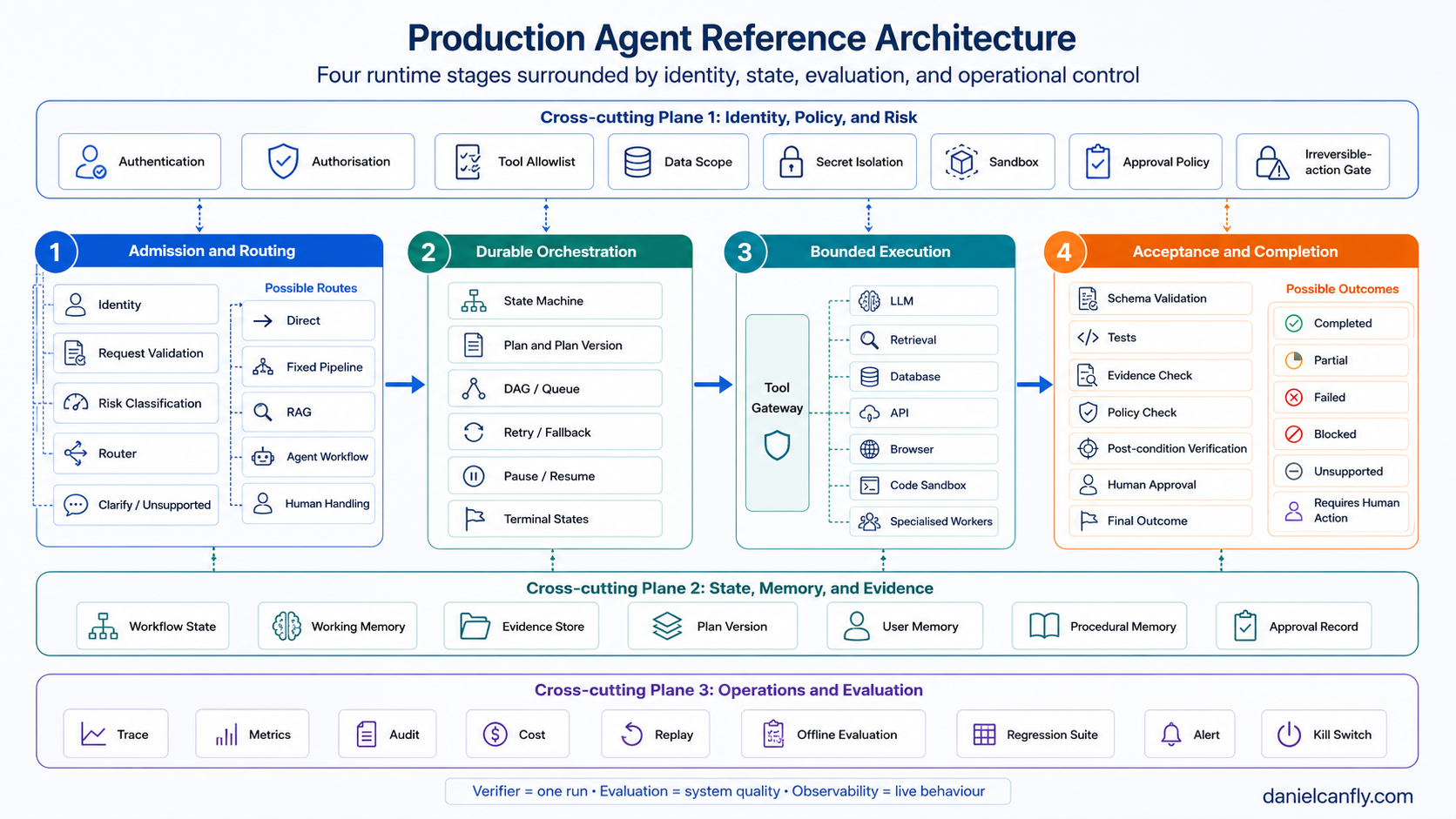
四個 Runtime Stage 與三個 Cross-cutting Plane
舊稿使用七層架構,適合盤點 Component,卻把 Sequential Stage 與包圍整個 Run 的 Concern 混在同一條直線。
更清楚的 Reference Model 是四個 Runtime Stage 加三個 Cross-cutting Plane。
Runtime Stage 1:Admission 與 Routing
這一層判斷:
- Request 是否被支援
- 是否真的需要 Agent
- 需要哪個 Source of Truth
- 是否需要 Tool
- 使用者是否可讀取資料
- 適用哪個 Risk Class
- 是否需要 Clarification 或 Human Handling
可能 Outcome:
- Direct Response
- Fixed Pipeline
- RAG
- SQL 或 Deterministic Tool
- Bounded Agent Workflow
- Human Review
- Clarification
- Unsupported
Router 必須能 Abstain。強迫選路,只是把不確定性包裝成自信的錯誤分類。
Runtime Stage 2:Orchestration
Orchestration 負責 Task 如何移動:
- Workflow 或 State Machine
- Plan 與 Plan Version
- Task Dependency
- Queue
- Retry 與 Fallback
- Pause 與 Resume
- Approval State
- Deadline
- Terminal Outcome
Orchestrator 不必決定每個局部 Action。它可以在某個 State 內呼叫 Bounded ReAct Executor、啟動 DAG,或執行 Deterministic Pipeline。
Runtime Stage 3:Execution
Execution 透過以下能力完成工作:
- Language Model
- Retrieval
- Database
- API
- Code Sandbox
- Browser
- File
- External Service
- Specialised Worker
每個可執行 Capability 都應有 Contract:
- Allowed Input
- Permission
- Timeout
- Cost
- Side-effect Class
- Idempotency Behaviour
- Structured Output
- Error Taxonomy
Runtime Stage 4:Acceptance 與 Completion
這一層判斷 Result 是否可以被接受。
可以使用:
- Schema Validation
- Executable Test
- Source 與 Citation Check
- Policy Check
- Post-condition Verification
- Model-based Rubric Evaluation
- Authorised Human Approval
Outcome 不應只有 Pass 與 Fail:
- completed
- failed
- partial
- blocked
- cancelled
- pending
- unsupported
- inconclusive
- requires human action
Cross-cutting Plane 1:Identity、Policy 與 Risk
它會限制每個 Runtime Stage:
- Authentication
- Authorisation
- Data Access
- Tool Allowlist
- Delegation Right
- Secret Isolation
- Sandbox
- Risk Classification
- Approval Requirement
- Irreversible-action Gate
重要 Control 必須由 Application 或 Infrastructure Enforcement,不能只靠自然語言指示。
Cross-cutting Plane 2:State、Memory 與 Evidence
它保存 Run 所需資訊:
- Workflow State
- Step Status
- Plan Version
- Working Memory
- Evidence Store
- User-scoped Memory
- Procedural Memory
- Shared State
- Tool Result
- Approval Record
即使共用相同 Physical Storage,State、Memory 與 Evidence 仍應保持不同語意。
Cross-cutting Plane 3:Operations、Evaluation 與 Accountability
它使系統可以被營運:
- Trace
- Metric
- Log
- Audit Record
- Replay
- Alert
- Cost Accounting
- Offline Evaluation
- Regression Suite
- Release Gate
- Incident Response
- Kill Switch
Observability 解釋 Live Run 發生什麼;Evaluation 評量 System Version 是否值得發布或繼續運作;Per-run Verifier 則判斷單一 Candidate 是否滿足 Contract。三者相關,但不能互換。
先從 Non-agent Baseline 開始
選擇任何 Recipe 前,先問一次有界操作或 Fixed Pipeline 是否足夠。
Input
  -> Validate
  -> Model or Function
  -> Validate Output
  -> Result
適合 Baseline 的任務:
- 翻譯
- 改寫
- 摘要
- 固定欄位抽取
- 分類
- 格式轉換
- 根據已提供內容回答
- 確定的計算
- 沒有 Adaptive Branching 的穩定 Retrieval Pipeline
Direct Path 仍可包含:
- Input Validation
- Output Schema
- Policy Check
- Token Limit
- Fallback Model
- Basic Logging
- Deterministic Post-processing
原則很簡單:
使用能可靠滿足 Contract 的最小架構。
用一座 Agent 主題樂園證明一個 Function 就能完成,成本通常頗有教育意義。
Recipe 1:Production RAG
原始 RAG 架構結合 Parametric Generator 與被檢索的 Non-parametric Knowledge。到了 Production,困難的地方不是加上一個 Vector Index,而是控制 Source Selection、Access、Context Assembly、Evidence 與 Failure。
固定 RAG Pipeline 可以完全不是 Agent:
Query
  -> Retrieve
  -> Rerank
  -> Build Context
  -> Generate
  -> Verify
只有在 Path 必須適應時,Agentic Behaviour 才值得加入,例如:
- Source Selection 取決於 Request
- 讀完 Gap 後必須繼續 Retrieval
- 系統必須判斷是否 Clarify
- 需要數個 Tool 或 Corpus
- Evidence Conflict 需要新增 Research Step
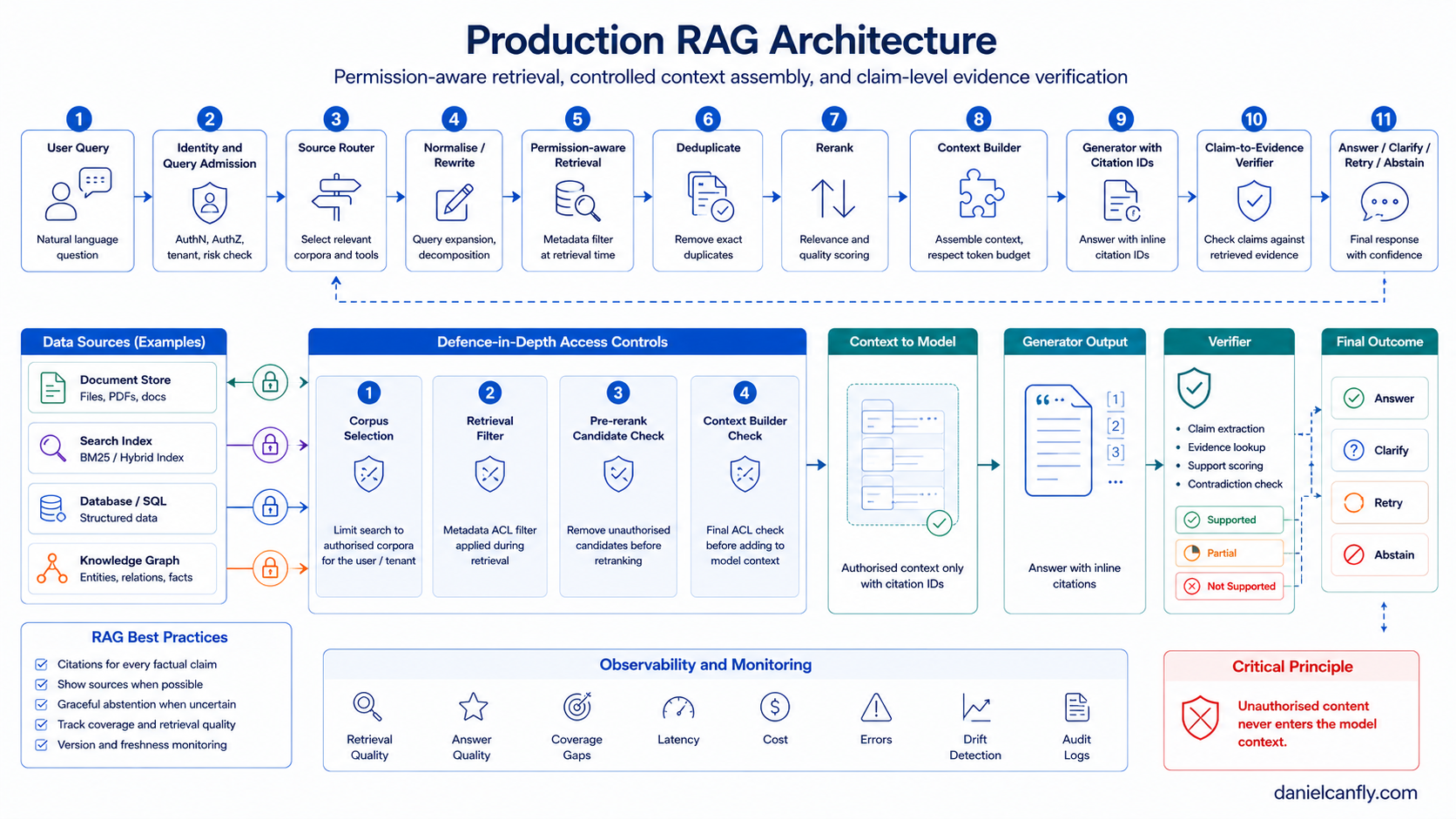
Production Flow
Request
  -> Identity and Query Admission
  -> Source Router
  -> Query Normalisation or Rewrite
  -> Permission-aware Retrieval
  -> Deduplicate and Rerank
  -> Context Builder
  -> Generate with Citation IDs
  -> Claim-to-Evidence Verification
  -> Answer, Clarify, Retry, or Abstain
在 Model Exposure 前執行 Access Control
如果 Unauthorised Content 已經進入 Log、Cache、Reranker 或 Model Context,最後才做 ACL Filter 就太晚了。
使用 Defence in Depth:
- 驗證 User 與 Tenant
- 限制可搜尋 Corpus
- Retrieval 時套用 Metadata Filter
- Rerank 前移除 Unauthorised Candidate
- Generation 前再次檢查 Selected Context
- Audit 被拒絕的 Access Attempt
Query Rewrite 是受控制的 Transformation
Rewrite Node 應保留:
- User Intent
- Security Scope
- Entity
- Time Range
- Language
- Source Constraint
不能把 Private Query 默默擴張到更廣的 Corpus。
Context Builder 責任
Context Builder 應管理:
- Token Budget
- Source Diversity
- Duplicate Passage
- Document Version
- Chunk Adjacency
- Citation Identifier
- Permission
- Recency
- Conflicting Evidence
- Prompt-injection Boundary
Retrieved Content 是 Untrusted Data。文件或網頁裡的指示不能自動推翻 System 或 Tool Policy。
Verification
有 Citation 的 Answer 仍需檢查:
- 每個 Material Claim 是否有 Evidence?
- Cited Passage 是否真的支持 Claim?
- Source 是否被允許?
- Version 與 Date 是否相容?
- 是否遺漏重要 Limitation?
- Answer 是否滿足完整 Contract?
- 是否應 Abstain?
Failure Policy
| Failure | Primary Response |
|---|---|
| 找不到被允許的 Source | Clarify、切換 Approved Corpus 或 Abstain |
| Retrieval Coverage 太低 | Rewrite 或啟動 Deep Retrieval Profile |
| Citation Mismatch | Repair 或 Reject Answer |
| Source Conflict | 揭露 Conflict 或要求 Review |
| Source 過時 | 使用有效的新版本或標記 Limitation |
| Unauthorised Content | 移除、記錄並調查 |
| Context Budget 超限 | Compress、Prioritise 或拆分 Task |
| Source 內有 Prompt Injection | 當作 Data、排除指令並記錄 Incident |
Production State
只保存能重現與診斷 Run 的資訊:
- Original Query
- Rewritten Query
- Corpus 與 Policy Version
- Retrieved Document ID 與 Version
- Reranker Score
- Selected Evidence
- Citation Map
- Verifier Result
- Retry Count
- Terminal Outcome
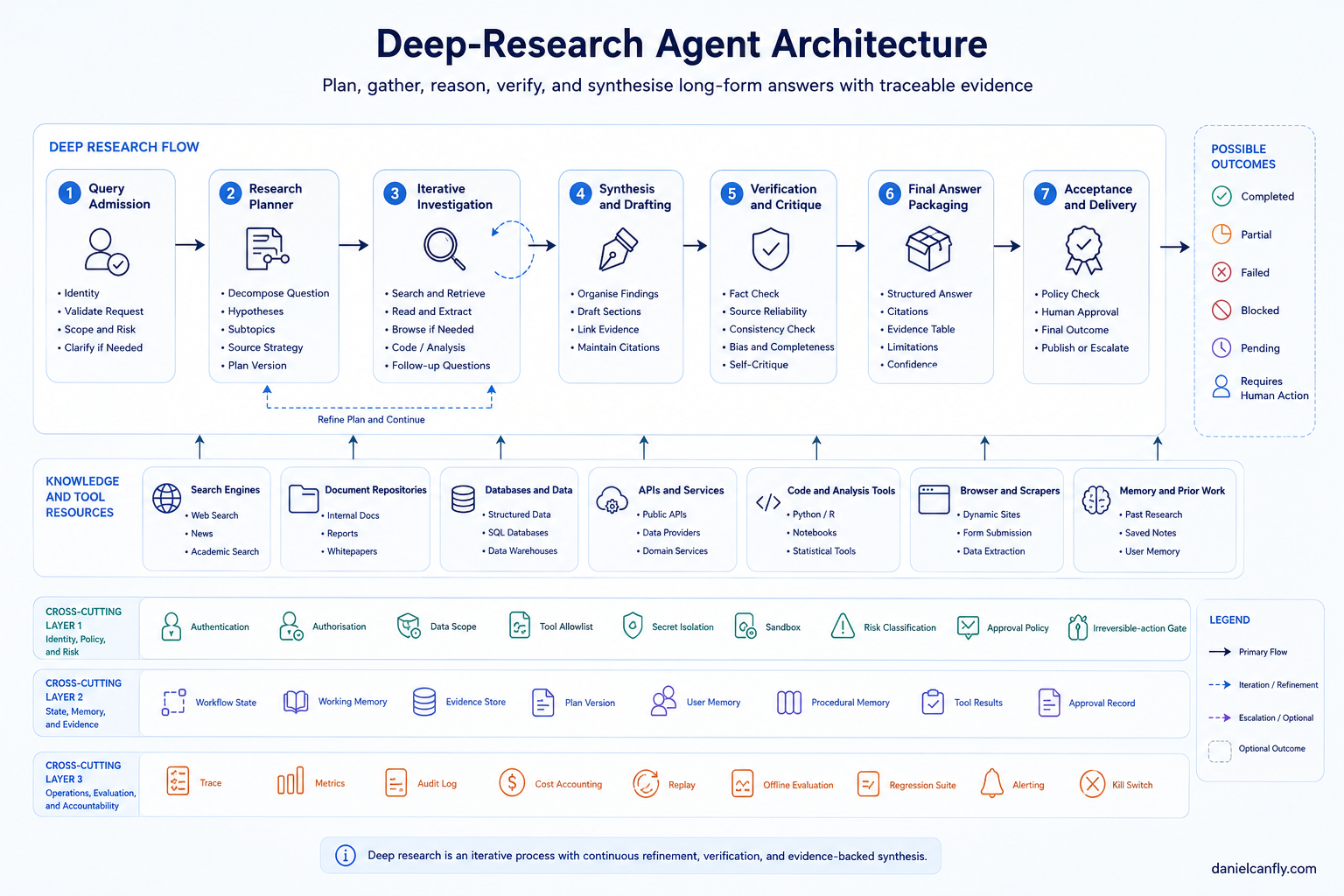
Recipe 2:Deep Research Agent
Deep Research 不是單純「搜尋更多」。它必須把 Open Question 轉成可追蹤 Claim,並產生 Gap 可見的 Synthesis。
典型架構:
Research Goal
  -> Admission and Source Policy
  -> Planner
  -> Versioned Research Plan
  -> Dependency-aware Task Graph
  -> Bounded Research Workers
  -> Evidence Store
  -> Synthesis
  -> Coverage and Conflict Verifier
  -> Complete, Repair, or Replan
Planner 產生 Research Contract
有效 Subtask 包含:
- Question
- Objective
- Dependency
- Allowed Source
- Required Evidence
- Output Schema
- Completion Criteria
- Budget
- Deadline
- Failure Policy
「研究市場」不是 Contract。
DAG 是選配,不是儀式
只有在 Subtask 真的有 Directional Dependency 與 Independent Branch 時才使用 DAG。
可平行的 Branch 例如:
- Product Capability
- Pricing
- Security
- Deployment
- Customer Evidence
- Regulation
不要只因 Worker Card 很好看就 Parallelise。平行工作可能耗盡 Rate Limit、重複 Search,並製造昂貴的 Join Problem。
Evidence Store,不是 Paragraph Warehouse
每個 Evidence Unit 應保留:
- Claim 或 Field
- Source
- Source Type
- Publication Date
- Access Date
- Document Version
- Supporting Extract
- Scope
- Worker
- Validation Status
- Source Lineage
Source Lineage 很重要。五篇 Secondary Article 都引用同一份 Report,不代表五個獨立 Source。
Synthesis 必須保存 Disagreement
Synthesiser 不應把互相衝突的 Evidence 磨成一段平滑文字。
應記錄:
- Agreement
- Conflict
- Unresolved Gap
- Time 或 Version Difference
- Inference
- Confidence
- 對 Recommendation 的影響
Replanning Boundary
一個 Source 或 Query 失敗,但 Subtask 仍有效時,使用 Local Repair。
以下情況才 Replan:
- Decomposition 不完整
- Premise 為假
- 多個 Dependency 改變
- Deliverable 改變
- Evidence Contract 無法滿足
Verifier Fail 不應自動重啟所有 Research。仍然有效的 Evidence 應被保存。
Stop Condition
- Required Question 已涵蓋
- Minimum Evidence Quality 達標
- Material Conflict 已揭露
- Citation Coverage 通過
- 不存在 Critical Gap
- Budget 已達上限
- 達到 No-improvement Limit
- Human Deadline 到期
「也許還有另一個 Source」不是 Completion Policy。
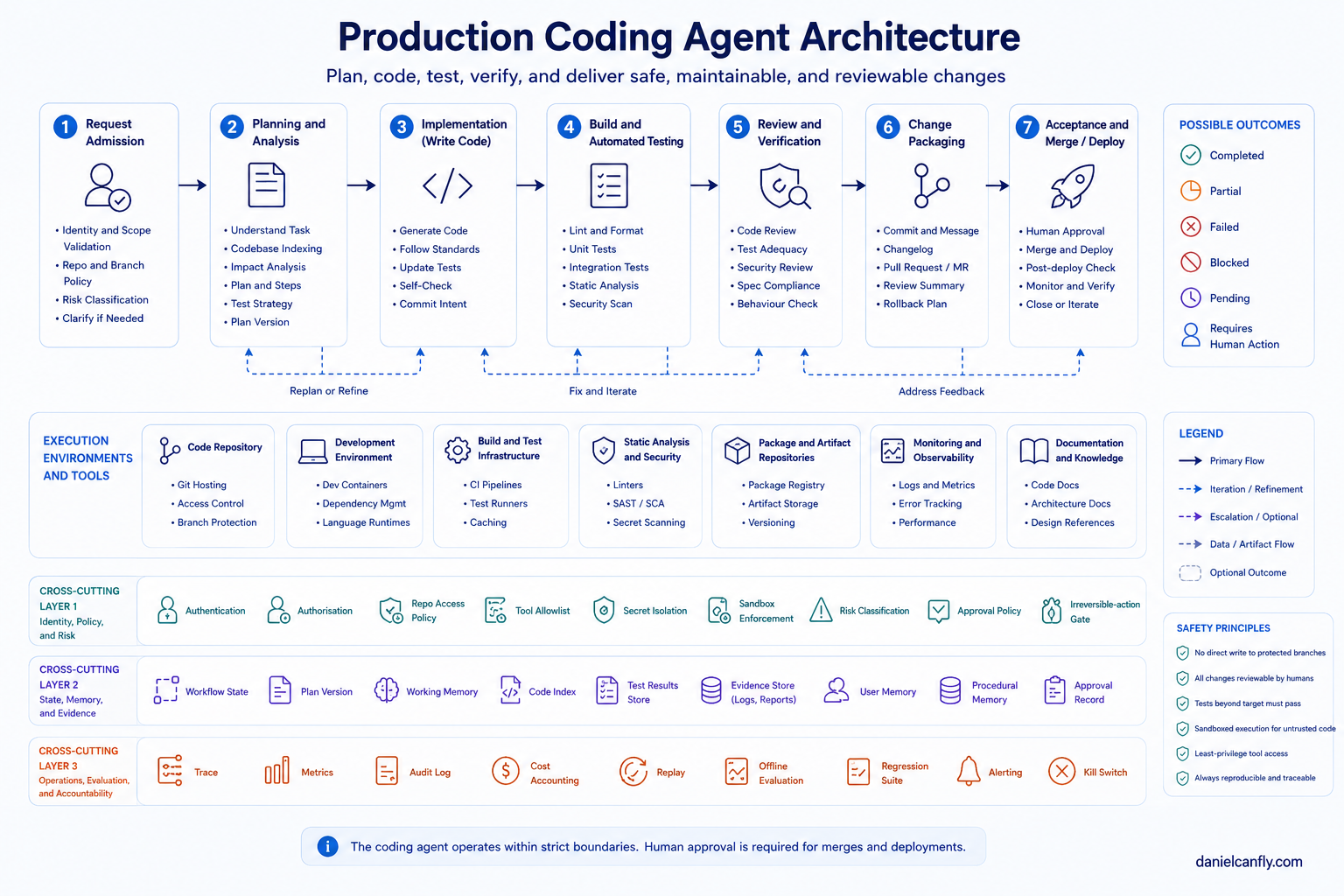
Recipe 3:Coding Agent
Production Coding Agent 是可執行的 Software-change Workflow,不是 Code-completion Prompt。
它必須能:
- 理解 Repository
- 限制 Change Scope
- 在隔離環境修改
- 執行 Test
- 讀取 Structured Failure
- 在限制內 Repair
- 檢查 Final Diff
- 重現結果
- 安全停止
Reference Flow
Task
  -> Repository and Environment Snapshot
  -> Scope and Acceptance Contract
  -> Inspect Code, Tests, and History
  -> Plan or Direct Repair
  -> Generate Patch
  -> Static Validation
  -> Sandbox Execution
  -> Target Test
  -> Related and Regression Tests
  -> Lint, Type Check, and Build
  -> Security and Change-scope Review
  -> Evidence Bundle
  -> Approval or Delivery
先建立 Snapshot
保存:
- Repository URL 或 Identity
- Branch
- Commit SHA
- Dirty State
- Runtime Version
- Dependency Lock
- Environment Variable Reference,不保存 Raw Secret
- Test Environment
- Relevant Service Version
沒有 Reproducible Base 的 Patch,只是一則穿著 Diff 外套的傳聞。
修改前先理解
Agent 應檢查:
- Failing Test
- Call Path
- Nearby Implementation
- Configuration
- Similar Code
- Repository Convention
- Relevant Recent Change
- Error Log
Stack Trace 可能只指出 Symptom 出現的位置,不是 Root Cause。
Layered Validation
實際 Test Suite 依 Repository 而異,但 Acceptance Chain 一般應包含:
- Target Test
- Related Test Group
- Relevant Regression Suite
- Lint 與 Formatting Check
- Type Check
- Build 或 Package Check
- 適用時的 Security Check
- Diff 與 Scope Review
- Reproducibility Check
不需要宣稱每個 Repository 都必須執行巨大 Global Suite。應在 Task Contract 定義 Required Suite,並說明哪些 Check 未執行。
保護 Verifier
Agent 不得透過以下方式取得 Pass:
- Delete Test
- Skip Test
- Weaken Assertion
- 未經 Authorisation 修改 Expected Result
- 修改 Protected Fixture
- 隱藏 Error
- 修改 Unrelated File
Test-file Change 應分開追蹤;Acceptance Artefact 被修改時必須 Review。
Sandbox 與 Permission
Code Execution 應使用:
- Isolated Workspace
- Least-privilege Credential
- Controlled Network Access
- Resource Limit
- Timeout
- Output Limit
- Secret Isolation
- 可行時使用 Disposable Environment
Delivery Evidence
Deliverable 應包含:
- Base Commit
- Changed Files
- Root Cause 說明
- Commands Run
- Exit Codes
- Tests Passed 與 Not Run
- Lint 與 Build Result
- Remaining Risk
- Reproducible Install 或 Placement Steps
SWE-bench 類 Benchmark 的核心提醒是:Real Repository Repair 需要跨檔案理解與 Executable Evaluation,不只是看起來合理的 Code Generation。
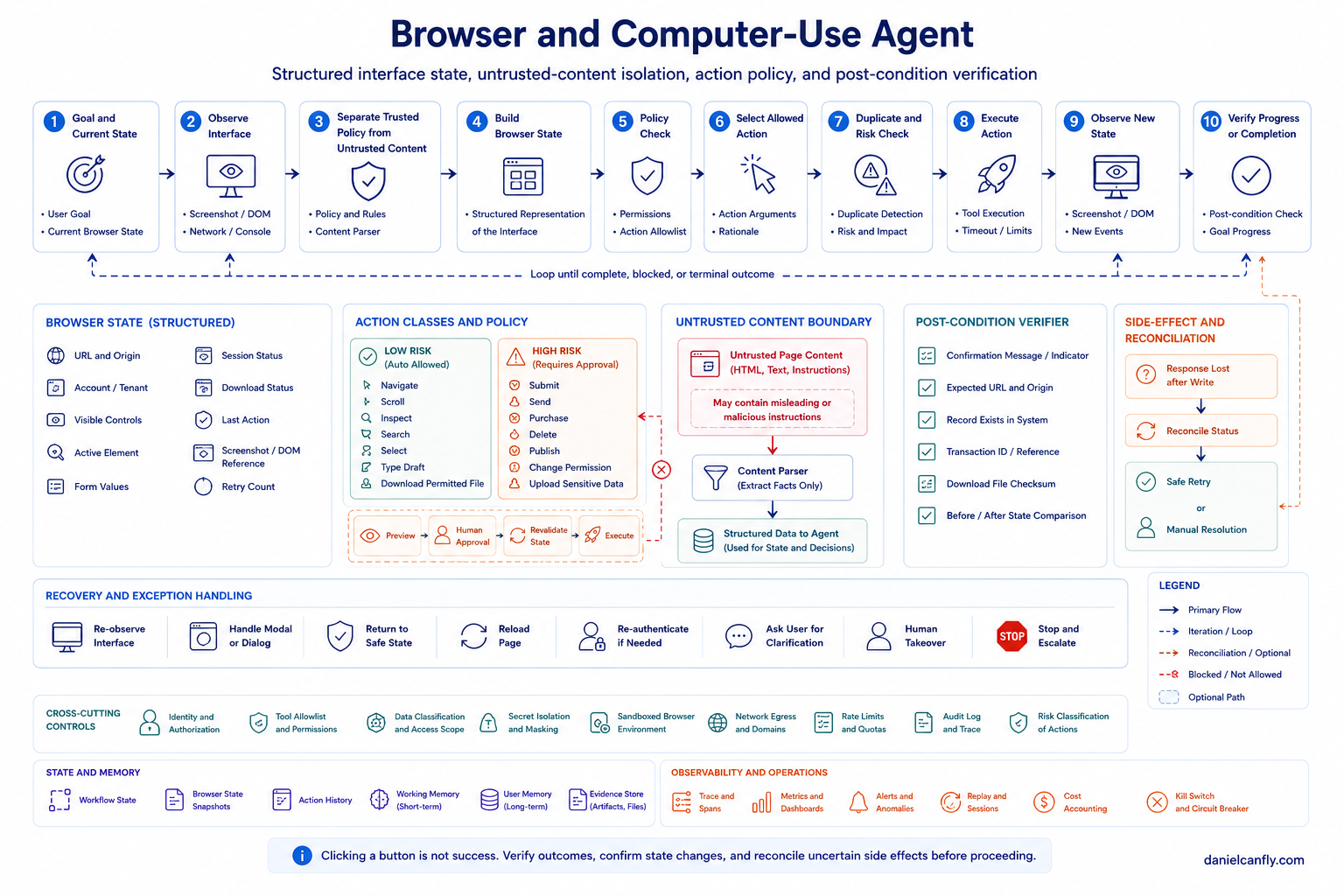
Recipe 4:Browser/Computer-use Agent
Browser Agent 在 Partially Observable 且持續變動的 Environment 中行動。
Button 被 Click 不等於成功,系統必須檢查 Post-condition。
Reference Loop
Goal and Current State
  -> Observe Interface
  -> Parse Trusted and Untrusted Content
  -> Build Structured Browser State
  -> Check Policy
  -> Select Allowed Action
  -> Duplicate and Risk Check
  -> Execute
  -> Observe New State
  -> Verify Progress or Completion
Structured Browser State
保存:
- Current URL 與 Origin
- Page Title
- Selected Account 或 Tenant
- Visible Controls
- Active Element
- Form Values
- Navigation History
- Last Action
- Last Observation
- Download Status
- Session Status
- Screenshot 或 DOM Reference
- Retry Count
- 適用時的 Transaction Identifier
Action Class
低風險:
- Navigate
- Scroll
- Inspect
- Search
- Select
- 在 Draft Field 輸入
- 下載被允許的 File
高風險:
- Submit
- Send
- Purchase
- Delete
- Publish
- Change Permission
- Upload Sensitive Data
- Accept Legal Terms
高風險 Action 應先通過 Preview、Policy Check 與 Approval Gate。
Prompt Injection 與 Untrusted Interface
Web Page、Email、Document 與 Retrieved Instruction 可能試圖操控 Agent。
Page Text 必須被視為 Untrusted Input;Action Policy 應來自 Trusted Application Boundary,而不是頁面內容。
Post-condition Verification
Action 後檢查真實 Effect:
- Confirmation Message
- Expected URL
- Server Response
- Created Record
- Transaction ID
- Downloaded File 與 Checksum
- Changed Form Status
- Before-and-after State
Write Action 後 Response 遺失會形成 Ambiguous Side Effect。再次操作前,必須先 Reconcile Outcome。
Recovery
- Wait and Re-observe
- 關閉或處理 Modal
- 回到 Known Safe State
- Reload
- Re-authenticate
- 使用 Alternative Approved Route
- Ask User
- Human Takeover
- Stop
WebArena 等 Realistic Web Benchmark 說明了為何 Long-horizon Browser Task 需要 Functional Post-condition Evaluation,而不能只用 Action Count 安慰自己。
Recipe 5:High-risk Enterprise Automation
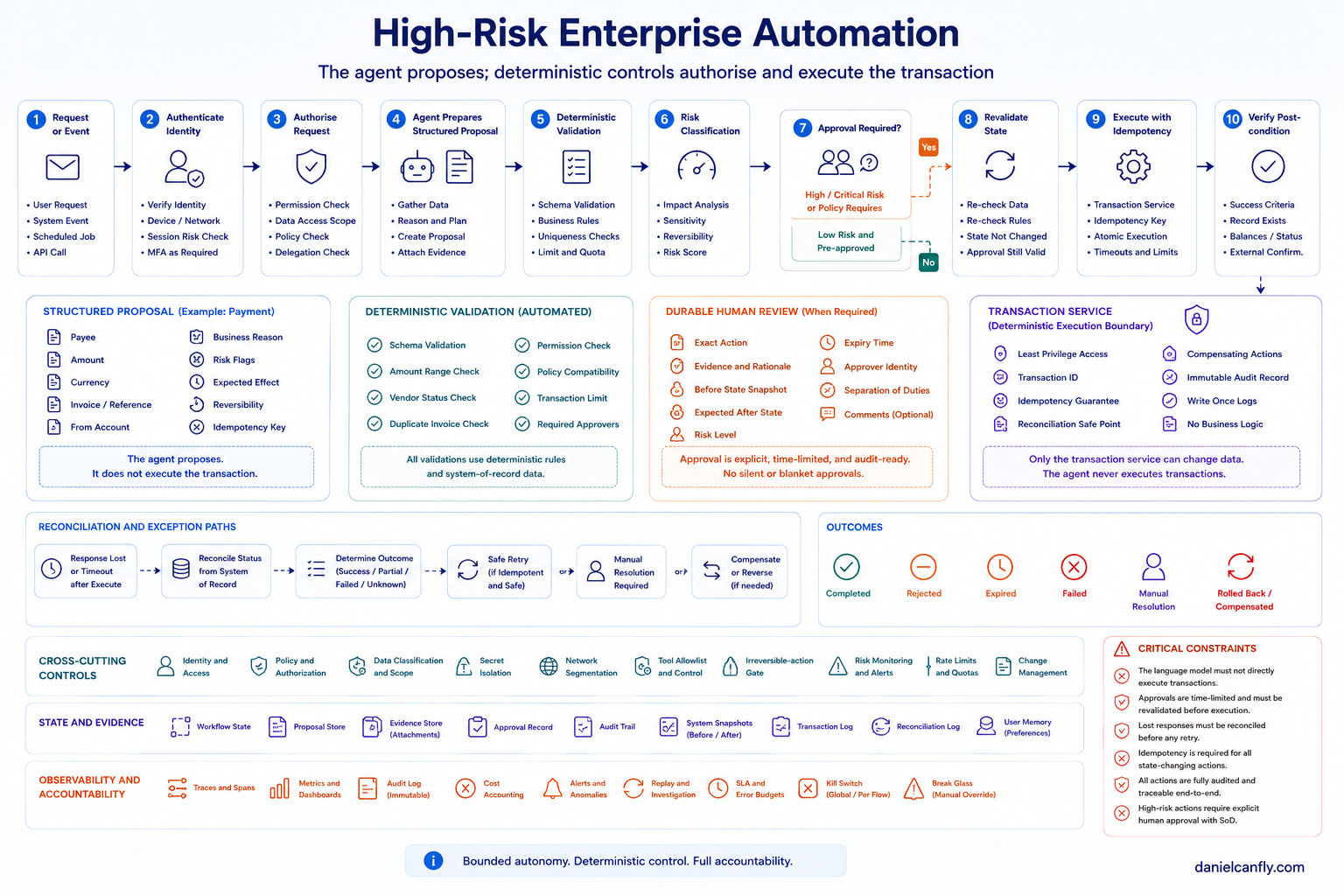
High-risk Automation 不應讓 Language Model 直接擁有 Business Transaction Authority。
較安全的 Pattern:
Request or Event
  -> Authenticate
  -> Authorise
  -> Agent Prepares Structured Proposal
  -> Deterministic Validation
  -> Risk Classification
  -> Approval Decision
  -> Transaction Service Executes
  -> Post-condition Verification
  -> Reconciliation and Audit
Agent 產生 Proposal
Payment Proposal 可以包含:
- Payee
- Amount
- Currency
- Invoice
- Account
- Business Reason
- Requested Execution Time
- Risk Flags
- Expected Effect
- Reversibility
- Idempotency Key
Agent 可以整理 Evidence 並解釋 Request,不應默默變成 Transaction Authority。
Deterministic Validation
檢查:
- Schema
- Amount Range
- Account Ownership
- Vendor Status
- Duplicate Invoice
- Permission
- Policy
- Business Rule
- 適用時的 Sanctions 或 Compliance Check
- Transaction Limit
- Required Approval
Durable Approval
Approval Request 應顯示:
- Exact Proposed Action
- Evidence
- Before State
- Expected After State
- Risk
- Reversibility
- Alternative
- Expiry
- Who May Approve
Resume 前重新檢查 State。昨天 Account Balance 下的 Approval,不應自動批准今天已改變的 Transaction。
Transaction Boundary
真正 Side Effect 由 Deterministic Service 執行。
要求:
- Idempotency
- Reconciliation
- Transaction Identifier
- Least Privilege
- 可行時的 Rollback 或 Compensating Action
- Immutable Audit Record
- 高影響操作的 Separation of Duties
Security 與 Governance
NIST AI Risk Management Framework 與 OWASP 的現行 Guidance 都強調:Risk 必須跨整個 Lifecycle 管理,不能把 Model Behaviour 當成唯一 Control Boundary。
Recipe 6:Long-running Monitor
Long-running Monitor 會重複檢查 Condition,只在 Meaningful Change 發生時通知。
例如:
- Price Threshold
- Weather Risk
- Service Outage
- New Filing
- Policy Change
- Job Posting
- Inventory Return
- Security Event
Reference Flow
Schedule or Event
  -> Load Cursor and Baseline
  -> Fetch Current Source
  -> Validate Source Health
  -> Normalise Observation
  -> Compare with Baseline
  -> Condition Met?
       no -> Update Health State and Stop Quietly
       yes -> Verify Change
            -> Deduplicate and Apply Cooldown
            -> Notify or Escalate
            -> Update Cursor and Alert History
Persistent State
保存:
- Source
- Cursor
- Baseline
- Last Successful Check
- Last Attempted Check
- Last Change
- Last Notification
- Alert Signature
- Cooldown
- Retry Count
- Health Status
- Policy Version
Event Contract
CloudEvents 等 Common Event Envelope 可以統一 Event Producer 與 Consumer 之間的 Identity、Type、Source、Time 與 Correlation。
No-change Behaviour
Condition 未成立時:
Do Not NotifySilence 是 Product Contract 的一部分,不是缺少 Feature。
Health Monitoring
Monitor 可能持續排程,卻已經 Silent Failure。
追蹤:
- Missed Run
- Stale Last-success Time
- Repeated Empty Response
- Source Schema Change
- Authentication Expiry
- Dead-letter Message
- Clock 或 Scheduler Drift
- Alert-delivery Failure
Notification Policy
- Severity
- Recipient
- Channel
- Quiet Hours
- Cooldown
- Acknowledgement
- Escalation
- Maximum Reminders
- Deduplication
Stop 與 Retention
Long-running System 需要:
- Expiry
- Cancellation
- Kill Switch
- Retention Policy
- History Compaction
- Source-removal Handling
- Ownership Transfer
- Human Escalation
Per-run Verifier、Evaluation Suite 與 Observability
這三個 Mechanism 常被一起稱為 Evaluation,但 Scope 不同。
Per-run Verifier
問題是:
這次 Run 是否滿足 Contract?
例如:
- Citation 支持 Claim
- Target Test 通過
- Transaction Post-condition 成立
- Browser Task 達成 Goal
Evaluation Suite
問題是:
這個 System Version 是否值得發布或繼續運作?
可以包含:
- Curated Task Set
- Regression Case
- Adversarial Input
- Permission Test
- Prompt-injection Test
- Failure 與 Recovery Scenario
- Cost 與 Latency Threshold
- Human-scored Quality
- Canary 或 Shadow Evaluation
Observability
問題是:
Live Operation 發生什麼,系統在哪裡退化?
使用 Trace、Metric 與 Log。OpenTelemetry 提供 Vendor-neutral Telemetry 與 Distributed Tracing Convention,但 Application 仍需定義 Domain-specific Attribute。
Agent Span 可以包含:
- Request 與 Trace ID
- Route
- State Transition
- Model 與 Prompt Version
- Tool
- Policy Decision
- Evidence ID
- Retry 或 Replan
- Approval
- Cost
- Terminal Outcome
Trace 解釋一個 Run,但不能證明 Architecture 很好;Evaluation Score 衡量 Performance,但不能解釋單一 Production Incident。
Shared Control Contract
每種 Recipe 都需要以下 Control,只是數值不同。
Budget
可以限制:
- Model Call
- Tool Call
- Search Query
- Browser Action
- Test Run
- Worker Count
- Wall Time
- Token
- Monetary Cost
- Retry
- Replan
- Approval Reminder
使用 Global Task Budget,加上 Per-component Allocation。
Timeout 與 Cancellation
為以下項目定義 Timeout:
- Model Call
- Tool
- Worker
- Approval
- State
- Workflow
- External Source
並定義 Timeout 後的行為:
- Retry
- Reconcile
- Fallback
- Partial Result
- Reassign
- Human Review
- Terminal Failure
Idempotency 與 Reconciliation
所有 Side-effecting Operation 都應定義:
- Request Identity
- Duplicate Detection
- Outcome Lookup
- Safe Repeat Behaviour
- Ambiguous-result Handling
- Compensating Action
Terminal Outcome
至少包括:
- completed
- failed
- partial
- pending
- blocked
- cancelled
- expired
- unsupported
- inconclusive
- requires human action
沒有 Formal Safe Stop 的系統,只剩一個昂貴的 Hope Loop。
Agentic System 的 Security Boundary
Agent Security 不是一段 Prompt。
把 External Content 視為 Untrusted
包括:
- Web Page
- Document
- Tool Output
- Retrieved Memory
- User-uploaded File
- Other Agent Message
將 Data 與 Instruction 分離,保留 Source Boundary。
Minimise Agency
每個 Executor 只取得:
- 必要 Tool
- 最小 Data Scope
- Short-lived Credential
- Resource Limit
- Explicit Side-effect Class
- Bounded Delegation
- 不得有通往高權限 Tool 的隱藏路徑
Execution 前驗證 Model Output
會變成 SQL、Code、API Call 或 Transaction 的 Model Proposal,應先通過 Typed Parser、Policy Engine 與 Execution Boundary。
保護 Memory 與 State
Untrusted Content 不能未經 Validation 就寫入 Permanent Memory、改變 Policy 或重寫 Goal。
準備 Incident Response
保存足夠資訊以便:
- Suspend Workflow
- Revoke Credential
- Identify Affected Tasks
- Safe Replay
- Correct Memory
- Notify Owner
- Preserve Evidence
六種 Recipe 比較
| Recipe | Primary Uncertainty | Main Execution Structure | Strongest Verification Signal | Essential Persistent Data |
|---|---|---|---|---|
| Production RAG | 哪些 Evidence 可以回答 Query? | Pipeline 搭配可選 Adaptive Retrieval | Claim-to-source Support 與 ACL | Query、Source Version、Citation Map |
| Deep Research | 哪些 Subquestion 與 Source 能關閉 Gap? | Planner + Task Graph + Outer State Machine | Coverage、Provenance、Conflict Check | Plan、Evidence Unit、Source Lineage |
| Coding Agent | 哪個 Repository Change 能滿足 Executable Acceptance? | Stateful Generate-and-Test Workflow | Test、Build、Diff、Reproducibility | Snapshot、Patch、Command、Result |
| Browser Agent | 哪個 Safe Action 能達成 Interface Goal? | Bounded Action Loop + State Machine | Functional Post-condition | Browser State 與 Action History |
| High-risk Automation | Proposed Side Effect 是否可執行? | Proposal Workflow + Deterministic Transaction Service | Policy、Approval、Reconciliation | Proposal、Approval、Transaction ID |
| Long-running Monitor | Meaningful Change 是否發生? | Event 或 Scheduled Stateful Workflow | Change Verification 與 Deduplication | Baseline、Cursor、Health、Alert History |
這些是 Starting Point,不是通用評分。Cost 與 Latency 取決於 Implementation、Scale、Data 與 Quality Standard。
Assembly Order
不要先選 Framework。
1. 定義 Contract
- Desired Outcome
- Accepted Evidence
- Prohibited Outcome
- Terminal State
- Latency 與 Cost Envelope
2. 判斷是否需要 Agent
能用 Direct 或 Fixed Pipeline 時,使用較簡單的選項。
3. 盤點 Data 與 Tool
- Source of Truth
- Permission
- Side Effect
- Freshness
- Availability
- Trust Boundary
4. 分開 Fixed 與 Adaptive Work
穩定邏輯 Hard-code。只有 Observation 真的會改變下一個有效 Action 時才加入 Autonomy。
5. 選擇 Execution Structure
- Pipeline
- Router
- State Machine
- DAG
- Bounded Action Loop
- Event-driven Workflow
6. 在 Generation 前定義 Verification
- Schema
- Evidence
- Test
- Post-condition
- Policy
- Human Decision
7. 定義 State 與 Memory
- 哪些必須精確
- 哪些可以 Summary
- 哪些 Persist
- 哪些 Expire
- 誰可以 Read 或 Write
8. 套用 Identity 與 Policy
- Authorisation
- Tool Access
- Data Scope
- Approval
- Risk
- Sandbox
9. 加入 Budget 與 Stop
- Calls
- Time
- Money
- Retry
- Replan
- Concurrency
- Terminal Outcome
10. Instrument 與 Evaluate
- Trace
- Metric
- Audit
- Replay
- Offline Evaluation
- Security Test
- Release Gate
- Rollback
完成這些問題後,Framework 才只是 Implementation Choice,而不是 Architecture Substitute。
常見 Anti-pattern
每個 Request 都走最自主的 Path
簡單工作承擔最大 Latency、Cost 與 Failure Surface。
Policy 只寫在 Prompt
Runtime 仍然暴露 Forbidden Capability。
Unauthorised Data 只在 Model Exposure 後才 Filter
Leak 已經發生。
Orchestrator 用 Conversation Prose 保存 Progress
Precise State 變得 Lossy,且難以 Resume。
Verifier 只問另一個 Model 答案對不對
沒有 Executable 或 Evidential Signal。
把 Runtime Trace 當成 Evaluation
Team 可以非常清楚地看到每個錯誤答案。
只在 Launch 前做 Evaluation
Model、Prompt、Tool、Source 與 Environment 都會 Drift。
Human Approval 看不到 Evidence 與 Exact Action
Approval 退化成儀式性按鈕。
Side Effect 沒有 Idempotency 或 Reconciliation
Timeout 變成 Duplicate Write。
Coding Agent 修改 Test 製造 Pass
Acceptance Mechanism 自己變成 Attack Surface。
Browser Success 只代表 Click 發生
沒有 Post-condition 證明 Task 完成。
Monitoring 每次 Run 都發 Alert
系統產生 Notification Fog,而不是有用 Signal。
Memory 保存所有東西
Sensitive、Stale 與 Unverified Information 進入未來 Context。
不支援 Terminal Failure
每個 Failure 都被轉成下一次 Attempt。
結論
Production Agent Architecture 是把 Autonomy 組裝在 Control 周圍的工程。
成熟系統通常包含:
Identity and Admission
  -> Router
  -> Durable Orchestration
  -> Bounded Execution
  -> Independent Acceptance

Surrounded by:
Policy · State · Memory · Evidence · Budget · Evaluation · Observability · Human Control
六種 Recipe 強調不同 Constraint:
- Production RAG 控制 Evidence 與 Access。
- Deep Research 控制 Decomposition、Provenance 與 Coverage。
- Coding Agent 控制 Executable Change 與 Reproducibility。
- Browser Agent 控制不確定介面中的 Action。
- High-risk Automation 控制 Authority 與 Side Effect。
- Long-running Monitor 控制 Time、Change、Silence 與 Health。
真正讓系統取得運作資格的,不是 Agent 或 Tool 的數量,而是它是否能證明自己做了什麼、限制自己可以做什麼、在不重複傷害的前提下恢復,並以有人負責的 Result 停止。
Part 9 會把整個系列變成 Decision Process:
面對一個真實 Task,如何選擇能滿足 Evidence、Risk 與 Operational Requirement 的最小架構?
參考資料
- Lewis et al., Retrieval-Augmented Generation for Knowledge-Intensive NLP Tasks
- Jimenez et al., SWE-bench: Can Language Models Resolve Real-World GitHub Issues?
- Zhou et al., WebArena: A Realistic Web Environment for Building Autonomous Agents
- LangGraph Documentation, Persistence
- LangGraph Documentation, Interrupts
- OpenTelemetry Documentation
- CloudEvents, A specification for describing event data in a common way
- NIST, Artificial Intelligence Risk Management Framework: Generative Artificial Intelligence Profile
- OWASP, Top 10 for Large Language Model Applications