A start-up’s first tax model is often one line in a forecast: profit multiplied by a corporate tax rate. For a Singapore company, 17% is the prevailing headline corporate income-tax rate. It is a valid input, but an incomplete model.IRAS: Corporate Income Tax Rate, Rebates and Tax Exemption Schemes
Consider a fictional Singapore software company. It loses money during its first two Years of Assessment (YAs), spends heavily on product development, becomes profitable in its third YA, approaches the GST registration threshold, starts paying overseas suppliers and later establishes a related company abroad. None of those events waits politely for the others.
The result is a set of tax questions running on different clocks. The profit and loss account may show current and deferred tax. Tax losses may be available for later use. GST may affect invoices and cash collection before corporate tax becomes large. A payment to a non-resident may need a withholding analysis. Overseas expansion can raise residence, treaty, permanent-establishment and transfer-pricing questions.
The title uses VAT as the familiar generic label for this family of indirect taxes. Singapore calls its system Goods and Services Tax, or GST. VAT/GST belongs on a different branch of the tax map from corporate income tax.OECD: International VAT/GST Guidelines
Start by separating the tax accounts from the tax cash
IAS 12 draws a basic distinction between current tax and deferred tax. Current tax relates to tax payable or recoverable for the current and prior periods. Deferred tax arises from specified temporary differences and, subject to recognition conditions, unused tax losses and credits.IFRS: IAS 12 Income Taxes
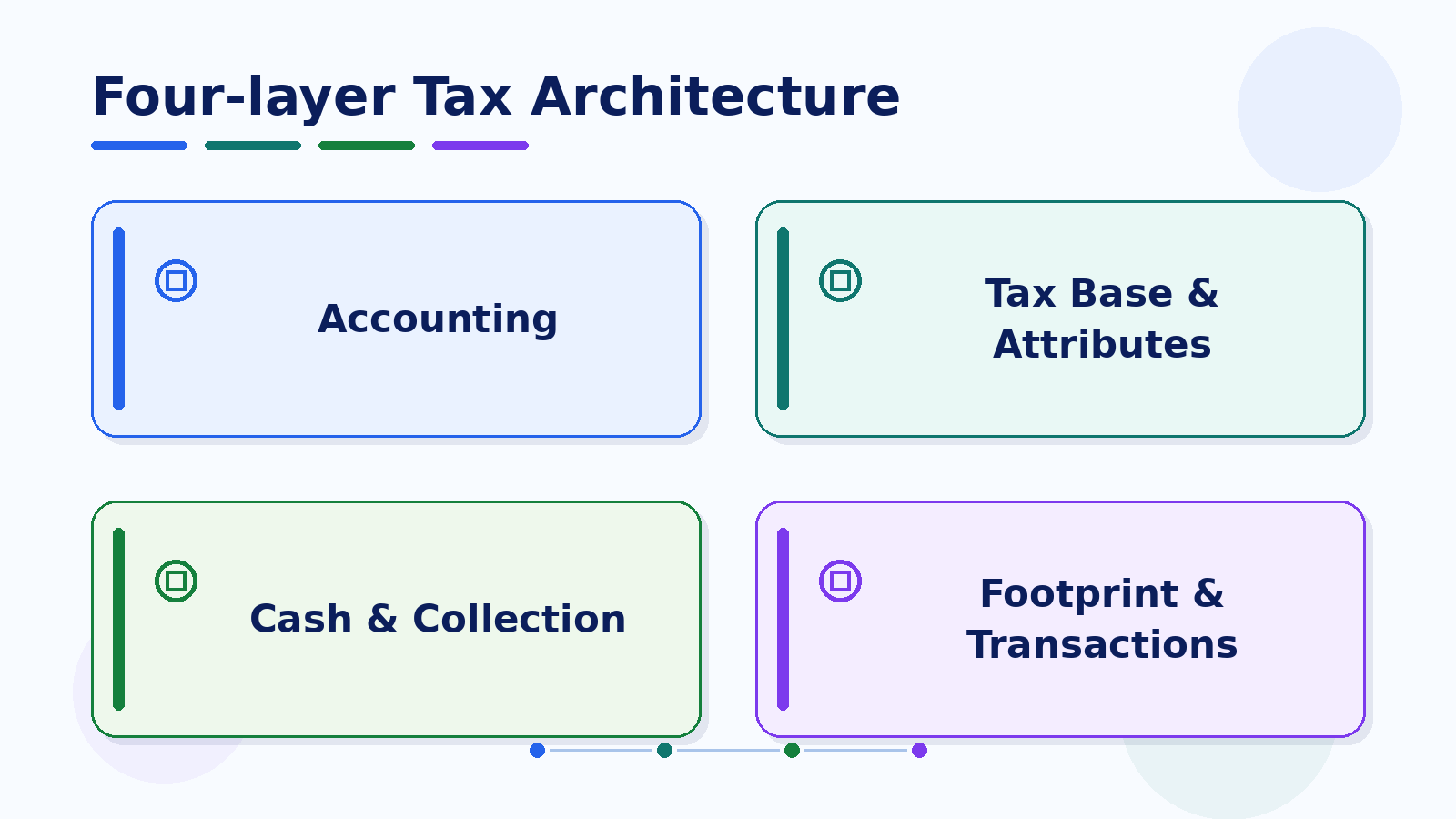
That accounting split is only the first separation the company needs. A practical tax model has four layers.
- Financial reporting: current tax expense, deferred tax movements and tax balances reported in the accounts.
- Tax base and attributes: taxable income, temporary or permanent differences, losses, exemptions and other legal attributes.
- Cash and collection: actual tax payments, GST collected and remitted, and withholding attached to qualifying payments.
- Footprint and transactions: residence, permanent establishments, treaty routes, related-party pricing and transaction consequences.
These layers can move independently. A deferred-tax entry does not itself move cash. A GST liability can arise from sales activity even when the company is still loss-making. An effective tax rate may explain part of the reported tax charge while saying little about the date on which money leaves the bank account.
A loss carried forward is useful, but it is not a cash balance
Suppose the company records tax losses during its first two YAs. Singapore generally allows unutilised trade losses to be carried forward subject to conditions. Qualifying current-year items can also be carried back one YA, subject to a S$100,000 cap and the relevant tests.IRAS: Carry-Back of Unutilised Capital Allowances & Trade Losses
Three values may now appear in management discussions, and they should not be collapsed into one:
- the legal amount of tax losses that remains available;
- any deferred tax asset recognised in the financial statements;
- the future cash saving if those losses are eventually used against taxable income.
Each depends on a different set of conditions. The legal attribute can survive without being recognised in full as a deferred tax asset. Recognition of a deferred tax asset does not place money in the bank. Cash value appears only when the company has taxable income against which an available attribute can actually be used.
A runway model that adds the face amount of losses multiplied by 17% to today’s available cash is bringing a future, conditional benefit into the present.
Innovation incentives have different value when the company has no taxable profit
Now add qualifying innovation expenditure. Singapore’s Enterprise Innovation Scheme (EIS), available for YA2024 to YA2028, offers enhanced deductions or allowances of up to 400% for specified qualifying R&D, intellectual-property, training and innovation activities, subject to activity-specific limits and conditions.MOF: Enterprise Innovation Scheme
A deduction is naturally more valuable when there is taxable income to shelter. For a company that is still loss-making, an enhanced deduction may instead increase tax attributes that will only matter later.
EIS therefore has another route worth separating from the deduction. An eligible business can elect to convert up to S20,000 per YA. The converted expenditure no longer receives the corresponding deductions or allowances. The payout route also has eligibility conditions, including a requirement relating to three full-time local employees.IRAS: Enterprise Innovation Scheme
If S10,000. For a start-up still funding payroll from its cash balance, the decision is partly about timing rather than the headline generosity of a deduction percentage.
Government grants can support the same business without being tax relief. They should sit elsewhere in the financing model rather than being bundled into the EIS calculation.
First profit: work through reliefs before treating 17% as the answer
Assume the business reaches normal chargeable income of S$200,000 in its third YA. That timing matters because Singapore’s Start-Up Tax Exemption (SUTE) is available to qualifying new start-up companies for their first three consecutive YAs.
From YA2020, SUTE exempts 75% of the first S100,000. The maximum exemption is therefore S$125,000 per YA.IRAS: Explanatory Notes to YA 2026 Form C-S
A deliberately simple illustration, before other adjustments or credits, looks like this:
| Step | Amount |
|---|---|
| 75% exemption on first S$100,000 | S$75,000 |
| 50% exemption on next S$100,000 | S$50,000 |
| Total exempt amount | S$125,000 |
| Remaining normal chargeable income | S$75,000 |
| 17% of S$75,000 | S$12,750 |
The calculation does not mean every Singapore start-up enjoys three tax-free years. SUTE has qualifying conditions. The company must be incorporated in Singapore and be a Singapore tax resident for the YA. It must also satisfy the prescribed shareholder test, and investment-holding companies and specified property-development companies are excluded.IRAS: Explanatory Notes to YA 2026 Form C-S
Companies outside SUTE, or beyond the SUTE window, may generally fall into the Partial Tax Exemption (PTE) regime instead. From YA2020, PTE provides a 75% exemption on the first S190,000.IRAS: Corporate Income Tax Rate, Rebates and Tax Exemption Schemes
Revenue growth can trigger GST while income-tax cash is still modest
The next change in the company’s tax profile may come from revenue rather than profit.
Singapore’s GST rate is 9%. Compulsory registration generally needs to be considered when taxable turnover exceeds S1 million in the next 12 months under the prospective test.IRAS: GST Rates IRAS: Do I Need to Register for GST?
A company can therefore reach an indirect-tax threshold while still reporting thin margins or continuing to use tax losses. Once GST is part of the operating flow, it affects quotations, invoices, collections, input tax and remittances. Amounts collected as GST are not ordinary operating revenue simply because they pass through the bank account.
The precise mechanics depend on the supply and the parties involved, which is why a generic VAT/GST model should not assume that every transaction follows the same collection route.OECD: International VAT/GST Guidelines
An overseas invoice does not tell you the withholding result by itself
Imagine three payments leaving the Singapore company: interest to an overseas lender, a royalty to an IP owner and a fee to an overseas consultant. The cash movements may look similar in the bank feed, but their tax character is different.
Singapore withholding tax can apply to specified payments to non-residents, including categories such as interest, royalties and certain service or management payments. The result depends on the nature of the payment and the surrounding facts.IRAS: Overview of Withholding Tax
Before anyone reaches for a rate table, the company needs to identify what is being paid for, who the recipient is, where relevant services are performed and whether an applicable tax treaty changes the domestic result. Contract language can matter because a single commercial invoice may combine software, IP rights and services.
This is why ‘foreign SaaS vendor’ is not a tax conclusion. It is merely the first fact in a characterisation exercise, preferably carried out before the invoice is due and before the parties discover that the contract says nothing about withholding or gross-up.
Cross-border growth turns residence and treaty access into factual questions
Incorporation establishes where the company was legally formed. It does not, on its own, settle every international tax question.
For Singapore corporate tax purposes, residence is based on where the company’s control and management is exercised. Strategic decision-making and the facts around how the board operates can therefore matter.IRAS: Tax Residency of a Company / Certificate of Residence
Residence can affect access to tax treaties. A Singapore tax-resident company may apply for a Certificate of Residence where appropriate, but treaty benefits remain subject to the relevant treaty and its conditions. Treaties allocate taxing rights and help relieve double taxation; anti-abuse provisions are part of that architecture too.OECD: Preventing Tax Treaty Abuse
Foreign income adds another branch. Singapore provides exemptions for specified foreign-sourced income and also provides foreign tax-credit mechanisms, each subject to their own requirements.IRAS: Companies Receiving Foreign Income IRAS: Foreign Tax Credit
Then there is permanent establishment (PE). The OECD Model Tax Convention provides a widely used Article 5 framework, but the applicable treaty and actual activities still govern the analysis.OECD: Model Tax Convention on Income and on Capital 2017
A customer in another country does not automatically create a PE. Neither does one employee automatically settle the question in either direction. The company has to look at places of business, activities, agents, authority and the relevant treaty language.
Related companies create a pricing question of their own
A year later, the group has a foreign subsidiary. The Singapore company owns core technology and provides product support; the subsidiary sells in its local market. There may also be loans, licences or shared costs between them.
Those flows bring transfer pricing into the operating model. IRAS applies the arm’s-length principle to related-party transactions.IRAS: Transfer Pricing
The first task is to understand the actual controlled transaction. Who performs the functions? Which assets are used? Who assumes the relevant risks? Do the contracts reflect what the businesses actually do? The OECD Transfer Pricing Guidelines treat that accurate delineation as a foundation for the pricing analysis.OECD: Transfer Pricing Guidelines 2022
Singapore also has contemporaneous transfer-pricing documentation rules where the requirements apply. Documentation thresholds are a compliance question; the economic basis for related-party pricing is a substantive question. One should not be mistaken for the other.
A board-approved 5% mark-up may be commercially convenient. The tax file still needs an explanation for why that price reflects the transaction the group is actually carrying out.
In a deal, yesterday’s tax choices become part of today’s economics
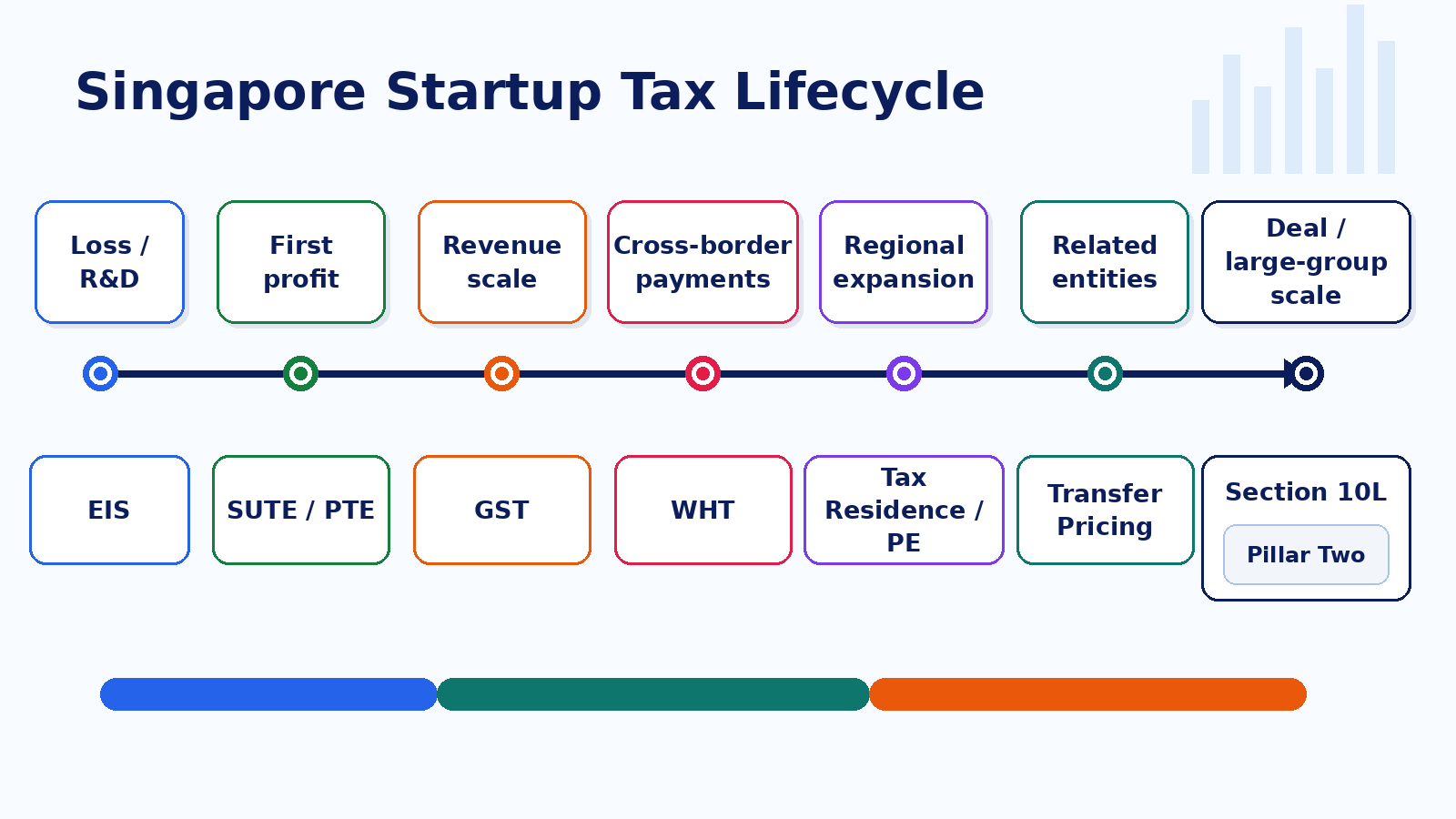
Tax diligence turns accumulated history into current transaction questions. Buyers and investors may revisit the availability of tax losses, GST registrations, withholding positions, treaty claims and related-party pricing. An issue that can create additional tax, limit an attribute or require remediation can affect cash, valuation or contractual risk allocation.
Losses illustrate the problem neatly. A S170,000 in a transaction merely because the headline corporate rate is 17%. Its economic value depends on whether and when the attribute remains usable after the transaction.
Singapore’s section 10L adds another boundary for exit planning. From 2024, certain foreign-sourced disposal gains received in Singapore can fall within the Singapore tax net, and economic-substance conditions can be relevant for certain non-IP foreign assets.IRAS: Economic Substance Requirement / Section 10L
Pillar Two belongs much further up the scale curve. Singapore’s Multinational Enterprise Top-up Tax and Domestic Top-up Tax apply from financial years beginning on or after 1 January 2025 to in-scope multinational groups meeting the relevant size test, including the €750 million consolidated-revenue threshold.IRAS: GloBE Rules and Domestic Top-up Tax
For an ordinary early-stage start-up, that is context rather than a weekly compliance task. It becomes operational when scale and group structure make the threshold relevant.
Put tax into the runway model as a calendar of events
The company now has enough moving parts that a single annual tax percentage is no longer an adequate control. A more useful operating schedule records events as they arise.
| Event | Tax branch | What needs checking | Amount status | Cash timing | Owner |
|---|---|---|---|---|---|
| Annual profit | Corporate income tax | losses, SUTE/PTE, other applicable items | estimate / filed | forecast payment period | Finance / Tax |
| Turnover approaches threshold | GST | registration requirement and supply scope | forecast | collection/remittance cycle | Finance / Ops |
| Overseas royalty or service payment | WHT | payment character, recipient, service location, treaty | invoice-level | around payment | Finance / Legal |
| Overseas activity expands | residence / PE | management facts, local activity, treaty | fact-dependent | unresolved | Finance / Legal |
| Related-party flows begin | transfer pricing | transaction, functions, risks, pricing support | recurring | transaction/adjustment cycle | Finance |
A tax calendar is allowed to contain uncertainty. Some rows will carry ranges. Others will say that the legal conclusion is still being checked. What matters for liquidity is that the event, expected timing and owner are visible rather than buried inside an annual tax-rate assumption.
When a new transaction appears, classify it before calculating it:
- Which layer changed: reporting, tax base/attributes, cash collection, or cross-border footprint?
- Which jurisdiction and rule set governs the event?
- When is cash expected to move?