A board can approve the wrong thing perfectly well
Northstar has an acquisition in front of it. Management likes the strategic fit, the price is still negotiable, and the timetable is tight enough that a board answer is wanted within days.
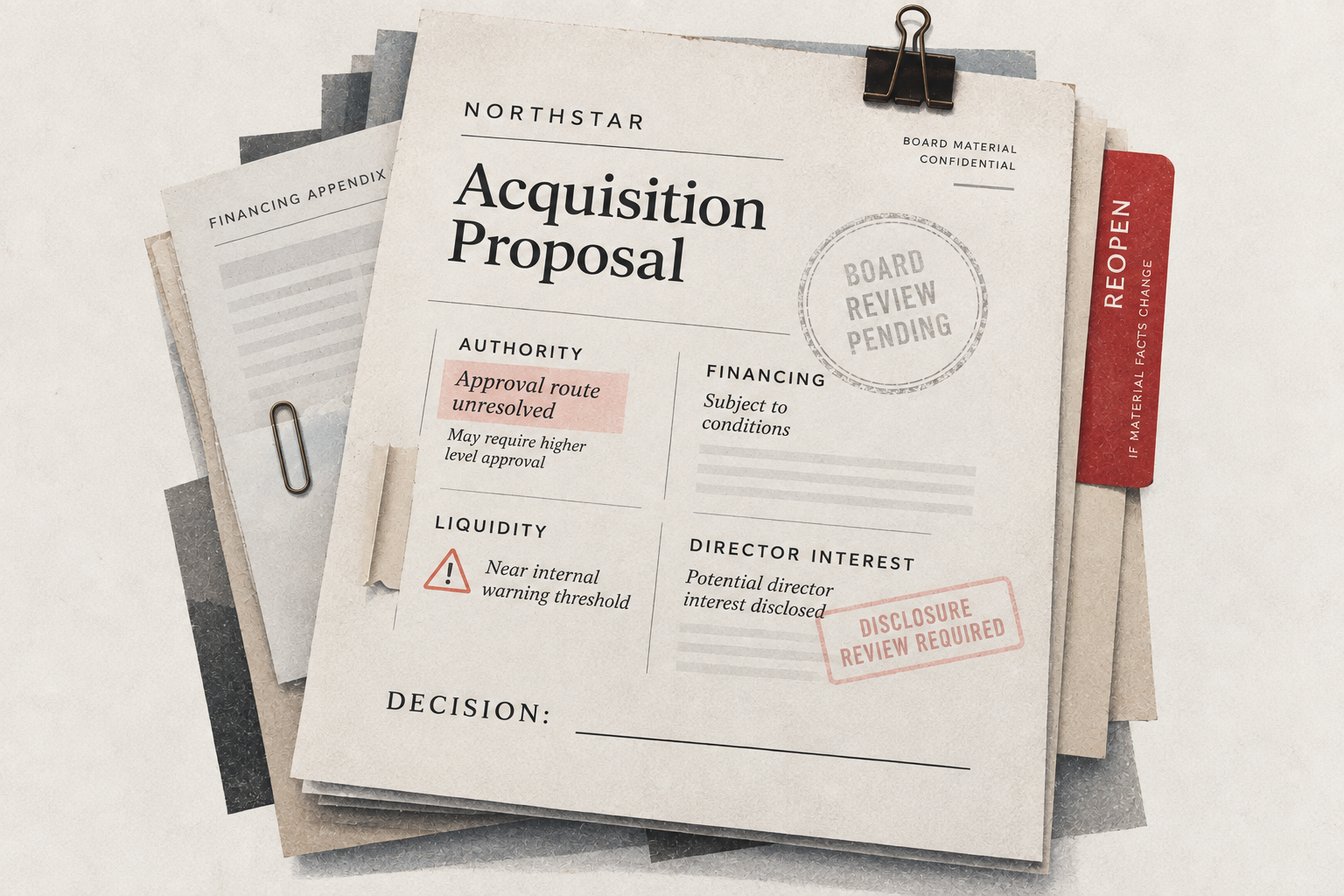
The valuation is only part of the problem. The proposed spend sits outside the annual investment envelope already approved. One director has a potential interest connected with the counterparty. Under the downside integration case, usable liquidity moves close to an internal warning threshold. Some of the financing is still conditional.
A clean vote would not resolve any of those issues by itself. Northstar needs to know whether the matter has reached the correct authority, whether the board has the information required for this decision, whether the evidence and conflict process can be relied upon, and what would force the matter back for another decision.
I use Board Decision System as shorthand for those connected jobs: Authority, Information, Assurance and Escalation. It is an editorial model, not a legal doctrine. The useful part is the connection between them. A sound authority route is of little help if the board is working from stale cash data; a good board pack does not cure an undisclosed conflict; an approval made today may need reopening when the company’s liquidity changes next week.
Authority starts in documents, not in the size of the number
Management can research a target, negotiate, build a valuation and recommend a transaction without necessarily having authority to sign and close it. Northstar therefore has to map the acts separately: who may negotiate, who may commit the company, which matters are reserved for the board, whether a committee must review them, and whether a shareholder, class or investor has a consent right.
The G20/OECD Principles of Corporate Governance 2023 place strategy, major plans, annual budgets, risk and significant corporate actions within the board’s responsibilities. They do not provide a universal delegation matrix. The actual route comes from the applicable law and the company’s own constitutional documents, delegations, shareholder agreements, financing documents and other contracts.
Delaware provides a useful jurisdiction-specific illustration. DGCL §141 generally places the corporation’s business and affairs under the board’s management or direction, subject to the statute and certificate of incorporation. A certificate amendment can follow a different route. Under DGCL §242, the relevant process can involve a board resolution and, where required, stockholder or class approval. Venture-backed companies may add negotiated protective provisions giving specified investors approval rights over particular actions; the NVCA Model Legal Documents show examples of that drafting rather than a default constitution for every private company.
Information rights can also sit in statute or contract. They may be qualified by purpose, confidentiality or other restrictions. That becomes important in a transaction process: a party with an approval or inspection right does not necessarily have an unlimited entitlement to every document on any timetable.
This is why “material” should prompt an authority check, not replace one. A company can create just as much friction by escalating every large number as it can create risk by allowing management to act beyond its delegated powers.
Build the board pack backwards from the decision
Suppose Northstar confirms that the acquisition is a board matter. The next failure mode is easy to recognise: a polished deck answers a hundred questions except the one the board is being asked to decide.
The decision ask needs a boundary. Is management seeking approval for a price ceiling and transaction structure? Permission to keep negotiating? Authority to sign once financing conditions are met? A staged approval with a later closing gate? Without that boundary, the board can appear to approve more than it intended, while management can leave without knowing what it is actually authorised to do.
The OECD principles emphasise decision-making on a fully informed basis and timely, accurate and relevant information. For Board Finance, that points towards a decision pack rather than a bundle of routine financial reports. Northstar’s pack should show the economics and the downside, when integration cash is paid, what usable liquidity remains, which funding is committed or conditional, how much headroom remains, what alternatives management has considered, and who owns the critical assumptions.
Those liquidity categories should stay separate. Cash in the bank, committed facilities, operating cash flow and future capital-market access do not carry the same certainty. A forecast that assumes refinancing will remain available precisely when the downside case arrives is using the contingency as an assumption rather than testing it.
The US SEC’s Item 303 is a public-company disclosure requirement, not a board-pack rule. Its treatment of liquidity, capital resources and material trends is still useful here because it forces those items into one view of future financial capacity.
If Northstar gives directors an EPS-accretion headline and a three-year synergy estimate while leaving out integration cash timing, financing conditions and credible alternatives, the presentation may be concise but the decision is under-specified.
Conflict handling and control reliability belong in the same conversation
Now add the director with a potential interest connected with the counterparty. The board should not jump straight to a yes/no question about voting. The process needs to establish what has been disclosed, who evaluates the conflict, which safeguards apply, and what the record will show afterwards.
The mechanism depends on jurisdiction, corporate documents and transaction facts. Independent or disinterested review, a special committee, recusal, additional shareholder approval or external advice may be relevant in different settings. None is a universal prescription. Current DGCL §144 provides one Delaware-specific statutory framework for interested-director, officer and controlling-stockholder transactions. MFW is another Delaware example showing that process design can matter in a particular controller-transaction setting.
Committees can provide more focused oversight of audit, risk, controls or conflicts. OECD guidance and US listing rules for audit committees illustrate different institutional settings for that work. The existence of a committee does not, by itself, erase whatever responsibility remains with the full board under the applicable regime.
Evidence quality sits alongside conflict handling because both determine whether the board can rely on the process. Imagine that Northstar’s cash forecast has no clear owner, purchase commitments are missing, a key assumption has not been refreshed for six months, and control overrides are being approved verbally. The numbers may still look plausible. Their provenance is weak.
The FRC’s Corporate Governance Code Guidance connects risk management, internal control, monitoring, significant failings and remediation. The OECD principles similarly connect board oversight with reporting integrity and control systems. When a control determines whether a material assumption is traceable, whether an exception is visible or whether a failure reaches the board, it is part of governance rather than background administration.
The decision record closes that loop. Minutes, written consents and resolutions should allow a later reader to reconstruct the decision asked for, the material information considered, the conflict treatment, the conditions attached and the formal action taken. DGCL §141(f), for example, provides a Delaware rule for board action by written consent and the corporate record.
An approval needs reopening conditions
Two weeks after Northstar’s initial approval, a major customer delays payment. Financing terms deteriorate. The downside cash forecast moves towards the company’s minimum-liquidity threshold.
Nothing about the target company has changed. Northstar has.
The earlier article How Does Risk Governance Become Operational? From Risk Appetite and KRIs/KCIs to Controls and Escalation dealt with the broader operating loop around Risk Appetite, KRIs/KCIs, thresholds and controls. In this transaction, the relevant link is narrower: a threshold needs to connect to a decision right. If the threshold is crossed, who is informed, what new evidence is required, and who must decide again?
The FRC guidance calls for clear escalation procedures and agreed triggers for significant matters. For Northstar, that could mean requiring financing certainty before closing, converting a single approval into staged approval, increasing the frequency of cash reporting, making a control remediation a closing condition, or pausing the transaction. A material control failure can trigger the same result if it removes confidence in evidence that the board relied upon.
As liquidity tightens, the reporting cadence and level of detail may change as well. A 13-week cash forecast, more frequent liquidity reporting, critical-payment visibility, drawing conditions, covenant headroom and funding lead times can become more useful than the normal monthly pack. These are management tools. They do not establish legal insolvency.
That distinction matters. The earlier article Why Can a Company Run Out of Options Before It Runs Out of Cash? From Distress and Covenants to Change of Control covered the wider option-decay problem. Delaware’s Gheewalla also warns against the shorthand that financial stress automatically causes directors’ fiduciary duties to “shift to creditors” in a loosely defined zone of insolvency. The legal consequences depend on the jurisdiction and facts; a liquidity trigger is not a substitute for that analysis.
A sale of Northstar is a different governance state
There is another way the route can change. Suppose Northstar becomes the target rather than the acquirer.
A Change of Control can bring different consent rights, conflicts, financing-document consequences and approval requirements into play. The transaction process may also face a different standard of review. Delaware cases including Revlon, MFW and Corwin address different sale-of-control, controller-transaction and shareholder-approval settings. They should not be blended into a generic global M&A checklist. They are useful here for a narrower point: transaction state can change the process that makes a decision defensible.
Business-as-usual governance often fails in these moments because the company keeps the same calendar and approval template while the rights, incentives and downside have moved underneath them.
What should remain after the meeting
Northstar’s board does not need to prove that every risk has disappeared. It needs a decision that matches the authority, evidence and state of the company at that point in time.
That can produce four legitimate outcomes. The board may approve. It may approve subject to financing, a control repair or another safeguard. It may defer because a material information or process gap is still open. It may reject because the economics, risk or governance conditions do not support proceeding.
A useful decision record can be remarkably short if the work behind it is sound. It should make three things clear:
- what has been authorised now;
- which conditions remain open;
- which trigger would invalidate the current route or require the matter to return.
That is the practical use of the Board Decision System. Authority determines who can act. Information shows the consequences and alternatives. Assurance supports reliance on the evidence and conflict process. Escalation stops yesterday’s approval from being treated as permanent when today’s facts have changed.
Board speed is therefore a weak governance metric on its own. The more useful question is whether the company can still identify who must decide, what they are relying on, and when the decision has to be made again while there is still room to choose.
References
- OECD, G20/OECD Principles of Corporate Governance 2023
- Delaware General Assembly, Delaware General Corporation Law, Subchapter IV: Directors and Officers
- Delaware General Assembly, DGCL §242: Amendment of Certificate of Incorporation
- National Venture Capital Association, Model Legal Documents
- Financial Reporting Council, Corporate Governance Code Guidance
- Financial Reporting Council, UK Corporate Governance Code
- Electronic Code of Federal Regulations, 17 CFR §229.303, Management’s discussion and analysis
- Electronic Code of Federal Regulations, 17 CFR §229.404, Transactions with related persons
- Delaware Supreme Court, North American Catholic Educational Programming Foundation, Inc. v. Gheewalla (2007)
- Delaware Supreme Court, Revlon, Inc. v. MacAndrews & Forbes Holdings, Inc. (1986)
- Delaware Supreme Court, Kahn v. M&F Worldwide Corp. (2014)
- Delaware Supreme Court, Corwin v. KKR Financial Holdings LLC (2015)