A company needs another 100 units of capital. It can borrow the full amount, combine 60 of senior debt with 40 of common equity, or fund half with senior debt and half with a convertible or hybrid instrument.
On day one, the debt-heavy package is easy to like. It has the lowest interest rate and avoids immediate dilution. The balanced package looks more expensive, while the hybrid keeps its cash coupon relatively light.
The ranking becomes less obvious when the financing has to survive for several years. A weaker operating result can narrow covenant headroom. A concentrated maturity can force the company back into the market before the underlying investment has recovered. A facility that exists on paper may not be fully accessible under stress.
The OECD’s 2026 Global Debt Report puts the timing issue in context. At the end of 2025, refinancing requirements over the following three years were equivalent to roughly 24% of outstanding investment-grade corporate debt and 31% of non-investment-grade debt. Those figures do not predict a refinancing crisis for an individual company. They do show why the cost quoted at issuance is only part of the decision.
All figures in the example below are illustrative assumptions, not market quotations or financing advice for a specific company. The aim is not to produce a universal debt-to-equity ratio, but to see what changes once each structure is tested outside the base case.
Start with the instrument, not the rate
IAS 32 provides a useful starting point. The presentation of an instrument as a financial liability or equity depends on its contractual substance, including whether there is an obligation to deliver cash or another financial asset. A label such as “preferred”, “convertible” or “hybrid” does not settle the economics.
For the 100-unit financing, assume these structures:
| Structure | Illustrative mix | First impression |
|---|---|---|
| A: Debt-heavy | 100 senior debt | Lowest rate, no immediate dilution |
| B: Balanced | 60 senior debt + 40 common equity | Lower fixed-payment burden, but higher equity cost |
| C: Hybrid | 50 senior debt + 50 convertible / hybrid | Lower cash coupon, but conversion and dilution economics |
Debt brings promised repayment obligations. Equity has no fixed principal maturity, but investors may require a higher return and existing owners may be diluted. A hybrid can contain both sets of economics, which is why its fixed payments, redemption provisions, conversion mechanics and interaction with senior debt have to be read rather than inferred from the name.
Before comparing price, identify four things: fixed cash obligations, potential dilution, terms that affect lender control or operating freedom, and costs that do not appear in the headline coupon.
The cheapest quoted package may not have the lowest all-in cost
WACC combines the cost of equity and the after-tax cost of debt using capital structure weights. It is useful, but the output can look more certain than the inputs deserve. Cost of equity, tax effects and future market access are not made precise simply because the spreadsheet reports two decimal places.
Give the three packages these illustrative terms:
| Structure | Illustrative cash terms | Easily missed economics |
|---|---|---|
| A | 6% debt coupon, 2% upfront fee | Three-year bullet maturity, tighter covenants, refinancing dependence |
| B | 7% debt coupon + 40 equity | Equity required return and ownership dilution |
| C | 6.5% senior debt + hybrid with 2% cash coupon | Conversion value, potential dilution and contractual complexity |
A wins immediately if “cost” means only the stated interest rate. That comparison omits debt issuance costs, fees, warrants, conversion value and contractual restrictions. An early refinancing can add another cost even when the original coupon was attractive.
It helps to separate three kinds of cost. Visible cash cost includes coupon, cash interest and fees. Economic cost includes dilution, conversion economics, embedded options and issuance costs. Constraint cost appears when covenants, security, maturity structure or lender consent rights reduce what management can do later.
The last category does not fit neatly into a WACC cell. It becomes visible when the company is put under stress, which is where debt capacity needs to be tested.
Test debt capacity where the plan is weak
The company produces EBITDA of 50 in the base case and 32 in the downside case. Ignoring accounting and covenant-definition differences for the moment:
- A has 100 of debt, so debt / EBITDA moves from about 2.0x to roughly 3.1x.
- B has 60 of debt, moving from about 1.2x to 1.9x.
- C has 50 of senior debt plus a hybrid. Senior debt alone gives the lowest apparent leverage, but that would understate the burden if the hybrid also carries fixed payments or redemption obligations.
Those leverage ratios are not a debt-capacity answer. Revenue can fall without EBITDA, working capital, capex, tax, leases and interest moving in the same proportion. A company can also show positive full-year EBITDA and still run short of cash during the year.
A credible downside test therefore needs cash flow coverage, enough liquidity to survive the trough, covenant headroom after performance weakens, and a maturity schedule that does not arrive before cash generation recovers. Debt capacity is the amount of fixed financing the business can carry through that combination of conditions, rather than the maximum amount available from a lender today.
That distinction changes the three packages. A remains efficient in the base case but concentrates the greatest fixed financing pressure in the downside. B pays more for capital and keeps more capacity. C cannot be placed cleanly between them until the hybrid terms are known.
Covenant headroom can disappear before a breach
Now add a 3.5x maintenance leverage covenant to A. With leverage around 3.1x in the simplified downside, the company is still compliant. The remaining margin is not large, and the legal calculation may not match management’s spreadsheet.
A loan agreement can define EBITDA, debt, cash netting, acquisition add-backs, synergies, baskets and exclusions in its own way. LSTA materials on financial definitions illustrate how those calculations can be negotiated between borrower and lender. “Our model says 3.1x” is therefore not enough to establish the covenant result.
Maintenance covenants are also recurring tests. Passing today does not establish that the company will pass six months later. More importantly, strategic freedom can narrow before any formal breach occurs. Thin headroom may cause management to defer capex, avoid an acquisition, cancel distributions or begin waiver and refinancing discussions earlier than expected.
Depending on the agreement and jurisdiction, covenant problems can also affect liability classification, lender control or refinancing options. Those consequences are contract-specific and should not be generalised.
For monitoring, a useful line is:
Forecast covenant metric → Threshold → Headroom → Downside headroom → Earliest pressure date
Applied to the example, A may lose room to act first even while remaining compliant. B normally has more buffer because it carries less fixed debt. C still requires a term-by-term check: whether the hybrid enters the debt definition, whether it has redemption triggers, and how it interacts with the senior facility.
Match the maturity wall to the cash-flow recovery
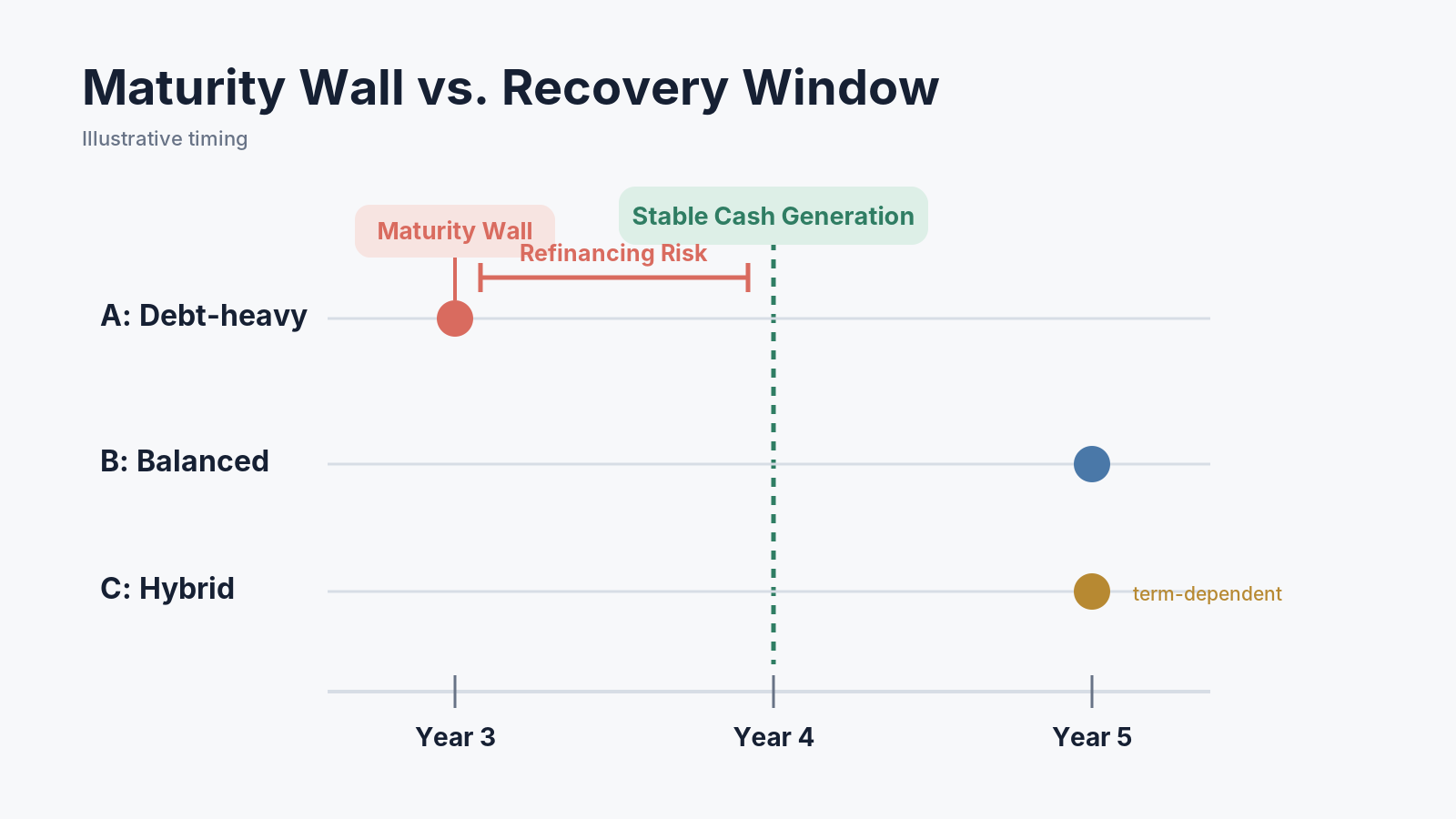
The next problem is timing. Let A mature as a three-year bullet, while B’s principal debt matures in five years. C also has a roughly five-year horizon, with a separate conversion or redemption window for the hybrid. The investment being financed is expected to reach stable cash generation only in year four.
A must therefore return to the capital markets before the investment has fully demonstrated its cash-flow recovery. If markets are open in year three, refinancing may be routine and could even improve the terms. If credit spreads have widened, the industry is weak and the company is still recovering, the same maturity creates a much harder problem.
The OECD’s 2026 corporate debt analysis provides market context here. A significant amount of debt maturing in 2026–2028 was issued at lower coupons than prevailing financing costs later on. Even a successful refinancing can raise the interest burden if the debt is repriced at a higher rate. That is a market-level observation, not a prediction for this company.
A company-specific test should put the financing calendar next to the operating recovery. How much principal matures over the next three years? Is it concentrated in one year or quarter? Will the cash-flow improvement be visible before refinancing? Does the structure still work if refinancing spreads rise by 200–300 basis points? Is there another liquidity bridge if markets are shut for six to twelve months?
A financing plan that works only if lenders are willing to refinance on schedule contains a market-access assumption. That assumption belongs in the downside case, not in a footnote.
A revolver is not the same as financial flexibility
Liquidity should be broken into what is actually accessible: cash and immediately available assets, committed facilities, uncommitted lines, draw conditions, covenant or borrowing-base restrictions, known future cash requirements, debt maturities and other contractual obligations.
That distinction is consistent with the liquidity and capital resources framework in Regulation S-K Item 303, which asks companies to discuss their ability to obtain adequate cash, material cash requirements, internal and external liquidity sources, and likely changes in the mix and relative cost of capital resources. The management question is straightforward: will the funding source still be usable when it is needed?
Financial flexibility goes beyond meeting existing obligations. Suppose the economy is weak in year three and a competitor puts a valuable asset up for sale at a distressed price. A may be unable to act because covenant headroom is thin and its maturity wall is approaching. B paid more for capital at the outset but may still have capacity to invest. C’s ability to act depends on the hybrid’s conversion mechanics and restrictions in the senior debt.
A resilience view therefore needs more than an “unused line” figure. It should bring together accessible liquidity, covenant headroom, maturity runway, incremental borrowing capacity and equity access under stress. If one of those components fails, nominal liquidity may not translate into a usable choice.
The ranking changes when the downside becomes real
The same 100-unit decision now looks different:
| Dimension | A: Debt-heavy | B: Balanced | C: Hybrid |
|---|---|---|---|
| Visible cash cost | Lowest | Higher | Low to medium |
| All-in economics | Low fees, but short maturity and restriction costs matter | Higher equity cost and dilution | Conversion and dilution economics must be included |
| Downside debt capacity | Weakest | Strongest | Medium, depending on hybrid substance |
| Covenant headroom | Thinnest | Widest | Medium, depending on debt definition |
| Maturity risk | Higher, concentrated at year three | Lower, longer runway | Medium |
| Liquidity flexibility | Weaker under stress | Stronger | Medium to strong, depending on terms |
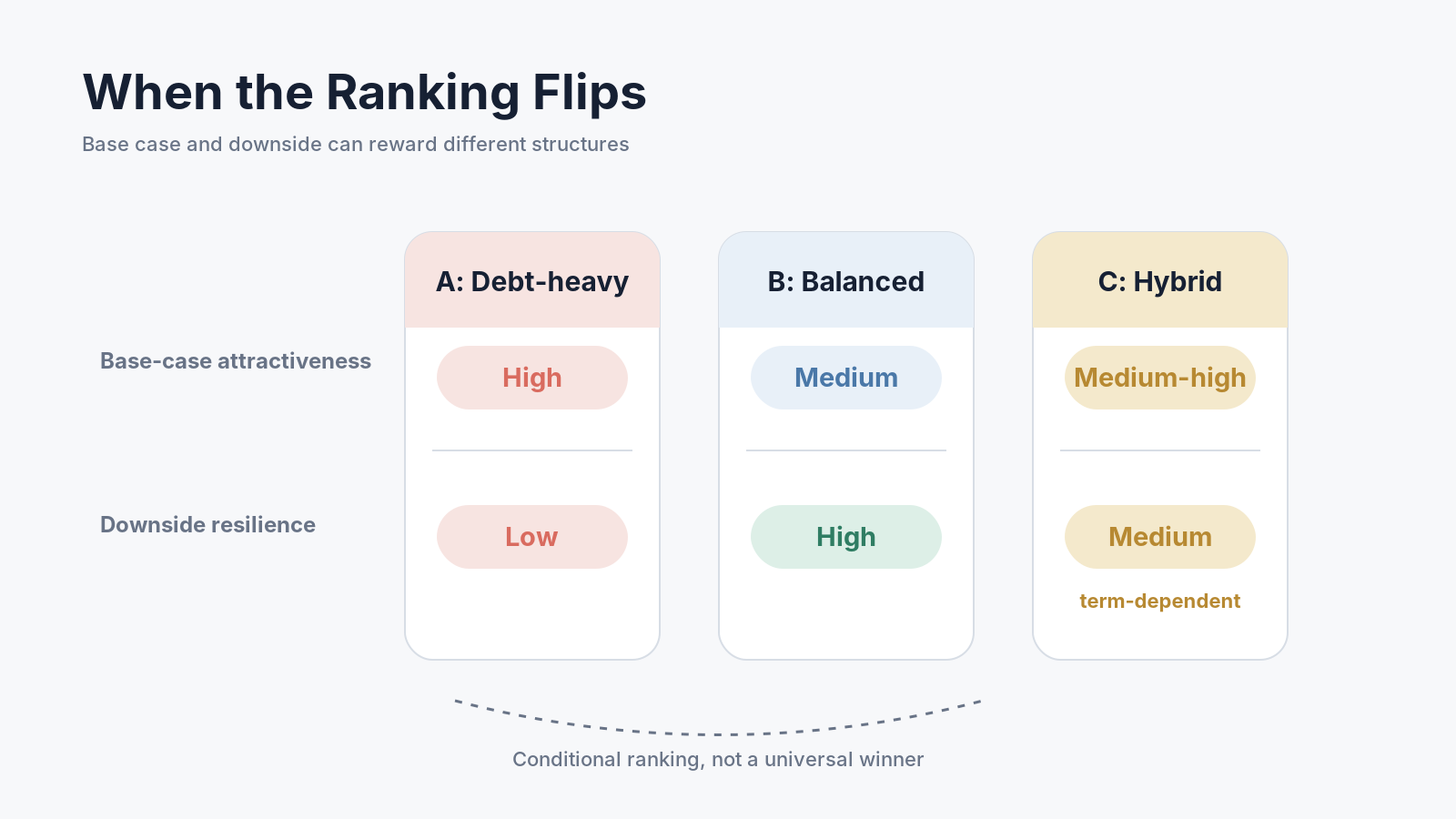
| Base-case attractiveness | High | Medium | Medium-high |
| Downside resilience | Low | High | Medium |
A may still be the CFO’s favourite in the base case. The interest cost is low, dilution is avoided and the modelled WACC may be attractive. If EBITDA falls from 50 to 32 while markets remain expensive in year three, however, A’s leverage rises, covenant headroom narrows and the maturity wall approaches during the recovery window.
B has the opposite trade-off. Equity raises today’s financing cost, but reduces fixed payments and preserves more headroom. C may have a lower cash burden than B, yet its result depends on conversion price, redemption mechanics, seniority and covenant treatment.
There is no permanent winner. If cash flow is exceptionally stable, the asset has a clear long-lived payback profile, no major additional investment is expected for five years and maturities can be extended, more debt may be entirely reasonable. If the business is volatile, still investing heavily or likely to pursue acquisitions, the value of flexibility rises.
The useful exercise is to find the assumption that changes the decision. Move the EBITDA downside from -20% to -35%. Add 300 basis points to the refinancing spread. Require another 30 units of capital for an investment. Close the equity market for a year, then run the same test with the debt market closed for a year. Record which package first loses headroom, cash affordability or access to the market it depends on.
Those are the flip points that make a financing recommendation auditable.
Before approval, make the dependencies explicit
A final financing memo does not need to repeat the whole analysis. It does need to show what the recommendation depends on.
For A, that might mean approval only if the covenant calculation retains acceptable downside headroom, the three-year maturity does not precede a credible recovery window, and the company has a liquidity bridge if refinancing is delayed. B needs a different set of conditions: the higher equity cost and dilution must be acceptable in exchange for the extra capacity. C cannot be approved on its low cash coupon alone; conversion economics, redemption, seniority and covenant treatment have to be resolved first.
The same memo should state which market-access assumptions are doing work. If an option stops functioning when the debt market is closed for a year, or when refinancing spreads rise by 300 basis points, that dependency should sit next to the recommendation rather than being hidden inside the model.
This is the link to the previous article on Distress, Covenants and Change of Control. That article dealt with the stage at which a company’s choices begin to disappear. Capital structure is decided earlier. The useful work is to identify, before signing, which contractual, timing and liquidity conditions could cause those choices to disappear later.
References
- IFRS Foundation, IAS 32 Financial Instruments: Presentation
- SEC / Investor.gov, Investor Bulletin: What Are Corporate Bonds?
- FASB, Accounting Standards Update 2015-03: Debt Issuance Costs
- Aswath Damodaran, NYU Stern, Capital Structure: The Choices and Trade-offs
- LSTA, Financial Definitions 101: Borrower and Lender Perspectives
- Electronic Code of Federal Regulations, 17 CFR § 229.303 — Management’s discussion and analysis of financial condition and results of operations
- OECD, Global Debt Report 2026
- EUR-Lex, Commission Regulation (EU) 2023/2822 — Non-current Liabilities with Covenants